Coinbase has found a new narrative, but the market has not been fully convinced.
Written by: SoSoValue
After the U.S. stock market closed on May 7, 2026, Coinbase released its financial report for the first quarter of 2026. In terms of revenue, profit, EPS, or Q2 guidance, this is not a report that would satisfy the market.
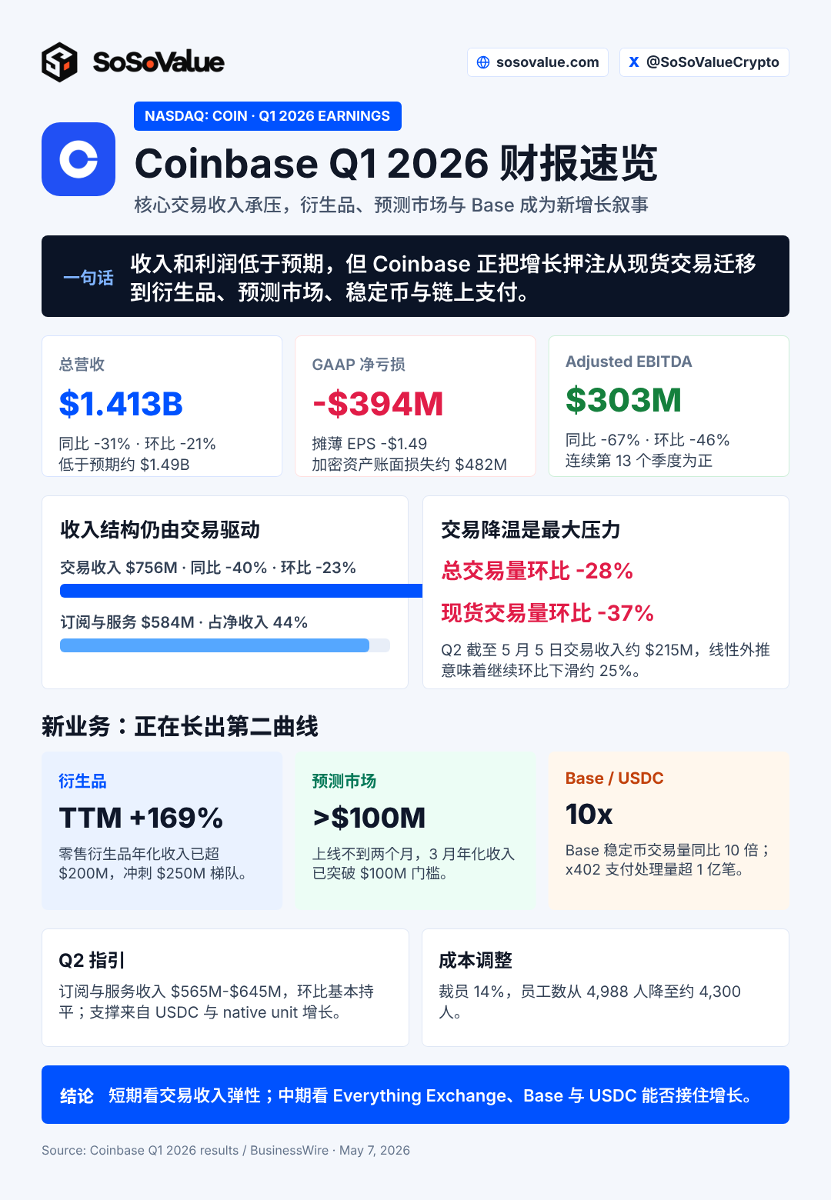
The total revenue for Q1 was $1.413 billion, down 31% year-on-year and 21% quarter-on-quarter, falling short of market expectations of about $1.49 billion; the GAAP net loss was $394 million, primarily affected by the impairment of cryptocurrency assets, with unrealized losses of about $482 million. This is also the second consecutive quarter of losses for Coinbase. The diluted EPS was -$1.49, also below market expectations.
The adjusted EBITDA was $303 million, down 67% year-on-year and 46% quarter-on-quarter. Although it maintained positive results for the 13th consecutive quarter, the decline in profitability has become very apparent.
After the financial report was released, the price of COIN responded directly. It fell more than 6% in after-hours trading, indicating that the market's initial reaction to the report was negative. Investors are currently more concerned not with how much Coinbase talked about long-term narratives on USDC, Base, prediction markets, and AI Agents, but with several more direct issues: revenue below expectations, a shift to negative GAAP, declining trading revenue, and weak Q2 guidance.
Therefore, the first conclusion from this financial report is clear: Coinbase's short-term performance remains under pressure, and the market has not ignored the decline in financial data because of its platform narrative.
However, this does not mean that Coinbase's long-term story is invalid.
The real point of interest in this financial report is that Coinbase is attempting to complete a valuation logic switch: from a trading platform highly reliant on the activity of cryptocurrency trading to an on-chain financial infrastructure platform focused on USDC, Base, derivatives, prediction markets, and AI Agent Commerce.
The problem is that this story has started to take shape, but has not yet been fully validated by financial data.
In other words, Coinbase's biggest contradiction right now is: in the short term, it is still weighed down by declining trading revenue; in the long term, it is trying to prove that it is more than just a cryptocurrency exchange.
1. Unsatisfactory on paper, Q2 guidance does not instill confidence in the market
Looking at the financial data alone, the keyword for Coinbase's Q1 is not growth, but pressure.
The total revenue for Q1 was $1.413 billion, down 31% year-on-year, and 21% quarter-on-quarter; GAAP net loss was $394 million; diluted EPS was -$1.49; adjusted EBITDA, although still positive, fell 67% year-on-year, and 46% quarter-on-quarter.
More critically, the Q2 guidance did not show significant improvement.
Coinbase expects Q2 subscription and service revenue to be between $565 million and $645 million, remaining basically flat quarter-on-quarter. Supporting factors include the market value of USDC, USDC balances within Coinbase products, and native unit growth; pressure comes from declining average cryptocurrency asset prices.
But the market is most worried about trading revenue.
As of May 5, Q2 trading revenue was about $215 million. Although the company specifically noted that "linear extrapolation is not advisable," if estimated based on the current pace, Q2 trading revenue may continue to decline by about 25% quarter-on-quarter.
Meanwhile, Coinbase confirmed it will recognize a one-time restructuring expense of $50 million to $60 million in Q2 and announced a 14% workforce reduction, bringing employee numbers down from 4,988 to about 4,300.
The layoffs can be understood as cost-cutting measures, but announcing them on the night of the financial report conveys a challenging signal to the market.
This indicates that management is not optimistic about the trading environment for Q2 or even the entire year. The company is telling the long-term stories of platforming, stablecoins, Base, and AI Agents, while also dealing with short-term operational pressures through layoffs and cost control.
Therefore, from the financial results and management actions, Coinbase's short-term operational environment still appears cautious.
2. Trading revenue continues to decline, but Coinbase has not lost market share
Coinbase's Q1 trading revenue was $756 million, down 40% year-on-year and 23% quarter-on-quarter, still its largest source of income.
The direct cause of the decline in trading revenue is the overall cooling of the cryptocurrency market. Q1 total trading volume fell 28% quarter-on-quarter, with spot trading volume down 37%. For a company still heavily reliant on trading fees, a decline in trading volume directly translates to revenue impact.
This is also the market's core concern about Coinbase: as long as trading revenue remains the primary source of income, the company will struggle to break free from the impacts of cryptocurrency prices, volatility, and market trading volume changes.
However, this should not be simply understood as a decline in Coinbase's competitiveness.
In Q1, Coinbase achieved a global crypto trading volume market share of 8.6%, up from 8.0% in Q4 and 6.0% in the same period last year, reaching a historical high.
This means that Coinbase is not stalling in competition; rather, it has gained a larger share in a market where overall trading volume is contracting.
In other words, Coinbase's issue is not that it "cannot compete" but that it is still unable to completely escape the impacts of the overall industry cooling. When the entire market's trading volume rapidly declines, even an increase in market share is not enough to offset the pressure from declining trading revenue.
This is also one of the core contradictions in this quarter's financial report: Coinbase's relative competitiveness remains, but its absolute revenue performance is still dragged down by market conditions.
3. USDC is becoming a profit buffer, but also exposes new dependencies
More worth noting than the decline in trading revenue is that Coinbase's revenue structure is changing.
In Q1, Coinbase's subscription and service revenue was $584 million, down 14% year-on-year and 16% quarter-on-quarter, accounting for 44% of net revenue. Among this, stablecoin revenue reached $305 million; if we include the company's own USDC balance-related income, stablecoin-related revenue is about $324 million.
This means that USDC is no longer just a supplementary business for Coinbase, but an important buffer for supporting the company's revenue structure when trading activity declines.
In Q1, the average market value of USDC reached $75 billion, setting a historical high of about $80 billion in March. Coinbase currently holds about 50% of the economic benefit rights from USDC, with an average USDC holding of $19 billion in Q1, a year-on-year increase of 55%, also setting a historical high and accounting for over 25% of USDC circulation.
This data indicates that Coinbase's business model is gradually shifting from a simple reliance on trading fees to income from stablecoins, on-chain settlements, and infrastructure-related revenues.
This is the most realistic and quantifiable part of Coinbase's platform story. Compared to trading fees, USDC-related income is more stable and closer to a form of "infrastructure rent." When trading activity in the cryptocurrency market declines, stablecoin revenue can help Coinbase smooth out some cyclical fluctuations.
But this is also a double-edged sword.
On one hand, USDC provides Coinbase with a more stable income buffer; on the other hand, it makes Coinbase more sensitive to several external variables: whether the partnership with Circle is stable, if the market value of USDC can continue to expand, and whether the interest rate environment continues to support stablecoin reserve returns.
Because USDC is becoming increasingly important to Coinbase, management clearly reinforced its relationship with Circle during this earnings call. Coinbase CFO Alesia Haas stated that the company's USDC distribution agreement with Circle automatically renews every three years and has a nature of perpetual renewal; Coinbase Chief Legal Officer Paul Grewal also added that the contract terms already signed by the two parties have been confirmed, and the company expects to continue to cooperate with Circle under the same terms.
However, caution is necessary here. This statement primarily comes from Coinbase management's explanation during the earnings call, and Circle has not yet independently confirmed specific statements such as "perpetual renewal and non-terminable." Therefore, it should be understood more as Coinbase actively reinforcing the narrative of revenue certainty from USDC under earnings pressure, rather than a joint announcement of a new agreement.
The purpose of this statement is very clear: Coinbase wants to tell the market that the company does not solely rely on trading volume; it also has a long-term, relatively stable, and sustainable source of income from the USDC ecosystem.
Essentially, Coinbase is attempting to redirect its valuation logic from "high Beta cryptocurrency exchange" to "on-chain financial infrastructure platform."
But what the market really needs to assess is whether the structural income from USDC can cover the volatility arising from declining trading operations.
If it can, there may indeed be a shift in Coinbase's valuation system; if not, it will still be seen by the market as a cryptocurrency exchange highly reliant on trading activity rather than an infrastructure company.
4. Everything Exchange has progress, but is not enough to change the overall financial structure
Besides USDC, another key narrative for Coinbase is Everything Exchange.
The core of this strategy is to expand Coinbase from a single cryptocurrency trading platform to a unified trading platform covering multiple asset classes such as spot, derivatives, stocks, commodities, foreign exchange, and prediction markets.
In Q1, this direction began to show some quantifiable progress.
TTM trading volume for derivatives was approximately $42.24 billion, an increase of 169% year-on-year; annualized revenue for retail derivatives has exceeded $200 million, and management indicated they are sprinting towards an annualized revenue target of $250 million.
Prediction markets have become one of the most noteworthy new businesses this season. Launched only two months ago, the annualized revenue had already surpassed the $100 million threshold in March, becoming one of the fastest-growing products in Coinbase's history, and is expected to be the company's 13th product line with annualized revenue exceeding $100 million.
These data points indicate that Coinbase's multi-asset platforming is not just a pure concept; in fact, some businesses are starting to emerge.
However, one must not be overly optimistic.
While derivatives and prediction markets are growing rapidly, their current scale is still not large enough. They can support Coinbase's platform narrative but have not yet fully absorbed the revenue pressure from core trading business declines.
This is Coinbase's most awkward position currently: new businesses are imaginative and growing but not yet large enough to change the overall financial structure of the company.
If these businesses continue to grow rapidly in the future, the market will be willing to accept the time discrepancy between Coinbase's current investments and returns.
But if trading activity in the cryptocurrency market continues to remain sluggish, and derivatives and prediction markets cannot sustain their growth momentum, then the valuation gap between a "platform company" and a "cryptocurrency exchange" will become increasingly difficult to bridge.
Coinbase has a long way to go to effectively tell the story of Everything Exchange.
5. Base and AI Agents are the most imaginative stories, but still need delivery
Compared to trading, stablecoins, and derivatives, Base is currently Coinbase's most imaginative asset.
The trading volume of stablecoins on the Base chain grew tenfold year-on-year in Q1. In on-chain AI Agent commercial transactions, USDC accounts for over 99%; the transaction volume of Agent stablecoins carried by Base represents over 90% of the total Agent transaction volume on the chain. The x402 payment protocol has also surpassed 100 million transactions.
This data is important because it means Coinbase is trying to position itself as the settlement layer, distribution layer, and business layer of the AI Agent economy.
If this direction holds, Coinbase's growth logic will no longer just be "more people coming to trade cryptocurrency," but rather it becomes "more on-chain commercial actions are settled through the Coinbase system."
This would be a completely different valuation story.
Exchanges earn from volatility and trading activity, whereas infrastructure earns from settlements, distributions, and the commercial activities themselves. The former is highly dependent on market cycles, while the latter theoretically can be more stable, more frequent, and more scalable.
But restraint is also necessary here.
AI Agent Commerce currently appears more like an imaginative new growth curve rather than a core engine already supporting Coinbase's financial performance. It can enhance the market's imagination of Coinbase's long-term space but does not yet directly offset the pressures from declining trading revenue and profit constraints.
The market may be willing to give Coinbase a valuation premium for Base and AI Agents, but the premise is that these will continue to translate into real users, real transaction volumes, and real revenues.
Otherwise, this will still just be a beautiful but not yet fully realized new story.
6. Regulation may become a catalyst but cannot replace performance realization
From a regulatory perspective, if the Clarity Act progresses smoothly later, it will be an important upward catalyst for Coinbase.
For Coinbase, regulatory clarity is not just a legal benefit, but may also provide more freedom in terms of business model and valuation logic.
If the regulatory framework becomes clearer, Coinbase may gain greater space in asset listings, institutional participation, stablecoin applications, derivatives expansion, and cross-asset trading. This would strengthen Coinbase's logic of transforming from a cryptocurrency exchange to a compliant on-chain financial infrastructure platform.
But regulatory benefits cannot replace performance realization.
The progress of the bill still carries uncertainty, and even if it is ultimately passed, the execution details will affect the actual outcome. More importantly, regulatory improvements can enhance market expectations but cannot directly resolve several core issues currently facing Coinbase: declining trading revenue, small scale of new businesses, increasing reliance on USDC, and the ongoing transition to platforming that has yet to be fully proven by financial data.
Therefore, regulation is a potential catalyst, not the main storyline.
What Coinbase truly needs to prove is still its ability to establish a sufficiently stable, sufficiently high frequency, and sufficiently scaled new revenue structure beyond cryptocurrency trading activity.
Summary: Coinbase has found a new story, but the market has not been fully convinced
Overall, Coinbase's Q1 financial report is not simply a negative signal, nor is it proof of successful transformation.
It resembles more of an intermediate state.
In the short term, Coinbase remains a highly impacted cryptocurrency exchange, influenced by trading volume, cryptocurrency prices, and volatility. Trading revenue remains the largest source of income, and when market trading volume declines, the company’s revenue and profits will quickly come under pressure.
In the long term, Coinbase is working hard to reshape itself as an on-chain financial infrastructure platform centered around USDC, Base, derivatives, prediction markets, and AI Agent Commerce.
This story is imaginative, and there is already some early evidence emerging.
USDC provides Coinbase with a more stable income buffer; Base opens new spaces for on-chain commerce and AI Agent settlements; derivatives and prediction markets are beginning to contribute new growth curves; Everything Exchange attempts to expand Coinbase from a single cryptocurrency trading platform to a cross-asset trading platform.
But the problem is, these new businesses are not yet large enough to change Coinbase's overall financial structure.
Therefore, it is reasonable that the market has not fully bought into it.
Investors do not fail to see Coinbase's long-term story but have not yet seen sufficiently strong financial realization. Especially in the context of revenue falling short of expectations, a shift to GAAP losses, declining trading revenue, and weak Q2 guidance, the market prefers to price it first as a "high Beta cryptocurrency exchange," rather than providing it with a direct valuation premium as a "financial infrastructure platform."
In the coming quarters, what Coinbase truly needs to demonstrate is not whether it can continue telling stories about USDC, Base, AI Agents, and Everything Exchange, but whether these stories can convert into more stable revenue, higher quality profits, and a business model that relies less on cryptocurrency trading activity.
If it can achieve this, Coinbase has the opportunity to be revalued from a "high Beta cryptocurrency exchange" to an "on-chain financial infrastructure platform."
If it cannot, then these new stories will ultimately be seen by the market as mere packaging to cover short-term performance pressures.
免责声明:本文章仅代表作者个人观点,不代表本平台的立场和观点。本文章仅供信息分享,不构成对任何人的任何投资建议。用户与作者之间的任何争议,与本平台无关。如网页中刊载的文章或图片涉及侵权,请提供相关的权利证明和身份证明发送邮件到support@aicoin.com,本平台相关工作人员将会进行核查。


