
Author: Azuma, Odaily Star Daily

The cryptocurrency bear market continues, but some significant signals have emerged in the primary market.
On May 4, venture capital firm Haun Ventures, founded by former U.S. federal prosecutor Katie Haun, announced the completion of a fundraising round totaling $1 billion, with $500 million allocated for both early and late-stage funds, mainly focusing on cryptocurrency and blockchain startup companies in the next 2 to 3 years, while further expanding into interdisciplinary fields such as AI agents, fintech, and alternative assets.
Just one day later, a16z announced that its fifth cryptocurrency fund, Crypto Fund 5, has completed fundraising, securing $2.2 billion in committed capital. This fund will continue to delve into the cryptocurrency market, focusing on those parts that are often overlooked during market cycles but can create long-term value, transforming the next generation of infrastructure into products that people use every day.
If you pull the timeline back, you will find that this is not a coincidence, but more like a “collective consensus” among top VCs.
In February this year, Dragonfly's Fund IV completed a $650 million fundraising; at the end of February, multiple media reported that Paradigm was seeking to raise up to $1.5 billion for its next fund; in March, ParaFi announced it had completed a $125 million fundraising; in late April, sources revealed that Blockchain Capital was raising $700 million for its two funds... In less than three months, these six VCs have quietly amassed over $6 billion in capital.
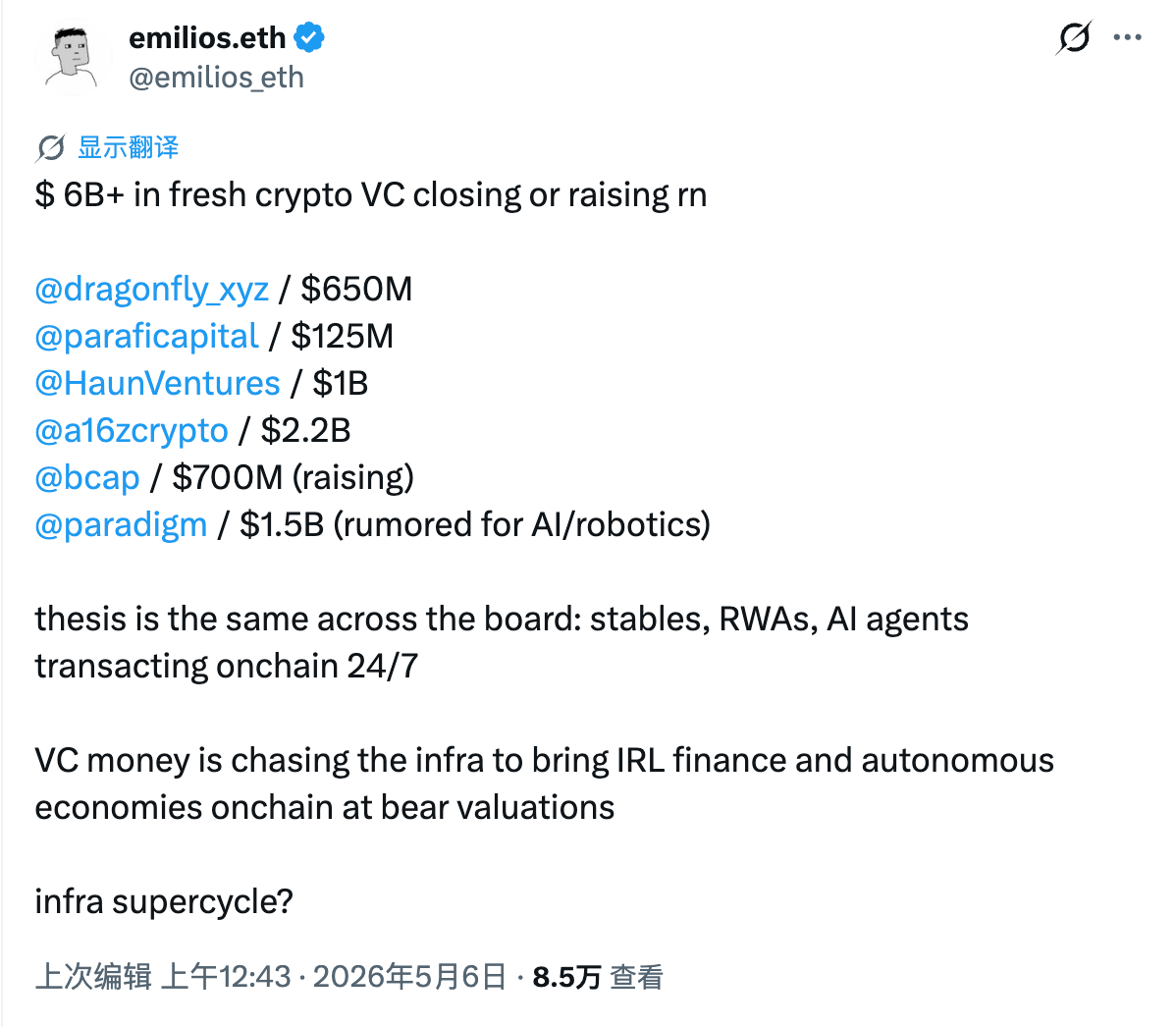
Moreover, crucially, this wave of fundraising did not occur during the hottest market periods but rather during a bear market phase characterized by the exhaustion of altcoin liquidity, declining primary market valuations, and persistently low industry sentiment. As a16z partner Chris Dixon said, “We are in a relatively quiet phase,” this is not a continuation of the victorious momentum in a bull market, but a typical counter-cyclical layout.
Primary market shows signs of divergence
If we only focus on the $6 billion fundraising amount, it is easy to create the illusion that “the primary market is warming up,” but the reality is far from that simple. A comprehensive look at the current survival status of top VCs versus small and medium-sized VCs reveals a clear trend of divergence in the primary market.
For most small and medium-sized VCs, this round of the cycle is much harder than expected. Due to the continued sluggishness of altcoins (almost missing the entire bull market), combined with tightening liquidity in the secondary market, fund exit channels have been severely hindered, and the positive returns on the books often dwindle or even turn negative over the long unlocking periods. The disappointing investment returns directly lead to decreased confidence from LPs, making fundraising for new funds increasingly difficult.
Therefore, we see that most small and medium-sized VCs are forced to adopt passive contraction during the bear market: some VCs choose to reduce fund scales and decrease their activity frequency; some have turned into pure secondary funds; and others have completely exited the market. Many small and medium-sized VCs, which had high visibility during the last bull market, have now disappeared from the market.
In stark contrast, there are those top VCs that are still aggressively fundraising. Although the investment pace of these VCs has slowed down with the market turning bearish, their structural advantages are continuously reinforcing their dominant role in the primary market.
As for the so-called structural advantages, first, top VCs often possess stronger resource monopolization capabilities, allowing them to more effectively capture the few high-quality projects (such as Kalshi's investors including a16z and Paradigm, Polymarket's investors include Dragonfly and ParaFi, and Blockchain Capital invested in Coinbase and Circle); second, top VCs can cover a more complete investment lifecycle, from early pre-seed and seed stages to later Series A and B rounds, providing more opportunities to participate or amplify returns; third, top VCs have a larger margin for error, allowing them to absorb relatively higher failure rates and bet on longer-term narratives; fourth, the brand effect of top VCs means stronger bargaining power, enabling them to obtain more favorable terms than small and medium-sized VCs even within the same funding round.
This structural disparity ultimately leads to market divergence, with the Matthew effect becoming increasingly pronounced — in a bull market, small and medium-sized VCs might still achieve comebacks through a few lottery-level bets, but during the bear market cycle, this trend will only become more evident.
What are these $6 billion being invested in?
According to the disclosures from these six VCs, the newly raised $6 billion funds will be allocated to the following sectors and directions.
- Dragonfly: optimistic about the trend of the financialization of cryptocurrencies, mentioning stablecoins, prediction markets, agent payments, on-chain privacy, and tokenization of real-world assets;
- Paradigm: expanding beyond crypto into AI, robotics, and other cutting-edge technology fields;
- ParaFi: stablecoins, asset tokenization, institution-level on-chain financial products;
- Blockchain Capital: focusing on early-stage and growth-stage cryptocurrency startups;
- Haun Ventures: optimistic about the new generation of financial infrastructure, including stablecoins, asset tokenization, and prediction markets, and has a favorable view of the agent economy;
- a16z: mentioning stablecoins, DeFi, prediction markets, and asset tokenization as financial infrastructure, also believes that in the era of AI explosion, the original characteristics of crypto networks can still be used to solve issues of software transparency and verifiability.
Putting the statements from the six VCs together, we see that while there are still some differences in focus, overall, they have significantly converged.
The most core consensus, without a doubt, centers on a new generation of on-chain financial infrastructure represented by stablecoins, asset tokenization (RWA), prediction markets, and on-chain payments. Whether it's Haun Ventures, a16z, Dragonfly, or ParaFi, these keywords are repeatedly mentioned in the direction of their new funds. To some extent, this indicates a shift in the investment logic of the cryptocurrency industry. Compared to the emotion-driven bets in the previous cycle, this time, top VCs are more focused on those infrastructure projects that have already begun to validate real demand and have the potential to continue to capture traditional financial flows in the long run.
In addition, top VCs are also clearly increasing their investment in AI-related fields, with Paradigm explicitly stating it will allocate some funds to AI and robotics, while Haun Ventures and Dragonfly have also mentioned agent-related directions. The reasons behind this trend are not complex; on one hand, AI has become the most certain main thread in the global technology industry, and top VCs cannot afford to miss out; on the other hand, the cryptocurrency industry is trying to prove that it is not just a marginalized old narrative in the AI boom but can become part of the foundational infrastructure in the AI era—especially as the agent economy gradually rises, the inherent openness, composability, and permissionless characteristics of crypto networks begin to regain their value.
Fundraising in a bear market is essentially betting on the next cycle
For VCs, the bear market is often the true phase that determines the future landscape.
While funds in a bull market are the easiest to raise, project valuations often come with higher entry barriers; only in periods of depressed market sentiment, liquidity depletion, and ineffective industry narratives can VCs amplify their opportunities to capture excess returns through their judgment.
Looking back at past cycles, bear markets do not stifle truly high-quality projects; instead, they accelerate market consolidation, allowing “gold to shine faster.” This is why, even when market sentiment remains low, top VCs are still aggressively raising funds during the counter-cyclical periods.
Because what they are truly betting on is never “the now,” but rather who can become the new Circle, the new Hyperliquid, or the new Polymarket after the next round begins.
免责声明:本文章仅代表作者个人观点,不代表本平台的立场和观点。本文章仅供信息分享,不构成对任何人的任何投资建议。用户与作者之间的任何争议,与本平台无关。如网页中刊载的文章或图片涉及侵权,请提供相关的权利证明和身份证明发送邮件到support@aicoin.com,本平台相关工作人员将会进行核查。
