Source: AI Reips
Reported by AIPress.com.cn
On April 27, it was reported that the office of the National Development and Reform Commission officially made the decision to ban the investment, halting Meta's acquisition of the AI intelligence company Manus.
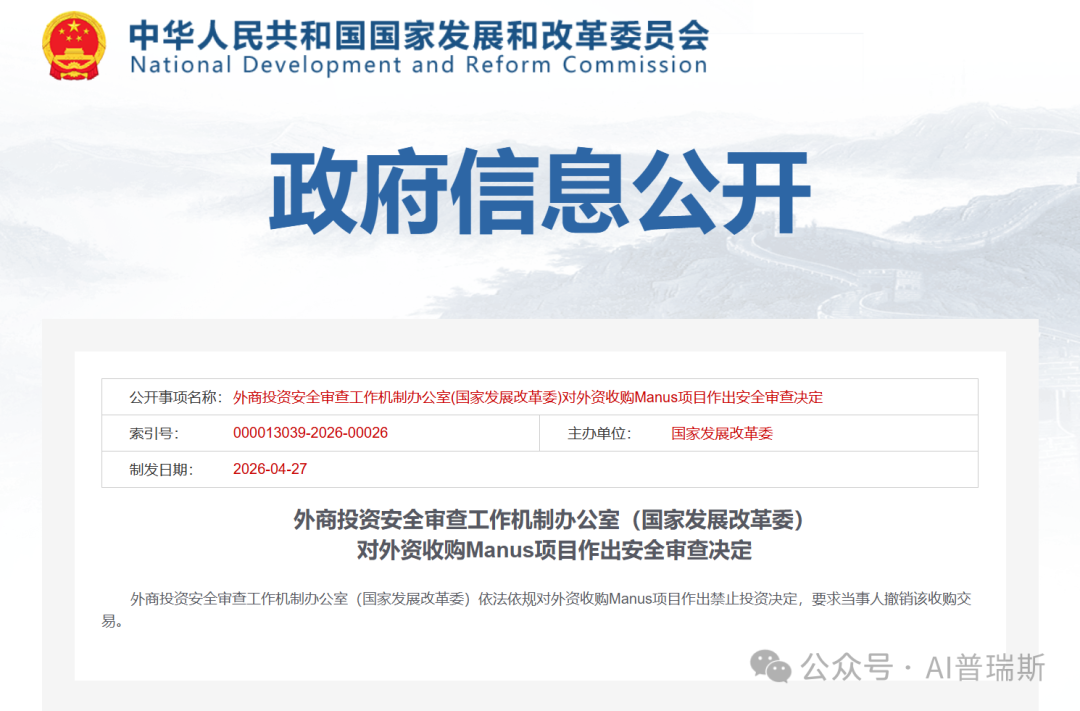
This deal, once regarded as Meta's third-largest acquisition in history, was announced in December 2025 and banned in April 2026, lasting only four months.
Key Timeline of the Manus Acquisition
In March of last year, Manus was officially launched. The Monica.im team introduced the world's first universal AI intelligence entity, igniting the market as soon as it went online, with invitation codes being sold at high prices, and annual revenue rapidly exceeding $125 million.
On December 30 last year, Meta announced it would acquire Manus's parent company, Butterfly Effect, for $3 to $5 billion, with negotiations taking only a little over ten days. Founder Xiao Hong was to become a vice president at Meta.
On January 8, regulators initiated an investigation, with the Ministry of Commerce and relevant departments conducting evaluations to check compliance with technology exports, cross-border data flows, and foreign investment declarations.
In March, the National Development and Reform Commission summoned executives from both sides, pointing out the risks of technology transfer and data security, and required them to pause progress.
On April 27, the foreign investment security review office officially prohibited the transaction, requiring the acquisition to be revoked and the status quo restored.
Revocation of the Transaction: Complete Restoration from Equity to Data
According to Article 12 of the "Foreign Investment Security Review Measures," after the state makes a decision to prohibit investments, the core requirement is to restore to the state prior to the implementation of the investment within a specified period and eliminate impacts on national security. This is divided into three modules:
(1) Equity and Transaction Entity Level
All parties must sign a written termination agreement, rescind the acquisition and terminate all supporting documents (shareholder agreements, technology transfer agreements, etc.).
If Meta has completed the equity delivery, it must return all held Manus equity to the original shareholders/domestic entities and complete commercial and overseas entity registration changes.
Regulatory agencies will supervise the equity changes to ensure there is no "disguised control" (such as control through agreements, proxy holdings, etc.).
(2) Funds and Consideration Return
Meta must fully return the approximately $2 billion already paid (including deposits, prepayments, etc.) to the accounts related to the transaction.
After receiving the funds, the original shareholders must complete the foreign exchange return through the original route as per regulatory requirements and report to the foreign exchange regulatory department.
Both parties must handle intermediary fees, penalties, etc., and it is prohibited to complete consideration payments in disguised forms under the names of "compensation" or "consulting fees."
The foreign exchange management department will conduct a full verification of the funds' flow to prevent capital outflow under the guise of "terminating the transaction."
(3) Data and Technology Security
Data Isolation and Deletion:
Meta must delete all obtained domestic user data, training data, and business data from Manus, issue a deletion certificate, and accept verification; Manus must restore data localization storage and terminate all cross-border data transmission channels.
Technology and Code Recovery:
Terminate all technology authorizations and code transfers to Meta, reclaim control over core AI technologies and algorithm models, and prohibit Meta from using any Manus technological results; any transferred technical documents or code copies must be destroyed.
Personnel and Management Isolation:
All management and technical personnel dispatched by Meta must withdraw, terminate all management agreements involving control, and ensure that domestic entities manage independently.
Core Reasons: Stepping on Three Red Lines
1. Technology and Data Security
Manus's core technology was developed by a Chinese team domestically, and during the transaction, the entity structure moved to Singapore. Regulatory agencies focused on whether there were behaviors of "technology laundering" or evading Chinese technology export regulations. The core algorithms, training data, and user data could flow overseas through the acquisition, directly threatening data sovereignty and technology security.
2. Compliance Gaps in Foreign-Invested Mergers
This deal, "an American company acquiring a Singaporean enterprise," essentially involves Chinese domestic AI technology being acquired by foreign capital through an overseas entity change, which did not fulfill China's foreign investment security review procedures. Regulatory agencies determined that this action constitutes a typical "cross-border acquisition bypassing review."
3. Structural Reorganization to Evade Regulation
The "Foreign Investment Security Review Measures" explicitly require that foreign mergers involving critical technologies and data must declare for security review. Manus attempted to transfer control through a path of "domestic research and development + overseas restructuring + foreign acquisition," and the undeclared transaction was deemed invalid.
Regulatory Supervision and Subsequent Constraints
The parties involved must complete all operations mentioned above within the deadline specified by the regulatory department. The office of the working mechanism will conduct on-site verification in conjunction with the National Development and Reform Commission, the Ministry of Commerce, cyber administration, foreign exchange, and other departments to confirm that the transaction has been completely restored to its original state.
If the revocation is not completed as required, the regulatory department may impose penalties, restrict domestic operations, prohibit related entities from engaging in foreign investment activities, and related responsible persons will also bear legal responsibility.
More importantly, Manus and the original shareholders must fulfill legal procedures such as foreign investment security review and outbound data security assessments for any subsequent cross-border cooperation or financing activities, and cannot evade review to transfer control, data, or technology overseas.
No Gray Area in AI Cross-Border Mergers Anymore
This investment prohibition decision is not targeted at a single case, but rather delineates clear boundaries for the AI industry:
It explicitly prohibits the transfer path of "domestic research and development + overseas restructuring + foreign acquisition"; AI cross-border mergers must undergo complete security review and data evaluation procedures; AI technology developed domestically in China must not have its control transferred overseas without review.
For Meta, the termination of the acquisition plan means missing out on key AI Agent technology assets, and any payments made need to be fully refunded; for the Manus team, control must be restored to the domestic entity, ending all cooperation with Meta and returning to compliant operations within the country.
免责声明:本文章仅代表作者个人观点,不代表本平台的立场和观点。本文章仅供信息分享,不构成对任何人的任何投资建议。用户与作者之间的任何争议,与本平台无关。如网页中刊载的文章或图片涉及侵权,请提供相关的权利证明和身份证明发送邮件到support@aicoin.com,本平台相关工作人员将会进行核查。


