Written by: Tiger Research
Translated by: AididiaoJP, Foresight News
Key Points
Different asset classes are accelerating their integration: stocks, cryptocurrencies, and prediction markets were once independent of each other. Now, the trend of integrating all assets into a single platform is accelerating. Robinhood has demonstrated this model with data; Polymarket and Kalshi are moving in the same direction.
In prediction markets, collateral utilization will become a core competitive advantage: in prediction markets, collateral is locked before the outcome is determined. Polymarket's launch of perpetual futures trading is likely aimed at turning idle assets into revenue.
Traditional finance is also merging in the same direction: the new generation of users has been accustomed to engaging with multiple asset classes from a young age. As generations change, the demand for integrated platforms will only continue to grow, and large financial institutions will gradually accept cryptocurrency spot trading and prediction markets as the regulatory environment opens up.
On April 21, 2026, the two leading platforms in prediction markets, @Polymarket and @Kalshi, announced the launch of perpetual futures trading on the same day. The trading targets are expected to include cryptocurrencies like Bitcoin, commodities like gold, and stocks like Nvidia. Both platforms stated they will officially launch once they obtain regulatory approval.

Why Now
This can be understood through the "Robinhood model." The trend of integrating originally independent asset classes into a single platform has already begun, and the announcements from Polymarket and Kalshi are merely a continuation of this trend.
Robinhood originally began as a stock trading application, adding cryptocurrency trading in 2018 and then including prediction markets in 2025, pioneering the integration of fragmented trading markets into a single platform.
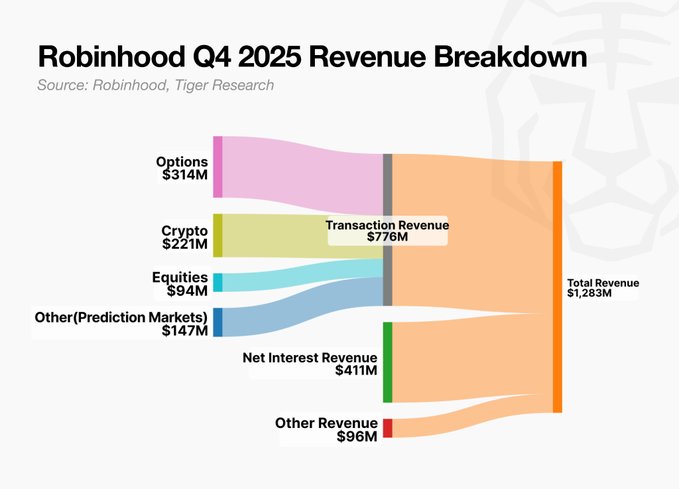
This model has been validated by data. After expanding into cryptocurrency, trading revenue from cryptocurrency became Robinhood's largest single source of income in the fourth quarter of 2024. In the fourth quarter of 2025, cryptocurrency revenue fell by 38% year-on-year, but total revenue remained stable, with options, stocks, and prediction markets filling the gap. A diversified structure achieving resilience has taken shape.
Polymarket and Kalshi are heading towards the same destination from opposite directions. They originated in prediction markets and are now adding futures trading. While the starting points are different, the end goals are consistent. With the Robinhood model being validated, traditional finance is likely examining the same path.
Simple Analogy
Smartphones have integrated cameras, MP3 players, and navigation functions into a single device, marking the end of an era where different devices were carried separately. A similar transformation is occurring in the financial sector.
Brokerage accounts, cryptocurrency exchanges, and prediction markets are merging into a single platform. Robinhood started as a stock application and sequentially added cryptocurrencies and prediction markets; Polymarket started from prediction markets and is now adding cryptocurrency perpetual contracts. The starting points are different, but the directions are aligned.
Generalization of the Robinhood Model
With generational changes, this trend will further accelerate. The new generation of users has been exposed to stocks, cryptocurrencies, and prediction markets simultaneously from a young age. Just as smartphone users would not accept separate devices for cameras, MP3s, and maps, this generation finds the idea of using separate applications for each asset class unfamiliar from the start. The demand for an integrated platform that can handle all assets in a familiar interface will naturally grow with each generation's maturation.
This is the generalization of the Robinhood model.
Polymarket and Kalshi have a particularly advantageous position in this model. Since collateral in prediction markets is locked before the outcome is determined, how to utilize these idle assets will become a key competitive differentiator.
On December 3, 2025, a developer proposed the concept of PolyAave: depositing Polymarket's outcome tokens into an Aave liquidity pool to earn interest. This is an early attempt to convert prediction market collateral into DeFi yields. The launch of perpetual futures by Polymarket is likely an extension of this logic. The strategy of not letting locked capital sit idle is reasonable.
Polymarket and Kalshi are taking the lead, but traditional finance also faces the same pressures. As the regulatory environment gradually opens, large financial institutions will directly support cryptocurrency spot trading and gradually embrace new asset classes, including prediction markets.
免责声明:本文章仅代表作者个人观点,不代表本平台的立场和观点。本文章仅供信息分享,不构成对任何人的任何投资建议。用户与作者之间的任何争议,与本平台无关。如网页中刊载的文章或图片涉及侵权,请提供相关的权利证明和身份证明发送邮件到support@aicoin.com,本平台相关工作人员将会进行核查。


