Meta and Microsoft announced layoffs of over 10,000 employees within hours of each other, as the AI arms race is forcing Silicon Valley giants to restructure their workforce under the banner of "efficiency first." This round of layoffs is essentially not just about cost control, but embodies a "blood exchange" logic of replacing low-paid generalists with high-paid AI specialists. Companies like Snap and Block are following suit with layoffs, marking the emergence of a new era characterized by rising unemployment among white-collar workers and significant downsizing in the tech industry.
Written by: Zhao Ying, Yang Chen
Source: Wall Street Journal
Tech giants are restructuring their workforce at an unprecedented speed. Under the pressure of capital expenditure driven by the AI arms race, Meta and Microsoft announced significant layoff plans within hours of each other, and this wave of mass layoffs has swept over several Silicon Valley companies, including Snap, Block, and Amazon, ushering in a new era for the tech industry under the guise of "efficiency first."
According to a report from the Wall Street Journal on Thursday, Meta plans to reduce about 10% of its workforce on May 20, affecting approximately 8,000 employees, and will leave 6,000 originally planned vacant positions unfilled, totaling nearly 18% of the company's current workforce.
In an internal memo, Meta characterized this round of layoffs as a necessary measure to "enhance operational efficiency and create space for other investments." Some analysts believe that the essence of this round of layoffs at Meta is more akin to "employee replacement" rather than mere cost control—the positions being cut are often general roles, while new hires will likely be higher-paid AI and specialized technical talents.
Meanwhile, Microsoft announced the introduction of the company's first voluntary retirement plan in its 51-year history, targeting about 7% of its U.S. workforce. Based on its U.S. employee count of approximately 126,000, the potential number of departures could exceed 9,000.
At the time of the layoffs, both companies' stock prices were under pressure. Microsoft's stock price has dropped nearly 20% over the past six months, reaching its worst performance for the period since 1997 as of early April; Meta's stock price has remained basically flat this year.
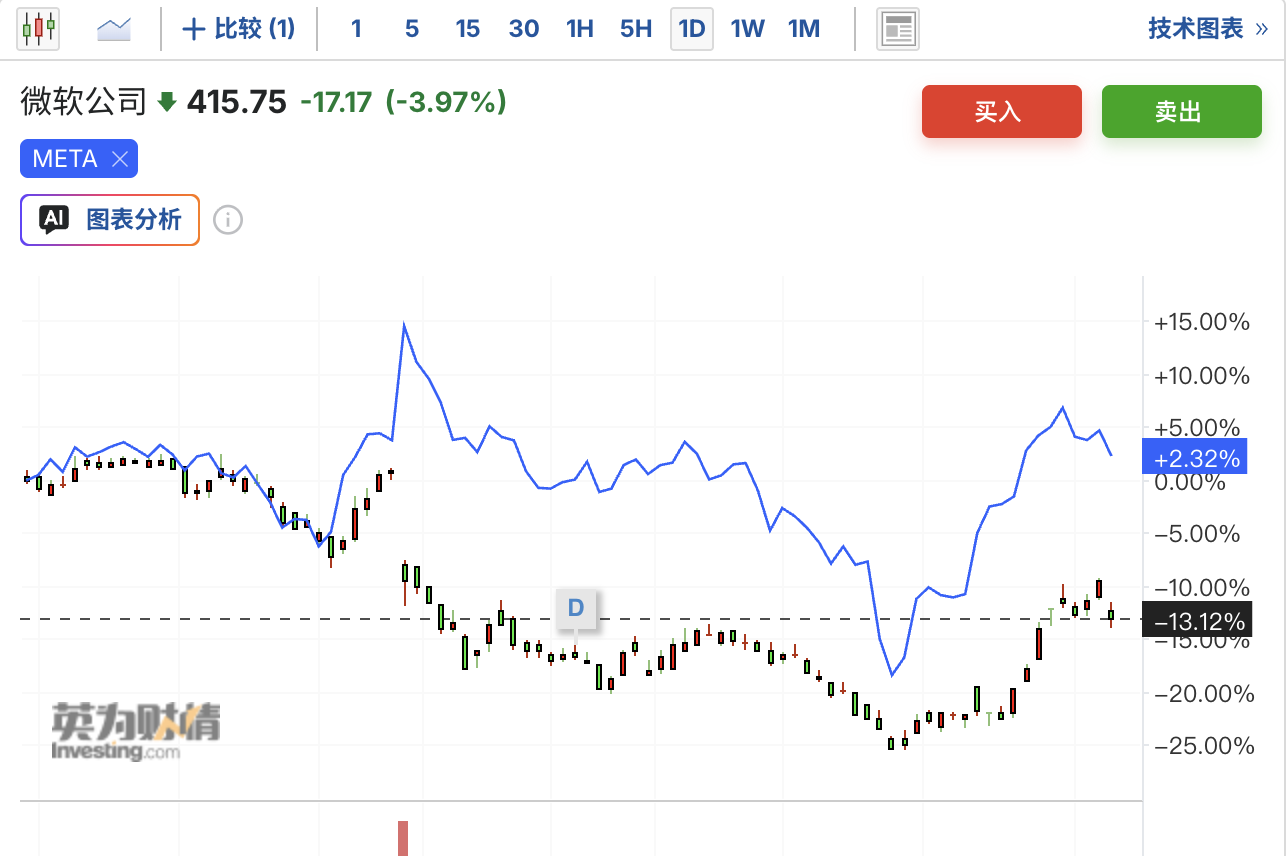
Microsoft introduces "buyout" for the first time in 51 years, with simultaneous restructuring of the compensation system
The voluntary retirement plan introduced by Microsoft marks the first known instance of such a mechanism by the 51-year-old software giant and signifies a major shift in its workforce adjustment strategy.
According to an internal memo obtained by the Wall Street Journal, the plan was announced by Amy Coleman, Microsoft's Executive Vice President and Chief Human Resources Officer, and is characterized as "a one-time retirement program." Coleman wrote in the memo: "We hope this plan allows eligible employees to take the next step at their own pace, with the company’s generous support."
Eligibility has certain thresholds: employees must be at the senior director level or below, and the sum of their years of experience and age must reach 70 years or more. Microsoft's report for the 2025 fiscal year shows that the company has approximately 228,000 employees globally, of which about 126,000 are in the U.S. Based on the approximately 7% ratio, the potential number of departures could exceed 9,000. Although the actual participation is expected to represent only "a small portion of employees," this scale still represents the company's largest proactive workforce restructuring to date.
This workforce adjustment is not an isolated move. At the end of March, Microsoft had already implemented a hiring freeze on certain positions in its cloud computing and sales departments, and last year, it cut over 15,000 employees in sales, Xbox, and other departments. Alongside the layoffs, a systematic reform of the compensation system is underway—the company is separating stock incentives from cash bonuses and streamlining performance evaluation options from nine tiers to five tiers to concentrate resources on rewarding core employees.
Meta lays off 8,000 employees, fundamentally more for "blood exchange"
Meta's layoffs are a direct financial reflection of Zuckerberg's gamble on AI. In January of this year, Meta disclosed that its capital expenditure could nearly double to $135 billion, for data center construction and recruitment of high-end AI talent, in pursuit of catching up with Google and OpenAI.
Meta's Chief Human Resources Officer Janelle Gale candidly stated in an internal memo: "This is one of our measures to continuously improve operational efficiency and create room for other investments. I know this is an unwelcome message, and confirming this decision will make everyone feel uneasy, but we believe it is the best path in the current situation."
The layoffs will take effect on May 20, and affected employees will receive a "generous severance package," with U.S. employees eligible for 18 months of medical insurance coverage. Gale also acknowledged in the memo: "I know this creates nearly a month of uncertainty for everyone, which is extremely unsettling."
This layoff is a continuation of Meta's multiple rounds of workforce adjustments over the past two years. According to the Financial Times, several employees reported that they have gone through multiple rounds of layoffs, restructuring, and executive turnover, resulting in persistently tense internal sentiment. Additionally, Reuters reported that Meta also plans to install tracking software to capture employee mouse movements, clicks, keyboard inputs, and screen content to train AI models, raising employees' concerns about "self-replacement."
Analysis from The Information shows that historical data indicates that large-scale layoffs at tech companies do not significantly reduce overall staffing levels but are essentially about "blood exchange"—replacing laid-off employees with higher-paid professionals. Meta expects total spending to grow by 40% year-on-year by 2026, which explicitly includes new hiring costs for priority areas such as AI, suggesting that this round of layoffs may not yield substantial cost savings in the short term.
Silicon Valley enters a new era of "mass layoffs"
The actions of Meta and Microsoft are not isolated; rather, they are part of a larger structural adjustment within Silicon Valley. Snap is cutting 16% of its workforce, Block is slashing 40%, and Oracle is massively reducing its positions; according to the Wall Street Journal earlier this week, the Gates Foundation also plans to cut about 500 positions, accounting for approximately 20% of its total workforce.
This wave of layoffs shows a different market logic than in the past. Analysts point out that layoffs are no longer seen as a signal of companies in distress by investors but are interpreted as a reflection of management's "decisive action." Venture capitalists note that many companies cutting 30% to 50% of their workforce will not materially affect performance, and the rise of AI provides a ready-made rationale for management to push forward with "the personnel optimization that should have been completed long ago."
Block's Chief Financial Officer and Chief Operating Officer Amrita Ahuja revealed that after the company announced a 40% workforce cut, a number of corporate executives proactively contacted Block, seeking to replicate this "mass layoff script." She bluntly stated that this approach is "inevitable," adding: "As a CFO, I believe it is better to act early than to fall behind."
This trend reflects a fundamental shift in tech companies' attitudes toward professional talent. Over the past decade, many companies were willing to offer high salaries and generous benefits to attract knowledge workers, but now, corporate leaders generally believe that large teams hinder rather than facilitate development.
Meanwhile, laid-off employees are facing increasingly dire circumstances—data analysis from the U.S. Department of Labor shows that in the past 12 months, the unemployment rate for college graduates aged 34 and below has equaled the 4.1% rate of those with two-year associate degrees, and may even begin to surpass it, significantly increasing the difficulty of reemployment for white-collar workers.
免责声明:本文章仅代表作者个人观点,不代表本平台的立场和观点。本文章仅供信息分享,不构成对任何人的任何投资建议。用户与作者之间的任何争议,与本平台无关。如网页中刊载的文章或图片涉及侵权,请提供相关的权利证明和身份证明发送邮件到support@aicoin.com,本平台相关工作人员将会进行核查。


