Author: Hu Lin Dance King
If someone had told you a few years ago, "You might be evaluating a new AI model, and before you finish writing your review, the next generation will be out," you would likely think it's nonsense.
But now, this has actually happened.
GPT-5.4 was released six weeks ago. Today, GPT-5.5 has already been pushed to paying users on ChatGPT.
This is not an ordinary version iteration. OpenAI positions it as a "whole new level of intelligence" – maintaining reasoning delays comparable to GPT-5.4 while achieving a "significant leap" in intelligence level.
In short, it's smarter but faster.
Based on current user feedback, OpenAI may really be about to "turn the tide" this time!
01 "Faster" and "Stronger," this time OpenAI wants both
To understand the core logic of GPT-5.5, one must first grasp a long-standing paradox in the AI industry.
The smarter the model, the slower and more expensive it often is. This is almost a default rule in the industry. If you want deeper reasoning and more complex task handling, you have to pay a higher latency and more computational costs. Users and enterprise clients usually can only choose one of these.
GPT-5.5 aims to break this trade-off.
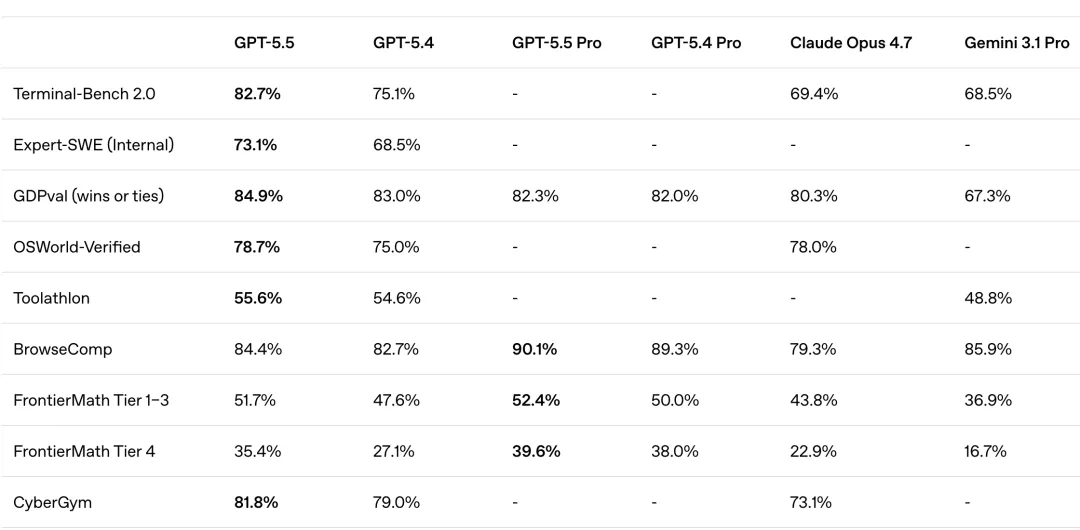
GPT-5.5's performance stands out among its peers|Image source: OpenAI
OpenAI claims the new model has the same token latency in "real-world services" as GPT-5.4, but its intelligence level far exceeds that of the latter. VentureBeat's testing data shows that GPT-5.5 achieved state-of-the-art levels in 14 benchmark tests – in contrast, Anthropic's Claude Opus 4.7 reached 4, and Google Gemini 3.1 Pro reached 2.
In terms of capabilities, GPT-5.5 excels in tasks like coding and debugging, online research, data analysis, document processing, and operating software in "agent-like" tasks.
OpenAI co-founder Greg Brockman referred to it as a "significant advancement" toward "more agentic and intuitive computing."
The most perceptible case comes from Jackson Laboratory. Genomic medicine professor Derya Unutmaz used GPT-5.5 Pro to analyze a dataset of 28,000 genes, generating a complete report in minutes—work that typically takes his team months.
This isn't just compressing time; it’s a magnitude of changing the way work is done.
02 Six weeks a generation, is it product rhythm or market anxiety?
But more noteworthy is the signal behind OpenAI's release rhythm.
Six weeks. Only six weeks from GPT-5.4 to GPT-5.5.
Looking back over the past two months, OpenAI's actions have been unusually intense. On April 21, ChatGPT Images 2.0 was released, and Sam Altman stated in a livestream that the leap from gpt-image-1 to gpt-image-2 "is equivalent to the leap from GPT-3 to GPT-5." On the same day, OpenAI announced a partnership with consulting firms to promote Codex to enterprises, with Chief Revenue Officer Denise Dresser stating this would help reach "enterprise clients that they couldn't touch on their own."
Codex currently has over 4 million weekly active users—up from 3 million two weeks ago and 2 million last month. This growth rate itself is indicative of the issue.
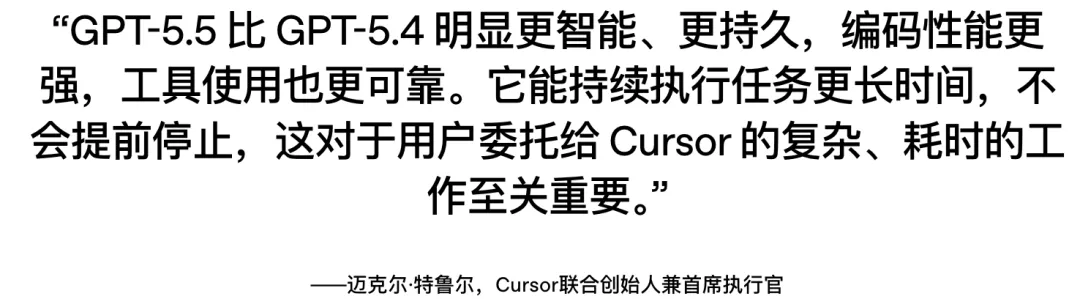
Cursor CEO sent in congratulations|Image source: OpenAI
Meanwhile, in recent weeks, OpenAI has also completed the acquisition of personal finance startup Hiro and new media company TBPN. The former is interpreted as "not just a chatbot, but something worth paying for," while the latter is clearly aimed at "better shaping public image—given that the recent image has not been ideal."
Seeing these actions together gives a sense of subtle urgency.
This company just completed a new round of financing worth $122 billion, with monthly revenue reaching $2 billion. From any perspective, this is one of the richest AI companies in the world. However, voices on social media about "OpenAI losing consumer appeal" and "lagging behind Anthropic in the competition for enterprise clients" have not dissipated due to these numbers.
The release of GPT-5.5 is, in a sense, OpenAI's public response to these doubts.
03 Benchmark tests won, but enterprises want "error-free"
However, defining wins and losses by benchmark tests can often be misleading in the enterprise market.
New York bank CIO Leigh-Ann Russell stated directly—what she cares about most is not how strong a capability is, but "response quality and impressive illusion resistance." "Banks need very high accuracy, which is critical for a highly regulated institution."
This statement represents the real demands of a significant portion of enterprise clients. They are not choosing "the smartest AI"; they are selecting "the least error-prone AI."
This is also why Anthropic continues to gain market share in the enterprise sector—the Claude series has long maintained high brand recognition in terms of "safety" and "predictability." GPT-5.5’s comprehensive lead in benchmark tests will need to accumulate more evidence of "trustworthiness" to truly convert into enterprise contracts.
One detail worth noting: NVIDIA engineers have expressed that "losing access to GPT-5.5 feels like having a limb cut off." This saying circulating within the industry somewhat indicates that GPT-5.5's capabilities have established a real sense of dependence among certain high-end users.
But there's still a long distance from "some people really like it" to "enterprises are willing to deploy it in core systems."
04 When speed itself becomes a competitive edge
From a higher perspective, the release of GPT-5.5 reveals a deeper industry trend.
The competition among cutting-edge AI labs is evolving from "whose model is stronger" to "whose iteration is faster."
A major version every six weeks is unimaginable two years ago. And it's not just about the version number update; there is a real leap in capabilities behind each iteration—Axiom Bio's CEO Brandon White even predicts that if OpenAI maintains this speed, "the foundation of drug discovery will change by the end of this year."
This statement may be somewhat optimistic, but it captures a real feeling: the speed of AI capability improvement is starting to surpass most people's imagination of its application potential.
OpenAI Chief Research Officer Mark Chen summed up the capabilities of GPT-5.5 in the fields of science and technology research as "meaningful progress," pointing out that it can "help expert scientists make advancements." This wording is worth pondering—not "replace" scientists but "help experts make progress." It’s a way of actively managing the narrative while showcasing capabilities.
GPT-5.5 is available to Plus, Pro, Business, and Enterprise subscription users, launched simultaneously in ChatGPT and Codex. This distribution strategy itself is a commercial signal—both to maintain user stickiness on the consumer side and to accelerate penetration on the enterprise side through Codex and consulting partners.
Walking on two legs, the pace is still accelerating.
In six weeks, we will likely see GPT-5.6.
免责声明:本文章仅代表作者个人观点,不代表本平台的立场和观点。本文章仅供信息分享,不构成对任何人的任何投资建议。用户与作者之间的任何争议,与本平台无关。如网页中刊载的文章或图片涉及侵权,请提供相关的权利证明和身份证明发送邮件到support@aicoin.com,本平台相关工作人员将会进行核查。


