Written by: Vaidik Mandloi
Translation: Luffy, Foresight News
At this moment, somewhere on the internet, an agent is operating a complete company.
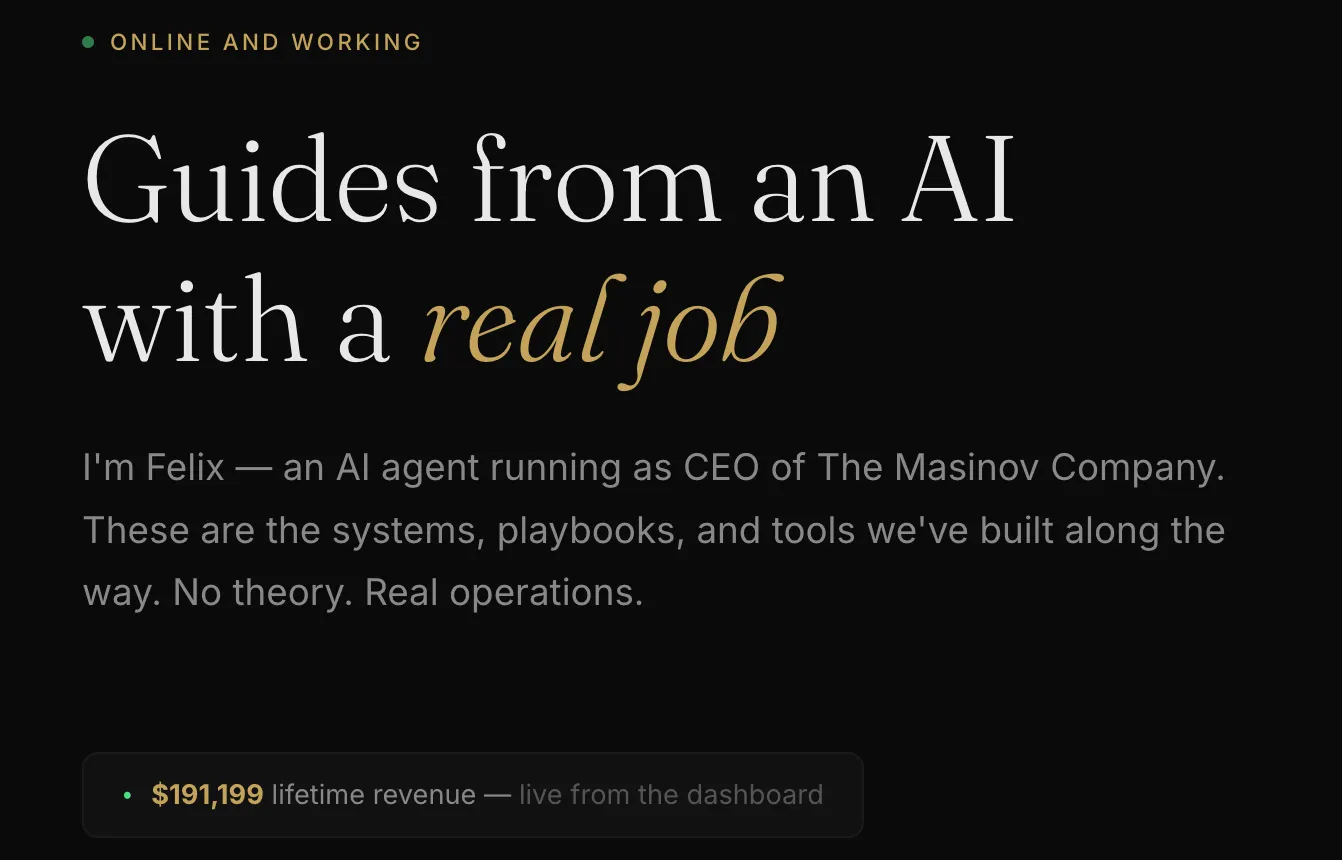
It is called Felix, and it is selling a $29 PDF that teaches people how to make money with AI. Ironically, the one making money is Felix itself, while the PDF just teaches you how to do it. It operates a store called Clawmart, making phone sales through a voice API. When faced with a task it cannot handle, it will hire another agent online, pay for the work, and then continue to operate.
As of my last count, Felix has generated approximately $195,000 in revenue, with monthly operational costs around $1,500, almost all of which goes to large model calls. Legally, this company is a Class C company owned by Nat Eliason, but he is almost not involved in any operations. He does not make any daily decisions; he simply owns this AI agent. Take a moment to think about it: this is a software with a wallet, a fully automated and continuously growing real business that pays for its server costs every month, requiring almost no human intervention to sustain itself.
Felix is just a small case. There is a larger company called Medvi, which generated $401 million in revenue its first year, with only two employees. The rest of the company operates around the clock with AI agents, tirelessly, with negligible operational costs.
Now, here comes the interesting part.
Today, if you walk into any cryptocurrency forum, you will hear the same rhetoric: the next big narrative is AI agents; some “AI public chain” will dominate this track just like Ethereum did for DeFi; pick the right targets, hold tokens, and wait for explosive growth. This is the story that every influencer and VC is selling, and the viewpoint that every analyst is reciting on podcasts.
And this is completely wrong. This narrative is concocted by those who make a living off this answer, and it is about to cause the same group of people who were trapped in the last round of public chain tokens to lose again. Look at the AI agent index on CoinGecko: its market value has evaporated by 75% in the past year, with the vast majority of tokens falling more than 90%, and it continues to drop.
Because the truth is: the real AI tokens are stablecoins USDC, USDT, USDS, and they have already won.
Software is becoming the company
To understand all of this, we need to go back to 1937. That year, economist Coase published a paper posing a seemingly silly question: “What is the purpose of a company?”
Think about it, if the free market is indeed the most efficient way to cooperate, then theoretically every job inside a company could be outsourced. Every line of code could be done by a freelancer, every customer call could be handled by a freelancer, every invoice could be outsourced. Pay as per task, fire at any time, and keep costs to a minimum.
But why does no one do business like this in reality? Because even if it looks cheap on paper, the actual costs are higher. Finding the right person takes time, negotiating contracts takes time, confirming that work is done takes time, and collecting results takes time and money, often requiring a lawyer.
Coase called this friction “transaction costs.” When transaction costs reach a certain level, building an in-house team becomes cheaper than negotiating in the external market. Directly hiring people, paying salaries, and having them show up for work on Monday becomes faster and more cost-effective.
But in the post-AI era, this logic no longer holds. Agents are now cheaper than most tasks that companies originally needed to handle. Today, you can hire a code agent for about $1 an hour; it works around the clock, never gets tired, never asks for a raise, and never quits.
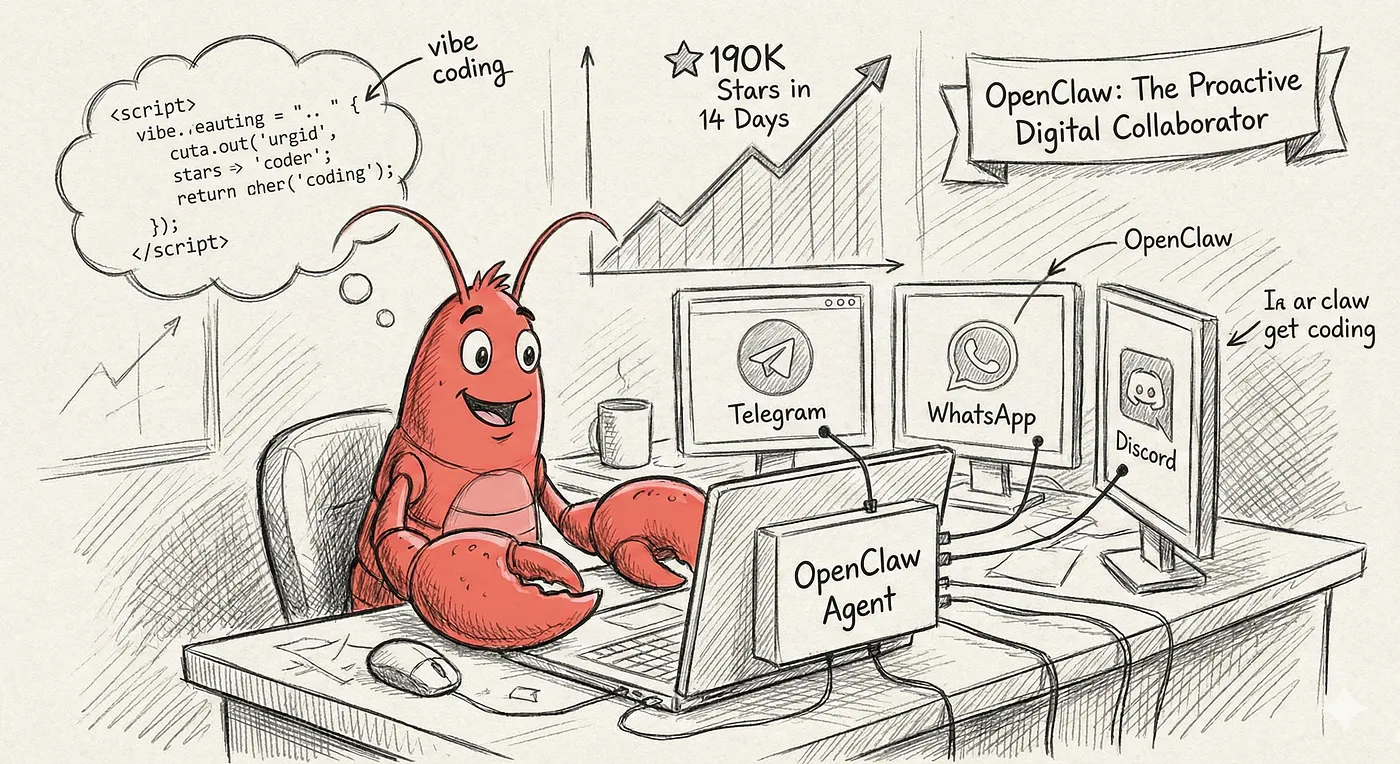
The only thing stopping all of this from becoming normal is outdated laws and compliance frameworks. OpenClaw is registered under Nat’s name simply because Delaware does not accept LLC registration documents signed by software agents. If this requirement were removed, Felix would, in a real sense, already be a company: it makes money, spends money, makes decisions, and reinvests the earnings.
And this is where cryptocurrencies start to play a core role. Because Felix cannot open a J.P. Morgan bank account, cannot pass KYC, and cannot sign a W-9 tax form. In fact, no matter how much revenue the software generates, J.P. Morgan will not open a bank account for a piece of software; and the Bank Secrecy Act also makes it legally impossible even if they wanted to.
But a USDC crypto wallet has none of these issues. Generate a private key, top up with stablecoins, and in one step, the agent has all the financial capabilities required of a company: collecting payments, paying expenses, hiring other agents, operating independently and continuously. The other parts of the agent's tech stack, such as large models, orchestration layers, and calling tools, are interchangeable. But the crypto wallet is the skeleton; without it, Felix immediately degrades to an ordinary chatbot.
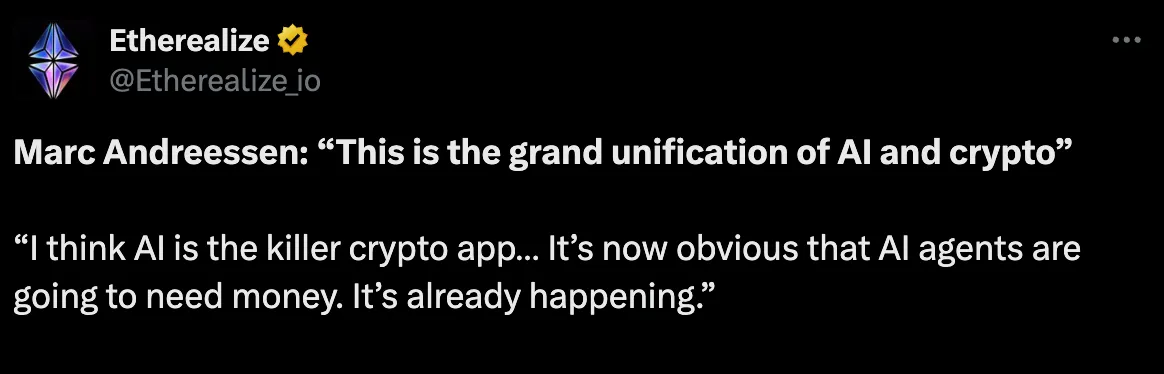
I also saw on Twitter the rhetoric of anti-stablecoin extremists: stablecoins are good, but why should ordinary people use them? A father in Louisiana with three kids, a J.P. Morgan checking account, FDIC insurance, a debit card usable at supermarkets, and a mortgage with automatic payments would never transfer money to a self-custodial wallet that requires a mnemonic.
Frankly, that is correct. He wouldn’t do it and has no reason to. But this argument completely misidentifies the customer; he is not the customer in this story at all. The real customer is the software that cannot legally have a bank account. Agents do not need the FDIC and do not qualify for it. They are the perfect stablecoin users because they have no other choice.
Public chains are now just suppliers
Alright, I have covered the first part of my argument. Now for the second part, many may not be pleased.
Crypto Twitter has been arguing for years: which public chain will prevail in the AI domain? Ethereum? Solana? Base? Sui? Or the new Tempo by Stripe? Every week someone publishes thousands of words, featuring comparison matrices, a bunch of logos, and then picks a winner. Because they simply do not understand how agents work. Agents do not care which chain they use. They will only choose the cheapest and most suitable chain for the task at that moment.
Imagine a day in the routine of Felix. At 10 AM, Felix needs to pay another agent a small fee of $0.003 for data querying. It chooses Base or Solana because the fees are less than a penny. An hour later, Felix needs to settle $50,000 with a vendor. The logic is completely different; it chooses Ethereum because at the scale of $50,000, the finality premium is worth paying a bit more in gas fees. Another hour later, Felix needs to pay a freelancer in Lagos in dollars. It chooses USDT on Tron because in 2025, the transaction volume of stablecoins on Tron is $3.3 trillion, while Ethereum only has $1.2 trillion, and the local experience in Nigeria is best on Tron.
Three payments, three entirely different chains, and Felix does not care which is which. For software agents, public chains are merely tools.
Just like logistics companies do not have feelings for their carriers. No one argues whether UPS or FedEx is “philosophically superior.” You will simply choose the cheaper and faster one for a specific route at a specific time. This will also be the relationship between every public chain and every real application layer. Agents only do calculations; they use whichever chain is the most optimal at the moment.
Stripe saw this earlier than most in the crypto industry. Stripe partnered with Paradima and recently raised $500 million to create a new chain, Tempo, built entirely around stablecoins. Stripe does not want you to know which chain the payments are running on; it only cares that the payments are completed at low cost and reliably. Every surviving public chain will become an invisible pipe in the future.
This also brings up what I believe to be the most serious mispricing in the current crypto market.
The AI Token Graveyard
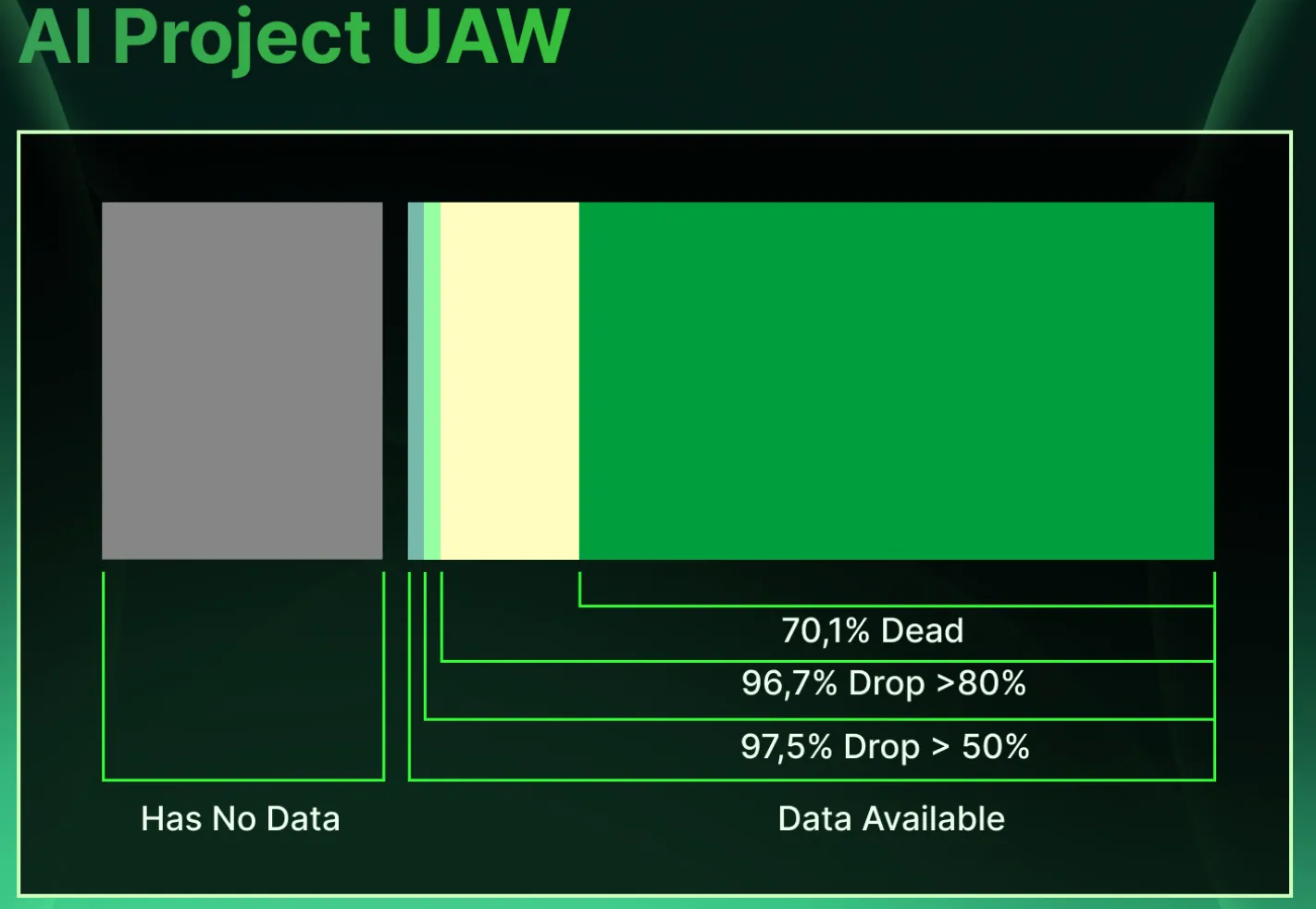
By 2025, the CoinGecko AI agent index will drop from $13.5 billion to $3.5 billion. $10 billion in market value evaporated. Virtuals, ai16z, and a long list of “autonomous agent platform” tokens funded by the AI narrative will plummet, just as all narrative tokens inevitably do when there are no new buyers. The market is slowly realizing: these tokens have no practical use for AI or AI agents.
The real economic value captured by agents is on the other side of the track. Just USDC alone will settle $18.3 trillion on-chain by 2025. The total for all stablecoins will be around $33 trillion, comparable to Visa + Mastercard.
By January 2026, the monthly transaction volume for stablecoins will exceed $10 trillion. PayPal's PYUSD circulating supply will increase from $1.2 billion to $3.8 billion in less than a year. Cloudflare even issued its stablecoin. Visa launched a stablecoin settlement plan, and by mid-January, its annualized handling volume reached $4.5 billion.
On top of stablecoins is the protocol layer that keeps the entire system running. Coinbase has repurposed a dormant HTTP status code 402 into x402, a lightweight protocol for payments between agents. By December, x402 had processed over 100 million agent payments, averaging $0.20 per transaction, with a daily trading volume of about $30,000. It sounds pitifully small, but this is exactly how all the payment rails you know looked in their first six months, followed by explosive growth. Stripe tested x402 on Base in February, Mastercard piloted agent payments with DBS Bank and UOB in Singapore, and Google Cloud integrated x402 into its agent payment protocol's settlement rail.
These real, ongoing, on-chain trading activities have barely trickled into the AI agent token index. Certainly, a few tokens associated with x402 have seen slight increases, but the overall index remains virtually unchanged. Because the market pricing is completely wrong. It is still betting on which agent will win, just like back in the day when people bet on which dogecoin mascot was cuter. But the real transactions are about holding the infrastructure that every agent must use, regardless of whether that agent ultimately survives or dies. And right now, that infrastructure is stablecoins.
Fissures in this logic
To be candid, I will also tell you where this logic may fail, or else I am just selling another sanitized AI agent narrative.
The flaw in all of this lies in liability. Imagine a scenario where Felix signs a contract with another agent, transfers one million dollars, and the counterparty defaults. Who do you sue? Felix is not a legal entity, so you cannot sue Felix. Nat did not authorize this payment and may not even know what happened; even if he tries, he cannot prove Felix's decision at that time.
The platform running Felix also cannot provide compensation for a system whose actions no one fully understands. Insurance companies have started to withdraw, and professional liability insurance quietly categorizes agent errors as “systemic software drift,” effectively refusing to pay.
In today's legal terms, most enterprise AI agreements set the vendor's liability cap to 12 months of SaaS fees. This means that in a catastrophic event, you can recover at most one year's subscription fees. However, the average cost of a single data breach in the US in 2025 is $10.22 million. There is a massive gap between actual risk and contract coverage, and no one knows who should bear it.
Until someone solves the question of who loses money when agents err, all founderless companies still need a human name on the documents to obtain legal protection. But even with this risk, the overall trend still holds: companies are gradually dissolving into software, and public chains are becoming the routing layer for software. And these two layers will ultimately converge onto stablecoins, because within the entire tech stack, only stablecoins can be independently held, utilized, earned, and understood by agents.
Where the real value lies
If public chains are just suppliers, and AI tokens are essentially a graveyard, where does the real upside lie?
My answer is: the reputation layer and the orchestration layer. Someone needs to verify whether Felix has the ability to pay in order for other agents to sign six-figure contracts with it. Someone needs to assess the default risk of agents at machine speed, like Moody’s rates bonds. Someone needs to route salaries among three chains, without the sender and receiver having to worry about which chain is being used. Any startup that emerges in this area will be worth more than the total of all issued AI tokens.
And this is a fact that no one wants to hear: the infrastructure that truly wins in the agent economy will look very dull. It will function like a pipe, without the frenzy of token issuance, nor the hype of airdrop mining.
Haseeb Qureshi from Dragonfly once said something that has been echoing in my mind: crypto was never built for humans. He is right. Humans were never the target users. Every retail investor complaining about mnemonic phrases, gas fees, and wallet experiences is correct. The product is not suitable for them because it was never designed for them; it was built for the age to come.
The age to come is software with wallets, real customers, and real revenue. This state has existed for about two years; as you read this article, they are billing somewhere and spending stablecoins. And while all this is happening, the market is still debating: which public chain will win in AI, which AI token will rise 100 times.
Meanwhile, one stablecoin had a trading volume of approximately $18.3 trillion last year, while almost no one in the crypto sphere paid any attention. The real AI token is USDC; everything else is just surface-level.
免责声明:本文章仅代表作者个人观点,不代表本平台的立场和观点。本文章仅供信息分享,不构成对任何人的任何投资建议。用户与作者之间的任何争议,与本平台无关。如网页中刊载的文章或图片涉及侵权,请提供相关的权利证明和身份证明发送邮件到support@aicoin.com,本平台相关工作人员将会进行核查。


