Author: Arthur Hayes
Translation: Deep Tide TechFlow
Deep Tide Introduction: BitMEX founder Hayes rare admits that he traded very little in the first quarter. He believes the market is standing on the edge of two cliffs: AI will destroy the jobs of American white-collar workers, triggering a deflationary collapse, and the war in Iran could completely rewrite the hegemony of the dollar. Bitcoin may drop first, but ultimately it will outperform all mainstream assets.

(This article only represents the personal views of the author and should not be used as a basis for investment decisions, nor should it be considered as investment trading advice.)
Want to know more? Follow the author on Instagram, LinkedIn, and X
Due to very light trading in the Maelstrom fund this quarter, many brokers occasionally contact me to ask for my views on the market, and what they can do for us. My answer is: "This is a non-trading zone." Aside from gradually increasing our long position on Hyperliquid, we hardly made any trades in the first quarter. Two factors combined created a trading dead zone, at least for our purely long positions.
The surge of AI agents will destroy the career prospects of ordinary knowledge workers in the flexible labor markets of Western developed economies (mainly the United States), triggering a deflationary financial collapse. I wrote about this topic in “This Is Fine.” Since that article was published, to turn Iran into the latest dumpster fire, President Trump, with the support of Israeli Prime Minister Netanyahu, has launched a selective war against Iran. The war has lasted nearly seven weeks, and the only important question is how the flow of goods and commodities through the Strait of Hormuz will be arranged.
I always declare when I express views on wars or geopolitics that I am just a simple skiing enthusiast, a cryptocurrency player who dances to house music. I have no insider information on what wars or global leaders will do. But I can read mainstream propaganda narratives and use AI agents to make simple calculations using publicly available information. I try to filter out the noise and focus on what is important for my portfolio. Fortunately, I don’t live in the Levant or the Middle East, so my life and freedom are not at risk.
In my simplified worldview, there are three scenarios to consider; in fact, there are four, but the fourth, nuclear war, is not investable, so there is no need to write about it. I will present each scenario and then delve into how they might affect the price of Bitcoin. I do not know the probability of each scenario. What I want to figure out is whether there is a portfolio configuration that can outperform the prices of hydrocarbons and their derivatives like food and fuel in the best-case scenario, and in the worst-case scenario, although it underperforms hydrocarbons prices, it can still outperform all major asset classes.
Scenario One: Return to Normal
In this scenario, the war ends immediately, restoring the pre-war status quo. However, the long-term trend of replacing expensive knowledge workers with cheaper and more efficient AI agents continues. The U.S. economy is most easily affected, as about 70% of its GDP is driven by consumer spending. Consumers finance materialistic consumption with bank credit, and these loans become assets on banks' balance sheets. If ordinary knowledge workers lose their ability to repay, these banks will effectively become insolvent and will need the central bank to print a large amount of money.
Scenario Two: Tehran Toll Booth
In this scenario, the U.S. military is unwilling or unable to stop Iran from restricting ships from passing through the Strait of Hormuz. Iran makes good on its promise, allowing "friendly" vessels to pay 2 million RMB, cryptocurrency, sanctioned dollars, or other diplomatic arrangements to pass through the strait. The worst-case scenario for U.S. financial hegemony is that countries will now have to find ways to obtain RMB. Given that most countries have a trade deficit with China, the only way to raise RMB on a large scale would be to sell U.S. dollar assets (such as U.S. Treasury bonds or U.S. tech stocks), buy physical gold, and then sell the gold in the Shanghai or Hong Kong gold markets for RMB. Among the top ten economies by GDP, only Brazil and Russia have a trade surplus with China, ranking ninth and tenth respectively. In contrast, the U.S. has the largest trade deficit of all economies, financed by an equally huge capital account surplus. However, when countries sell dollar assets to raise RMB or fill commodity shortages at extremely high prices in the spot market, the capital surplus of the empire will mathematically decline. The financialized U.S. economy needs foreign capital to finance government spending; without it, the numbers do not add up. Eventually, falling bond prices or rising yields and falling stock prices will require printing money to finance the government.
Scenario Two Point Five: Stars and Stripes Blockade
Interestingly, after the U.S. and Iranian negotiating representatives failed to reach a permanent ceasefire agreement, on Sunday, April 12, Trump announced that the U.S. Navy would blockade all ships entering and exiting the strait. Perhaps this blockade will evolve into a pirate baron toll, where ships must pay double tolls to both Iran and the United States, then shout "God is the Greatest" and "Hallelujah." Or perhaps the exemptions issued to this or that country afterward will be so many that the blockade is just a moldy Swiss cheese. The above perspective still holds; if holding dollars doesn't guarantee that pirates won’t sink your ship, then why hold dollars at all?
Scenario Three: Empire Strikes Back
In this scenario, the U.S. Air Force and Navy do what they should do, destroying the Islamic Revolutionary Guard's ability to disrupt shipping in the Strait of Hormuz through punitive long-range bombings. The strait reopens, and any ship can pass safely without extra fees. The restoration of a powerful imperial hegemony eliminates the need for countries to use any currency other than the dollar, and there is no need to bid on expensive commodities in the spot market, at least for a few days. The problem is that ending Iran's control over the strait likely means the complete destruction of that country. Or, as Trump said, "send them back to the Stone Age." Many Americans who have been taught from birth that Iran is the most evil country on Earth cheer for this tough stance against the number one enemy. However, destroying Iran in this way means that at Iran's last breath, they will fulfill their promise to take other goods and energy production in the Gulf region to the grave. Spices absolutely will not flow, and global central banks will have no choice but to print money to save the global financial system as commodities soar.
If you live in some rundown countries, your local currency will suffer hyperinflation against the dollar or the ruble. The United States and Russia will be the only large swing producers left able to fill the gaps left in the Middle East's scorched earth. There will be famine and widespread social unrest. So, while your Bitcoin may be worth infinite units of some worthless fiat currency, if you can't escape in time, your welfare will be at serious risk.
Before I continue discussing Bitcoin's performance in each scenario, let’s quickly browse some chart visuals to provide graphical evidence for my words.
Return to Normal
Given that I have detailed this situation in “This Is Fine,” let me repost some charts and tables provided in that article:
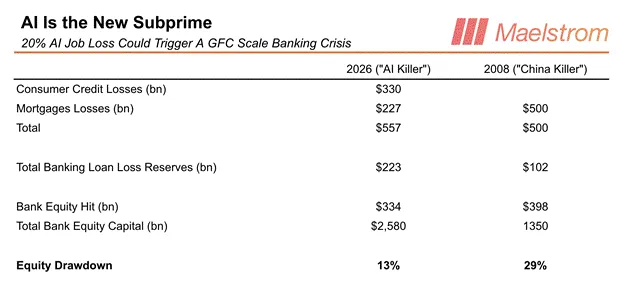
In summary, the severity of the deflationary collapse caused by AI agents is comparable to the 2008 subprime mortgage crisis in the U.S.
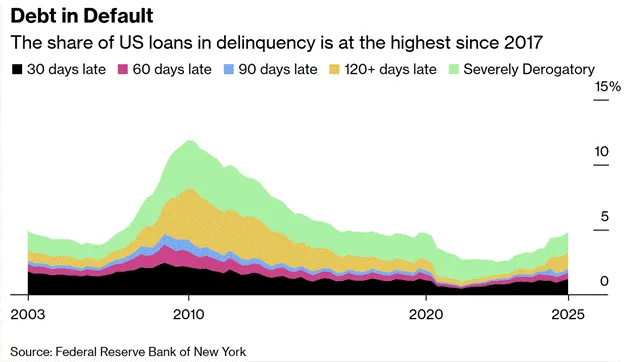
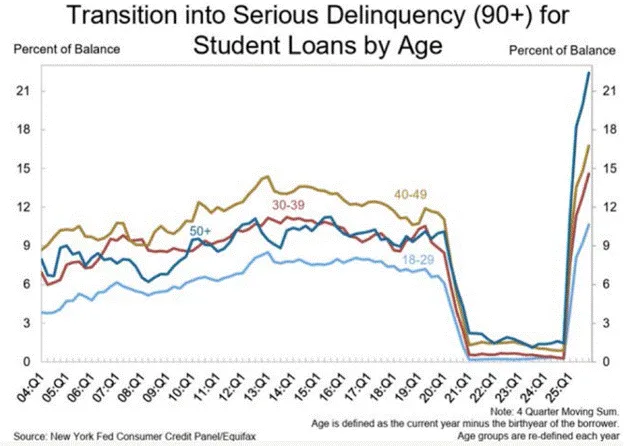
The delinquency rate on consumer credit has already risen, and the layoff party hasn’t even really started.
Tehran Toll Booth
Essentially, if this situation occurs, it is the end of petrodollars and the rise of a new global reserve currency or a basket of currencies. Currently, the Islamic Revolutionary Guard is very flexible on payment terms. But if they consolidate power over the strait, why continue to accept dollar payments when the U.S. is doing everything it can to limit their ability to use dollars? Ultimately, I believe they will not allow payments in dollars. RMB and gold are likely to become the two main currencies for sovereign trade.
If goods cannot be shipped without paying RMB, then why save in dollars? Given that most major economies have a trade deficit with China, the only way to raise RMB would be to sell dollars, buy gold, and then purchase RMB. From now on, countries must save trade surpluses in gold instead of U.S. Treasury bonds or stocks.
To highlight the growth of RMB use in trade, I want to focus on several charts published by Luke Gromen, which show that a quasi-RMB-gold standard is quietly emerging.
Step One: Sell dollar assets (Treasuries) and buy gold
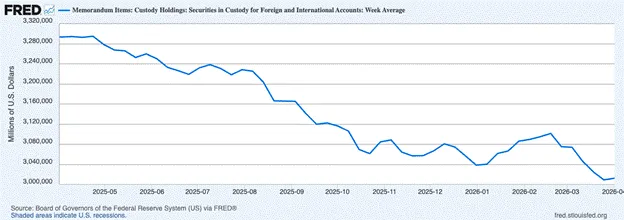
Since the war began, foreign holdings of securities in the Federal Reserve have net decreased by $63 billion. I use this as a directional proxy for foreign holdings of Treasury bonds and other dollar securities like stocks.
What did sellers do with these dollars?
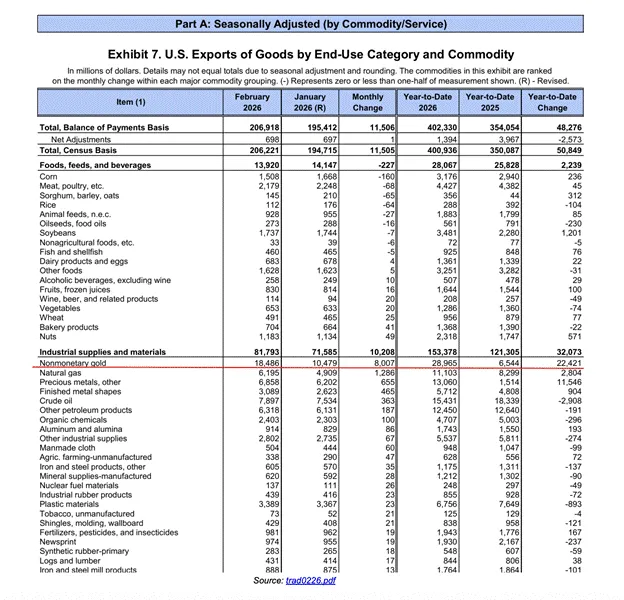
Non-monetary gold has been the largest U.S. export since four of the past five months, with an increase of 342% year-over-year.
They used these dollars to buy gold and ship it out of the U.S. This is what a resurgence of American manufacturing looks like; the only thing leaving America is primitive artifacts. Sorry to all those who thought they could get back high-paying factory jobs -- another term of an American presidency has resulted in blue-collar workers being screwed without any lubrication.
Step Two: Sell gold for RMB
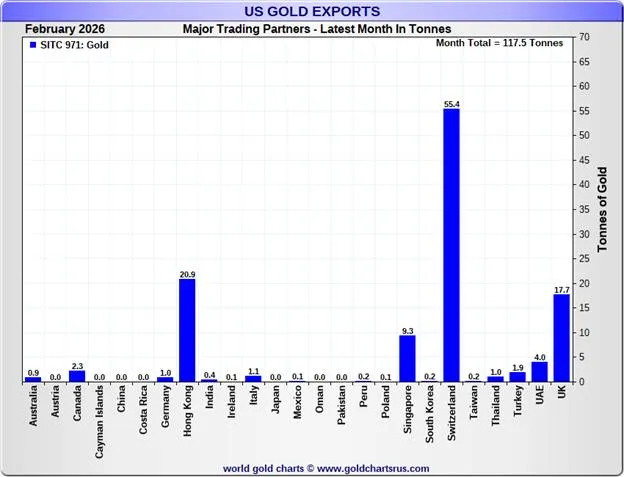
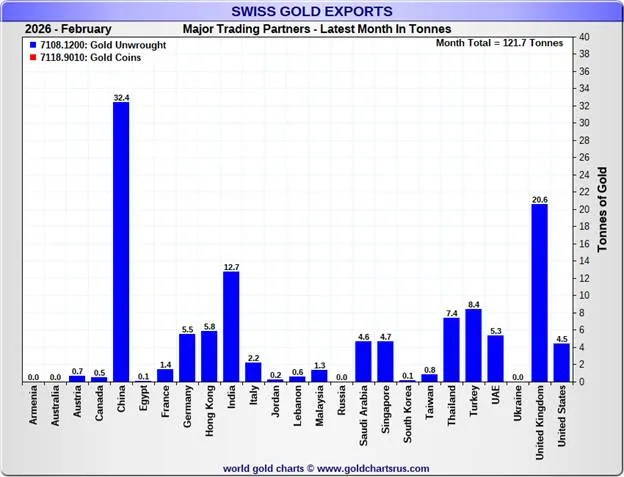
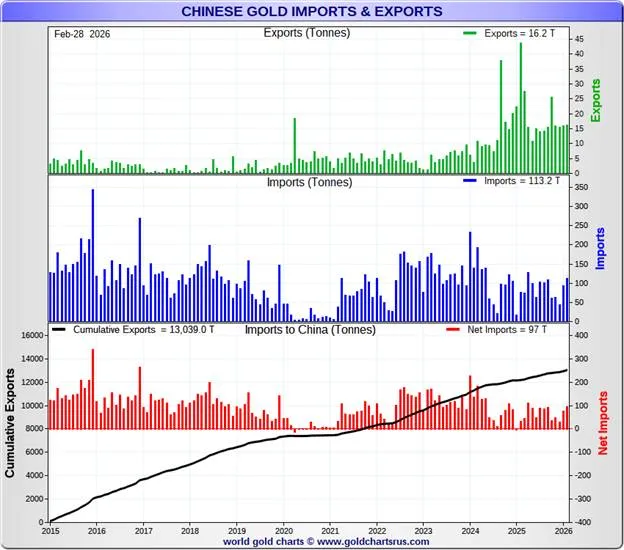
Swiss refineries receive American gold, remelting it into bars suitable for delivery to China.
Step Three: Pay the Tehran toll
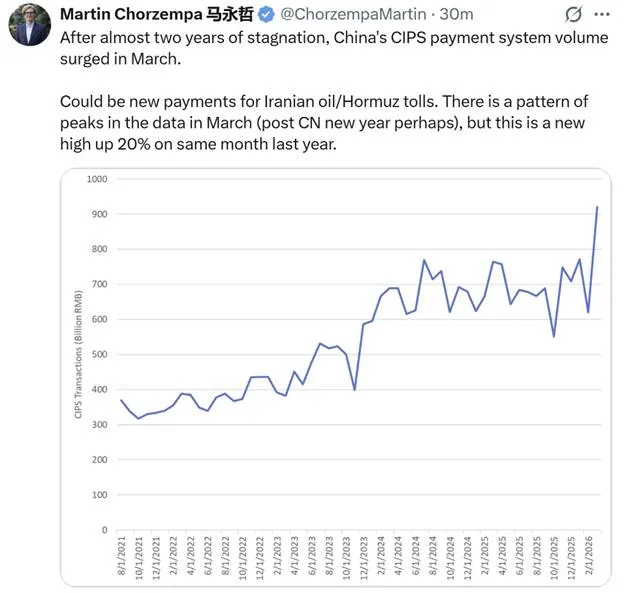
When Treasury Secretary Besant says, "Either pay in dollars or be sanctioned again," he is serious. Due to sanctions imposed on Iran about fifteen years ago, Iran cannot use the SWIFT payment network. Transferring RMB into the dirty hands of the Islamic Revolutionary Guard requires using the Chinese fiat currency CIPS messaging system. As you can see, trading volume increased significantly after the war started.
This series of charts shows the flow from the sale of dollar assets to the purchase of gold, ultimately funding payments in RMB for Tehran or other suppliers. It does not matter that the dollar remains the dominant currency used in trade. Markets are forward-looking, so the acceleration of RMB use in global trade is more important than the relatively low absolute use compared to the dollar. Investors can protect their portfolios by abandoning dollar assets before the consensus accepts the existence of a new monetary system. The pound was technically the global reserve currency until the Bretton Woods Agreement in 1944, but the dollar effectively replaced the pound as the global reserve currency in the early 20th century as the U.S. economy became the most productive economy in the world. By 2026, the United States will have a trade deficit with the most productive economies: China, Japan, South Korea, Germany, Taiwan, etc. Most countries have a trade deficit with China. I will emphasize once more: if you must pay RMB to those Stone Age turban wearers to receive goods, what the hell is the point of holding dollars?
Stars and Stripes Blockade and Empire Strikes Back
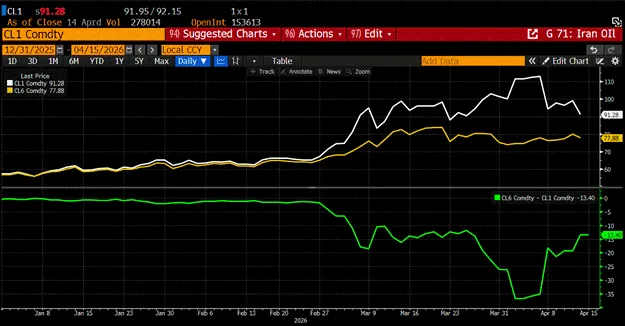
To determine whether the strait is open or closed, you can look at the charts above or generate similar versions with your preferred charting tool. The top panel shows the WTI futures prices for May 2026 (CL1, white line) and October 2026 (CL6, gold line). I use WTI because this benchmark price is most relevant to U.S. gasoline consumers. Only when gasoline prices remain high before the midterm elections in November will Trump truly downgrade the situation. The bottom panel shows the spread between the two contracts (far month minus near month); the curve is inverted. Since the price increase of the far month is less than the near month, the market expects the flow of oil through the strait to increase significantly. If this occurs, the spread will widen because the price of the near month will plummet. But if the spread narrows due to rising far month prices, the global economy will fall into chaos. Ignoring the verbal sparring between Trump and the Iranian Revolutionary Guard, focus on this chart.
Quantity vs. Price of Currency
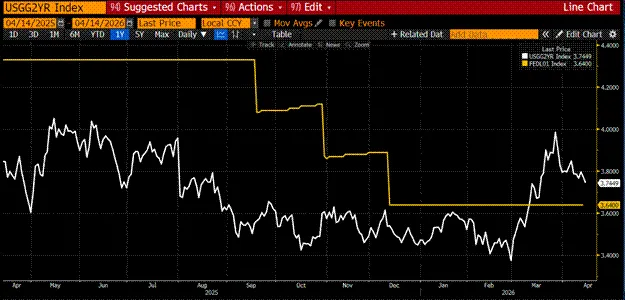
After the war began, the two-year Treasury yield (white line) rose much more steeply than the effective federal funds rate (gold line). This indicates that the market believes the Federal Reserve will raise interest rates to combat rising energy inflation.
It is important to form a judgment on this because I believe we may enter a situation where major central banks, including the Federal Reserve, may print money while raising interest rates, either directly or through the commercial banking system. As the war leads to surging food and energy prices, capable politicians will subsidize the major input costs of the economy. Failing to do so could trigger social unrest or famine. But to prevent inflation from spreading to all goods and services, central banks must destroy demand by raising interest rates to dampen the activity of credit-sensitive parts of the economy. Any entity borrowing money to purchase goods and services will reduce spending if credit costs rise.
If central banks stop there, then my prediction for Bitcoin will be very straightforward. In an environment where people reduce spending on all but food and energy, Bitcoin prices will decline. But whether allies or adversaries under U.S.-led peaceful order, every country will need to increase defense spending and stockpile critical goods. Do you want your country to be like Australia, which relies on almost 100% refined hydrocarbons imported from China? When the war started, China stopped all exports, and Australia's reserves lasted less than a month. They had to turn to Singapore, and I believe paid a hefty price for jet fuel; otherwise, all those Aussie hillbillies would be stuck at home indefinitely! I know some of you will cheer for this outcome, especially Japanese skiers.
Making bombs, especially nuclear bombs, to protect oneself from being turned into a dumpster of a country by skinny tie prophets, as well as stockpiling goods, require substantial increases in government borrowing. If domestic private investors cannot or do not wish to buy these trash government bonds, central banks and/or the commercial banking system will print money to purchase these bonds, increasing the fiat money supply.
As you read my predictions for Bitcoin's performance in various scenarios, keep this dynamic in mind. You have to judge whether the quantity or price of currency is more important. Otherwise, you will not be able to understand the seemingly contradictory price movements of different risk assets.
Return to Normal
After the situation returns to pre-war conditions, Bitcoin may rebound slightly. However, the deflationary bomb from AI agents is still ticking beneath the surface. Bitcoin will not rise significantly until the Federal Reserve provides the necessary liquidity to fill the black hole created by consumer credit defaults on the banks' balance sheets. This does not mean it cannot soar to $80,000 to $90,000, but for me, putting new fiat money in requires the Federal Reserve to send a full go signal. Given that I have already gone long significantly, as I am operating a purely long book, seeing higher net worth numbers on the screen would make me feel better, but the risk-reward ratio is not sufficient for me to load up completely and turn my portfolio to maximum risk levels.
I do not know how long it will take for the banking system to collapse. Nevertheless, every week I read stories about various companies laying off large numbers of knowledge workers because AI agents are more efficient than ordinary humans, as well as other stories regarding rising consumer credit delinquency rates.
Here’s an anecdote. I recently chatted with a friend who is an entrepreneur running a successful crypto gaming company. He is an OG. We started discussing how AI is affecting his business. As someone trained in computer engineering, during the Christmas holidays of 2025, he sat down and attempted to create something using the latest Claude model. He was so surprised by how quickly he was able to produce deliverable code that months later, he took his best engineers to an off-site meeting to discuss how AI would affect the business. He asked them to create a workflow that would allow AI agents to code around the clock. They automated every step, including code reviews, so that every morning when they woke up, there was available, tested code waiting for senior engineers to review. One person completed his six-month roadmap alone in four days, supported by an AI agent team. After this meeting, my friend decided that his company needed to change the workflow immediately. Therefore, 50% of his employees would be laid off in the coming weeks. In the age of AI agents, ordinary engineers are redundant, but with AI agents, the productivity of top talent will increase by 10 to 100 times.
As models gain more expertise in specific domains, all mediocre knowledge workers face the risk of unemployment. Unfortunately, despite unemployment insurance, according to BLS and St. Louis Fed data, the annualized maximum median payment for unemployment insurance in U.S. states is about $28,000, which pales in comparison to the $85,000 to $90,000 median salary of knowledge workers. There is no choice but to default on consumer credit repayments owed to banks. The false fiat fractional reserve banking system ends here.
Bitcoin (gold line) vs. U.S. Software SaaS ETF IGV (white line)
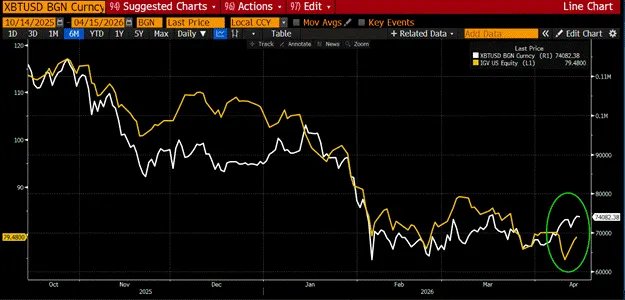
That said, after the ceasefire, U.S. SaaS software stocks have returned to a trend of only going down, while Bitcoin has held its ground and rebounded. This is a delightful breakthrough of correlation, but for me, it is still too early to assert that Bitcoin has pierced through the disinflation of knowledge workers related to AI and is predicting a significant rise.
Tehran Toll Booth
As countries sell dollar assets to raise RMB to pay tolls, Treasury and stock prices will decline. This could be a slow process as there are currently other payment options besides RMB. But due to embedded leverage in the system, a little snowflake falling could trigger a financial avalanche, as sell-offs lead to more sell-offs, volatility rises, and the market freezes. Then currency officials must intervene to print money. A key indicator to watch is the MOVE index, which measures volatility in the U.S. bond market. When the index rises above 130, some form of money printing will occur.
As volatility rises, the prices of large U.S. tech stocks will drop, making it difficult for Bitcoin to rebound significantly. As investors reduce portfolio risk due to higher volatility and lower prices, they will sell Bitcoin to meet margin calls. Bitcoin will only rise when the situation is bad enough for the expectations of a bailout to become consensus.
Waiting for Besant and/or whoever is the Federal Reserve Chairman to press the money-printing button. The risk-reward ratio of trying to front-run this situation is not worth it. I hope that during any comprehensive TradMarket financial collapse, Bitcoin can hold $60,000. If Bitcoin tests this level a second time and holds it, overall I would be inclined to increase risk.
Stars and Stripes Blockade and Empire Strikes Back
As back-end oil futures prices rise rapidly to catch up with spot or near-term prices, the global economy will suffer significant impacts. At some point, demand destruction will hit Treasury and U.S. stock prices. As before, the initial reaction would be a decline in Bitcoin. Once the over-leveraged Western financial system collapses, the money printer will start up. If the blockade ultimately ends through punitive bombing actions against Iran, followed by Iran destroying all energy production in the Persian Gulf, this could lead to the annihilation of the Iranian state. A Bitcoin rebound fueled by money printing could be short-lived, as the destruction of the Iranian state greatly increases the likelihood of World War III.
Portfolio Construction
As an unleveraged, purely long investor, Maelstrom can let time and compounding work. The slight outperformance of Bitcoin against IGV over the past few days is very encouraging. This will motivate me to reassess my bearish stance on Bitcoin prices, despite the accelerating financial deflation brought about by AI knowledge work. Currently, the only assets I am willing to increase risk in are gold and $HYPE (the governance token of Hyperliquid). HIP-4 will launch in a few weeks, and I anticipate it will capture a significant market share from the prediction market verticals of Polymarket and Kalshi.
Aside from this, I will pray to Satoshi every day, hoping they can infect the thoughts of our global political elite, convincing them to take psychedelics instead of dropping bombs.
Want to know more? Follow the author on Instagram, LinkedIn, and X
Visit the Korean version: Naver
[1] The trade data used is from 2024 to 2025.
[2] IRGC - Islamic Revolutionary Guard Corps
免责声明:本文章仅代表作者个人观点,不代表本平台的立场和观点。本文章仅供信息分享,不构成对任何人的任何投资建议。用户与作者之间的任何争议,与本平台无关。如网页中刊载的文章或图片涉及侵权,请提供相关的权利证明和身份证明发送邮件到support@aicoin.com,本平台相关工作人员将会进行核查。


