Author: Claude, Deep Tide TechFlow
Deep Tide Guide: TSMC’s Q1 revenue reached $35.9 billion, exceeding expectations, with capital expenditure pushed to the upper limit of $56 billion. Wei Zheji stated that AI demand is "extremely strong" and supply shortages will last at least until 2027. Meanwhile, data from SemiAnalysis shows that the one-year rental price for H100 surged from $1.70 per hour in October last year to $2.35 in March this year, an increase of nearly 40%. The daily usage of tokens in China has grown more than a thousand times in two years, with multiple price increases from Tencent Cloud, Alibaba Cloud, and Baidu Smart Cloud this year. From chip manufacturing to GPU leasing to model invocation, the entire chain of AI infrastructure has entered a price increase cycle.
The shortage of computing power is no longer a prediction, but a fact that is happening.
On April 16, TSMC provided the clearest supply timeline yet during its Q1 earnings call: the supply shortage of AI chips will continue at least until 2027. On the same day, a report by Financial Associated Press quoted multiple industry insiders indicating that the rental prices for NVIDIA's H100 series GPUs have risen approximately 20%-30% since last October, with the H series overall being "unavailable." All upcoming Blackwell production capacity scheduled to be online before September 2026 has been fully booked.
TSMC: AI demand is "extremely strong," building a factory takes 2-3 years, there is no shortcut
TSMC reported Q1 revenue of $35.9 billion in US dollars, a year-on-year increase of over 40%, slightly above the company's guidance upper bound. The high-performance computing (HPC) business grew 20% quarter-over-quarter, accounting for 61% of total revenue, serving as the core engine driving performance.
More crucial signals come from capital expenditure. TSMC has pushed its capital budget for the full year of 2026 to the upper limit of the previous guidance range of $52 billion to $56 billion, nearing $56 billion. This figure exceeds more than half of the company's total capital expenditure of $101 billion over the past three years.
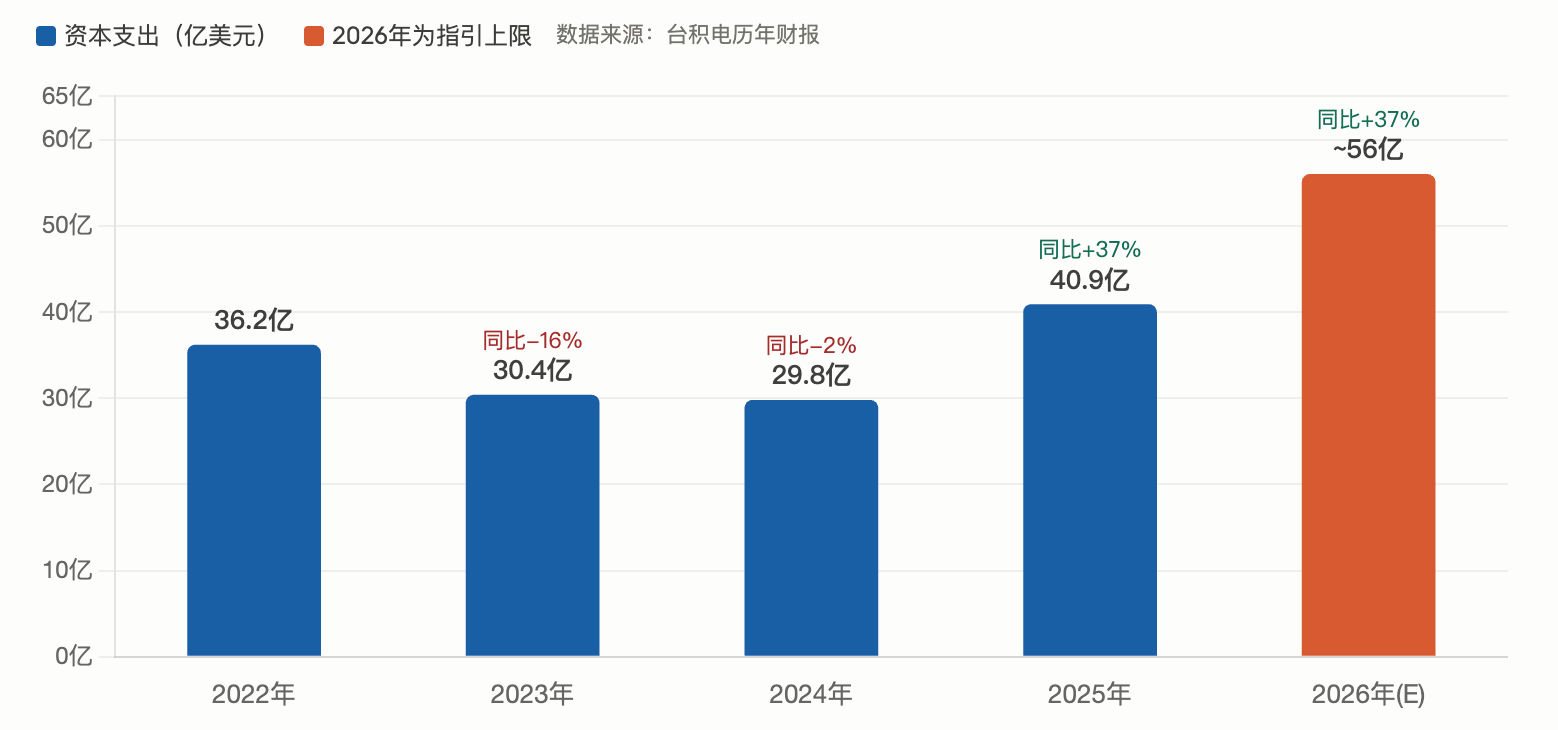
TSMC Chairman and CEO Wei Zheji explained the increase in capital expenditure with just one sentence: "Demand is extremely strong, especially for high-performance computing and artificial intelligence applications. We are racing to accelerate and procure equipment early, but supply remains tight."
A JP Morgan analyst directly asked during the call how long the supply tightness would last. Wei Zheji's response was also straightforward: building a new wafer factory takes 2-3 years, and setting up and ramping up production requires time. At the current pace, it is expected that supply tightness will continue at least until 2027. A phrase he repeatedly emphasized was "there is no shortcut."
To address the demand gap, TSMC announced a rare global expansion plan for 3nm nodes. Historically, TSMC would not add capacity after reaching the target capacity at a specific technology node, but this time it made an exception: a new 3nm facility in Tainan Science Park (mass production in the first half of 2027); the second factory in Arizona, USA will use 3nm technology (mass production in the second half of 2027); the second factory in Japan plans for 3nm (mass production in 2028). Additionally, existing 5nm equipment in Taiwan is being modified for 3nm capacity.
Wei Zheji stated that TSMC is "firmly convinced" of the great trend of AI and expects capital expenditure in the next three years to be significantly higher than in the past three years. The company's revenue guidance for 2026 is for a year-on-year growth of over 30%.
H100 rental prices skyrocketed in six months, entire H series is "unavailable"
On the same day TSMC confirmed capacity bottlenecks upstream, data from the downstream GPU leasing market verified the true strength of demand.
The Semiconductor research firm SemiAnalysis released its one-year rental price index for H100 this month, showing that the one-year contract price for H100 surged from $1.70 per GPU per hour in October 2025 to $2.35 in March 2026, an increase of nearly 40%. This index is based on monthly surveys of over 100 market participants, including Neocloud service providers and buyers and sellers of computing power.
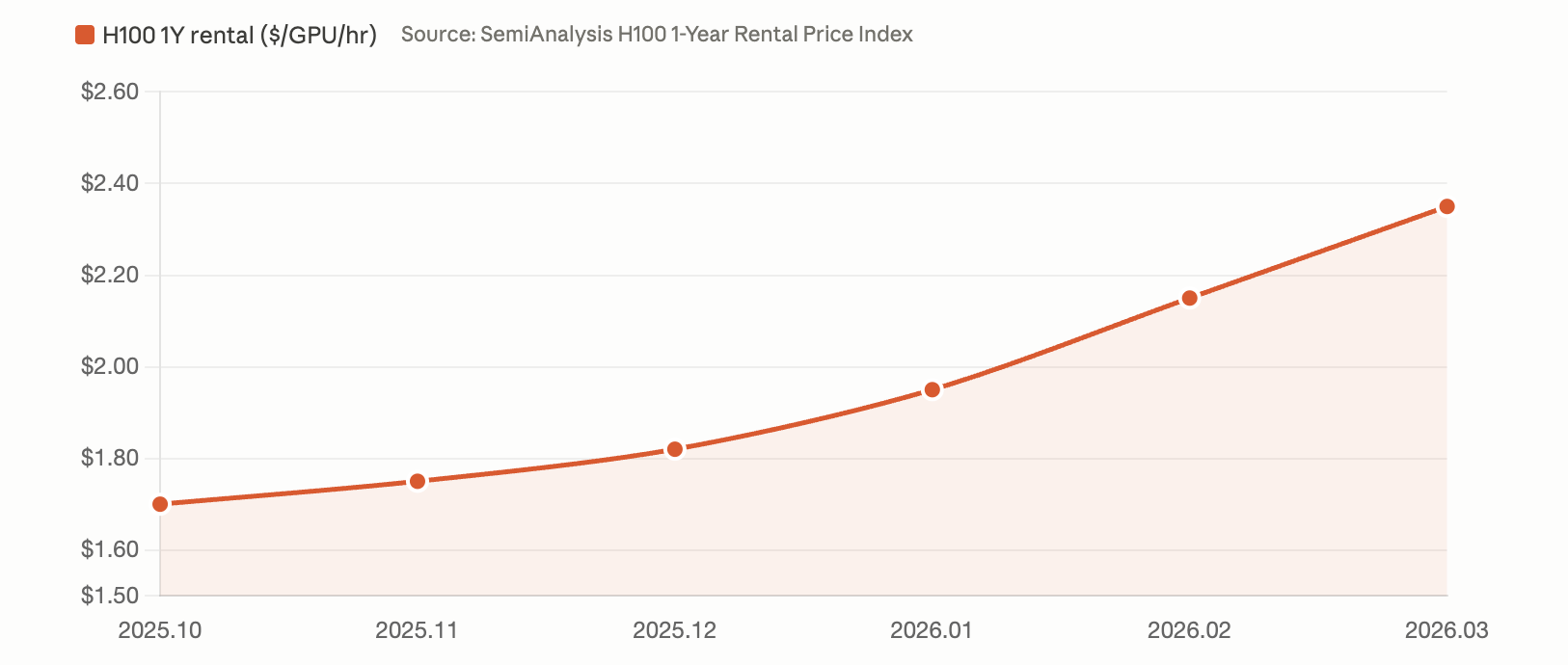
Multiple domestic industry insiders interviewed by Financial Associated Press reported a slightly lower increase than SemiAnalysis's global data, but the direction was consistent, stating, "The rental increase for H100 is about 20%-30%." In terms of specific prices, the monthly rental for H100 including cabinets has risen from previous lows of 40,000-50,000 yuan to 80,000-90,000 yuan. Not only for H100, the rental prices for the entire H series have seen a general increase.
According to the SemiAnalysis survey, half of the GPU suppliers questioned stated that the H series is "unavailable," with most suppliers indicating that there are no H cards available for lease renewal when the current contracts expire, with some H100 contracts having renewal terms lasting up to 4 years. All upcoming capacity for the Blackwell series scheduled to come online before August to September 2026 has also been fully booked.
Cloud vendors collectively raise prices, cost pressures transmit upstream
The direct consequence of the supply-demand imbalance of tokens is the collective price increase by cloud vendors and model providers.
On March 11, Tencent Cloud announced an increase in prices for its Hongyuan series models, with input-output prices rising generally by over four times. On March 18, Alibaba Cloud announced a price increase of up to 34% for AI computing power, storage, and other products. On the same day, Baidu Smart Cloud increased its AI computing power products by about 5%-30%. Zhipu has also announced price increases three times this year.
The price increase trend continued into April. Tencent Cloud announced on April 9 that from May 9, prices for AI computing power-related products would be uniformly raised by 5%; Alibaba Cloud announced on April 15 that some model services on the Bailian platform would increase by 2%-7%, effective May 15.
An industry insider from the computing power supply chain pointed out an important price transmission logic: "Large domestic enterprises that used to rent servers have shifted to selling models or tokens directly, and this price increase is several times. So compared to this, a 20%-30% increase in hardware is not much; it is still due to the imbalance of supply and demand, and serious shortages."
$700 billion in capital expenditure chasing limited capacity, supply-demand imbalance difficult to resolve short-term
Putting TSMC's supply constraints and GPU market demand data together, the structural causes of the AI computing power shortage become clear: demand growth far exceeds the speed of capacity expansion, while the delivery cycle for new capacity is measured in years.
On the demand side, the four major super cloud firms (Alphabet, Microsoft, Meta, Amazon) have combined capital expenditure guidance of nearly $700 billion for 2026, an increase of over 60% from 2025. NVIDIA holds about 85%-90% market share in the GPU market, which means that the vast majority of expenditure is ultimately directed toward NVIDIA chips, which are almost all manufactured by TSMC.
On the supply side, TSMC's $56 billion capital expenditure is already at an all-time high, but building a new wafer factory takes 2-3 years from breaking ground to production, and ramping up capacity requires another 1-2 years. The 2nm process just began volume production in Q4 2025, and the global expansion plan for 3nm will earliest contribute incremental capacity in the first half of 2027.
This supply-demand time lag determines that, at least until 2027, the pricing power of AI computing will continue to rest with the suppliers. For downstream entities, the trends of rising GPU rental prices, increasing cloud service prices, and escalating model invocation costs show no signs of reversal in the short term. For upstream players TSMC, NVIDIA, and HBM memory manufacturers (Samsung, SK Hynix), this is a period of extremely high certainty for growth.
免责声明:本文章仅代表作者个人观点,不代表本平台的立场和观点。本文章仅供信息分享,不构成对任何人的任何投资建议。用户与作者之间的任何争议,与本平台无关。如网页中刊载的文章或图片涉及侵权,请提供相关的权利证明和身份证明发送邮件到support@aicoin.com,本平台相关工作人员将会进行核查。


