Author: jay
Translated by: Jiahua, ChainCatcher
Perpetual contracts ("perps") refer to futures contracts that never settle. As a crypto-native innovation, they experienced explosive growth on-chain in 2025. Today, they have become one of the largest markets in the crypto space, covering traditional assets with trading volumes reaching several trillion dollars.
Last year, the trading volume of perpetual contracts settled by top centralized exchanges reached $86.2 trillion (a year-on-year increase of 47%), while the growth rate of on-chain perpetual contracts was even more astonishing: leading decentralized exchanges (DEX) hit a trading volume of $6.7 trillion (a year-on-year increase of 346%). Currently, DEX volumes account for about 7.8% of centralized exchange (CEX) volumes, whereas just over a year ago, this ratio was only around 2.5%. [Note: While a few U.S. regulated centralized platforms offer products similar to perpetual contracts to U.S. investors, all centralized and decentralized exchanges restrict U.S. investors from trading actual perpetual contracts.]
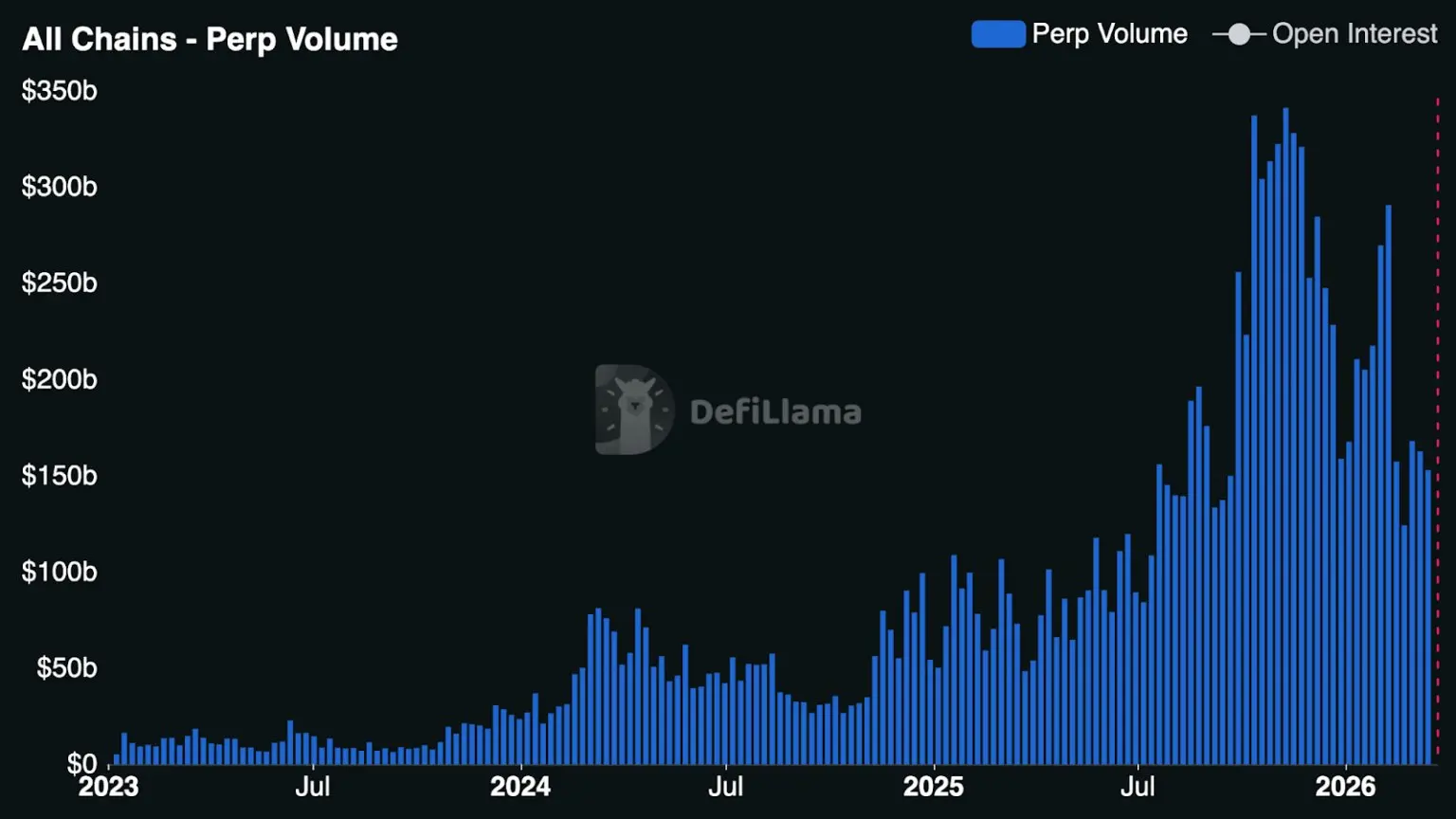
But more importantly, perpetual contracts are gradually shedding the stigma of being a marginal crypto primitive, beginning to show the fundamental transformative power to reshape trading behavior and market structure.
So, what is driving the popularity of perpetual contracts? Why now? The following content will explore why traders worldwide increasingly favor perpetual contracts, the size opportunities of this market, and the opportunities seen by builders.
A Brief History and Evolution of Perpetual Contracts
The idea itself is actually older than the crypto industry. Theoretically, perpetual contracts existed as early as 1993, when Nobel laureate Robert Shiller proposed perpetual futures contracts, which he initially envisioned as tools to hedge real estate value risks. However, it wasn't until 2016, with the rise of BitMEX and XBTUSD (the longest-running Bitcoin perpetual swap contract), that perpetual contracts became popular in the crypto space.
A decade later, modern exchanges now offer perpetual contracts covering stocks, indices, commodities, interest rates, startup company valuations, and even Nvidia H100 GPU prices.
For years, perpetual contracts have been a billion-dollar revenue engine for centralized exchanges. As retail demand for leverage has surged, perpetual contracts have become the primary venue for short-term price discovery, liquidity, and trading activity—on many large centralized exchanges in Asia, their trading volumes are several times that of spot trading.
In the past year and a half, decentralized perpetual contract exchanges have begun to meaningfully encroach on the market share of centralized exchanges. With the structural advantage of self-custody, perpetual DEXs are quickly closing the gap with CEXs in terms of liquidity, performance, and features aimed at active traders.
As platforms like Hyperliquid achieve breakthrough success, leading crypto wallets and applications have begun to support perpetual contracts and launch high-quality trading experiences, reaching millions of users. In the second half of 2025, the front ends of perpetual DEXs experienced explosive growth—ranging from casual mobile applications to complex multi-site trading terminals.
Especially with Hyperliquid, through HIP-3 (Builder-Deployed Perpetuals), the boundaries of services that DEXs can offer have been broken. This mechanism allows anyone to launch perpetual markets on the exchange without permission. With HIP-3, builders can list almost any asset and earn 50% of the fee share while managing their own oracle and risk parameters.
At the same time, new entrants and competitors like Avantis, Lighter, Ostium, and Variational have emerged or accelerated product development. The increasingly fierce competition has forced perpetual DEXs to differentiate themselves in exchange design, market structure, asset support, and permissionlessness, while prompting some trading platforms to find strong product-market fit in new categories such as Real World Asset (RWA) perpetual contracts.
For years, perpetual contract traders have speculated only on crypto assets—BTC, ETH, SOL, and various long-tail altcoins. However, at the end of last year, when the trading volume of perpetual contracts sharply cooled after a recent peak during a broader crypto market sell-off, RWA perpetual contracts began to gain traction. A handful of perpetual DEXs have listed commodities, stocks, and stock indices, expanding the range of tradable assets to include private companies like Nvidia, Samsung, and even SpaceX, as well as commodities like silver and palladium.
This year, the growth of RWA perpetual contracts has accelerated even more. In recent weeks, the proportion of RWA in Hyperliquid's total trading volume peaked at 44%, and RWA trading pairs have now stabilized as some of the highest-fee generating trading pairs on that exchange. On Ostium, RWA has accounted for the vast majority of the trading volume for months.
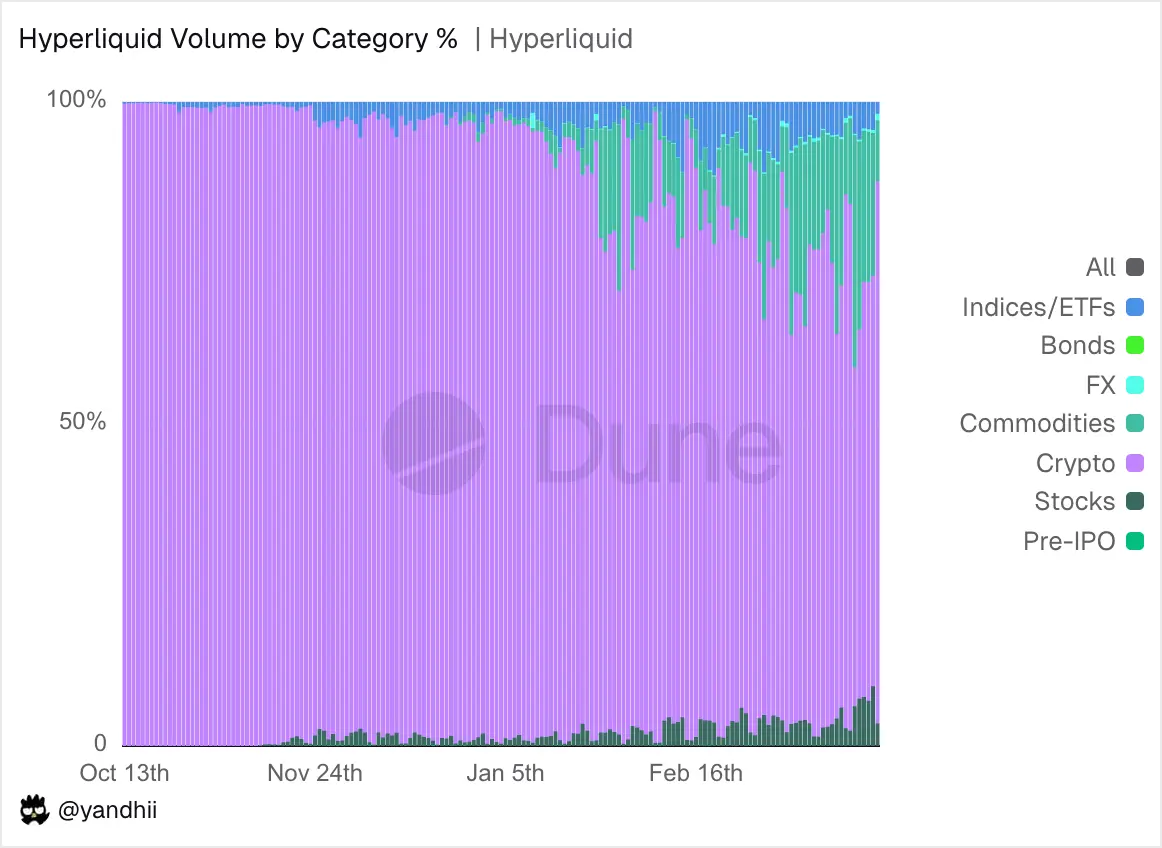
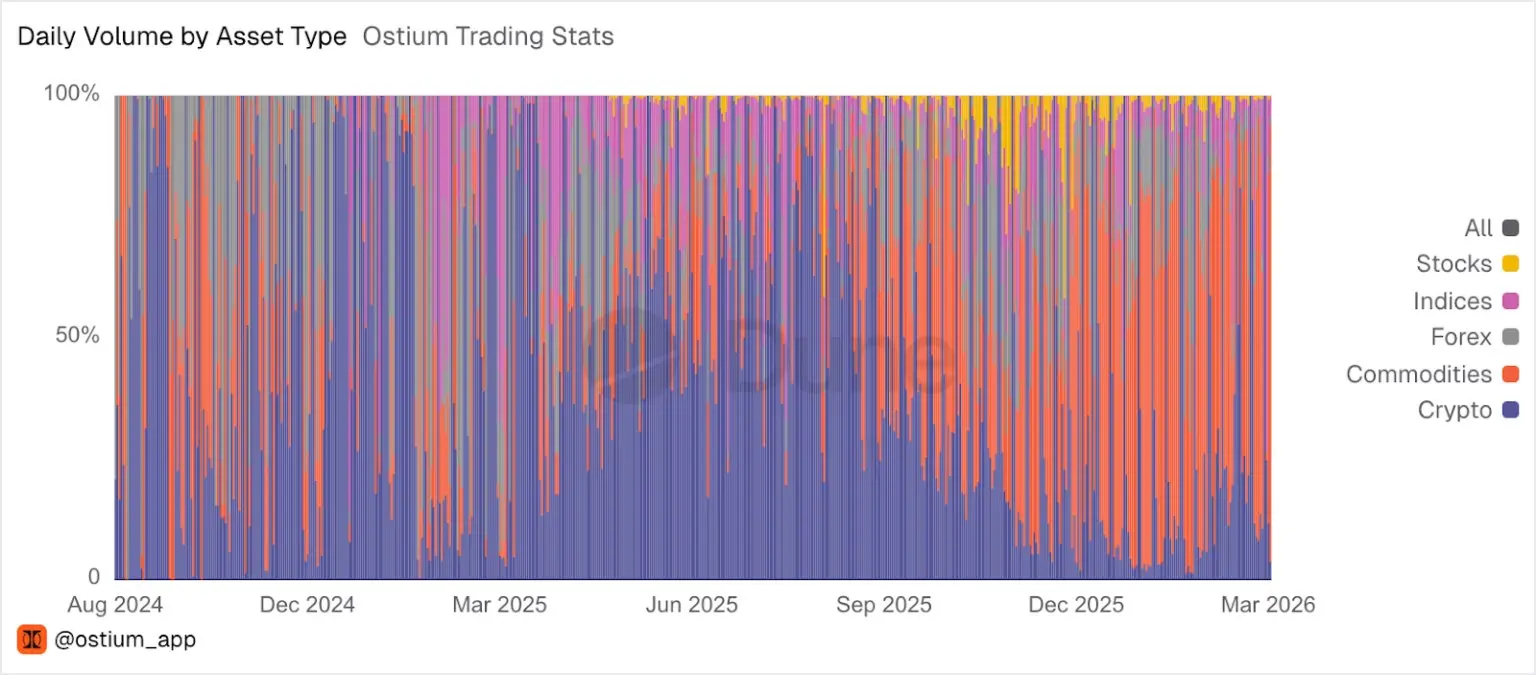
Decentralized exchanges have also excelled in facilitating price discovery for RWAs such as crude oil, especially during weekends when traditional exchanges are closed.
With the rise of RWA perpetual contracts, we see more and more companies beginning to develop products and businesses related to perpetual contracts. In just the past six months, new exchanges, trading interfaces, market deployers, and liquidity providers have emerged.
Players entering this space include brand new startups, startups transitioning to perpetual contracts, and some of the largest global fintech companies that are integrating perpetual trading into their existing products.
All these various players converge around the same opportunity: perpetual contracts are poised to become one of the dominant trading tools in global finance.
Market Opportunities for Perpetual Contracts
Stepping back and examining traditional finance (TradFi), options are one of the largest and most liquid markets globally. They exist within currencies, stocks, indices, commodities, and ETFs, and are extremely powerful and expressive tools that enable trading based on many different anticipations: timing, volatility, price ranges, and so forth.
However, when zooming in on retail trading behaviors, a significant amount of activity concentrates on a specific category of options: short-term, leveraged, directional risk exposure. A notable example is 0DTE (zero days to expiration) options—traders target high elasticity returns of intraday market movements at a low cost.
This type of trading is one of the fastest-growing categories of options. In 2025, average daily trading volume of 0DTE SPX (S&P 500 Index) options reached 2.3 million contracts, a year-on-year increase of 51%, accounting for 59% of the total trading volume for SPX options. In response to this demand, several new daily settlement index products have been launched, including CBTX and MBTX Bitcoin ETF index options, as well as options for the equal-weight Cboe Magnificent 10 index.
Thus, while options serve many complex purposes—structured hedging, volatility trading, discrete trading, convexity (the property where returns and risks are asymmetric, meaning your maximum loss is fixed, but potential gains are theoretically unlimited)—the immense and growing retail capital flow is actually only seeking short-term, leveraged directional exposure. This exposure is precisely what perpetual contracts are best suited to fulfill.
There is a trade-off: options excel at deterministic risks and convex payoffs, and remain the default tool for expressing volatility. The most a trader can lose is the premium they paid. However, with perpetual contracts, an entire collateral position can be liquidated. But for the directional leverage that most retail traders truly desire, perpetual contracts offer several structural advantages:
- Always online. The latest generation of perpetual markets trades 24/7 with no trading hours or interruptions. For a global, crypto-native user base, continuous access is an expected norm.
- No strike prices, no expiration dates, no rollovers. With a single continuous position, traders do not need to select parameters daily or weekly, manage expiration dates, or re-establish positions. They can hold for seconds, months, or theoretically even indefinitely.
- Simpler risk exposure. For perpetual contracts, the primary considerations are price, collateral, and liquidation thresholds. In contrast, for options, even if your directional judgment is correct, you may still incur losses due to time decay, changes in implied volatility, and path dependence. Perpetual contracts eliminate these complexities. Trading is a pure expression of directional beliefs.
- Capital efficiency for sustained exposure. Short-term options require upfront payment of entire premiums and frequent rollovers. Perpetual contracts require margin—typically just a small fraction of the nominal value—making them often more capital efficient for directional positions lasting from intraday to several days.
Options are not going away. They have long been a part of financial history and may maintain dominance in a significant portion of trading use cases, especially when involving deterministic risks and more complex payoff structures. But for the massive and growing flows of capital seeking Delta-1 directional leverage, perpetual contracts have captured trillions of dollars in trading volume and billions of dollars in revenue.
This raises the question: as perpetual contracts move from niche tools to mainstream trading primitives, where will value accrue within the technology stack?
In traditional markets, the most valuable companies often build on trading infrastructure rather than the exchanges themselves. For example, the market capitalization of retail brokerage Robinhood surpasses that of the underlying Nasdaq exchange.
Whether this model holds true in crypto—whether platforms like Hyperliquid, Lighter, or Ostium can accumulate sufficient network effects at the exchange layer—is one of the most interesting open questions in the field.
Regardless, builder activity is rapidly expanding. We see growth among developers in the following areas:
- Customized distribution layers: Frontends tailored to verticals or specific audiences that not only present markets but also package narratives, strategies, gamification, or social touchpoints.
- Market makers and operators (e.g., HIP-3 deployers): Operating a popular market on Hyperliquid allows deployers to essentially own a "mini-exchange" without building the most complex exchange infrastructure. Today's deployers may just be scratching the surface of what data or price factors could be "perpetualized" in the future.
- Specialized liquidity provision: Market makers focusing on long-tail markets, event-driven order books, and cross-site inventory management.
- Perpetual-specific data infrastructure: An ecosystem comprising community-driven dashboards, block explorers, heat maps, and analytical tools has emerged around positions, funding rates, liquidations, trader signals, leverage exposures, and retention groups. More mature, high-quality, real-time data will make the entire ecosystem more transparent and efficient for all participants.
Of course, significant open questions and challenges remain, covering distribution, liquidity depth of new trading platforms, oracle reliability as asset ranges expand, inevitable extreme events ("10/10" events), and regulation (currently restricting U.S. investors' access to these products). As perpetual contracts graduation from the crypto-native bubble and rise to the global financial stage, these are expected growing pains. With the maturation of the perpetual contract ecosystem, the issue is no longer whether perpetual contracts can scale, but who will build the most valuable applications and infrastructures around them when they do scale.
免责声明:本文章仅代表作者个人观点,不代表本平台的立场和观点。本文章仅供信息分享,不构成对任何人的任何投资建议。用户与作者之间的任何争议,与本平台无关。如网页中刊载的文章或图片涉及侵权,请提供相关的权利证明和身份证明发送邮件到support@aicoin.com,本平台相关工作人员将会进行核查。


