Author: momo, chaincatcher
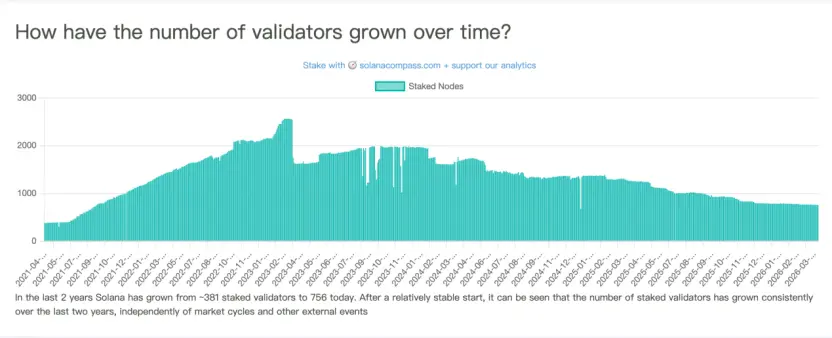
The number of Solana nodes has decreased by 70% from its historical peak. At the beginning of April, according to data from Solana Compass, the number of validators dropped sharply from 2,560 in March 2023 to about 756; during the same period, the Nakamoto coefficient fell from 31 to 20, a 35% decline, indicating a weakening level of decentralization.
This change comes at a moment when Solana is attempting to tell a grander narrative—becoming the "Nasdaq on-chain," supporting the global capital market. The sharp reduction in nodes and the inflation of ambitions create an unavoidable tension.
In the past, Solana has not been without responses to issues regarding nodes and centralization, but the effects have been unsatisfactory. Recently, according to SolanaFloor, the Solana Foundation will implement a new validator policy, which will officially take effect on May 1. What is the focus of this new policy? Will it be able to change the status quo?
1. Why has the number of nodes decreased significantly?
From the trend of changes in Solana's node count, the sharp decline in the number of validators is not a sudden drop. Since the beginning of 2024, the number of nodes has been continuously declining, gradually falling below 1,000.
The significant drop in the number of nodes caused panic in the community at the beginning of this year, to which Solana founder Toly responded that the main reason is the end of subsidies.
For a long time, Solana has been criticized for insufficient nodes and excessive centralization. To rapidly expand the validator scale, Solana launched the Foundation Delegation Plan (SFDP) in its early stages to provide blood supply to small and medium-sized nodes through three methods: staking matching, remaining delegation, and voting cost assistance.
In simple terms, the foundation matches external stakes at a 1:1 ratio, with a maximum match of 100,000 SOL; the remaining SOL after matching is distributed evenly among all qualified validators; and daily voting transaction fees are also subsidized. This mechanism was indeed effective in the short term. A report released by Helius in August 2024 showed that during peak periods, over 70% of validators relied on this system to varying degrees.
However, problems soon emerged. While these subsidy-dependent nodes constituted the majority in number, they controlled only about 19% of the total staking across the network; in contrast, the approximately 420 nodes not reliant on subsidies held over 80% of the staking share, with the stake of the top 20 nodes accounting for over a third.
It is clear that a large number of nodes does not imply "decentralization." Subsidies attract a large number of low-stake, low-performance "nominal nodes," which, despite being dispersed, lack the capability to compete in genuine staking; institutions and large holders controlling significant amounts of SOL are more inclined to direct resources towards large nodes with reliable technology and stable operations.
This also explains why, during the previous period of artificially high node growth, the Nakamoto coefficient did not see a corresponding rise.
For Solana, rather than maintaining a large number of underperforming, minimally contributing "nominal nodes," it is better to establish a smaller, more specialized group of validators to secure the long-term stability and security of the network. Thus, Solana began to actively reduce subsidies.
Starting in 2025, the foundation gradually adjusted its delegation strategy to phase out nodes that relied heavily on subsidies, with the core mechanism summarized as "one in, three out": for every new subsidized node, three existing nodes are to be eliminated based on two criteria—having received foundation delegation for at least 18 months and having external stakes below 1,000 SOL. According to estimates at the time, about 51% of nodes met the elimination criteria, potentially totaling around 686.
After the subsidies are removed, survival becomes even more challenging for small and medium nodes. Analyses indicate that nodes need to self-provide about 3,500 SOL for staking and approximately $45,000 per year (with voting fees accounting for a substantial portion, about 400 SOL) to survive.
At the same time, competition within the network is intensifying, with leading validators vying for delegations at almost zero fees, further compressing the profit margins for small and medium nodes.
Furthermore, upgrades such as Alpenglow have heightened hardware performance requirements, leading to the gradual phasing out of some older equipment, thus raising the entry barriers for validators.
Nevertheless, the cleanup of small and medium nodes and the significant decline in node numbers still leave the community concerned about excessive centralization of power. A Twitter user commented: "Users choose to use PoS chains for security, yet the chain becomes centralized in pursuit of security. What exactly are we supporting?"
2. What does the new Solana validator policy aim to achieve?
In the current situation, let us take a look at Solana's latest validator delegation plan.
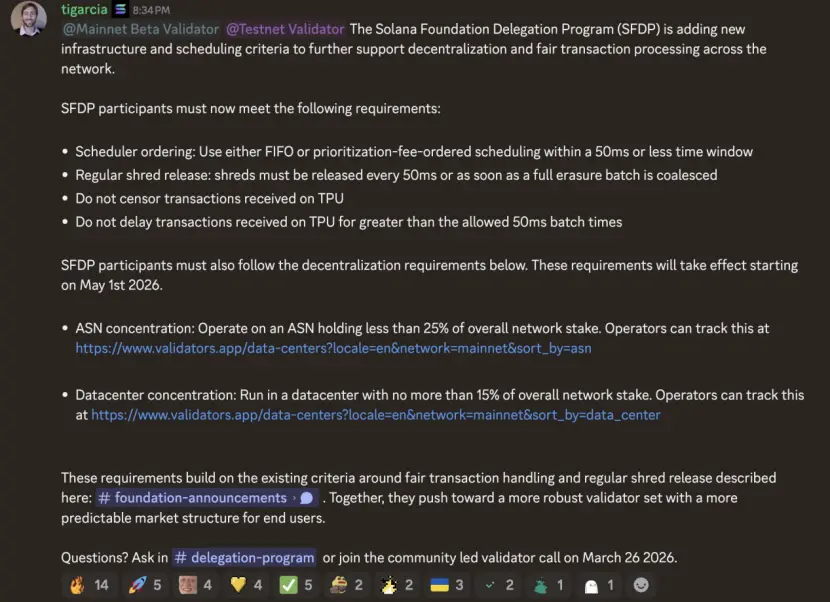
The core change focuses on strong constraints on the infrastructure layer.
The proportion of staking carried by any single ASN (cloud provider or network service provider) must not exceed 25%, and the proportion of a single data center must not exceed 15%.
In other words, even if you operate a compliant, stable node, as long as "too many people stay in the same place," you may lose the foundation’s delegated support.
The logic behind this is not complex. Currently, Solana's validators appear to be distributed in number, but are physically concentrated within a few cloud providers and data centers. A Helius report previously mentioned that two custodial services controlled over 40% of the staking across the entire network, most of which was concentrated in Europe. Sources have revealed that the Solana Foundation is also intentionally supporting nodes in Asia.
Thus, these new regulations seem more like a form of "enforced separation," with the goal not to increase the number of nodes, but to require nodes to migrate from overly concentrated infrastructure, redistributing the risks that were previously stacked behind a few nodes.
At the same time, the rules have further tightened validators' freedom at the execution layer, including requirements to complete transaction ordering within 50 milliseconds, handle transaction prioritization according to established rules, mandatorily release data shards in rhythm, and prohibit reviewing or delaying transactions received by TPU. This series of constraints directly addresses the long-standing MEV competition and execution transparency issues, essentially compressing the “operational space” for validators, exchanging more standardized rules for network consistency.
From a directional perspective, this upgrade is an evolution of last year’s "one in three out," aiming to filter out more qualified nodes through rules.
However, controversy has arisen. Node operator Chainflow has voiced concerns in public discussions.
On one hand, under the current rules, whether a node can continue to receive delegation does not entirely depend on the quality of its operation, but rather on its "location." If a cloud provider or data center has hit its upper limit, then regardless of how well the node itself performs, as long as it remains deployed there, it may be excluded from the subsidy system. This means that some small validators that run stably over the long term might lose their survival space simply because they "stayed in an overcrowded environment."
On the other hand, the more practical problem lies in the migration itself. Quality infrastructure resources are already concentrated among a few large service providers, and if small and medium nodes are forced to migrate, the options available are often data centers with lower performance and stability. In this situation, node performance may decline, block production rates may drop, which in turn affects profits, potentially accelerating their elimination from the market.
In conclusion, Chainflow believes that for small and medium validators, the largest uncertainty brought by the new regulations lies not in the technical threshold but in a mechanism of elimination that is "unrelated to their own capabilities." Therefore, Chainflow suggests that instead of setting a rigid upper limit for “network share,” it would be better to refine the restrictions to the subsidy allocation ratios within individual data centers, achieving more detailed decentralization while retaining quality infrastructure.
The new policy will be implemented in less than a month, likely further pressuring some small and medium validators, resulting in a decrease in the number of nodes. However, the ultimate effect depends on the data from the Ghost platform and the Foundation's execution details after May 1.
3. The Battle for "Nasdaq on-chain"
Currently, public chains have entered the competition for serving the global capital market, the "Nasdaq on-chain" battle.
For traditional financial capital, while "speed" and "cost" are certainly important, the prerequisites are "security" and "compliance." This means that the long-standing issues of node centralization that Solana has faced will be significantly magnified when addressing institutional narratives.
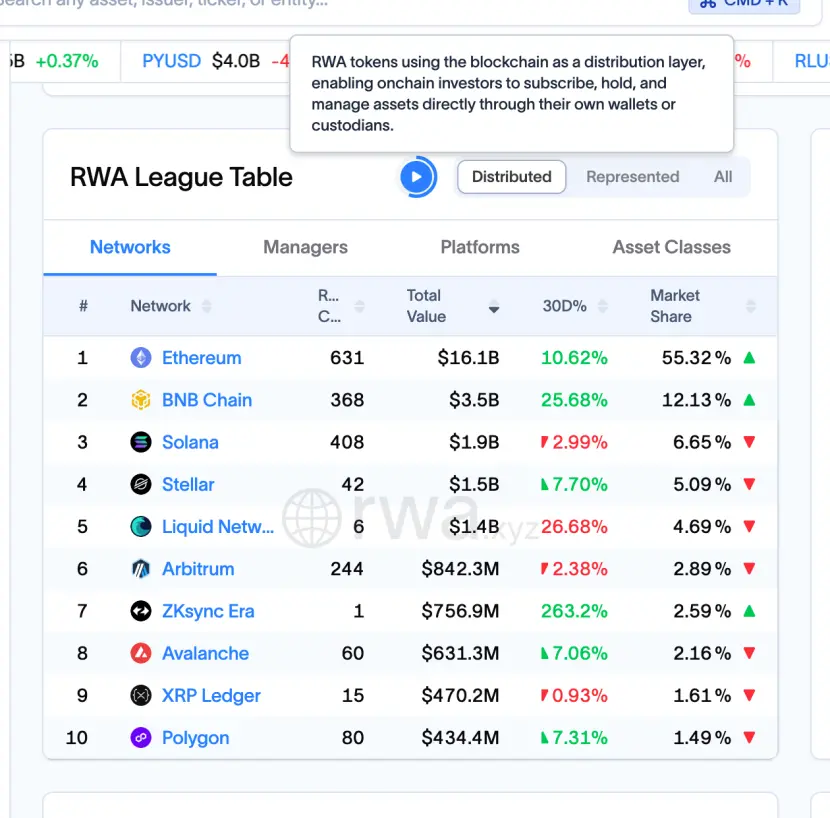
According to data from RWA.xyz, Ethereum still dominates in terms of the value of RWA assets, with over $16 billion in on-chain deployed assets, holding more than 55% market share; BNB Chain ranks second with $3.5 billion and a 12.13% share; Solana ranks third with about $1.9 billion and a 6.65% share. Most large tokenized government bonds and private credit platforms on the institutional side are still deployed within the Ethereum ecosystem.
In terms of RWA assets, Solana currently has surpassed Ethereum in both the number of wallets and active address count. The growth of on-chain RWA users is primarily attributed to the launch of tokenized xStock stocks in mid-2025. Solana has opened a door on the retail user side with speed and low cost.
In this competitive landscape, both Ethereum and Solana are undergoing key upgrades in 2026 to address their respective shortcomings. Ethereum's main focus is to improve mainnet performance through two major upgrades, Glamsterdam and Hegotá, aimed at making the mainnet run faster and more efficiently—through parallel execution, increasing Gas limits, optimizing transaction ordering, and lowering node thresholds to allow more participants in validation.
On Solana's side, the focus is on improving stability and risk resistance. In addition to the aforementioned new node policy, Solana is upgrading its consensus mechanism to reduce final confirmation times from seconds to milliseconds, while introducing a second independent client to avoid the risk of "one software failure causing the entire network to fail."
These two paths are converging in the same direction. At this stage, when true institutional capital and RWA assets begin to scale on-chain, the market's preference will still be for more mature, stable, and predictable infrastructure. For Solana, the key lies in whether it can address structural issues such as centralization, transforming "fast" into "trustworthy fast."
免责声明:本文章仅代表作者个人观点,不代表本平台的立场和观点。本文章仅供信息分享,不构成对任何人的任何投资建议。用户与作者之间的任何争议,与本平台无关。如网页中刊载的文章或图片涉及侵权,请提供相关的权利证明和身份证明发送邮件到support@aicoin.com,本平台相关工作人员将会进行核查。


