Author: Deep Tide TechFlow
The largest lending protocol in DeFi is undergoing a silent exodus of its security team.
Yesterday, a company called Chaos Labs sent a farewell letter, announcing the termination of its partnership with Aave. Most users may not have heard this name, but for the past three years, the collateral rate, liquidation line, and risk parameters for every loan you made on Aave were set by this company.
They also built an automated system called Risk Oracle, which can adjust parameters in real-time according to the market. Aave relied on this system to expand from dozens of markets to over 250 markets across 19 chains. They managed pools of hundreds of billions of dollars for three years with zero bad debts.
Simply put, what runs on Aave are smart contracts, but the numbers filled in those contracts have always been overseen by Chaos Labs.
CEO Omer Goldberg's farewell letter was very dignified, detailing the achievements. TVL increased from $5.2 billion to over $26 billion, cumulative deposits exceeded $2.5 trillion, liquidations surpassed $2 billion...
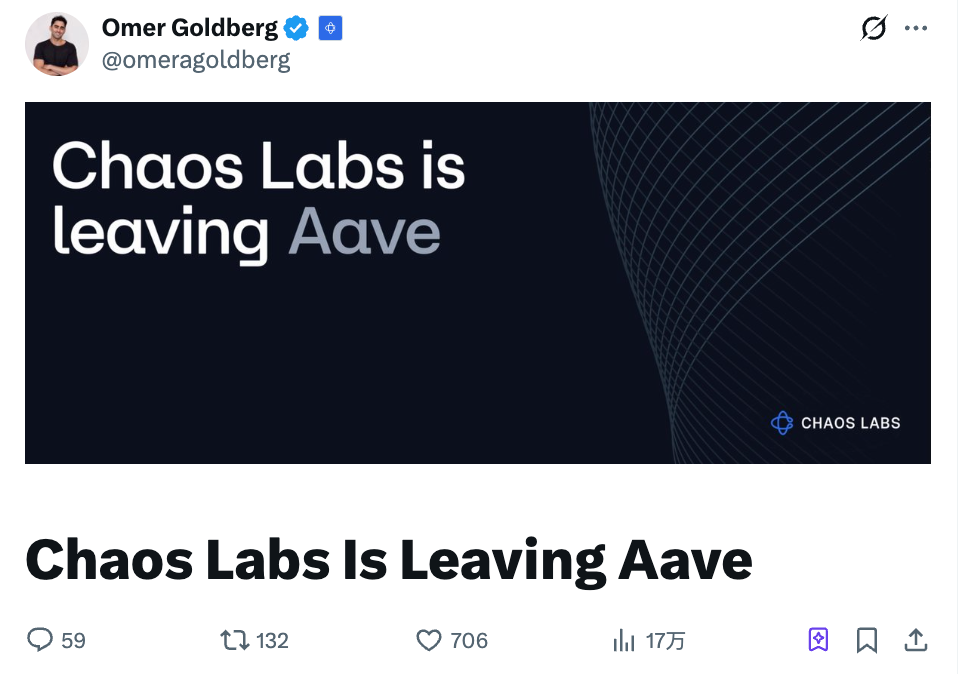
Then he said, we proactively proposed to terminate the contract. No one fired them, and the contract hadn’t expired. At the same time, Aave founder Stani Kulechov responded calmly, stating that the protocol was functioning normally and that another risk service provider, LlamaRisk, would take over.
It sounds like nothing happened.
But a risk control team that had been reliable for three years voluntarily leaving the largest lending protocol in DeFi is something that would be called an ominous omen in traditional finance.
Goldberg stated in the announcement that the disagreement was not about money, but that both parties’ fundamental philosophies on risk management no longer aligned.
Money is less, people feel wronged
Aave Labs proposed to retain personnel by increasing Chaos Labs' annual budget from $3 million to $5 million. Chaos Labs still left.
Goldberg provided three reasons for having to leave in the statement, but upon reading, you will find they all point to the same conclusion.
The first is money. Aave's revenue for the whole of 2025 is expected to be $142 million, with a budget for risk control set at $3 million, making up 2%. Traditional banks usually allocate 6% to 10% for compliance and risk control.
Goldberg mentioned that they had been losing money on this for the past three years, and even if the budget increased to $5 million, it would still result in negative profit. He believes the reasonable bottom line is $8 million. Aave has $140 million lying in its treasury, and Aave Labs just approved a $50 million funding proposal for itself, so it seems that the protocol isn’t out of money; it just doesn’t want to allocate so much to the security team.
The second is survival. Aave is upgrading from V3 to V4, with the underlying architecture, contracts, and liquidation logic all being rewritten. Goldberg stated that the only similarity between V4 and V3 is the name. During the upgrade, both systems need to operate simultaneously, meaning the workload for risk control doesn't just halve; it doubles.
The third is responsibility. Currently, there is no legal definition of the liabilities borne by DeFi risk control personnel, no regulatory framework, and no safe harbor provisions. When things are smooth, you are invisible, but when something goes wrong, you are the first to be blamed. Goldberg remarked that if the upside potential is marginal and the downside has no bottom, then continuing to operate is in itself a poor risk control decision.
The author finds this argument hard to refute. A protocol generating $142 million annually allocates 2% of its budget to a team safeguarding hundreds of billions in assets and then tells them they need to double their workload, with no legal protection should anything go wrong.
If it were you, what would you do?
Of course, the other side has a different narrative. Aave Labs founder Kulechov hinted in a response on X that Chaos Labs had recently been scaling back its risk consulting business and had started to reduce cooperation with other protocols.
Implying that the reasons in the farewell letter are more like a dignified narrative for their departure.
Whether it is a conflict of philosophies or an exit strategy, outsiders cannot judge. But one thing is certain: not only Chaos Labs has left.
Bear market coincides with overnight rain
Aave is still called Aave, but the group that built it has consecutively left over the past two months.
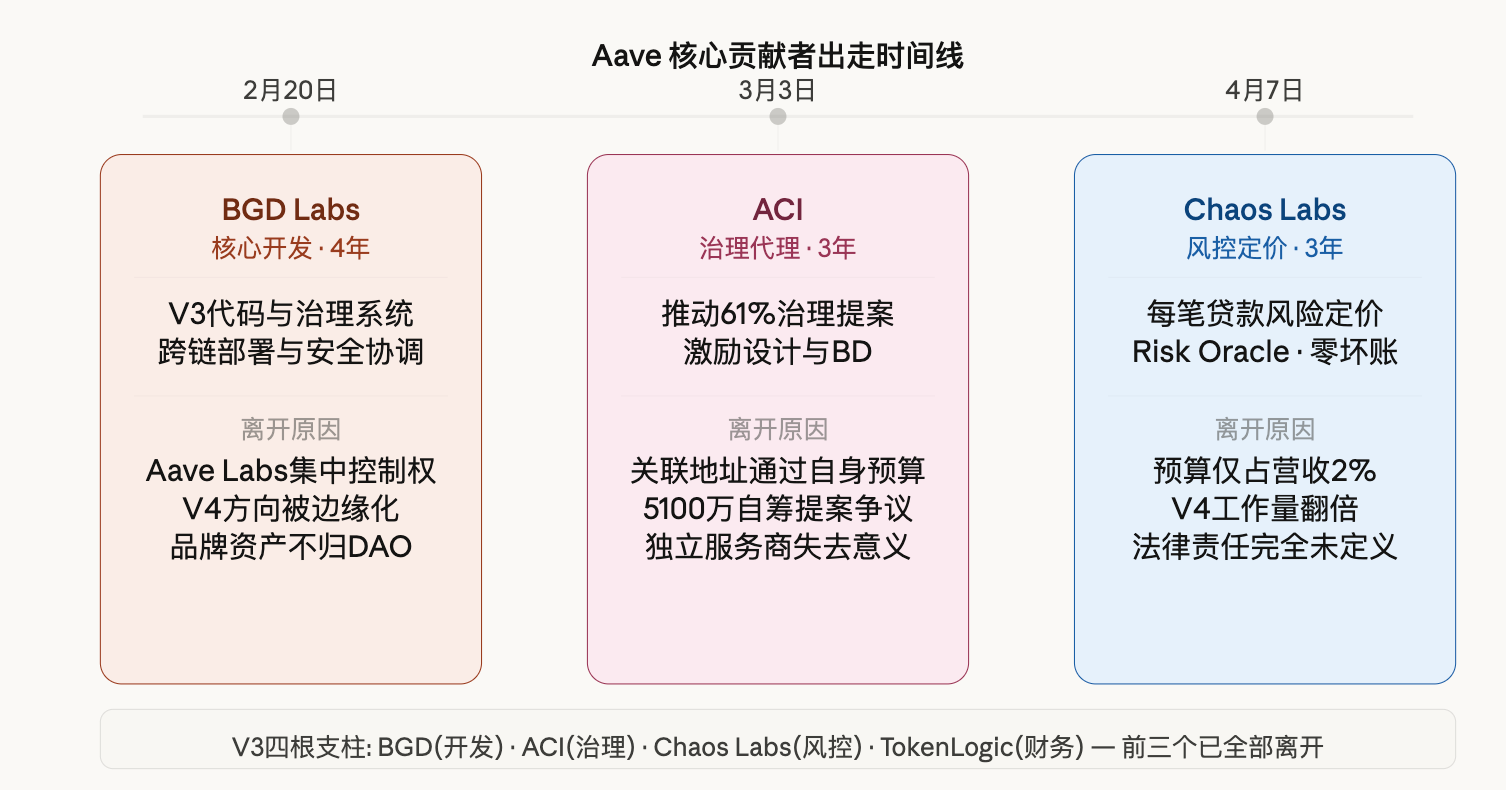
In February this year, the core development team of Aave V3, BGD Labs, announced that they would not renew their contract. This company was founded by Aave's former CTO Ernesto Boado, and essentially wrote the code, governance system, and cross-chain deployment for V3. After working for four years, they left when the contract expired.
BGD's reasons were straightforward. Aave Labs has been consolidating power, and the development, brand assets, and social media accounts for V4 are all controlled by Aave Labs. BGD feels they have no right to participate in design but must take responsibility for the results. This is called being marginalized in traditional companies.
A month later, the most active service provider in Aave's governance system, ACI, also announced their departure. This eight-member team pushed through 61% of Aave's governance proposals over three years. The founder, Marc Zeller, stated frankly in the farewell letter that Aave Labs can use its own voting rights to pass its own budget, making independent service providers meaningless in this system.
Two farewell letters in two months, one citing marginalization and the other saying the rules are unfair.
Then, in March this year, another event occurred.
The risk control system set up by Chaos Labs had a configuration error that led to the erroneous liquidation of approximately $27 million in positions, affecting at least 34 users. Chaos Labs stated that no bad debts were generated and affected users would receive compensation.
This event ultimately did not assign legal responsibility to anyone because there is no legal definition in DeFi that determines who should bear it.
However, managing hundreds of billions means that a single parameter error can cause fluctuations of tens of millions in funds, and your legal protection is virtually zero. This is the issue the risk control team repeatedly emphasized in their farewell letter.
As of now, the Aave of the V3 era operated based on four pillars: development, governance, risk control, and financial growth. Now, the first three have left.
The farewell letter from the risk control team includes a metaphor called the Ship of Theseus. If every plank of a ship is replaced, is it still the same ship?
The name Aave still exists, contracts are still executing, and TVL is still increasing. But the team writing the code has left, the team managing the governance has left, and the team managing risk control has left. Users continue to deposit and borrow money, possibly unaware that everything beneath the surface has been completely replaced.
What truly makes people uncomfortable is not who has left, but that nothing happened after they left.
Users open the page, deposit money, borrow money, interest rates are normal, liquidations are normal, everything appears as usual. If no one specifically reads the governance forum, most users would not know what has happened in the past two months.
In the short term, it might indeed be fine. Smart contracts will not cease to function simply because the risk control team has left; pre-set parameters will not change by themselves. Aave still has another risk service provider, LlamaRisk, so it's not completely exposed.
But risk control is not a one-time project. Setting parameters does not mean they will remain suitable indefinitely; markets change, assets change, and the methods of attack on the chain also evolve. The next time a similar issue arises, whether the new team can react as quickly is uncertain.
Moreover, this is not a calm period.
The price of AAVE has fallen from a peak of $356 last August to around $96 now, a drop of over 70%. The entire DeFi lending sector is shrinking, on-chain activity is declining, and protocol revenues are under pressure.
In a bull market, risk control is invisible; no one applauds because "nothing happened today." In a bear market, risk control is truly needed because asset prices fluctuate sharply, liquidation density rises, and the probability of black swans increases, precisely in the phase that tests the experience and responsiveness of the risk control team the most.
Ironically, during this phase, the most experienced group of people has left.
The risk control team stated in their farewell letter something that I believe is very accurate. Aave can outperform those more aggressive competitors not because of its numerous features, but because while others blew up, it did not. In this market, surviving is the product.
Now the question is, the group that kept it alive may no longer be there.
免责声明:本文章仅代表作者个人观点,不代表本平台的立场和观点。本文章仅供信息分享,不构成对任何人的任何投资建议。用户与作者之间的任何争议,与本平台无关。如网页中刊载的文章或图片涉及侵权,请提供相关的权利证明和身份证明发送邮件到support@aicoin.com,本平台相关工作人员将会进行核查。


