Author: Deep Tide TechFlow
“In 2026, Huobi HTX will definitely work hard; I have prepared major moves.”
At the Huobi HTX annual meeting before the New Year, Sun Yuchen, as the leader of Huobi HTX, shared his strategic outlook for 2026, while Molly, the head of the Huobi HTX marketing center beside him, is responsible for better executing and conveying these “major moves.”
With curiosity about the "major moves," as the Huobi HTX marketing center moves into its third year, we had an in-depth dialogue with Molly to explore the strategic thinking and action paths of this long-established exchange under a new cycle.
“2026 will definitely be a year of leapfrog breakthroughs for Huobi HTX in both brand and product dimensions.”
This was Molly's most determined statement during the conversation. In fact, this rationale and composure ran throughout the interview, making it particularly precious in the crypto marketing circle, which is filled with traffic anxiety.
With the marketing of exchanges characterized by competition, facing “traffic anxiety,” Molly stated:
Blindly chasing traffic can easily backfire; we need to maintain deep thinking amid the noise.
In actual actions, Molly also expressed her willingness to spend time on tasks that seem less related to traffic: refining product experience, practicing “user first,” solving user problems one by one, and insisting on not making excuses in every public sentiment situation. As for branding and marketing, Molly believes:
During the early stage from 0 to 1 at Huobi HTX marketing center, I indeed experienced confusion and chaos. But as I handled more issues, I realized that honesty, openness, and transparency are the best public relations. This confidence stems from my belief that whether it is Brother Sun or Huobi HTX, they can always adhere to principles and maintain their original intentions, which also gives me time to think about more substantial matters that can truly promote industry development.
Regarding 2026, Molly still left some mystery:
It's not convenient to disclose “major moves” right now, but whether it’s on the brand side or the product side, we will usher in a new phase of breakthroughs.
In this issue, let us follow Molly's narration, stepping into her unique Chinese management philosophy and brand methodology, further unveiling Huobi HTX's global ambitions in 2026.
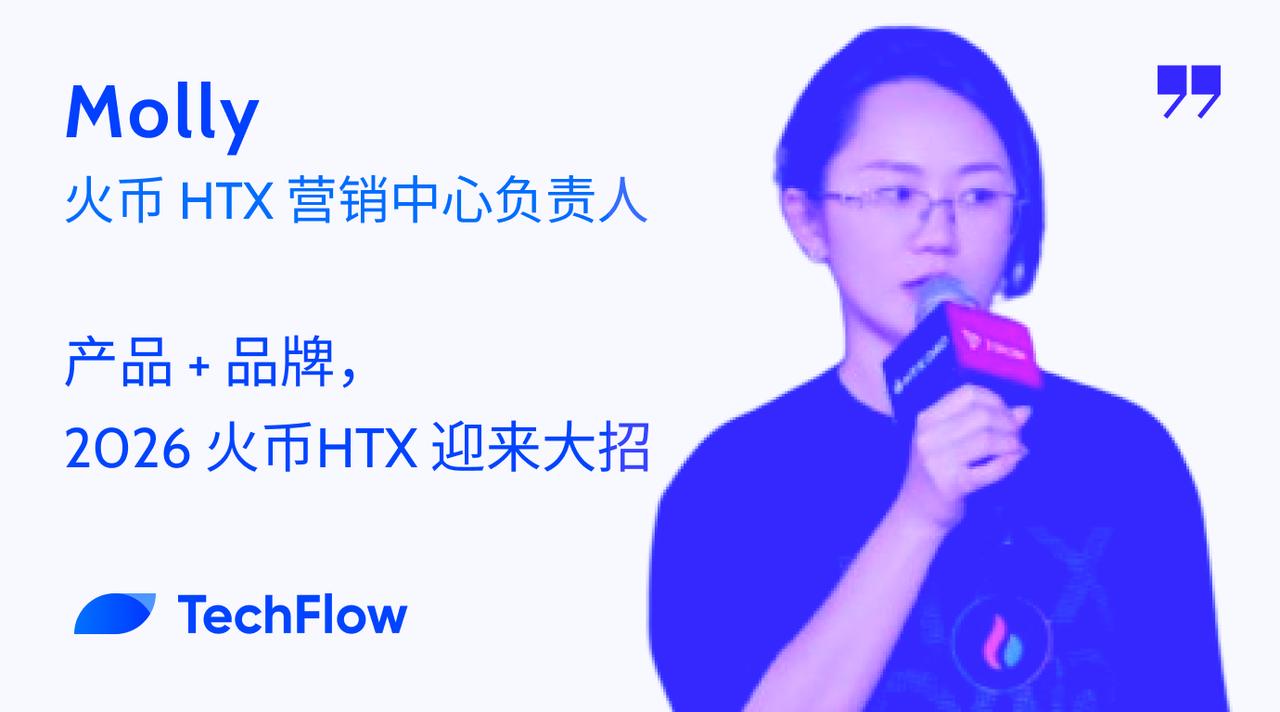
From "Darkest Hour" to "Light at the End of the Tunnel": Huobi HTX Gave Me Confidence
Deep Tide TechFlow: Welcome old friend Molly, what have you been busy with lately?
Molly:
Recently, I have been summarizing the annual brand planning for Huobi HTX with my colleagues in the marketing department, so I am mainly busy with two things:
On one hand, it’s breaking down the annual brand goals. Recently, I have been leading my team in various brainstorming meetings, continuously refining and colliding our brand positioning and objectives for this year. For instance, if we want users to feel that Huobi HTX is “warm,” how do we define “warmth”? How can we specifically make users perceive it? These all require us to detail specific execution strategies.
On the other hand, I am busy with sorting out and building the team's talent capability model. I need to reorganize the team structure, assess everyone's abilities, and determine if the existing team has the capability to achieve this year's goals. If not, should I cultivate internally or hire new talents externally? This is also something I’m currently contemplating.
Overall, we have quite a lot to roll out this year.
Deep Tide TechFlow: February 2026 marks the second anniversary of the formal establishment of the Huobi HTX marketing center. Over these two years, you have led your team through many tough battles and achieved a series of accomplishments. Could you please share: What “darkest hours” have you experienced in the past two years? What is the most share-worthy achievement?
Molly:
Regarding the “darkest moments,” I think it mainly originated from the self-challenge I faced when I first took over.
Two years ago, I was on a business trip in Egypt, and due to the six-hour time difference, I had to get up around 3 a.m. to attend a 10 a.m. meeting back home. In that hazy early morning, the meeting suddenly announced the establishment of the marketing center, with me as the head.
At that time, this was a huge challenge for me. On one hand, while simultaneously serving as the HTX DAO ambassador, the official spokesperson for Huobi HTX, and the head of the marketing center, I had to lead the team, work on projects, deal with a lot of execution, and consider how to balance and allocate the tasks of the three roles.
On the other hand, in the early stages of the Huobi HTX marketing center, I was facing a situation of “internal and external troubles”: as the official spokesperson, I was the one facing users and negative public sentiment, while the new team had to go through the process from 0 to 1. Many processes and mechanisms were not yet perfect, and no one could give me very clear guidance, making the psychological pressure I experienced during that time massive; for six months, I worked over 14 hours every day.
But I have always believed in a saying: everything is difficult at the beginning, but once the rules and habits are established, everything will become increasingly smooth. Just like learning to ride a bicycle, at first, it's always chaotic, but once you master the balance, you can handle it effortlessly.
After about ten months of adjustment, by the end of 2024, I suddenly felt a sense of “light at the end of the tunnel”: the processes became smoother, the talent was cultivated, and the team could take on more responsibilities... by then, I had endured what could be called the darkest moment.
Regarding the “most share-worthy achievement,” I think it is “this moment.”
Two years ago, we were confused and flustered. But now, not only has our team grown in size and dared to pursue higher goals, but we are also more capable of taking a broader view of the industry to do more international and global branding tasks, such as recently reaching cooperation intentions with universities like Tsinghua and Peking University, not only focusing on exchange business but also further discussing issues like the integration of AI technology and blockchain from a perspective that promotes the industry.
Now, I feel as though I hold many good cards in my hand, and I am considering how to play these cards to build a bigger blueprint, which is a very fulfilling thing for me.
Moreover, our team size continues to expand; from the initial confusion to now being familiar with everyone's strengths and how tasks should be allocated, witnessing team members gradually becoming capable of handling things independently, this sense of control and confidence about the future is also one of my biggest achievements.
Deep Tide TechFlow: After two years of frontline experience, what new insights have you gained about "exchange marketing"?
Molly:
I would like to share more about my mindset transformation.
When I first became the head of marketing and spokesperson, my first reaction when encountering negative public sentiment was often nervousness, instinctively wanting to calm the situation quickly.
But now, I am calmer because my approach has shifted from “seeking techniques” back to “the essence of things”: clarifying the cause and effect of events, and then communicating honestly in language that users can understand. As I have dealt with more issues, I found that honesty, openness, and transparency are the best public relations. Those operations intended to cover up often suffer more backlash, while openly discussing matters, users are more likely to accept it.
This confidence also stems from the essence of Huobi HTX. Since joining Huobi HTX, whether it is Brother Sun or the team, they give me a very positive feeling about values. Reflecting on the past two years, all the public sentiments, FUD, or events I handled have never once resulted in a slap in the face; on the contrary, the more matters I dealt with, the more confident I became.
So now, when encountering any issues, I know the problems are not likely to be severe because I can sense Huobi HTX's commitment to upholding principles and staying true to its initial intentions.
My core insight into exchange marketing is: as long as we stick to our principles, and our starting point and core values are correct, the overall direction won't veer off. We have the confidence to return to fundamentals and push forward, rather than relying on tactics to maneuver.
Facing Traffic: Let Go of Anxiety, Insist on Delivering Positive Values
Deep Tide TechFlow: Exchange marketing has always been competitive and seems increasingly "traffic-centric." As the head of the Huobi HTX marketing center, do you experience "traffic anxiety" amidst the diverse exchanges marketing?
Molly:
To be honest, I had traffic anxiety at one point, but now I no longer do.
For example, a few days ago, Brother Sun posted something about Huizhou, and a colleague asked me if I wanted to seize that hot topic; my response at the time was: the traffic I gained from trending topics doesn't belong to me. Although in the end, I did take the suggestion and shared based on my own experience, this small incident reflects my current mindset toward traffic.
I admit, when I first took over the marketing center, I was indeed very anxious. Back then, I hoped every event, every promotion could be seen by more people, and I wanted my influence to grow. To pursue traffic, we considered many methods, such as massive spending, collaborating with top KOLs, or even resorting to some strange tricks to generate traffic.
But why don’t I have such anxiety now? There are primarily three points to consider:
First, traffic is a double-edged sword, and blindly chasing it can backfire. Over these two years, we’ve seen many competitors or individuals do things extremely misguided to grab attention, resulting in negative outcomes, becoming slaves to traffic. If we don’t view traffic rationally, the harm it brings often outweighs any positive value.
Second, traffic cannot always stay at a peak; the key is "worth it." We cannot maintain an excited state forever, nor can we expect every event or every tweet to be a hit; this does not align with objective reality. Moreover, if the experience of an event itself is poor, pushing it hard can lead to even greater public sentiment disasters.
So now, I consider whether this event is worth full exposure. If it is worth it, I will concentrate all resources to promote it; if not, I will proceed with normal publicity. For exchanges, what’s more important is to ensure that each time we appear in the public eye, the information conveyed is positive and valuable; I think that’s enough.
Third, sometimes "slow is fast," and we need to maintain deep thinking amid the noise. If we are caught up in traffic anxiety every day, people can become very restless, losing the ability to think deeply. When I no longer overly focus on traffic, I can instead settle down to be an observer, analyzing those who once had massive traffic, stretching the timeline to see their outcomes, you will find that much of the past excitement is fleeting.
Therefore, I often tell the team not to be anxious; we need to invest time to refine good products and content. When we truly create something worthwhile, then we can concentrate our energy to promote it; that is a more sustainable and effective strategy.
Deep Tide TechFlow: Many projects have turned "female leaders" into a traffic secret, inadvertently deepening the public's stereotypical impression of “Web3 female executives.” How do you understand the role of "head of the Huobi HTX marketing center"? As a Web3 female executive, what kind of spirit do you hope to demonstrate to the industry?
Molly:
Actually, I have thought very seriously about this issue, including when I operate my own social media matrix; I have also set a core principle with my team: I hope that through myself, everyone can have a positive impression of Web3 and the cryptocurrency industry.
I believe we cannot merely enjoy the halo and traffic that the Title brings but should also shoulder the responsibilities behind that identity, because when you stand in the spotlight representing a community or a company, people will define the entire platform, community, or industry through you, so we cannot do as we please; we should better set an example.
Specifically, I break down this responsibility into three levels:
The first is the responsibility to outsiders; I represent Web3 practitioners. I want to convey that we are a group of diligent workers striving hard, just like those in traditional industries, who uphold long-termism values.
The second is the responsibility to insiders; I represent the corporate culture of Huobi HTX. When facing clients, KOLs, and media, my every word and action will naturally be associated with the corporate culture of Huobi HTX. Hence, I must constantly self-regulate and enhance myself to maintain the company's brand image.
The third is the responsibility of the “female manager” label. The outside world is curious about female managers, such as how to balance family and work, the interplay between emotional and rational aspects, and gender equality issues. I believe we should cherish the benefits that the female label brings but absolutely must not abuse it. In work, I tend to avoid appearing biased towards female employees because the workplace is about reason and facts; one should not demand privileges simply because they are female. I hope to break the stereotypes surrounding women through objective and professional performance.
In summary, the role I play has layered several tags; the weight of each label varies with different people. But the core question is singular: What values do I ultimately want to convey to everyone? I hope these values are positive and have a certain guiding significance.
User First: No Excuses, Poor Experience is Wrong
Deep Tide TechFlow: Whether it's community responses or social media sharing, we often hear the phrase “user first” from you, and we frequently see you actively engaged in the community. However, this is a challenging matter because if “user first” isn't put into practice, it becomes a grand and empty slogan.
Therefore, I would like to ask you to share: Compared to “embracing traffic,” why do you emphasize “user first” more? From a practical work perspective, in balancing the trade-offs between “embracing traffic” and “user first,” what are the gains and losses? And how do you and your team specifically implement “user first”?
Molly:
Actually, “user first” may sound like a marketing strategy or a politically correct phrase, but if you understand it deeply, you will find it is a very good guideline for work.
I believe facts speak more persuasively than reasoning; the recent USDE investment event I handled is a great case in point.
During the holiday season, we launched a USDE investment activity with an annualized rate of 15%. I pushed this event on the 19th, and on the 20th, Brother Sun also shared it urging everyone to pay attention. However, the next day this investment product was suddenly taken off the shelves. This angered users, and I was also very angry and directly approached the business department.
After understanding the situation, the business department thought this issue was not serious because:
Firstly, this investment product was initially planned to go offline on the 17th, and the 19th was already a delay; secondly, this was stablecoin investment, and the so-called price differences existed on other platforms as well, and would not cause any loss to users—it would only mean they would earn less, or even users who invested earlier still profited; additionally, this product was not created by our platform, and the interest rate changes were decided by the project side—the budget would run out and then it would go offline, and moreover, the platform has hundreds of investment products every day, it's hard to notify each one precisely.
Even though these objective reasons were valid, I still seriously pointed out: We should consider it more from the user's perspective.
Firstly, were there enough reminders about the product's announcement? In an age of information explosion, users cannot remember the offline time of every announcement. When faced with a sudden removal without seeing reminders, very few users can accept it rationally; secondly, it was illogical for the product to not go offline on the 17th but suddenly offline on the 22nd.
Based on the above communication, we conducted an in-depth review and reflection with the business department: on one hand, we acknowledged the oversight and provided welfare subsidies to all users who complained about their experience; on the other hand, we optimized mechanisms, stating that in the future, notifications regarding major investment adjustments must be emailed and the relevant departments informed in advance, and we will further optimize product reminders.
I think this incident exemplifies the “user first” principle well:
Many times we are indeed in a situation where “we have many excuses available,” but we choose to consider users' situations and perspectives, covering comprehensively from both product and human perspectives.
When encountering issues, we shouldn’t think about finding excuses but should reflect and adjust based on the perspective of user first. If user experience is poor or they suffer losses, that’s simply wrong. My understanding of “user first” is that it should not just be applied to major events but should reflect in all matters, and when implemented properly, it won’t become a hollow phrase.
Deep Tide TechFlow: Through this series of efforts under you and your team, what kind of brand image of Huobi HTX do you hope to establish in the hearts of users?
Molly:
I actually have a simple wish, we hope users perceive us as “honest and reliable.”
Specifically, users should be able to resolve issues by reaching out to us, and they should not feel that we are lying or making excuses.
Achieving this isn’t easy, but we will always insist on it.
Chinese Management Philosophy: Allow Growth Space, Permit Mistakes to Occur
Deep Tide TechFlow: In two years, under your leadership, the Huobi HTX marketing center has expanded from 2 to dozens of people: During the stage from 0 to 1 at Huobi HTX marketing center, what were your criteria for selecting team members? Additionally, we saw you published recruitment tweets on social media; have the criteria for selection changed at this stage? Do the new positions indicate the next direction of action for the Huobi HTX marketing center?
Molly:
The selection criteria certainly vary at different stages.
Starting from 0, to be honest, anyone was welcome. At that time, I hadn’t figured out how the marketing center should operate, so the criteria were very simple—being adaptable and not too dull was sufficient.
But now it’s different; I decompose the positions, and currently, I have divided the entire marketing system into 6 business lines with different standards for different roles.
For instance, the marketing strategy role is the brain center of the marketing team. My requirement for this position is: they cannot stick to old habits. I do not need people who are overly obedient; I need them to have critical thinking and a challenging spirit. Everyone should have ideas, courage, and innovative awareness, while also possessing rational assessment and execution experience for bringing those ideas to life.
As for the social media matrix role, I first require a strong sense of dedication; updates must happen regularly, even during holidays. Secondly, since social media interacts most with users, users can directly feel the team culture and atmosphere through the content of posts, so the person in this role should not be rigid. They should enjoy chatting with users, be engaging, and have personality. Additionally, we conduct many social media activities, and prizes must be delivered promptly; therefore, execution ability must be strong.
Although different roles have differing standards, I have one unified requirement for all members: don’t think about being passive but genuinely want to accomplish tasks.
I am someone who rejects passive attitudes, and even though many tell me not to be too serious, I hope to achieve meaningful outcomes. Thus, I do not want anyone on my team to feel that “getting along with Molly means they can slack off like a privileged insider.”
I hope everyone has goals and ambition. You may have a modest goal, and I can assign you relatively simple work, but a mentality of merely going through the motions is not acceptable. Conversely, those who are ambitious, driven, and genuinely want to accomplish tasks, I will provide them with numerous opportunities.
Regarding the recent recruitment tweet, the previous wave of recruitment was more about filling gaps due to personnel changes. Now we have another wave of new hiring plans, as I am formulating a larger brand strategy, and we need to recruit a group of new talents focusing on brand upgrades and globalization. This also means we will place greater emphasis this year on brand communication.
Deep Tide TechFlow: How do you perceive your management style? Do you think your team sees you as a wolf-like leader?
Molly:
I actually belong to the milder management style. In recent years, I have increasingly embraced Chinese culture. A couple of days ago, I shared two phrases that I believe encapsulate two core values of Chinese culture, which happen to reflect my management style.
One is “Heavenly actions are vigorous; a gentleman continuously strives for self-improvement,” and the other is “Earth’s situation is fertile; a gentleman carries virtue to support all.”
The meaning of this is that we should have a spirit of perseverance and struggle, being as robust as the heavens, and have the courage to explore and challenge the unknown. In team management, I hope everyone can continue to grow here.
Our team has grown rapidly; this year marks my fifth year at Huobi HTX, and many members have been with me for a long time. I often tell them I hope that three years from now, when they look back at themselves, they will feel a sense of achievement, rather than worry about being eliminated by the times. Every quarter, I also delve into communication with them to set new goals, providing everyone with new directions for development.
The second sentence speaks of inclusivity. The vast and gentle earth has a high tolerance, allowing everything to grow. In team management, we need to permit mistakes to happen.
In work, while I often point out their issues, I will not dismiss a person over a single matter. I frequently tell them that making mistakes is normal; anyone who wants to do something will inevitably make errors. What I genuinely care about is whether they realize the problem after making a mistake and if they have grown from it. If there has been progress, then in my eyes, they are talented and have potential. Therefore, I hope the environment I create within the team allows for bold attempts, mistakes, and genuine growth.
Deep Tide TechFlow: Speaking of crypto marketing, Sun Yuchen can be seen as a benchmark figure. What is your perception of Brother Sun? Regarding work, what is the best experience you have gained from him?
Molly:
I have known Brother Sun for more than three years, and my perception of him has undergone significant changes.
At first, I found him quite difficult to understand; he seemed very “abstract” and didn’t like to explain himself. But as we worked together more, I discovered that many events had been quite unfair to him, and eventually, I understood: he doesn’t need everyone to understand him; he focuses on doing what he believes is right.
After three years of working with him, I felt more grounded, as I know he won’t actively do harm, and many of the negative impressions from outside are not closely related to him.
For example, last year everyone was very focused on memes, and what Brother Sun did with SunPump in 2024 was a pivotal starting point that enabled memes to form an economic closed loop and generated a great deal of excitement. So when the BSC chain saw memes particularly booming last year, many urged me to talk to Brother Sun and have him use his influence to rally everyone.
When I communicated with Brother Sun, he felt that such matters should be left to the market and didn’t want personal influence to intervene too much. Many people didn't understand this at the time, but Brother Sun also didn't explain; in his view, many things require the right timing, conditions, and people to align, adhering to market economic rules, so he preferred to hand it back to the market.
This is also what I learned most from him: respect the laws of development and allow everything to happen.
As the saying goes: People plan, but events are determined by the heavens.
Thus, my mindset in doing things is now much more peaceful. I will strive hard to achieve, but if the outcome is what it is, I can accept it calmly without over-interfering.
This is particularly evident in business promotions. Previously, when I promoted investment products or new assets, I would seek many people to boost the publicity. Although the products were indeed good, I later realized this was somewhat irresponsible behavior as it interfered with others' judgment and decisions. So later on, I focused on providing objective presentations about investment promotions, allowing users to see the investment potential of the products but not creating FOMO, encouraging everyone to judge in as rational an environment as possible.
2026: Huobi HTX Will Welcome a New Breakthrough Period
Deep Tide TechFlow: At the recent Huobi HTX annual meeting, Sun Yuchen revealed: Huobi will definitely work hard in 2026; I have major moves prepared.
What are these major moves, and is it convenient to share them now?
To better prepare for the arrival of these major moves, what will be your work focus in 2026?
Molly:
The major moves are not convenient to disclose directly at this moment, but it can be confirmed that 2026 will absolutely be a year of leapfrog breakthroughs for Huobi HTX in both brand and product dimensions.
On the branding side, we will have considerable actions in marketing and traffic this year.
Enhancements on the product side will be a priority. I have previously shared that the product research and development team presented a three-year plan for product upgrades and iterations at the annual meeting.
As summarized at the annual meeting: Huobi HTX experienced many storms in 2022 and 2023; 2024 will be a year of honing inner strength and consolidating foundations; in 2025, we will achieve steady growth, and by 2026 to 2027, we will welcome a new breakthrough period.
This is very significant for me because how good a product is translates directly to user experience. At the annual meeting, the boss also mentioned that if the product research and development team is short on people, just hire; a 50% increase is fine, as long as we can improve the product. This is a very substantial investment in manpower and resources, so I am very much looking forward to this year’s overall product upgrade at Huobi.
Deep Tide TechFlow: You are often on the front lines, perhaps more sensitive to market sentiment. In the current bleak market situation: has the decline brought any changes to your work? And do you think this is the "bottom"? How do you view the market direction in 2026?
Molly:
Firstly, the overall impact of the decline on me is minimal, but it has sparked many strategic considerations.
I believe the current crypto circle is still in the “narrative era,” lacking real-world applications. It does not penetrate our daily lives like Taobao, WeChat, and Douyin, forming a true economic closed loop. If funds are endlessly poured in without any output, this model is unsustainable. Based on this reflection, I am adjusting the team’s energy distribution this year, I will build a team that truly understands content and technology to do more meaningful things.
On one hand, we will further return to the grounding of technology and be real Builders. For instance, we will collaborate with universities and the developer ecosystem to explore how to truly apply blockchain technology and AI in practice. I do not know if it will succeed, but I believe it is necessary for those with resources to push this matter forward.
Secondly, reject “garbage time” and delve into high-quality content. Many feel the current market resembles “garbage time” in a basketball game, with Twitter filled with various gossip, drama, and disputes, but arguments rarely yield results, only distracting the attention of the industry. I do not want my team to fall into this inefficient competition for traffic but instead to settle down and utilize our resources and expertise to create deeper, more quality content for those who truly need it.
Regarding the market direction, to be honest, it is difficult to predict. The global situation changes too rapidly now, unlike during last year’s U.S. elections when the situation was clearer. But I actually do not focus on whether “this is the bottom”; I care more about whether “this industry has a future.”
My investment logic is very simple: investing is about the future, not the present. As long as I believe this industry has a future and the current price is acceptable to me, then I will buy it without getting too tangled up in what 2026 will be like; as long as the direction is correct, I am willing to grow alongside it.
免责声明:本文章仅代表作者个人观点,不代表本平台的立场和观点。本文章仅供信息分享,不构成对任何人的任何投资建议。用户与作者之间的任何争议,与本平台无关。如网页中刊载的文章或图片涉及侵权,请提供相关的权利证明和身份证明发送邮件到support@aicoin.com,本平台相关工作人员将会进行核查。


