$SIREN, the token launched in the "broccoli" era of guessing CZ's dog's name on Binance Alpha and contracts, has almost been forgotten.
However, during the heated discussions about its "surge" in the past two days, the total liquidation volume of this coin was only second to Bitcoin, ETH, and XAU, ranking 4th with about 23.25 million USD. If it weren't for Trump's TACO boosting the volatility of gold, SIREN would have been in 3rd place.
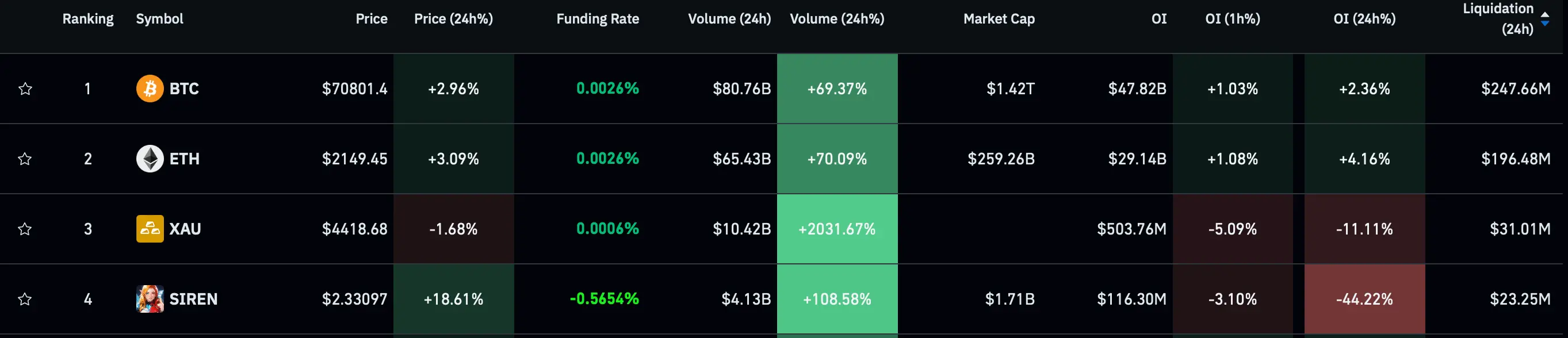
The price of this coin once approached 5 USD, corresponding to a market capitalization of approximately 3.675 billion USD, making it briefly rank in the top 30 of the total cryptocurrency market cap, surpassing well-established tokens like OKB and UNI.
In this lethargic market, this is not the first time we have seen such phenomena. $PIPPIN, $RIVER, $BEAT, $MYX... By sorting through the related questions of $SIREN, what experiences can we gain from these similar situations?
Is there a trace to the "leverage scam"?
As early as March 5, @c_ckoko tweeted that "$SIREN is obviously absolutely controlled, which is a way to harvest users across platforms."
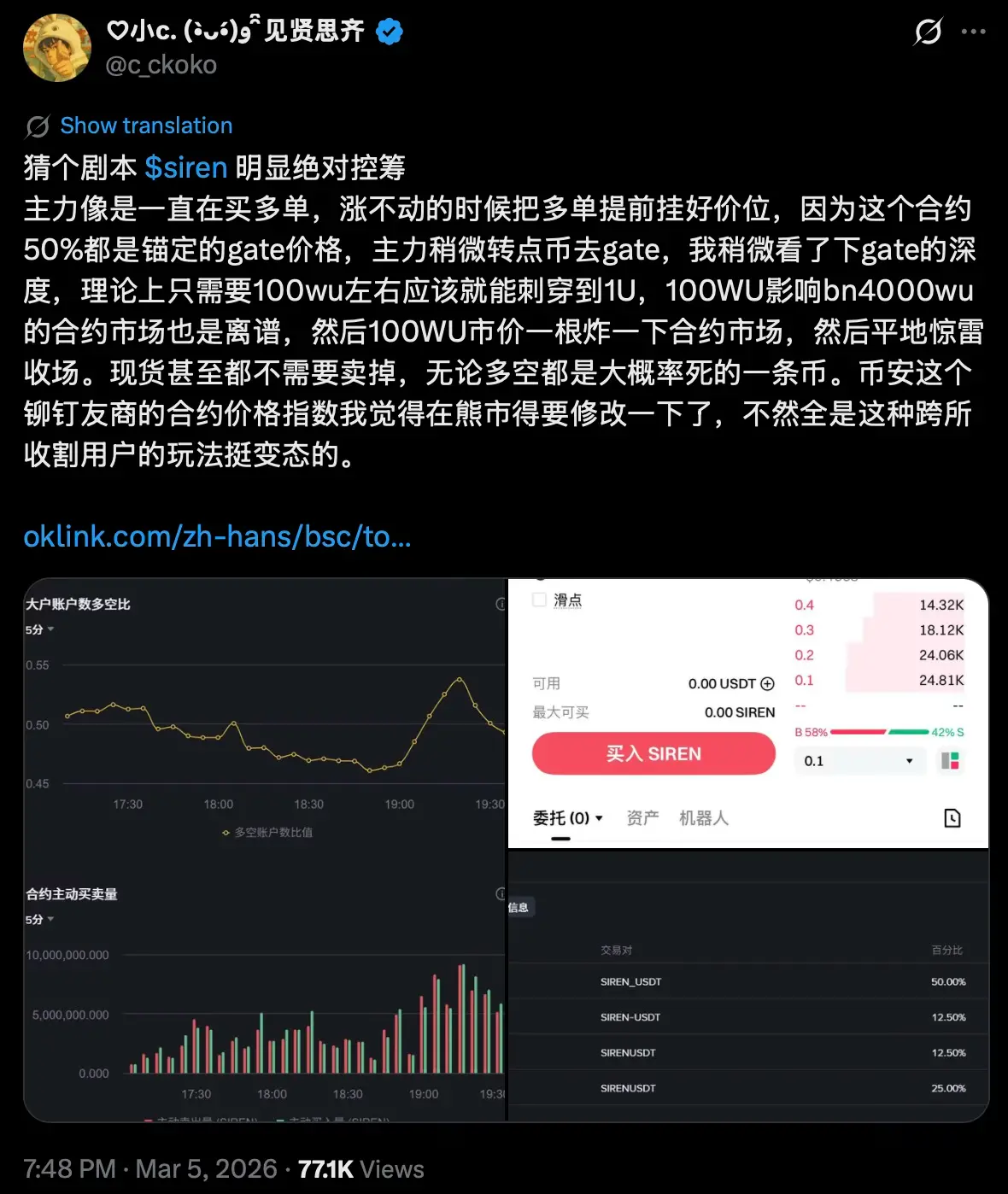
His tweet well explained how this "leverage scam" operates: the depth difference of spot trading platforms allows for significant volatility to be created with a small amount of funds, affecting the price of Binance contracts for harvesting.
Moreover, just as he suggested in the last part of his tweet, the price index of the $SIREN contract was adjusted. At the time he tweeted, the influence on the $SIREN Binance contract price index was 50% from Gate spot, 12.5% from Kucoin spot, 12.5% from Binance contracts, and 25% from Binance Alpha. After two adjustments, the current contract price index distribution is now 25% from Gate spot, 12.5% from Kucoin spot, 12.5% from Binance contracts, and 50% from Binance Alpha.
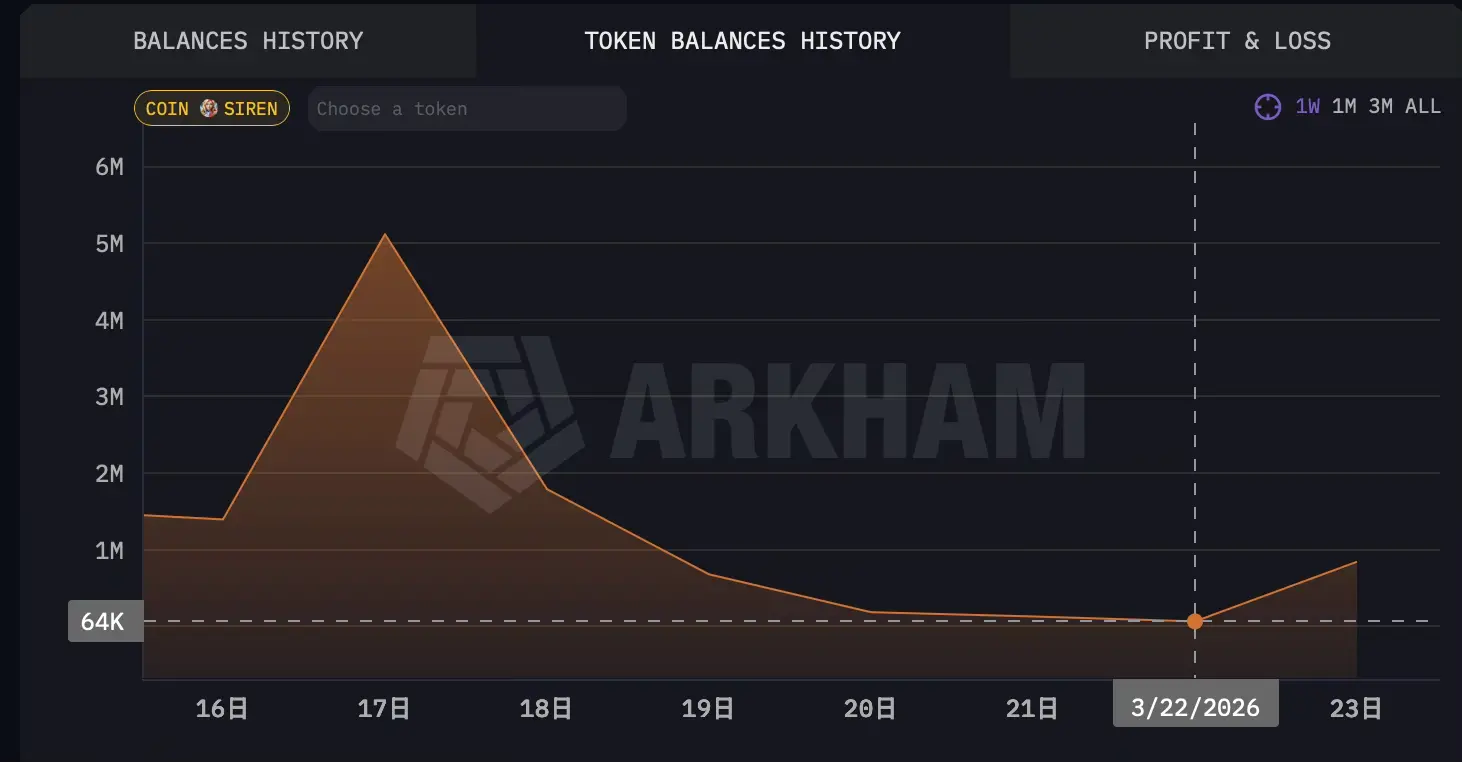
According to Arkham data, the $SIREN inventory on Gate was only 64,000 pieces on March 22.
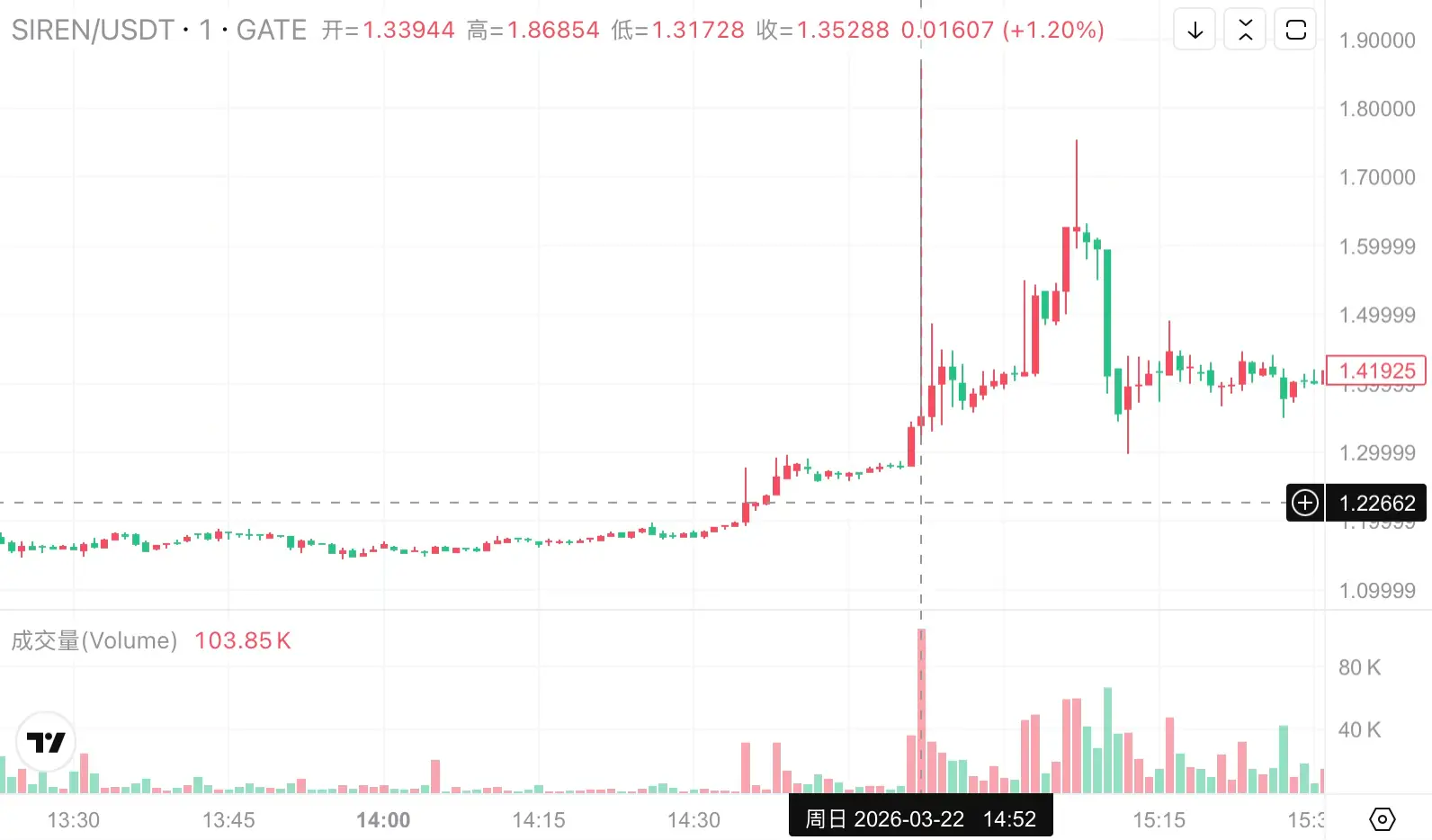
In this case, a trading volume of 100,000 USD could create a minute candlestick with nearly 40% volatility.
From the perspective of open interest, $SIREN showed significant anomalies starting from February 8, with the long-standing open interest that had been hovering around 3 to 5 million USD suddenly skyrocketing to 58.83 million USD.
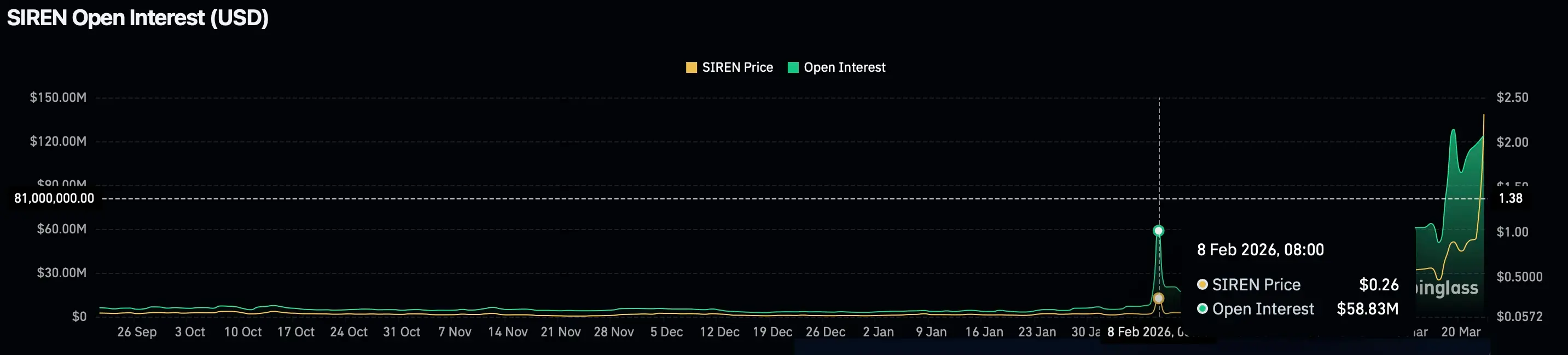
Of course, signs of anomalies do not necessarily lead to a specific inevitable result. After all, the chips are in the hands of the controlling dealers, and we cannot determine how the dealers will proceed with the harvesting.
Methods
First is controlling the supply, hoarding a large amount of spot chips, and opening large long positions to push the price high.
On-chain analyst Ember (@EmberCN) aggregated the control situation of $SIREN and found that up to 88.5% of $SIREN is controlled by dealers, based on on-chain verifiable information. If we include the portion held by dealers in centralized exchanges, this number would be even higher.
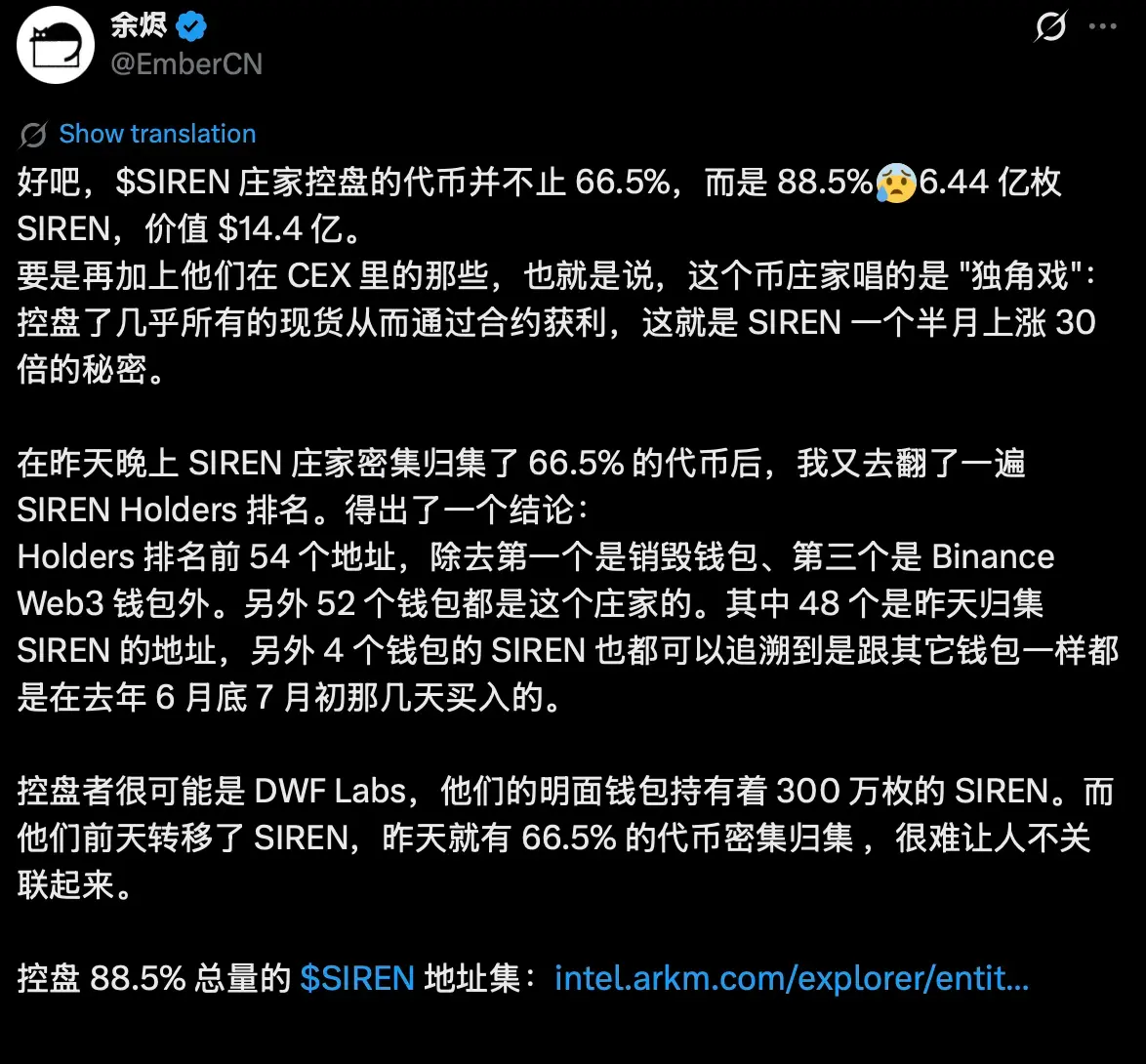
The above tweet also indicated that DWF Labs may be the controller of this event, but DWF Labs co-founder Zac denied this claim in the group chat.
After driving up the price, the dealers entice shorts and then reverse and lay down short positions, making retail investors feel that a peak is approaching.
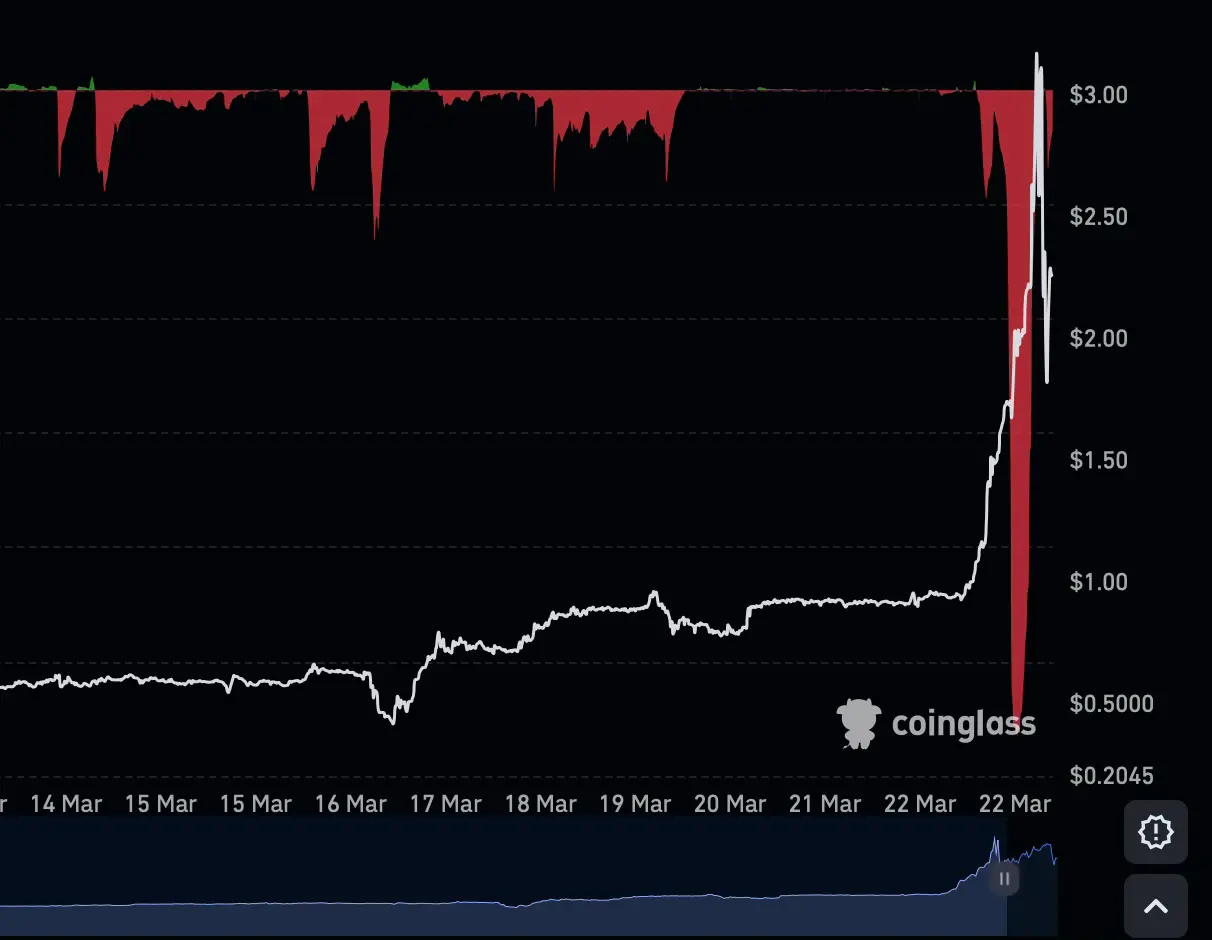
From the above rate chart, it can be seen that starting from March 14, $SIREN frequently experienced higher negative rates, with shorts continuously subsidizing the dealer's long positions, and the dealer then leveraging these "free" funds to continue pushing the price higher. In the early hours of March 23, there was a dramatic fluctuation of 78% on Gate spot within 10 minutes, with a transaction amount of only about 450,000 USD, and the price of $SIREN rose from 2.75 USD to nearly 5 USD. This means that many people were liquidated.
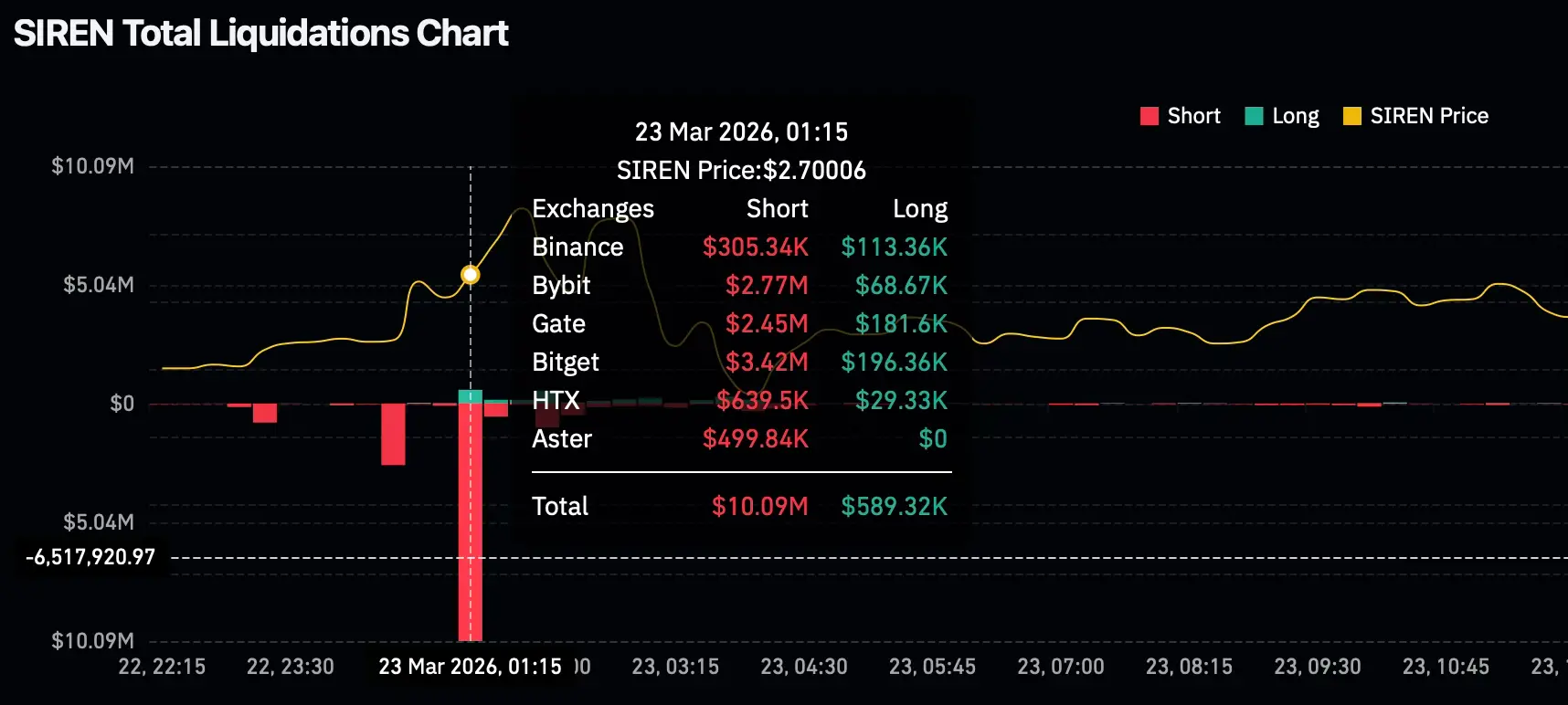
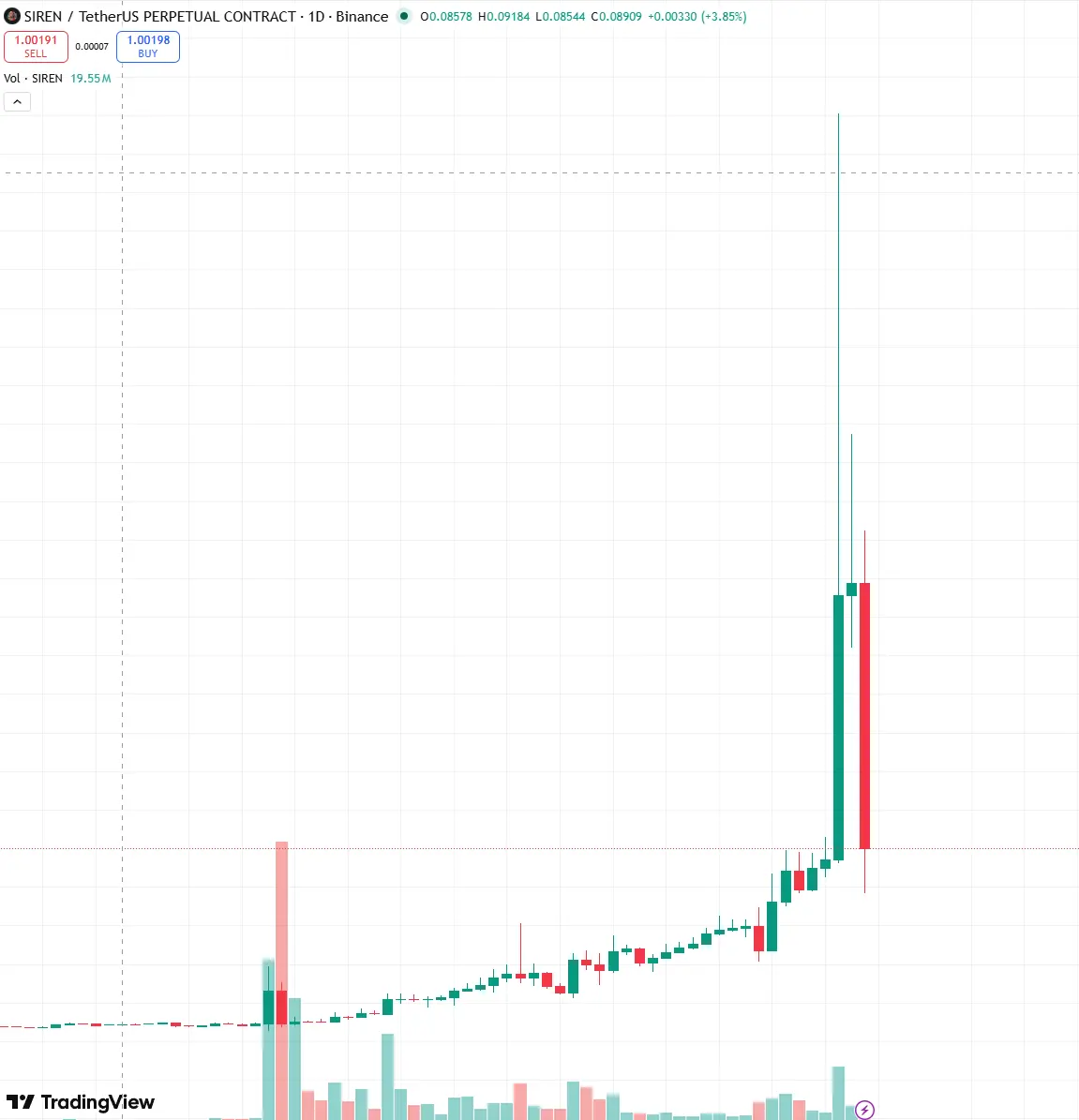
At this point, $SIREN might not be over yet, because looking at it from a rigid perspective, the dealer can still flatten the long positions and dump the spot, creating a huge bearish candlestick, and then close the short positions at a far lower cost than their opening price. By comparing the trends of $RIVER, $POWER, and $BEAT with $SIREN in one chart, it appears that $SIREN still lacks a final netting.
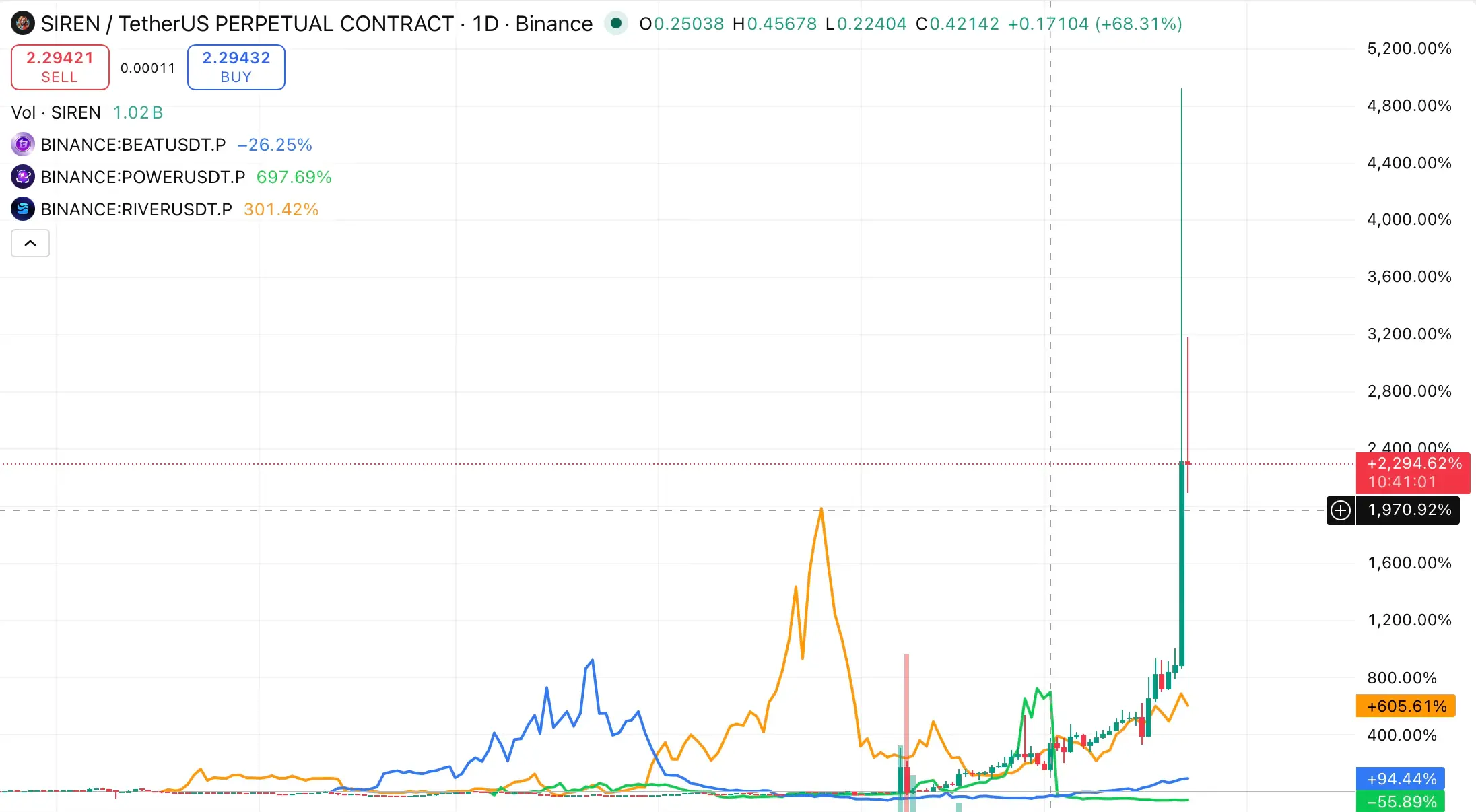
As this article is about to be published, the above speculations have been confirmed:
Conclusion
Regardless of whether the current market is depressed or not, the emergence of such harvesting schemes is always bad. Indeed, some trading experts can get a bowl of soup from the dealers amidst the fog of information, but for the vast majority of retail investors, it is merely an unfair gamble.
When such an obvious harvesting scheme appeared in the top 30 of the cryptocurrency market, I could only sigh.
免责声明:本文章仅代表作者个人观点,不代表本平台的立场和观点。本文章仅供信息分享,不构成对任何人的任何投资建议。用户与作者之间的任何争议,与本平台无关。如网页中刊载的文章或图片涉及侵权,请提供相关的权利证明和身份证明发送邮件到support@aicoin.com,本平台相关工作人员将会进行核查。


