Original author: David, Deep Tide TechFlow
On March 18, another blockchain mainnet went live.
It is called Tempo, backed by Stripe and Paradigm. Stripe is one of the largest online payment companies in the world, handling $1.9 trillion in transactions last year; Paradigm is one of the largest venture capital firms in the crypto industry. The two partnered last year to invest $500 million in Tempo, valuing the project at:
$5 billion.
A $5 billion blockchain, not trading cryptocurrencies, not doing DeFi, not launching memes. On the day of the mainnet launch, Tempo's most prominently announced product is:
Making machines pay each other.
This sounds a bit abstract; you can understand it as AI needing to spend money at every step. Calling an API costs money, purchasing computing power costs money, pulling a batch of data from a database costs money...
But the existing payment systems are all designed for humans, bank accounts need identification, credit cards need facial recognition, and Alipay requires a mobile verification code.
AI cannot pass any of these.
It can help you complete the entire workflow, but when it comes to the payment step, it has to stop and wait for a human to press "confirm."

Thus, along with the launch of the mainnet, an open protocol called MPP (Machine Payments Protocol) was launched, co-written by Stripe.
Simply put, it establishes a set of rules for transactions between machines, including how to request payments, how to authorize, and how to settle, etc.
The envisioned scenario is that AI can autonomously spend within a preset limit, without needing human approval for every transaction. On the launch day, more than 100 service providers were already integrated, including OpenAI, Anthropic, and Shopify.
But Tempo was not the only one doing this this week.
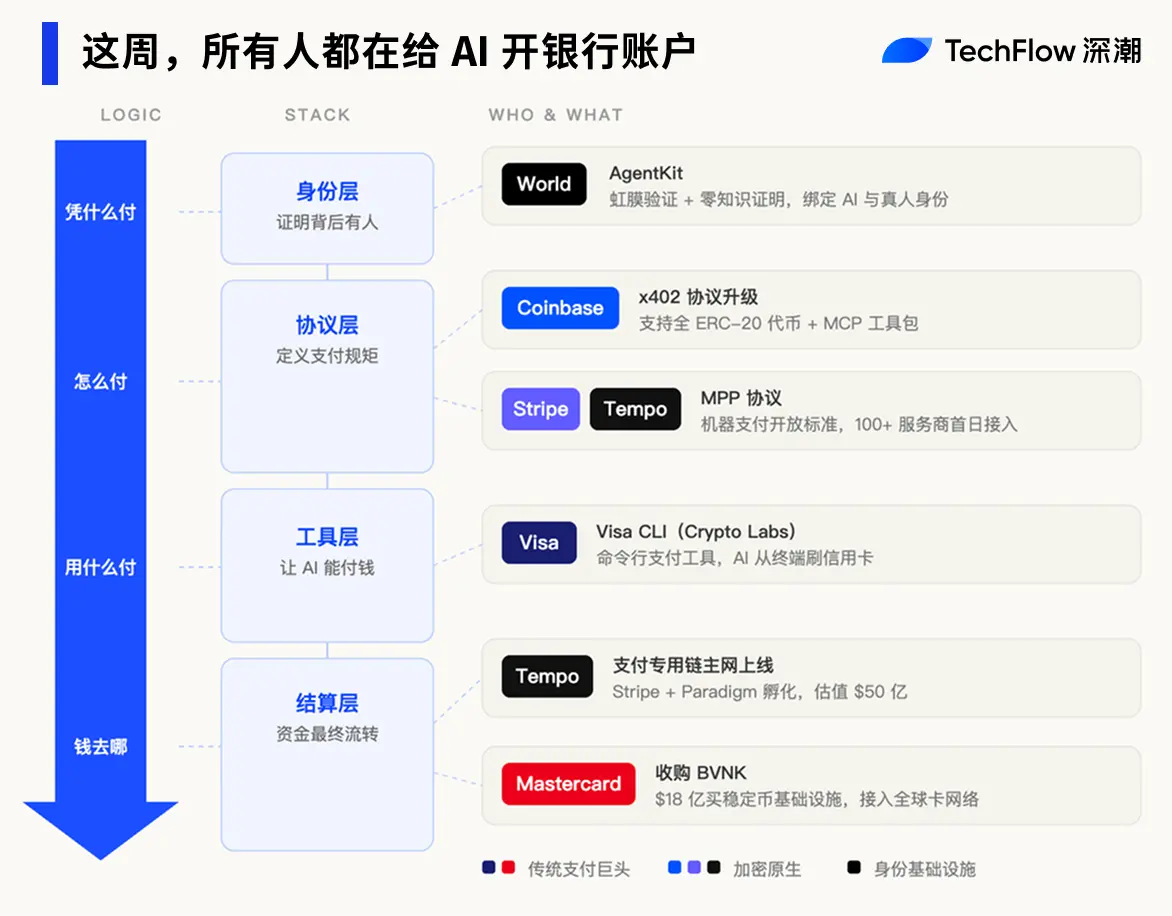
Within five days, Visa established a new department to launch AI payment tools, Coinbase's payment protocol underwent a major upgrade, Mastercard spent $1.8 billion to acquire a stablecoin company, and Sam Altman's World released a toolkit specifically for identity verification for AI.
Five giants crowded through the same door in one week, eager to open bank accounts for AI.
Two paths, the same door
Tempo's role is to facilitate settlement for AI. However, settlement is just one part of the payment system. An AI Agent needs payment tools, funding channels, and identity verification to truly spend money autonomously.
In this area, traditional payment companies and crypto companies are vying for pieces of the pie using their respective strengths.
On March 18, the same day Tempo's mainnet went live, payment giant Visa also took action. The newly established Crypto Labs department launched its first product: Visa CLI, a tool allowing AI Agents to initiate credit card payments directly from terminals.
No API keys are needed, no prior registration is required; if AI needs to purchase services during task execution, it can pay with just a command. Visa calls this "command line commerce."
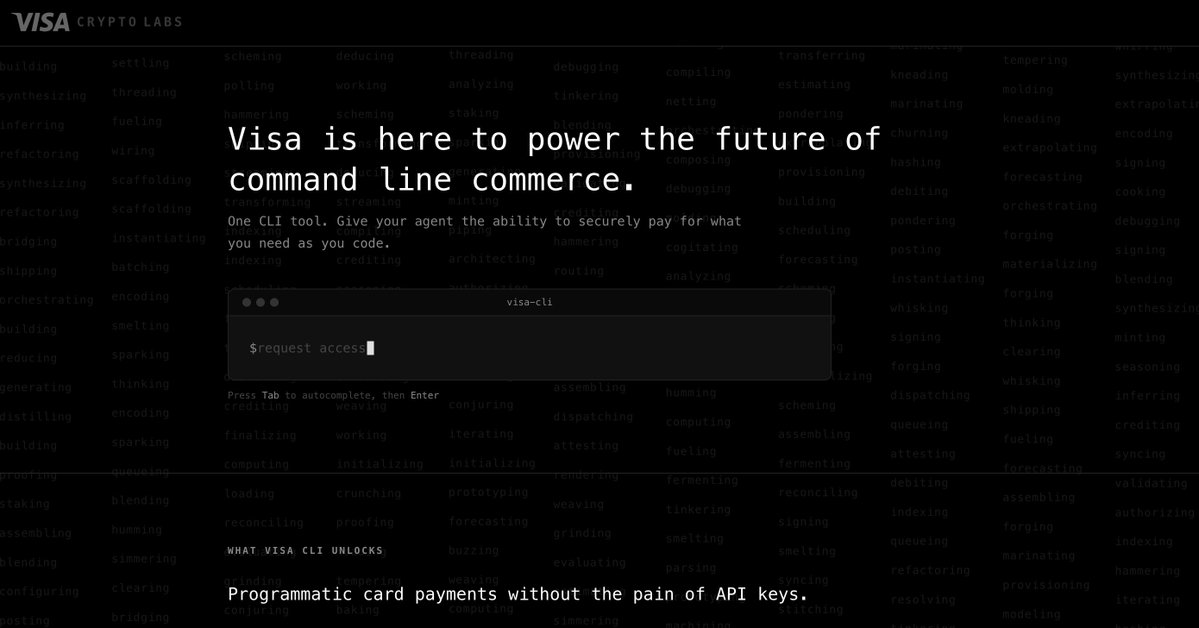
Visa's global card network connects billions of cards and millions of merchants; if AI payments can operate on this existing network, there’s no need to wait for any new infrastructure to mature.
Visa is extending the old path. Its competitor, Mastercard, took another route: directly building the path.
On March 17, Mastercard announced an $1.8 billion acquisition of London-based stablecoin infrastructure company BVNK. This is the largest stablecoin acquisition in the history of the crypto industry.
The purpose of this acquisition is straightforward; if AI payments are to be in stablecoins, those stablecoins will flow through my pipeline.
On the side of crypto-native companies, the actions have been equally intense.
Coinbase's x402 protocol is undergoing a significant upgrade, expanding its payment range from several stablecoins to all ERC-20 tokens, and it launched the MCP toolkit, allowing developers to integrate AI tools into the payment network with one click.

Although the starting points of both sides seem different, the actions point in the same direction: traditional payment companies are embracing crypto, while crypto companies are embracing AI. Ultimately, the crypto infrastructure is transforming into the underlying pipeline for AI payments.
There is still one aspect remaining. AI can spend money, but how do merchants know if there are responsible humans behind this AI spending?
On March 17, Sam Altman's co-founded World released AgentKit, integrating with Coinbase's x402. Its purpose is singular: to ensure that when AI pays, it proves that a verified human stands behind it. Merchants can confirm that someone is responsible for the transaction, but they cannot see who that person is.
In five days, five companies secured their positions across settlement, channels, tools, protocols, and identity.
The AI cake has been divided; only the checkout remains
Over the past three years, the positions within the AI industry chain have basically been claimed.
The model layer is dominated by OpenAI, Anthropic, Google, and various Chinese companies; computing power is tightly locked by Nvidia, and the application layer from programming assistants to search engines has become a red sea...
Every layer is crowded, and the competitive barriers in each layer are getting higher.
Yet, this payment layer is still relatively vacant.
It's not that no one has thought about it; it's just that the timing wasn't right. AI Agent payments have a prerequisite: AI needs to have the ability to independently complete an entire task chain. If it can only chat and doesn't need to call APIs, buy computing power, or hire other Agents to work, then payment is not an urgent need.
Over the past year, this prerequisite has begun to slowly take shape.
OpenClaw allows AI to directly manipulate computers, the MCP protocol enables AI to access external services, and the Agent capabilities of various large models are expected to break through significantly in the second half of 2025. AI is shifting from being a "dialogue tool" to a "work tool", and working requires expenditure...
The need to spend money has arisen, but the infrastructure to facilitate spending doesn’t exist yet.
This is why Stripe, Visa, Mastercard, and Coinbase have all made their moves simultaneously. For traditional payment companies, this is their first opportunity to gain a home advantage throughout the entire AI wave. They can't create models, nor can they manufacture chips, but payment is what they have been doing for decades.
Visa's global card network connects billions of cards and millions of merchants; Mastercard covers over 200 countries, and Stripe handled $1.9 trillion in transactions last year. If every AI expenditure flows through these pipelines, the more capable AI becomes, the more profit these companies make.
For cryptocurrency companies, the logic is somewhat different.
Coinbase CEO Brian Armstrong previously stated directly, "AI can have a crypto wallet but cannot open a bank account."
Every step of the traditional financial system confirms "who you are." Opening a bank account requires an ID, a credit card requires facial recognition, and each transaction needs a verification code. AI is software, not a human, and it cannot pass any of these hurdles.
However, a crypto wallet does not require these. A private key is an account; for AI Agents, on-chain payments are the path of least resistance.
Regardless of being crypto or not, AI payments will become a new infrastructure-level market. The difference lies in which pipeline is more suitable for machines.
The road is built, but the car has not arrived
The story has reached a point where everything seems ready, and the five giants are in their positions.
But there is one number worth noting.
Coinbase's x402 protocol is currently the earliest implemented and most widely applicable AI payment protocol. According to data from x402scan, in the past 24 hours, the total transaction volume for the entire ecosystem was $65,400. With 150,000 transactions, the average cost per transaction was less than 50 cents.
What infrastructure supports this number? Tempo is valued at $5 billion, Mastercard spent $1.8 billion to acquire BVNK, Visa specially established a new department, and Stripe personally drafted the protocol.
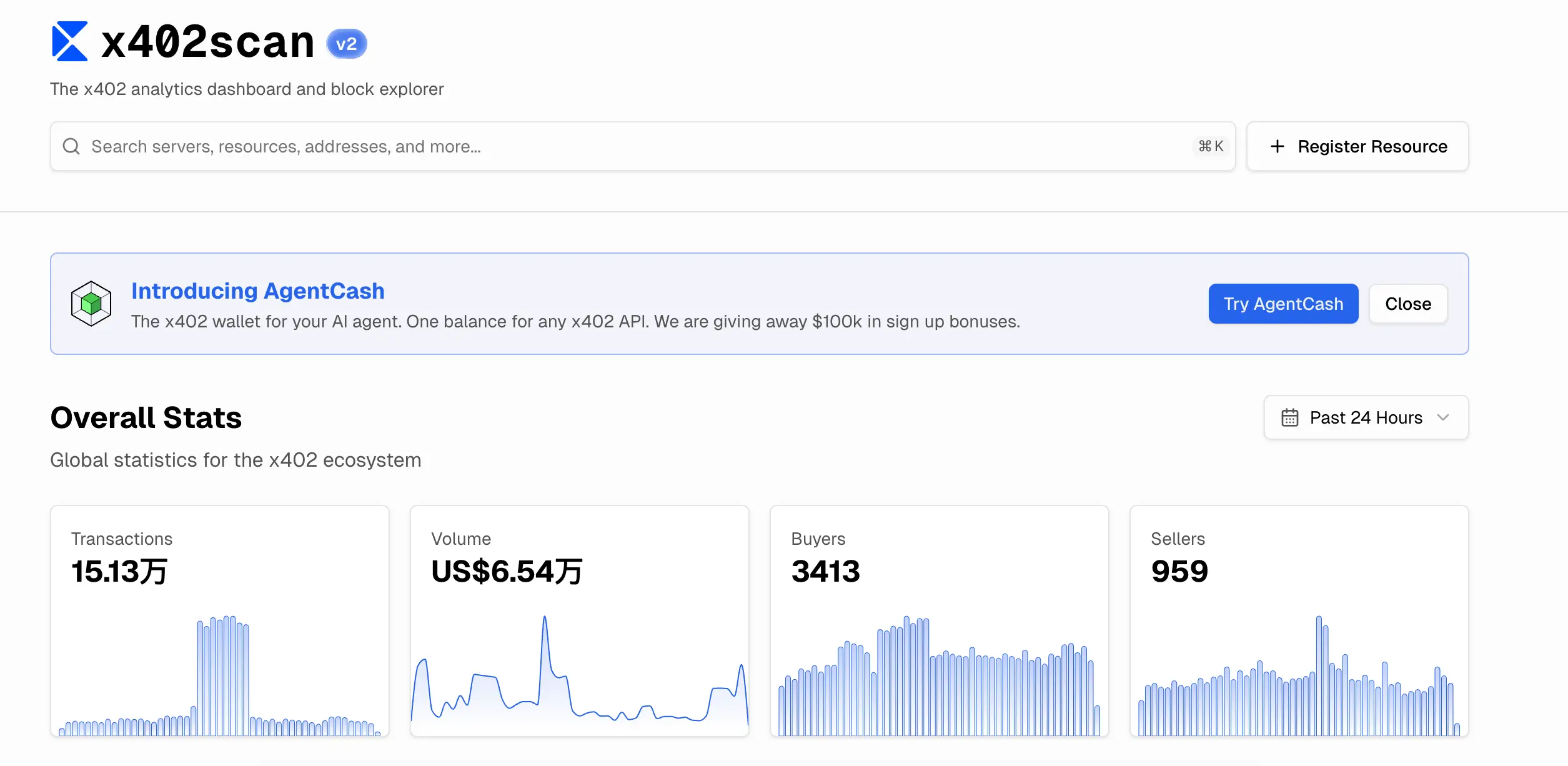
The infrastructure valued in the billions is serving a market with daily transaction volumes comparable to street-side milk tea shops.
All infrastructure businesses seem to follow this norm.
On the eve of the 2000 internet bubble, telecom companies laid millions of kilometers of fiber optic cables under the sea. After finishing, they found that only 5% of the global internet traffic utilized them. Most of those companies went bankrupt, but the fiber optic cables remained.
A decade later, video streaming and mobile internet filled those pipelines. The builders did not make a profit, but the roads were real.
AI payments are now at this stage. The logic for demand is valid: AI Agents are indeed becoming more capable, they need to autonomously spend money, and a new financial infrastructure is indeed necessary.
Everyone has arrived at the starting line, but after the starting gun fires, they find that there is temporarily only themselves on the track.
As for when an AI Agent's first truly autonomous transaction occurs in your life, it may happen sooner than everyone expects or perhaps slower than everyone anticipates.
The only certainty is that this battle has already begun, and you and I might be the last to know.
免责声明:本文章仅代表作者个人观点,不代表本平台的立场和观点。本文章仅供信息分享,不构成对任何人的任何投资建议。用户与作者之间的任何争议,与本平台无关。如网页中刊载的文章或图片涉及侵权,请提供相关的权利证明和身份证明发送邮件到support@aicoin.com,本平台相关工作人员将会进行核查。


