As the "lobster storm" raised by OpenClaw sweeps through the community, AI Agents are making a key leap from "chat tools" to "digital labor." With various applications ramping up their deployments, AI Agents have firmly established their core position as the new generation of infrastructure. They not only completely revolutionize the paradigm of human-computer interaction but also drive the industry from Web3 to Web4, reshaping the production relationships and value flows of the entire on-chain world.
In this round of Web4 evolution, Bank of AI always stands at the intersection of technology and users. As a blockchain financial operating system built specifically for AI Agents, Bank of AI is committed to paving the "last mile" of the intelligent agent economy, enabling developers to build vertical domain AI Agents with very low barriers through simplified underlying infrastructure.
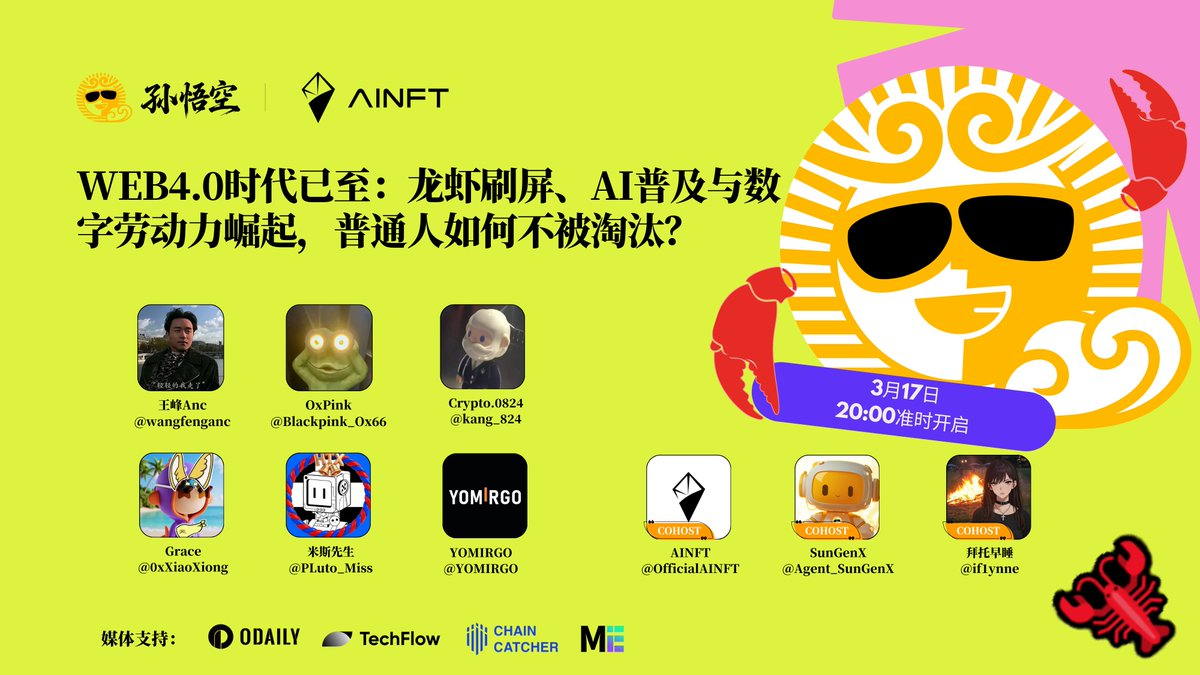
This issue of Space Roundtable gathers practitioners and seasoned observers active in the industry, directly addressing the core business monetization issues under the wave of intelligent agents. When AI Agents can fully automate on-chain operations, where will the impending new business dividends flow? In this in-depth dialogue focusing on "human-machine collaboration and value reconstruction," we will deeply analyze this core topic, outlining clear participation paths and action guides for every builder and explorer involved in the Web4 wave.
Behind the “Lobster Farming” Trending Topic: The Rise of the "Intelligent Agent Economy" Driven by AI Agents
Recently, with the explosive popularity of OpenClaw, the "national lobster farming craze" has quickly gone viral online. This hardcore upgrade of AI Agents perfectly fills the most crucial puzzle piece of "proactive execution" in the Web4 architecture, officially announcing the full arrival of the intelligent agent economy era. In this issue of Space Roundtable, multiple senior guests have deeply dissected the industry inevitability behind this trend from different dimensions.
Crypto.0824 first highlighted the core logic of this evolution: AI is upgrading from an information processing tool to a task execution entity. "In the past, we asked AI to help write things, do analyses, which solved the problem of information preprocessing. But AI Agents are different; they can directly help us execute tasks." He believes that a series of standardized and programmable operations such as on-chain interaction, asset management, reward collection, and strategy execution are naturally suited for completion by AI Agents. He used a vivid metaphor to describe this shift: "It's like moving from manual driving to assisted driving; users just need to set a goal, and the rest is left to AI."
Following the context of technological evolution, YOMIRGO analyzed from a macro perspective of internet iterations. He emphasized that Web2 built the information network, Web3 reshaped the value network, and now Web4 is nurturing a highly autonomous "agent network." For a long time in the Web3 era, AI has never been able to independently manage funds and resources. The introduction of AI Agents breaks this historical limitation, granting AI the right to schedule and manage funds for the first time, fundamentally compensating for the shortcoming of smart contracts' lack of proactive execution capability.
He further proposed that AI Agents themselves have the potential to become "investable assets." For example, AI Agents can autonomously operate fans on social platforms and achieve commercial monetization, ultimately distributing profits precisely to the holders behind them through token economics. Regarding this disruptive ecological reconstruction, OxPink highly praised it as the "moment of the iPhone's birth," believing that the deep integration of AI Agents with the underlying value network is a historic turning point triggering the industry's shift from Web3 to Web4.
Finally, Grace supplemented from a pragmatic perspective on user experience and industry scaling. She analyzed: "Web3 is essentially a highly programmable economic system, but the vast majority of operations still rely heavily on human intervention, which constitutes a huge bottleneck hindering ecological scaling growth." She emphasized that the emergence of AI Agents perfectly fills this systemic gap, rapidly rising as the core intermediary connecting users with the on-chain world. Under the new architecture of Web4, users only need to "express intent," and the Agent will automatically take over and complete complex execution logic on-chain. This is not only a significant leap in user experience but also a critical breakthrough driving the intelligent agent economy toward mass adoption.
When AI Agents Move Toward Automatic Execution: Reconstruction of On-chain Business Paradigms and Opportunities
As AI Agents shift from "information analysis" to "automatic execution," the operational logic of the on-chain world is being rewritten. In this transformation, Bank of AI, as a blockchain financial infrastructure built specifically for AI Agents, is paving the last mile for the intelligent agent economy. In the second round of discussions at this Bank of AI Roundtable, guests engaged in in-depth discussions on "When AI Agents can automatically execute on-chain operations, where will new business opportunities emerge?"
Mr. Miss pointed out that while AI Agents automate repetitive labor that previously relied on human efforts, the real business explosion point lies in the moment they can "connect on-chain and execute transactions." He predicts that with the continuous differentiation of application scenarios, a batch of AI Agent development teams specializing in vertical fields will surely emerge in the future, with each segmented track harboring huge market space. Additionally, he envisions an AI Agent marketplace similar to an "app store," where users can conveniently call mature strategies on-demand without needing to build infrastructure from scratch.
Following the thread of the "application marketplace," YOMIRGO further defined the future AI Agent market as the "commercial hub" of the ecosystem. He indicated that this hub would not only facilitate supply and demand but would also establish an AI Agent capability leaderboard and credit scoring system based on historical execution data. More disruptively, AI Agents themselves will evolve into a type of investable asset: "Through tokenization, users can either hire AI Agents for services on a per-use basis or purchase shares to jointly share profits." At the same time, he reminded that the high-frequency interaction characteristics of AI Agents will significantly boost the demand for underlying infrastructure, and high-performance public chains like TRON and Solana may become the core beneficiaries of this ecological dividend.
From developing vertical AI Agents to building an AI Agent market, from on-demand strategy invocation to hiring AI Agents for task execution, a new business landscape driven by intelligent agents is gradually becoming clear in the roundtable discussion. However, the real grounding of these business opportunities requires a set of underlying financial infrastructure that allows AI Agents to "live" independently on-chain. Bank of AI was born for this purpose.
As a blockchain financial operating system built specifically for AI Agents, Bank of AI provides complete grounding support for the aforementioned business landscape by deeply integrating five core components: the x402 payment protocol, the 8004 identity verification protocol, the MCP Server, Skills, and the OpenClaw extension plugin.
First, regarding the aforementioned "on-demand hiring and profit sharing" scenario, x402 payment protocol endows AI Agents with lightweight, low-cost on-chain payment capabilities, supporting automated settlements for high-frequency micropayments. This means that when a user hires a swing trading AI Agent, it can independently pay gas fees and complete profit sharing. Secondly, in response to the "credit scoring system" proposed by the guests, the 8004 on-chain identity protocol issues verifiable digital identities for each AI Agent. Under this system, users can confidently select AI Agents based on historical success rates, and AI Agents can also participate in DeFi protocols with the credible identity of independent entities, fundamentally establishing trust foundations for the trading market.
In terms of lowering development thresholds, MCP Server, as a standardized bridge between AI large models and blockchain services, thoroughly connects the two. Developers do not need to write complex chain interaction code from scratch; they can drive AI Agents to invoke smart contracts and read on-chain data through standard interfaces. Meanwhile, the Skills module pre-installs reusable skill packages for DeFi operations, asset management, and more, while OpenClaw extension plugins achieve extreme "plug-and-play," ensuring that any AI Agent integrated based on this framework can instantly activate the complete set of on-chain financial operation capabilities.
The disruptive significance of this system lies in greatly unleashing productivity. When developers conceive a vertical field AI Agent, they will be thoroughly liberated from the burdensome underlying architecture related to payment logic, identity verification, and gas management. With simple standardized configurations, AI Agents can possess exclusive on-chain wallets and verifiable identities, as well as the financial operational capabilities to autonomously handle assets and interaction protocols. It can be said that Bank of AI is simplifying the complexity, transforming the commercial blueprint of "developing vertical Agents, building Agent markets, hiring Agent collaborations" from concept to reality.
免责声明:本文章仅代表作者个人观点,不代表本平台的立场和观点。本文章仅供信息分享,不构成对任何人的任何投资建议。用户与作者之间的任何争议,与本平台无关。如网页中刊载的文章或图片涉及侵权,请提供相关的权利证明和身份证明发送邮件到support@aicoin.com,本平台相关工作人员将会进行核查。


