Author: @BlazingKevin_, Blockbooster Researcher
In the spring of 2026, Intercontinental Exchange (ICE) completed a strategic investment in the crypto trading platform OKX with a valuation of $25 billion. As the parent company of the New York Stock Exchange (NYSE), this transaction by ICE breaks away from the previous exploratory model of Wall Street, which relied solely on spot ETFs to establish a "funding channel." Analyzing the cooperation framework disclosed by both parties, the cooperation focuses directly on the underlying operational hubs of the financial market, ranging from the authorization of spot price data, the establishment of joint ventures, to the joint distribution of tokenized stocks.
The authorization of spot data aims to establish a regulated pricing anchor for traditional institutional funds entering the market; meanwhile, the push for joint ventures and tokenized stocks essentially attempts to stitch together the physical boundaries between the traditional fiat currency system and the crypto-native liquidity pools. This systematic strategic bundling indicates that mainstream traditional capital's strategy toward the crypto ecosystem has officially transitioned from the peripheral "asset allocation" to the "incorporation" phase, which relies on capital intervention in underlying infrastructure.
This is not merely a straightforward financial settlement; rather, it represents an upward power reshaping by the old financial system, utilizing capital leverage and compliance structures to reform the emerging crypto market from the top down.
Power Restructuring: the Transfer of Pricing Power and Infrastructural Cannibalism
The core anchor of this transaction lies in the fundamental stones of the financial system: pricing power and clearing infrastructure.
As an oligopoly in the traditional market, ICE monopolizes the pricing benchmarks of core macro assets, from stock data of the New York Stock Exchange (NYSE) to Brent crude oil and the U.S. dollar index. This pricing power, which is based on legal trading hours and centralized clearing, constitutes the core of its business model. However, faced with a crypto asset network with a total market value of trillions of dollars, operating 7×24 hours with highly decentralized liquidity, ICE's original traditional price discovery mechanism reveals evident structural gaps.
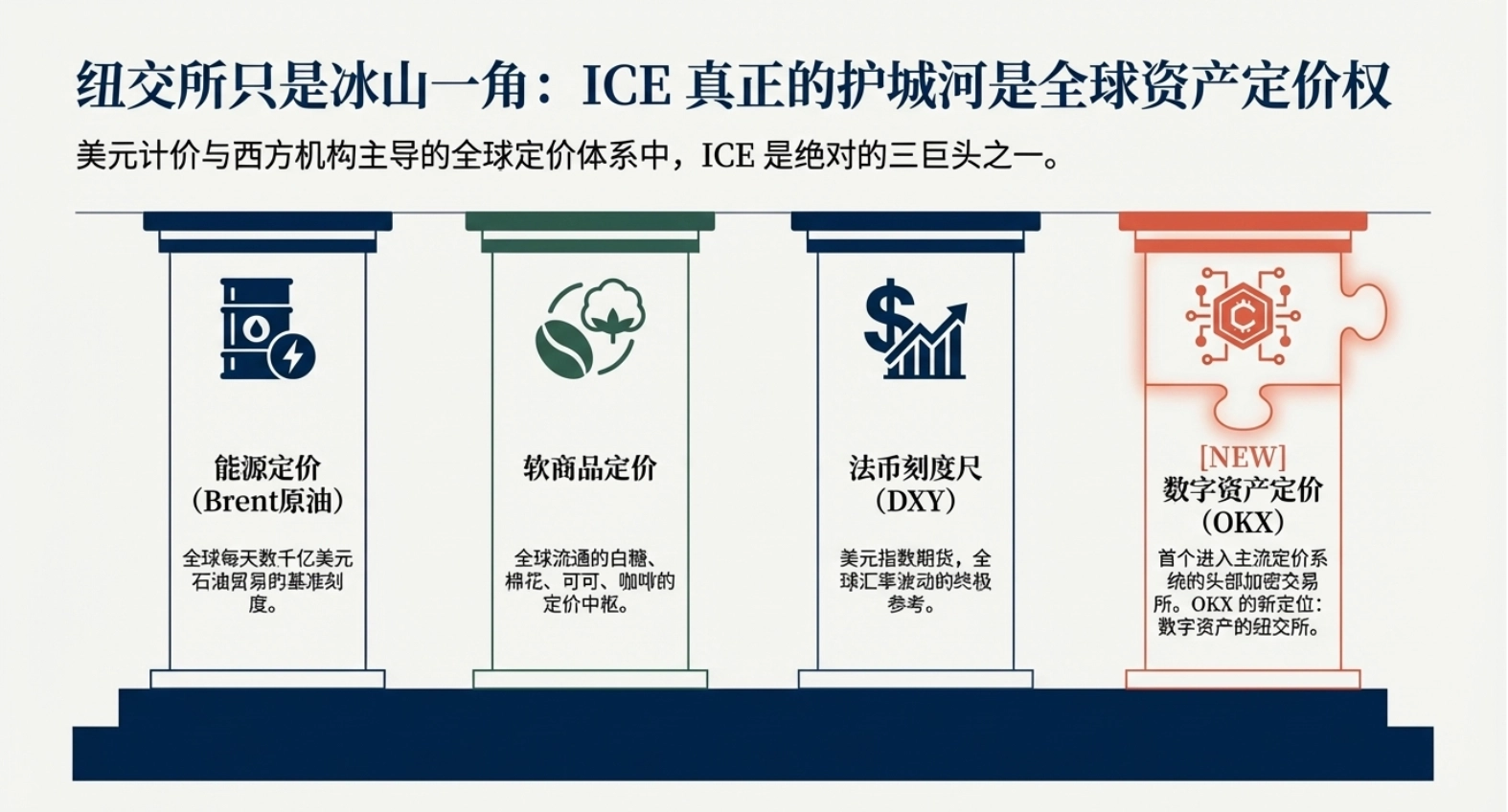
Acquiring authorization for OKX's spot data is a substantive move by ICE to fill this gap. At present, the Chicago Mercantile Exchange (CME) has captured some pricing advantages in the institutional market with regulated Bitcoin futures. By closely binding capital with leading spot platforms, ICE can directly penetrate the offshore market and obtain firsthand underlying trading and depth data. This enables it to bypass the long cold start and directly construct a proprietary crypto derivatives product line that aligns with U.S. regulatory standards, attempting to centralize the final interpretation of crypto liquidity within Wall Street's traditional infrastructure.
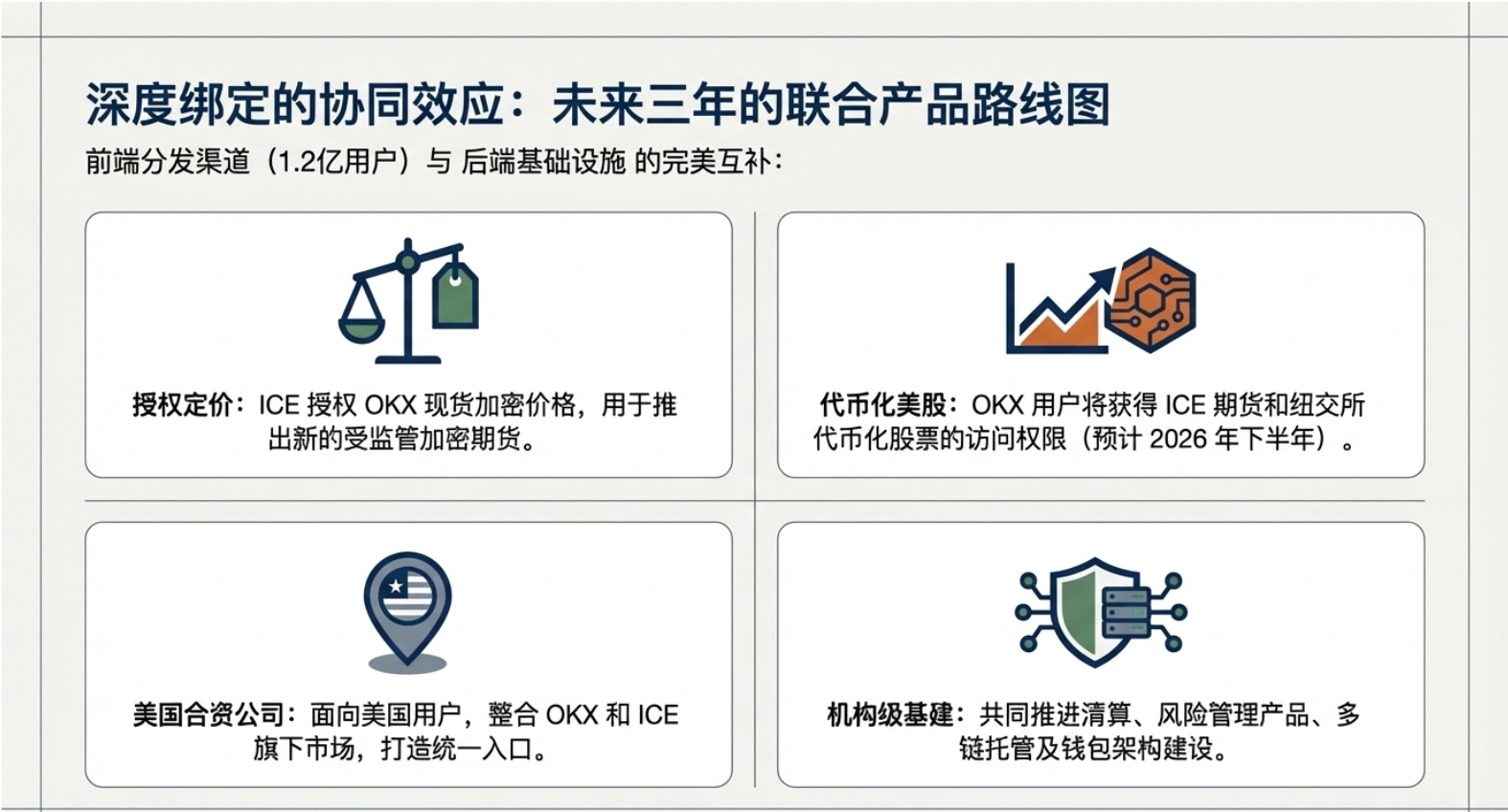
For OKX, relinquishing core spot pricing data serves as the counterbalance to break through its current business bottleneck. Currently, the competition among pure crypto asset trading platforms intensifies, the cost of acquiring individual users peaks, and relying solely on spot and perpetual contract fee models has reached growth ceilings. By accessing ICE's underlying compliance framework, OKX has substantially completed a transformation of its business model: from a singular crypto asset matching engine to a bi-directional distribution network connecting 120 million native crypto liquidity with Wall Street compliant financial products.
Path Evolution
Looking back at ICE's expansion into the crypto field, its business path has undergone a strategic correction based on real market feedback.
In 2018, ICE launched Bakkt, a Bitcoin futures platform focused on physical delivery. Its early strategic logic was a typical "compliance infrastructure first": attempting to siphon and regulate the trading volume in the crypto market by establishing clearing and delivery channels that met the highest regulatory standards of traditional institutions. However, the prolonged business stagnation of Bakkt later verified a structural rule: in the crypto market, compliance frameworks cannot create liquidity out of thin air. Traditional trading systems disconnected from the native retail network and the crypto market maker ecosystem are prone to becoming "compliance islands" lacking genuine trading depth.
Bakkt's setbacks during the cold start prompted ICE's management to reassess its business logic. They realized that in a bilateral trading market with very strong network effects, the cost of rebuilding the trading habits of tens of millions of crypto users and reshaping underlying liquidity far exceeds building a set of institutional-grade clearing codes. Rather than wasting time on internal incubation, it is better to directly turn to external capital capture.
Subsequently, ICE's resource allocation exhibited clear node embedding characteristics. In 2025, ICE invested in the decentralized prediction market Polymarket, whose commercial essence is to preemptively position on-chain event-driven data sources and pricing entrances for non-standard assets. The significant investment in OKX was a direct entry into the core of the crypto world— the bi-directional liquidity network of spot and derivatives.
From promoting Bakkt's "self-built closed loop" to now achieving "capital embedding" through stakes in Polymarket and OKX, ICE's evolution represents the prevailing consensus among current Wall Street giants: abandon the heavy asset model of reconstructing crypto rules from scratch, and instead utilize capital leverage as a "Trojan horse" to directly incorporate the crypto-native infrastructure with scale effects into their vast global clearing and distribution network.
The "Second Half" of Tokenized Assets
The large-scale on-chain of RWA (Real World Assets) serves as a direct commercial impetus for this infrastructure convergence.
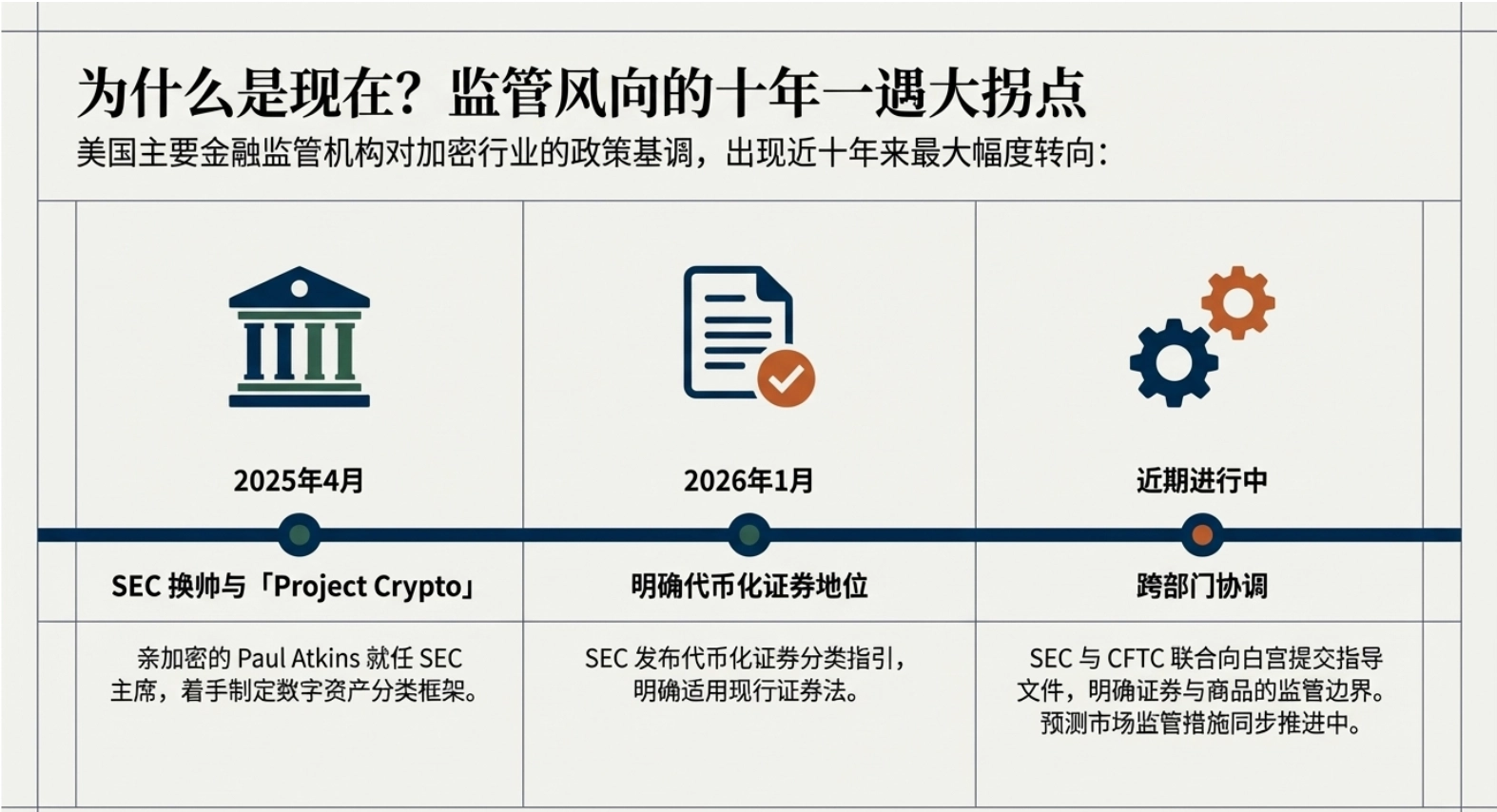
Entering the second half of 2025, as U.S. regulators initially clarified the categorical and ownership frameworks for tokenized securities, the on-chain mapping scale of underlying stock assets experienced structural leaps. In light of this incremental space capable of reshaping traditional securities market clearing protocols, core Wall Street institutions are accelerating their competition for the issuance and circulation hubs of tokenized assets.
In the infrastructure evolution of asset tokenization, the market has diverged into two distinctly different evolutionary routes. Nasdaq tends to be reformist, relying on traditional clearing centers like DTCC (Depository Trust & Clearing Corporation) to register and circulate tokenized assets within the existing compliance system. In contrast, ICE's strategic layout shows clear vertical integration characteristics, attempting to reconstruct the entire end-to-end closed loop from asset packaging to terminal distribution:
On the supply side, the NYSE is advancing a tokenized securities engine supporting instant delivery (DVP) and 7×24 hour circulation; on the clearing side, ICE is attempting to eliminate the cross-chain settlement friction between fiat currency and digital assets by establishing a Tokenized Deposits mechanism; while on the distribution side, the more than 100 million native crypto account systems retained by OKX complete its liquidity export for global retail terminals.
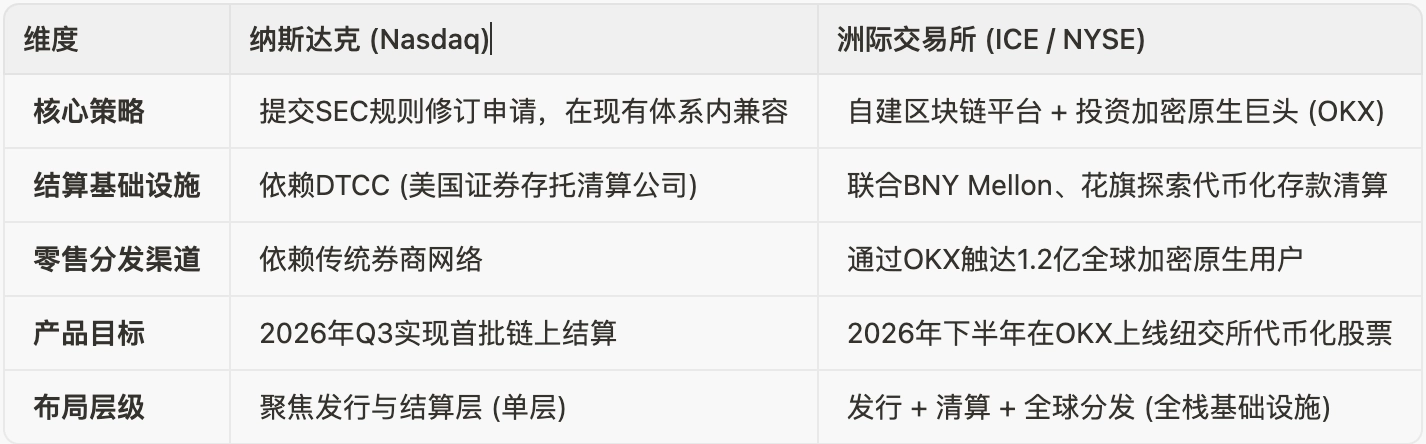
This hybrid infrastructure architecture of "licensed underlying assets + on-chain native distribution" poses a substantial alternative threat to the traditional T+1 settlement cycle in terms of trading efficiency. From a mid-to-long term industry perspective, the core barrier of the RWA track is shifting from a singular "asset on-chain capability" to an "integration capability of compliance channels and global liquidity." After this systematic integration, small and medium crypto platforms lacking quality fiat asset sides, and one-sided financial institutions restricted by traditional distribution channels, will face the risk of liquidity being siphoned off. Compound infrastructures capable of cross-domain asset clearing and global network reach will occupy substantial dominance in the next cycle of asset pricing.
Deep Game
Returning from strategic deductions to execution, this infrastructural integration faces significant structural frictions. The binding on the capital level has not directly eliminated the underlying misalignment between the traditional fiat currency system and the crypto-native ecosystem in terms of regulatory paths, clearing mechanisms, and governance structures.
First is the end of regulatory arbitrage and the compliance costs of multi-jurisdictional governance. After the rough expansion in early offshore markets, OKX attempted to complete the compliance reshaping of the U.S. market by introducing ICE's traditional licensing system. However, the U.S. regulation of crypto and tokenized assets has long remained in a divided state between the SEC (focusing on securities attributes) and the CFTC (focusing on commodities attributes). The cross-domain qualification of tokenized stocks, the penetrating review of offshore liquidity, and the lengthy compliance processes that joint ventures must undertake under a multilateral regulatory framework will substantially increase operational expenditures. Whether ICE's lobbying leverage on traditional Capitol Hill can yield substantial licensing benefits for OKX in the yet-to-be-defined regulatory battles of the crypto space still remains highly uncertain.
Second is the liquidity mismatch risk caused by asynchronous clearing mechanisms. Although the cooperation framework involves joint research and development of tokenized deposits, at this stage, traditional banks, constrained by banking days and fiat currency settlement cycles, inevitably experience physical time lags compared to the high-frequency matching of crypto networks operating 7×24 hours. When faced with extreme volatility events such as the release of macro data or on-chain black swan events, the closure or delays in fiat channels can easily lead to liquidity gaps on the crypto side. How to construct market-making and buffering mechanisms that can withstand extreme market conditions in asynchronous clearing networks forms the core technical resistance to the integration of the underlying systems.
Finally, the substantive exclusion of governance structures and risk preferences. The governance baseline of traditional regulated financial institutions is extreme risk aversion and absolute compliance; while the business drivers of crypto-native platforms are fundamentally based on agile iteration and exposure to high volatility. When the compliance committee of traditional capital intervenes substantively in the product launch flow and asset listing rights of a crypto platform, it will inevitably elongate the decision-making chain. This game of risk tolerance versus business expansion efficiency will trigger prolonged governance losses at the board level of the joint venture, potentially weakening the platform's competitive sharpness in purely crypto-native tracks.
Full Asset Circulation under the “Frenemy” Pattern
Horizontally examining the current macro-financial cycle, the cooperation between ICE and OKX constitutes a landmark node in "aligning TradFi and Crypto infrastructures."
This systematic alignment is rapidly replicating across the industry: from BlackRock establishing Coinbase as its core custodian and prime broker for spot ETFs, to traditional market-making giants Citadel Securities penetrating order flows on platforms like Kraken, and to JPMorgan advancing institutional-level intraday repos clearing based on its Onyx chain— the physical isolation between fiat capital networks and decentralized protocols is being systematically dismantled.
In this process, the market is evolving toward an "asymmetric symbiosis" pattern based on factor swaps. Traditional Wall Street oligopolies are no longer seeking to build crypto trading engines from the ground up, but rather, through capital injections and channel authorizations, they are precisely capturing high-frequency, globalized, and frictionless retail trading flows in the crypto market; while crypto-native infrastructures are exchanging partial equity and underlying data sovereignty to gain support from traditional finance's balance sheets, fiat clearing whitelist, and institutional moats against extreme compliance risks. This asset restructuring based on comparative advantages is substantially stripping away the "anti-establishment" label of the early crypto ecosystem, weaving it thoroughly into the operational tracks of global financial capital.
Following this path of infrastructure integration, the asset forms and circulation boundaries of global capital markets are tending to dissolve. The ultimate fate of next-generation financial infrastructure points toward a fully domain-cleared network with "unified ledger" attributes. Under this framework, the issuance carriers of heterogeneous assets— be it proof-of-work Bitcoin, tokenized U.S. stocks packaged by smart contracts, or RWA assets reflecting real yield rights— will detach from traditional settlement islands, achieving around-the-clock instantaneous delivery and cross-asset cross-margin circulation in a shared global liquidity pool, based on atomic settlement. This is not only a structural release of clearing efficiency but also a complete reshaping of the global liquidity pricing paradigm.
Conclusion
With ICE's stake in OKX marking it, the capacity clearance in the crypto asset trading circuit is nearing its end. In the foreseeable macro cycle, as traditional regulatory frameworks such as the Basel Accord achieve substantive coverage of crypto asset exposures, and as high compliance costs continue to squeeze platforms' profit margins, global crypto liquidity will irreversibly concentrate toward a few oligopolistic nodes equipped with “traditional licenses + native infrastructures.”
In this evolving landscape, trading platforms at the tail end, lacking quality fiat clearing channels, without core regulatory licenses and unable to access mainstream institutional order flows, will face severe liquidity exhaustion. They may passively exit in the stock game of bilateral markets due to an inability to bear exponentially increasing compliance expenses or become discounted acquisition assets in the complete chain infrastructure puzzle of traditional capital.
For leading native platforms that have completed capital binding, their business models have fundamentally transitioned: in exchange for accessing traditional finance's trillions of dollars in balance sheet and compliant distribution channels, these platforms must fully internalize Wall Street's stringent KYC/AML standards, anti-manipulation monitoring systems, and capital adequacy requirements. Pure “technical neutrality” is no longer applicable; instead, a highly privileged and access-controlled model of financial intermediation prevails.
Penetrating the underlying logic of this infrastructure reconstruction, this is not a simple zero-sum game, but a cross-cycle asset-liability swap. Traditional financial oligopolies, leveraging capital, have achieved low-cost capture of the next-generation distributed ledger and 7×24 hour clearing networks; while the crypto-native industry has exchanged substantial concessions of early "decentralization and anti-censorship" ideals for perpetual licenses to access the main arteries of global fiat currency liquidity.
About BlockBooster: BlockBooster is a next-generation alternative asset management company for the digital age. We utilize blockchain technology to invest in, incubate, and manage core assets of the digital era—from blockchain-native projects to real-world assets (RWA). As value co-creators, we are dedicated to exploring and unleashing the long-term potential of assets, capturing exceptional value for our partners and investors amid the wave of the digital economy. Disclaimer: This article/blog is for reference only, represents the author's personal view, and does not reflect the position of BlockBooster. This article does not intend to provide: (i) investment advice or recommendations; (ii) offers or solicitations to buy, sell, or hold digital assets; or (iii) financial, accounting, legal, or tax advice. Holding digital assets, including stablecoins and NFTs, carries high risks, with significant price fluctuations, and may even become worthless. You should carefully consider whether trading or holding digital assets is suitable for you based on your financial situation. If you have specific questions, please consult your legal, tax, or investment advisor. The information provided in this article (including market data and statistics, if any) is for general reference only. Reasonable care has been taken in preparing this data and the charts, but no responsibility is accepted for any factual errors or omissions contained herein.
免责声明:本文章仅代表作者个人观点,不代表本平台的立场和观点。本文章仅供信息分享,不构成对任何人的任何投资建议。用户与作者之间的任何争议,与本平台无关。如网页中刊载的文章或图片涉及侵权,请提供相关的权利证明和身份证明发送邮件到support@aicoin.com,本平台相关工作人员将会进行核查。


