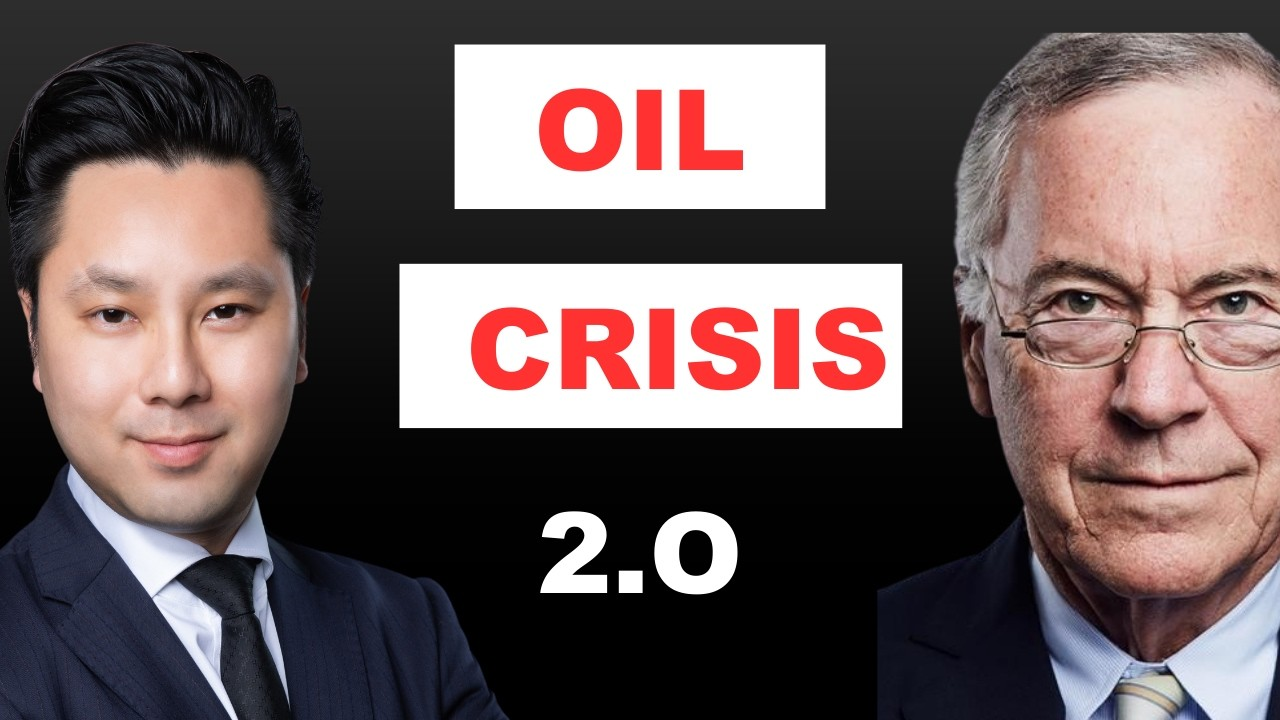
Podcast: David Lin
Compiled & Organized by: Yuliya, PANews
The Strait of Hormuz's lifeline is being choked, oil prices are surging, and the world is trembling, awaiting the "1979 crisis" to reoccur?
Don't be fooled by appearances! Johns Hopkins University professor Steve Hanke doused the panic sentiment with cold water in the latest podcast: the real crisis is not in oil prices but in the Federal Reserve's out-of-control money printing machine and the precariously high valuation bubble of the U.S. stock market. Additionally, this episode discussed the current stock market's bubble risks, the impact of war, and the geopolitical and global far-reaching effects brought by the Iran war.
PANews has compiled a text version of this dialogue.
Replaying the 1979 Oil Crisis? Actual Risks Lower
David: Are we on the brink of re-experiencing "Oil Crisis 2.0" of 1979? Looking back at 1979, the crisis began when the Iranian Revolution interrupted oil production from one of the world's largest exporters. The sudden drop in supply tightened global markets, leading to skyrocketing oil prices. In the United States, the immediate impact was gas shortages, with long lines at gas stations nationwide, and some states even experienced fuel rationing. Rising energy prices pushed up costs across the economy, and the Federal Reserve subsequently raised interest rates sharply to control inflation. That crisis also accelerated the establishment of the Strategic Petroleum Reserve (SPR) in the U.S.
Now, the markets are reacting again to geopolitical risks. The Strait of Hormuz, located between Iran and Oman, is the world's most important oil passage, with about 20 million barrels of oil (about one-fifth of global consumption) passing through it daily. As this strait has been closed due to conflicts involving Iran, oil prices have surged dramatically. Steve, welcome back to the program. How far are we from re-experiencing the second oil crisis we've not seen in nearly 50 years? What will happen next?
Steve Hanke: It's a pleasure to chat with you, David. To provide some context, let's review a bit of history. My first academic position was at the world-leading mining school, the Colorado School of Mines. In the late 1960s, specifically in 1968, I taught the first oil economics course there. The same year, I edited a book titled "The Political Economy of Energy and National Security," discussing the very topics we're talking about now. Later in late 1985, I developed a fundamental model for OPEC predicting it would collapse and oil prices would fall below $10 per barrel. This indeed happened in 1986, and prices fell as expected. At that time, I worked for the Friedberg Mercantile Group in Toronto, and based on my analysis, we held very large short positions, eventually controlling over 70% of the short interest in London market diesel contracts.
If we compare the current situation with 1978-1979, I believe the potential risk of disruption today is actually lower than it was then. There are several reasons:
In 1978, Iran’s oil production accounted for 8.5% of global supply, whereas now it only accounts for 5.2%.
The Middle East's production in 1978 accounted for 34.3% of global supply, which has now fallen to 31%.
In 1978, U.S. oil production accounted for 15.6% of the global supply, while now we've risen to 18.9%. We have decreased our dependence on foreign production.
Most importantly, our “oil intensity” (the amount of oil consumed per unit of GDP) has significantly decreased from 1.5% to 0.4%.
Oil Market: Supply Shock and Policy Response
David: Treasury Secretary Becerra mentioned just days ago that the government will issue a series of announcements. Currently, oil prices have surged to $86, and if this situation isn't resolved quickly, they will go even higher. The government clearly does not want gas station prices to rise. Besides implementing price controls, what else can the government do to stabilize gas prices for Americans?
Steve Hanke: If price controls are implemented, lines at gas stations will form because demand will exceed supply. If there's no intervention, the market will clear automatically; it will just be at a higher price.
To address the current shortage, the quickest way is to lift sanctions on Russia, allowing the massive "shadow fleet" sitting offshore to unload and sell their stored Russian crude. In fact, the U.S. has begun to pivot, allowing some Russian oil to flow to India.
David: How will America's allies react to the alleviation of sanctions on Russia? How will this affect the war in Ukraine?
Steve Hanke: Europe is being hit hard by the rise in energy prices. With Europe sanctioning Russia and the Nord Stream 2 pipeline being blown up, gas supplies from Russia to Europe have been significantly cut off. As a result, Europeans have had to primarily purchase liquefied natural gas from the U.S., which costs about three times that of Russian gas. So they are in a very tough situation, backed into a corner.
I think the idea of pivoting back to Russia is a compromise they may have to "swallow hard." Of course, I've suggested from the start not to impose any sanctions. I'm a free trader; I dislike sanctions, tariffs, or quotas at any time or place.
David: Do you think the Strategic Petroleum Reserve (SPR) will ultimately be tapped? Isn’t this the exact scenario for which the SPR was established in the 1970s? Currently, the Department of Energy reports that there are about 413 million barrels of oil in the SPR.
Steve Hanke: They can do that, and it is indeed its purpose. It would help. Remember a rule of thumb: for every $10 change in crude oil prices, gas prices at the pump will change by about 25 cents. At the moment we're talking on March 6, gas prices in most of the U.S. have already risen by about 50 cents. This is a significant issue. Wars come with various costs: the direct military costs of burning ammunition and fuel, the economic collateral damage we are discussing, and the extremely high loss of life (most of which are innocent civilians killed). Additionally, due to full tanks and the inability to export because the strait is closed, Iraq and Kuwait have recently been forced to shut down their largest oil fields. Shutting down oil fields can lead to potential equipment damage and high maintenance costs.
The Truth of Inflation: Money Supply is Key, Not Oil Prices
David: Let’s return to inflation. You just mentioned that rising oil prices will not cause inflation because inflation is caused by the expansion of the money supply. However, the well-known macroeconomic commentator Mohamed El-Erian stated that the more widespread the conflict, the greater the stagflation impact on the global economy. Can you explain why high oil prices won't immediately trigger inflation?
Steve Hanke: There’s a lot of erroneous narrative in newspapers claiming "rising oil prices will lead to severe inflation." Rising oil prices simply mean that the prices of oil, gas, and their derivatives are rising relative to all other goods, but that does not mean we will face overall inflation.
The best example is Japan:
During the 1973 oil embargo, oil prices surged, and the Bank of Japan adapted to this price increase by increasing the money supply, resulting in Japan not only facing rising relative oil prices but also severe inflation.
However, during the 1979 oil crisis, the Bank of Japan refused to increase the money supply as a compromise. The result was that Japan's oil prices rose, but inflation did not accompany it.
Inflation is always a monetary phenomenon. You must pay attention to the money supply. The reason I believe the U.S. cannot lower the inflation rate to a 2% target is that the broad money supply (M2) is accelerating in growth, bank lending is increasing significantly, banking regulations are loosening, and there is political pressure to lower the federal funds rate. More importantly, the Federal Reserve halted quantitative tightening (QT) in December of last year and shifted to quantitative easing (QE), and the Fed's balance sheet is actually expanding again.
David: The U.S. economy unexpectedly lost 92,000 jobs in February, and the labor market does appear to be weakening. Will the Fed slow its pace of rate cuts due to the current rise in oil prices?
Steve Hanke: No, I think they will keep a close eye on the labor market. By the way, this can largely be "attributed" to Trump's tariff policy. Tariffs were touted as a means to create jobs in the manufacturing sector, which is what he has been telling us. But in reality, manufacturing lost 108,000 jobs last year. Tariffs are killing jobs. If you look at the overall non-farm employment data, the jobs created last year were nearly zero, with only 181,000 jobs created in 2025, while 2.2 million could be created in 2024.
So, this "tariff person" is destroying the labor market. You can’t just listen to the media narratives; you have to look at the real data. This leads to my "Hanke 95% Law": 95% of what you read in financial media is either wrong or meaningless.
Stock Market Bubble is More Fragile
David: You mentioned at the start of the program that the current stock market is in a bubble. How exposed are companies in large indices to oil prices? Why does the stock market fall when oil prices rise?
Steve Hanke: Clearly, companies that directly or indirectly utilize oil (such as airlines or logistics companies) are hit harder.
But from a macroeconomic perspective, the price-to-earnings ratio (P/E) of the stock market in 1978-1979 was 8 times, whereas now it is as high as 28 or 29 times.
This means the current market is much more fragile than it was in 1978. When the market is in a bubble area, it is always susceptible to external shocks.
The wars in Israel and the U.S. against Iran are causing massive wealth destruction, not only from direct military costs of ammunition and fuel but also from the negative wealth effects stemming from distressed financial markets. If the stock market bubble truly bursts, people's wealth will shrink. Those who made money in the stock market and maintained America's exceedingly high consumption levels will see their wealth reduce, and they will begin to cut back on spending, such as postponing the purchase of new cars for a year or two. This negative effect will ripple through the entire economy.
The Fallacy of De-dollarization and Lessons from Hong Kong Currency
David: The President of South Korea announced the establishment of a 1 trillion won stabilization fund to address soaring energy prices. Asian countries are highly dependent on oil imports; will their financial interventions affect the dollar? Everyone is talking about "de-dollarization," is that true?
Steve Hanke: There are two erroneous narratives about the dollar: "selling off America" and "de-dollarization." These are completely garbage statements.
If you look at the data: net investments flowing into the U.S. grew by 31% year-on-year last year, and money keeps pouring into the U.S. The dollar compared to the euro (the world’s most important exchange rate) is very strong. The dollar has actually strengthened further since the outbreak of the war.
People talking about de-dollarization ignore data entirely, whether it's official data from the U.S. Treasury or data from the Bank for International Settlements, which demonstrates that the narrative of "de-dollarization" is fundamentally nonsense.
David: Central banks in Asian countries (like the Philippines and Indonesia) have had to suspend rate cuts due to the threats of oil prices, leading to their currencies being impacted. If you were an advisor to the central banks of these oil-importing countries, what would you suggest they do?
Steve Hanke: Stay steady. In places like Indonesia, you absolutely cannot loosen monetary policy, otherwise the Indonesian rupiah will take a hit. The currencies in these countries are very sensitive to interest rates.
Speaking of Indonesia, if they had adopted my advice when I was chief advisor to President Suharto (to establish a currency board system), they wouldn’t have this issue today. If the Indonesian rupiah was fully backed by the dollar and traded at a fixed exchange rate with the dollar, it would effectively be a clone of the dollar, just like the Hong Kong dollar.
Look at Hong Kong; the Hang Seng Index today (March 6) is one of the few markets that are up. The Hong Kong dollar is issued by a currency board, backed by 100% dollar reserves, maintaining a fixed exchange rate of 7.8 HKD to 1 USD. The Hong Kong dollar is essentially a clone of the dollar, so they do not have the worry of currency depreciation.
Strategic Risks and Uncertainty of the U.S. in the Middle East
David: China is estimated to have 40% to 50% of its crude oil imports pass through the now-closed Strait of Hormuz. Although they have the Malacca Strait as an alternative, oil supply will definitely be impacted. How do you expect China to respond or intervene?
Steve Hanke: China will try to do what all Gulf countries, Turkey, and Russia want to do—they all want this war to stop. I do not think China would watch Iran fall; I believe they will take all necessary measures to maintain that regime.
David: Do you think this conflict could spiral out of control and evolve into a global war beyond the Middle East? The Iranian Foreign Ministry stated that if U.S. ground troops intervene, they are prepared to greet the invasion of the U.S.
Steve Hanke: In my view, it has already spiraled out of control. There is a lot of speculation about whether the Iranian Kurds in northern Iraq will become U.S. proxy ground troops, and the situation is very murky. We are currently in the "fog of war," relying only on second-hand data for our speculations.
A dear old friend of mine, former head of Saudi intelligence and ex-ambassador to the U.S., Prince Turki Al-Faisal, recently stated in a great interview: Trump knows nothing about what he is doing in executing this war. It is one thing for the blind to lead the blind, but when the delusional lead the blind, you have a big problem.
David: What is the ultimate goal of the U.S.? The supreme leader has been assassinated, most commanders of the Iranian Revolutionary Guard have been eliminated, and regime change seems to be in progress. Why does it need to continue?
Steve Hanke: You act as if regime change is easy to achieve. According to Lindsey O'Rourke's academic work titled "Covert Regime Change," published in 2018, about 60% of regime change attempts that the U.S. has participated in since World War II have completely failed, while others have left a thoroughly chaotic mess. The history of regime change shows it to be a completely disastrous policy.
The U.S. is getting bogged down in a policy that is destined to fail; do not believe the words of those politicians in Washington. Trump's goals have always been shifting, but he will end up doing what Israeli Prime Minister Netanyahu tells him to do.
David: Is this related to containing China? The U.S. first controlled Venezuela (a friend of China and Iran) oil, is it now trying to fully take over Iran and control the Strait of Hormuz, thereby cutting off China's oil supply?
Steve Hanke: There is no doubt that China is affected, but that is secondary. As John Mearsheimer pointed out in "The Israel Lobby and U.S. Foreign Policy," the Israeli lobby has tremendous influence in Washington and has pulled Trump into this. For 40 years, Netanyahu has wanted to destroy Iran and Israel cannot possibly do this alone; it is a major U.S. operation. Essentially, the U.S. is fighting on behalf of Netanyahu.
David: So what strategic benefit does this have for the U.S.?
Steve Hanke: Very few benefits and enormous costs. In addition to economic and military costs, there are huge political costs. The American public is very opposed to this; I believe that the Republican Party led by Trump will suffer a terrible defeat in the midterm elections.
In the long term, the repercussions are even more devastating. Contrary to American political propaganda, the assassinated supreme leader will become a martyr in the Muslim world. This implies that in the foreseeable future, the Muslim world will almost inevitably become America's enemy. We are creating a large quantity of enemies for ourselves.
免责声明:本文章仅代表作者个人观点,不代表本平台的立场和观点。本文章仅供信息分享,不构成对任何人的任何投资建议。用户与作者之间的任何争议,与本平台无关。如网页中刊载的文章或图片涉及侵权,请提供相关的权利证明和身份证明发送邮件到support@aicoin.com,本平台相关工作人员将会进行核查。


