On March 9, 2026, the blockade of the Strait of Hormuz pushed energy prices higher, while at the same time, the cryptocurrency industry played out another frenzy under the shadow of high inflation. Stablecoin payment company KAST completed $80 million funding, with a latest valuation of $600 million, seen as a new entrance between traditional finance and the on-chain world; on the other side, Strategy‘s Bitcoin treasury trading volume soared to a historical high of $1.1 billion, while Zeta Network Group was approved for a 100-to-1 reverse stock split, signaling a capital market reshuffling narrative. These actions together form different aspects of the same crypto story: from payment infrastructure and treasury asset allocation to capital structure restructuring. Against the backdrop of WTI crude oil rising by 22% in a single day, breaking $110/barrel, cryptocurrency prices and risk appetite rose instead of falling, intertwining a main storyline of hedging and speculation—on one side, the imagination of a “digital safe haven” under inflation and geopolitical risks, and on the other, the profit-seeking impulse under high volatility and high leverage.
Oil Prices Surge to $110: The Dislocated Resonance of Inflation and Crypto Narratives
● Energy Shock Scenario: The blockade of the Strait of Hormuz triggered expectations of shipping and supply chain disruptions, with WTI crude oil prices quickly pushed up 22%, reaching $110/barrel, as the market reprices the inflation path for the upcoming quarters. Energy-importing countries face imported inflationary pressures, with production and logistics costs rising together, further squeezing the central bank's room for inflation control, leading risk assets and the bond market to sway in this uncertainty.
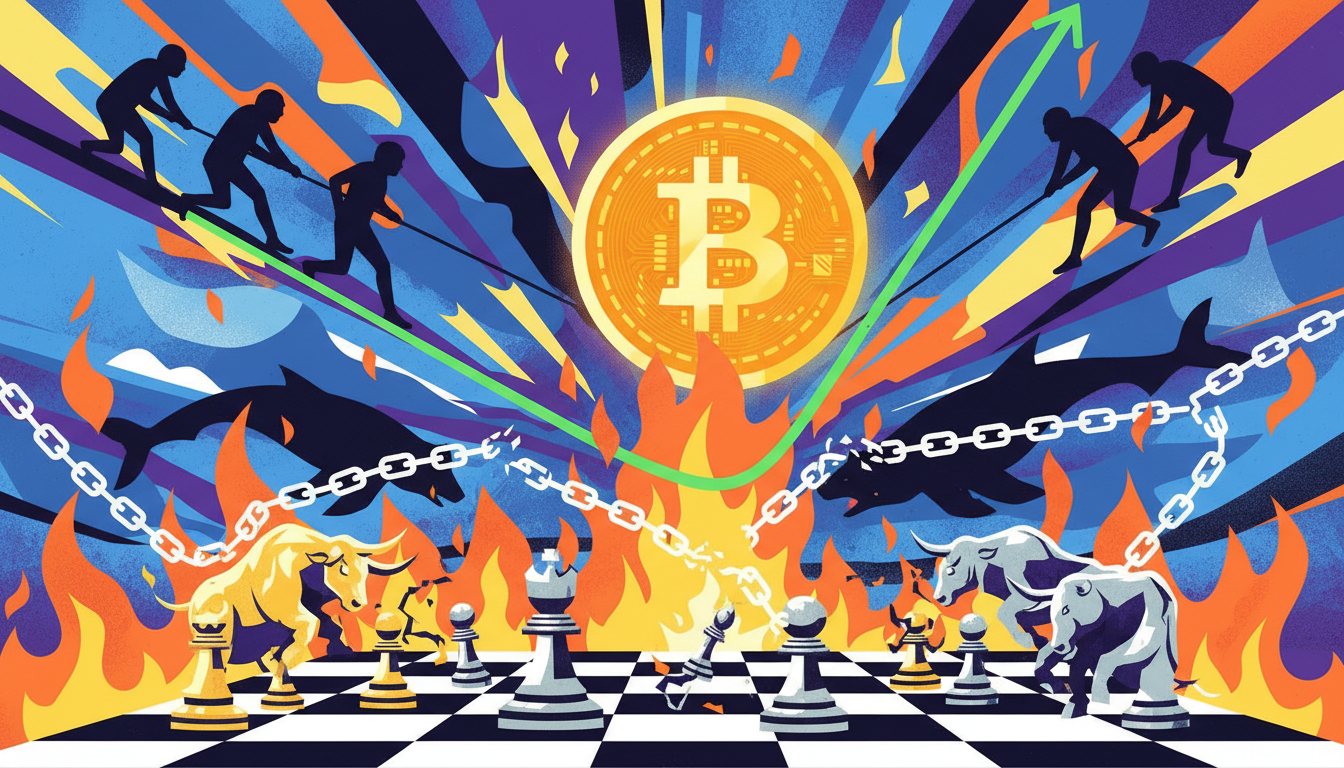
● Vulnerabilities of Traditional Assets: In the environment of an energy crisis, the memory of “double-kill” for stocks and bonds is awakened once more—concerns of profit erosion from high costs plague the stock market, while expectations of higher inflation suppress the bond market, weakening the outlook for real yields. Under these circumstances, funds begin to reassess assets that are less correlated with the macro cycle and have strong cross-border liquidity; the “safe-haven narrative” for cryptocurrencies like Bitcoin has been revisited as a potential hedge against currency devaluation and capital control risks.
● Tension Between PoW Costs and “Digital Gold”: However, the surge in energy prices directly raises the electricity and operational costs for PoW miners, with marginal expenditures for sustaining and expanding computing power soaring, creating inherent tension with the narrative of Bitcoin being packaged as “digital gold.” On one hand, miners are driven close to the brink of life and death by rising costs from oil and gas; on the other, secondary market investors see the same asset as a safety net against inflation and geopolitical risks, creating a structural contradiction that lays the groundwork for subsequent price repricing.
● Transaction Fee Wars and Leverage Amplifiers: In a high-volatility environment, leading exchanges ramp up competition with activities like zero order fees, attempting to seize the initiative between incremental users and existing depth. Binance launched zero fee activities alongside new trading pairs, reducing costs for short-term trading and market-making, essentially injecting higher trading elasticity into the volatility. These seemingly “beneficial” operational tactics, driven by macro volatility from energy and inflation, become technical amplifiers that magnify leverage and accelerate capital rotation.
$80 Million Bet: How Capital Selects “Compliant Entrances”
● Timeline and Valuation Leap: According to the briefing, KAST completed a $10 million seed round in December 2024, and within less than a year, on March 9, 2026, secured $80 million in new financing, with valuation soaring to $600 million. This acceleration from seed round to billion-dollar valuation reflects a capital willingness to concentrate bets on a few tracks seen as “critical infrastructure” during a period of heightened macro uncertainty, with stablecoin payment entrances being one of them.
● Preferences Under Inflation and Capital Control Expectations: The energy shock and warming inflation expectations, along with the expected cross-border capital controls from geopolitical tensions, have made programmable, auditable, and compliant cross-border payment channels scarce. In this context, compliant stablecoin payment entrances are viewed as key bridges connecting traditional banking systems and on-chain liquidity, capable of accommodating trade and remittance needs while operating within regulatory oversight; such financial infrastructures in the “gray area” are naturally favored by venture capital and institutional funds.
● Signal of $100 Million Annual Recurring Revenue: The briefing discloses that KAST expects an annual recurring revenue (ARR) of $100 million, the only publicly available revenue magnitude data currently, indicating that its business has crossed the purely conceptual stage and entered the sustainable cash flow validation period. For institutional clients, this means their service targets are likely focused on cross-border enterprises, financial institutions, or large payment scenarios, with far higher demands for stability, compliance, and auditability compared to retail payments, reflecting a strong demand profile for “institutional payment entrances.”
● Restraint in Not Projecting Market Share: No specific market share and user structure data of KAST is publicly available, and the briefing clearly lists this as missing information. This article deliberately refrains from projecting its scale and market share to avoid extrapolating the entire market structure from a single revenue metric. With limited information, what can be confirmed is only the strong preference of capital for this direction, rather than its precise ranking or width of competitive moat within the industry.
$1.1 Billion Bitcoin Treasury: Institutions Saving Themselves in Mutual Conflict
● Record Treasury Trading Volume: The briefing shows that the Bitcoin treasury trading volume of Strategy has climbed to $1.1 billion, setting a historical high; this data itself is a footnote of the structural migration of capital. Corporates and institutions no longer view Bitcoin simply as a speculative target, but through treasury management and asset allocation, they integrate it into a longer-term asset-liability portfolio, considered alongside traditional assets like cash, bonds, and gold.
● Combination Substituting “Quasi-Treasury + Quasi-Gold”: In the current context of repeated U.S. inflation expectations and high uncertainty regarding interest rate paths, the actual yield and safe-haven reputation of traditional treasury bonds are both damaged. Some institutions view treasury-type Bitcoin allocations as a substitute for a combination of “quasi-treasury yield expectations + quasi-gold hedging attributes”: the former reflects long-term profit space and liquidity, while the latter shows hedging function against currency overissuance and geopolitical risks, although this logic carries far higher volatility and drawdown risks than real treasury bonds and real gold.
● Boundaries of the Institutionalization Process: Financial products around Bitcoin are accelerating in institutionalization, from treasury management solutions to potential ETFs and accompanying derivative structures, gradually building a toolbox for servicing institutional funds. Since the briefing disclosed no specific ETF data or changes in institutional holdings, this article only emphasizes this collaborative path from a trend perspective: the demand for treasury allocations resonates with compliant financial products, promoting the transition of Bitcoin from “speculative chip” to “asset class,” rather than fabricating any capital flows into digits.
● “Mutual Conflict” in the Energy Crisis: Ironically, in the context of an energy crisis, many institutions face a comprehensive rise in production, transportation, and data center costs, while also hoping to hedge against currency devaluation and inflation risks by holding Bitcoin and other crypto assets. This results in their balance sheets being under pressure from energy costs while simultaneously possessing high-volatility hedging tools, creating a typical situation of “mutual conflict”: if crypto prices rise alongside inflation, the hedging is effective; if a macro environment shift triggers a collective withdrawal of risk assets, treasury positions may amplify overall volatility.
Reverse Stock Splits and Zero Fees: The Quiet War Between Exchanges and Capital Structures
● Intent of 100-to-1 Reverse Stock Split: Zeta Network Group was approved to implement a 100-to-1 reverse stock split; from a technical perspective in the capital market, this attempts to maintain compliance listing thresholds and institutional investment viability by increasing the per-share price. A higher stock price helps avoid the risk of being delisted while striving to regain liquidity and research attention amidst information noise; however, the briefing did not provide any stock price or market capitalization ranges, and this article focuses only on the structural adjustment action itself.
● Zero Fee War Among Exchanges: At a time of rapid fluctuation in spot and derivatives demand, Binance highlighted a short-term strategy in user acquisition and liquidity depth by launching new trading pairs alongside zero order fees—lowering trading friction and stimulating market-making and high-frequency trading, thereby seizing larger order book shares in peer competition. For users, the reduction in fees is a clear benefit; for the platform, it is a wager to exchange profit margins for market share and liquidity barriers.
● Linking Technical Moves with Trading Demand: Whether it's a reverse stock split or zero fee activities, they essentially revolve around the trading demands of the capital and crypto markets. The former attempts to enable traditional capital to maintain allocation pathways and liquidity toward crypto-related targets by adjusting the capital structure; the latter, during periods of extreme price volatility for on-chain assets, utilizes cost advantages to absorb larger scales of spot and derivatives trading. However, in the absence of clear data support, this article does not extrapolate any specific stock price performance or trading volume changes.
● Building the “Stage Setup” for the Next Round of Volatility: In the macro environment where oil prices are high and inflation expectations are tilted upwards, such seemingly technical structural adjustments look more like setting up a “stage” for the next round of more intense market volatility: listed companies maintain their legal status and trading channels in the capital market, while exchanges solidify liquidity fortifications through fee wars. When macro or policy catalysts emerge, these pre-established structures will amplify the speed of quoting, sentiment, and capital migration.
From Lobster Meme to Miner's Life and Death: The Tear Between Bubble and Fundamentals
● Emotional Sample of “Lobster” 250% Surge: During the window where geopolitical risks and the energy crisis continue to ferment, the “Lobster” meme coin surged 250% in 24 hours, becoming a reflection of extreme sentiment. Some capital entered crypto under the safe-haven narrative but quickly got siphoned away by the high volatility and narrative-driven trading in the market, turning to mad gambles on small-cap memes. Macroeconomic fear and local euphoria coexist, indicating that market psychology is torn between “survival” and “getting rich.”
● Class Differentiation Between Meme Frenzy and Miner's Predicament: On one side, short-term funds chase multiple ups in the meme segment; on the other, PoW miners face serious pressures from rising electricity and operational costs amid soaring oil and gas prices, forming an internal “class differentiation” within crypto. Creators and speculators can swiftly exit amid extreme fluctuations in on-chain assets, while capital-intensive miners must confront equipment depreciation, power contracts, and locked long-term investment cycles, experiencing entirely different risk structures within the same track.
● Amplifying Effects of Zero Fees and High Volatility: The combination of zero fees and high volatility environments at exchanges attracts short-term strategies and high-leverage speculative funds to frequently enter and exit the market. Such funds primarily serve to capture spreads and harvest volatility rather than long-term allocation and value discovery, with the “financialization layer” of the crypto market gaining weight in trading aspects. The result is that when macro risks heat up, the dominance of price volatility often falls into the hands of high-frequency and leverage funds, instead of long-term holders genuinely aiming for hedging.
● Repricing Risks from Coexisting Fundamentals and Bubbles: When macro narratives reach their extremes—including inflation, expectations of capital controls, geopolitical conflicts, and energy crises—there exist genuine demand for payments and treasury (such as the data from KAST and Strategy) within the crypto industry, yet there are also seriously over-leveraged memes and bubble excesses. Once macro expectations shift or regulatory and liquidity environments suddenly tighten, the market may undergo a sharp repricing of “safe-haven assets” versus “high-risk chips,” while many current asset prices are evidently not well-prepared for this.
The Long Night of Inflation Is Not Over: Can Crypto Maintain the Dual Narrative of Hedging and Institutionalization?
The energy crisis and inflation pressures have extended the shadow of global asset pricing; in this context, KAST’s $80 million funding and $600 million valuation, Strategy's historical high of $1.1 billion in Bitcoin treasury trading volume, and Zeta Network Group's 100-to-1 reverse stock split all point to a clear direction: crypto assets are transitioning from marginal speculative goods to being institutionalized as part of payment infrastructure and asset allocation tools. This process is not linear nor purely a “getting on board story,” but rather a complex reconstruction filled with technology, compliance, and capital battles.
At the same time, crypto is packaged as a “new safe haven” against inflation and geopolitical risks, yet still rife with meme frenzies and high-leverage speculation. From the extreme case of the “Lobster” surging 250% in a day to short-term betting ignited by zero-fee trading activities, hedging and speculative gambling coexist in the same market, forming the most fundamental internal contradiction in the crypto narrative—wanting to attract institutional funds while unwilling to give up the lucrative opportunities brought by high volatility.
Looking ahead, under the premise of gradually clarifying regulatory and compliance frameworks, payment tracks and treasury configurations are likely to become the primary entrances for institutional funds to continue expanding their crypto exposures: the former addresses cross-border settlement and fund circulation efficiency, while the latter provides new dimensions for asset combinations. KAST bridges the front-end payment experience, while Strategy adds new weights to the asset side, both promoting the industry's evolution towards a direction that is “visible and calculable.”
However, it is crucial to be wary that the simplistic myth of crypto's hedging attributes may be ruthlessly corrected in the next round of volatility. Under high energy and computing costs, and frequent reversals in macro expectations, the future volatility of the crypto market is likely to become more severe rather than milder. For participants, what truly needs to be established is not a belief in a single narrative, but a clear understanding of liquidity cycles, macro environments, and their own risk tolerance.
Join our community to discuss and get stronger together!
Official Telegram community: https://t.me/aicoincn
AiCoin Chinese Twitter: https://x.com/AiCoinzh
OKX Welfare Group: https://aicoin.com/link/chat?cid=l61eM4owQ
Binance Welfare Group: https://aicoin.com/link/chat?cid=ynr7d1P6Z
免责声明:本文章仅代表作者个人观点,不代表本平台的立场和观点。本文章仅供信息分享,不构成对任何人的任何投资建议。用户与作者之间的任何争议,与本平台无关。如网页中刊载的文章或图片涉及侵权,请提供相关的权利证明和身份证明发送邮件到support@aicoin.com,本平台相关工作人员将会进行核查。