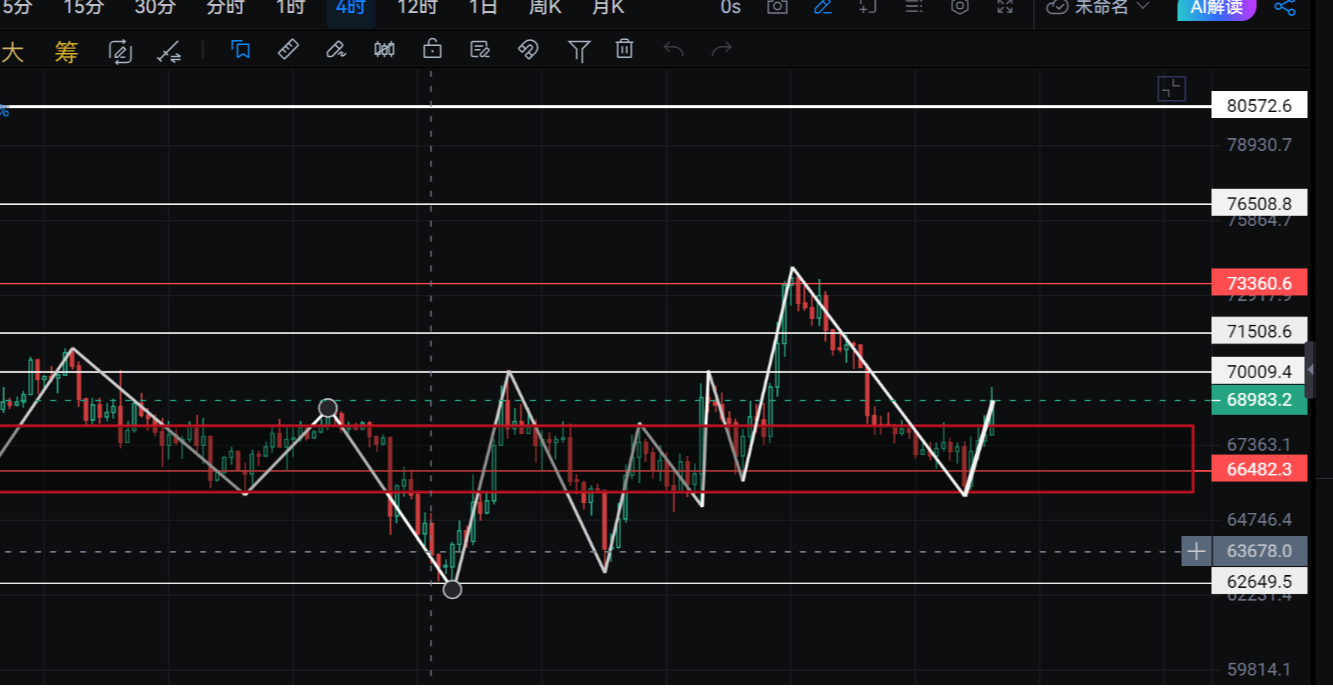
On March 9, 2026, Eastern Standard Time, the Bitcoin price once again broke through the crucial psychological barrier of 69,000 USD, forming a new round of price discovery on multiple trading platforms. Market data shows that the Bitcoin price increased by approximately 2.5% to 4.7% in the past 24 hours, reflecting characteristics of concentrated capital pushing the price up rather than a gradual climb. Meanwhile, on-chain monitoring indicates large withdrawals from long-dormant whale addresses, along with contract whales adding over 30 million USD in short positions. These actions coinciding with the new price highs have led to a situation where both “top warnings” and “continuing advances” are present. At this new high, amid the interplay of risk aversion expectations and derivative market dynamics, bulls still dominate overall, but market divergence regarding future price movements and pace is rapidly enlarging.
Impacting 69,000 USD: New Highs and Psychological Pressure Zones
● Key Price Zone: According to market data from platforms like HTX, the Bitcoin quotes on exchanges such as OKX, HTX, Bitget are concentrated in the 68,900 to 69,050 USD range. This zone corresponds not only to previous highs but also represents a psychological pressure zone where mainstream traders have concentrated orders during trading sessions. The repeated struggle for price above and below this range visually reflects the balance of power between bulls and bears.
● Ascending Momentum: Statistics from multiple platforms show that Bitcoin recorded a price increase of 2.5% to 4.7% within 24 hours, indicating a mid-to-high intensity surge for the day. This reflects a greater tendency for capital to prefer concentrated spurts rather than slow climbs over a long period. This momentum typically suggests that significant capital is actively stepping in around key price points, attempting to break past previous highs to open new price spaces.
● Price Discovery Phase: Technically, approaching and attempting to break previous highs signifies that the market has officially entered a new price discovery phase, where trend traders and momentum capital have a stronger tendency to follow “new highs.” An increase in break-out willingness will amplify the motivation for late-buyers to enter, making technical traders and quantitative capital more eager to add long positions near critical price points.
● Relatively Gentle Slope: Although Bitcoin has neared historical high levels, the current daily increase remains within single digits, with no extreme increases of over 10% yet observed. This relatively smooth upward slope indicates that the current trend is more akin to a steady ascent rather than a typical “vertical line” bubble peak, favoring the prolongation of market longevity but also reserving space for more intermediate washing and volatile fluctuations.
Awakening On-chain Whales: Withdrawals and Short Position Hedging
● Dormant Whale Alert: On-chain data platform Onchainlens has detected that the long-dormant address bc1qac0zzm5xzx7rvzuqaskmcy9ge9chwa0mcnx6v8 recently withdrew 404.38 BTC, seen as one potential “top warning” signal as the price approaches critical high levels. Historically, the awakening of such large, old addresses is often interpreted by the market as early holders considering cashing out gains, thereby enhancing caution among some investors.
● Contract Whale Shorting: Derivatives monitoring agency Hyperinsight shows that contract whale pension-usdt.eth has added about 34.42 million USD in Bitcoin short positions at the current high price range, betting that there is significant room for price correction. Such a scale of short positions indicates that substantial capital near the current price is still choosing to hedge or take directional shorts, positioning for potential downward trends.
● Stalemate at Floating Losses: Real-time profit and loss data shows that this whale's short position currently sits at approximately 1.04% in floating losses, indicating that while bulls have a slight short-term edge, they have not established absolute pressure on the bears. This state of “light floating losses” keeps the battle between bulls and bears in a stalemate, not triggering widespread liquidations nor resulting in significant active stop-loss rallies.
● Divergence Amplified: On one hand, there are large on-chain withdrawals; on the other hand, there are substantial shorts in the derivative market appearing simultaneously, directly amplifying the market's cognitive divergence regarding “whether we have approached the periodic top” and “whether there is still upward momentum.” For ordinary investors, this structure implies that the market is more sensitive to emotional and capital flow changes, making it easier for sudden information to trigger directional upheaval.
Resurgence of Risk Aversion Narrative: Oil and CPI Expectations
● Oil Risks and Inflation Concerns: On a macro level, the potential risk of the closure of the Strait of Hormuz has been viewed by multiple institutions as a scenario that could push oil prices to 150 USD per barrel. Should this assumption approach reality, it would significantly strengthen global inflation pressure expectations. Rising energy costs not only increase burdens for businesses and households but also prompt markets to reassess asset pricing and risk premium levels.
● Activation of Safe-haven Properties: Against the backdrop of escalating geopolitical tensions, some global funds have begun to reevaluate Bitcoin as a safe-haven asset, considering it alongside traditional hedging tools like gold and oil. Particularly, as concerns over fiat currency purchasing power erode due to inflation, the combination of Bitcoin's “scarcity + cross-border liquidity” has attracted a portion of funds seeking diversified hedges.
● Uncertainty in CPI Trajectory: Bank of America predicts that February CPI in the United States will increase by approximately 0.3%. This level is not extreme nominally but is sufficient to keep the market highly uncertain about future Federal Reserve rate cuts. If inflation declines less than expected, monetary policy may maintain a tight balance, forming recurrent pulls on equity markets and high beta assets, which also becomes an important external variable influencing Bitcoin's volatility in the short term.
● Restructuring Asset Weights: Under the dual pressure of inflation and geopolitical risks, global portfolios are rebalancing weights among gold, oil, and Bitcoin. On one hand, gold and oil remain traditional hedging and safe-haven tools; on the other hand, Bitcoin, due to its higher liquidity and return elasticity, is gradually being included in some institutions and high-net-worth investors' allocations as a “high-volatility hedge supplement,” enhancing its sensitivity to macro data and geopolitical news.
Derivatives Sector: Bullish Premium and Hedging Resonance
● Hedging under Crowded Long Positions: From the performance in the futures and perpetual contract markets, the price spread and premium levels have narrowed compared to earlier periods, combined with large whale shorts experiencing slight floating losses, indicating that current long positions exhibit clear crowding characteristics. Nevertheless, there remains active hedging at high levels. The leverage game between bulls and bears makes a simple one-sided imbalance in the market difficult.
● Potential Supply Source Above: Large short positions structurally provide downside protection for institutions or large holders, which can hedge the losses of spot or long positions should the price come under pressure. Simultaneously, these positions also constitute a potential selling pressure and supply source above in the market, and when prices repeatedly fail to break through, they may trigger some bulls to choose to take profits and exit, exacerbating the degree of pullback.
● Build-up of Short Squeeze Risk: If Bitcoin can effectively stabilize above 69,000 USD and establish new price-volume support, the current whale shorts at slight floating losses may be forced to cover their positions in batches to control risk. This process will create passive buying pressure in the short term, thereby amplifying upward momentum, evolving into a structural short squeeze scenario that accelerates breakouts in critical time windows.
● Amplifying Factor of Macroeconomic Data: In the context where long and short positions are highly concentrated within key price ranges, any unexpected macro-level data (such as CPI, employment data, or policy statements) could serve as a catalyst for large-scale position shifting and liquidations. The tighter the leverage structure, the greater the market's price elasticity to sudden information, leading to amplified volatility and transaction volume in the short term.
DeFi Security Rings Alarm Again: NFT Attacks and Risk Appetite
● Security Incidents Expose Vulnerabilities: According to community and security monitoring information, the NFT platform gondixyz was attacked, resulting in a loss of approximately 230,000 USD. Although this incident is significantly smaller than historical major security breaches in digital scale, it nonetheless highlights the current vulnerabilities in the DeFi and NFT sectors concerning contract security and risk control systems.
● Emotional Amplification Effect: During the phase when Bitcoin is at high price levels, even incidents with relatively modest amounts of security breaches can be easily amplified by market sentiment into systemic concerns for the entire on-chain ecosystem. Investors tend to enhance risk factors in high-valuation environments, leading them to reduce exposure to high-risk assets in order to hedge against potential cascading shocks.
● Capital Flow Back to Main Assets: Compared to the security uncertainties in the DeFi and NFT application layers, Bitcoin's long-term stable record in consensus and security enhances its relative attractiveness during periods of heightened risk. Liquidity that was previously spread across high-risk protocols tends to flow back to major assets like Bitcoin, reducing exposure to “contract breaches” and other tail risks.
● Dual Motivations Compound: The risk appetite cooling from security incidents, coupled with Bitcoin's own high volatility profile, creates a situation where it simultaneously holds both safe-haven allocations and profit-taking motivations in the short term. On one hand, some funds view it as a relatively safe on-chain asset; on the other hand, early bulls might choose to lock in gains by reducing exposure during high prices, leveraging the narrative of security incidents and macro uncertainties.
Maximized Divisions Between Bulls and Bears: Price Discovery Still in Early Stages
● High Prices Coexisting with Calm: As Bitcoin approaches 69,000 USD, it signifies the beginning of a new stage of price discovery, but the simultaneous appearance of withdrawals from dormant on-chain whales and large short positions in the contract market serves as a constant reminder for market participants to avoid blind optimism amid high emotions. Risks of liquidity reversal and collective profit-taking remain to be watched below high price levels.
● Dual-edged Sword of Risk Aversion and Volatility: Macroeconomic inflation expectations and geopolitical risks have provided Bitcoin with new safe-haven narrative space but also naturally amplify its price volatility range. As a high beta asset, while Bitcoin bears the role of “hedging,” it also increases sensitivity to changes in interest rate expectations, energy prices, and policy directions, making its risk-return profile more extreme.
● Key Variables Awaiting Realization: In the mid to short term, Bitcoin's trend direction will largely hinge on the rhythm of CPI data and Federal Reserve policy expectations realization and whether existing large short positions are forced to cover or choose to expand. If inflation and policy paths lean toward moderation, coupled with passive cover from shorts, bulls still have the opportunity to further explore new high areas in prices.
● Prioritize Risk Management: In the current environment of maximized disparity between bulls and bears, investors need to focus on large on-chain transfers and derivative leverage structure changes, placing position management and risk control above the pursuit of returns. Whether it is blind chasing highs during extremely optimistic sentiments or panicking and cutting losses during short-term sharp pullbacks, both will be amplified into irretrievable decision costs in this high volatility phase.
Join our community to discuss and become stronger together!
Official Telegram community: https://t.me/aicoincn
AiCoin Chinese Twitter: https://x.com/AiCoinzh
OKX Benefit Group: https://aicoin.com/link/chat?cid=l61eM4owQ
Binance Benefit Group: https://aicoin.com/link/chat?cid=ynr7d1P6Z
免责声明:本文章仅代表作者个人观点,不代表本平台的立场和观点。本文章仅供信息分享,不构成对任何人的任何投资建议。用户与作者之间的任何争议,与本平台无关。如网页中刊载的文章或图片涉及侵权,请提供相关的权利证明和身份证明发送邮件到support@aicoin.com,本平台相关工作人员将会进行核查。