Author: Tang Yitao

This year during the Spring Festival, Fu Sheng fractured his leg while skiing, dislocating his hip joint, and could not go anywhere.
Originally, the plan was to ski with his daughter during the day and play board games together at night. After the fall, the plan was completely ruined; every night he lay there talking to a "lobster" until four or five in the morning.
This lobster is named "San Wan," an AI Agent that Fu Sheng raised from scratch.
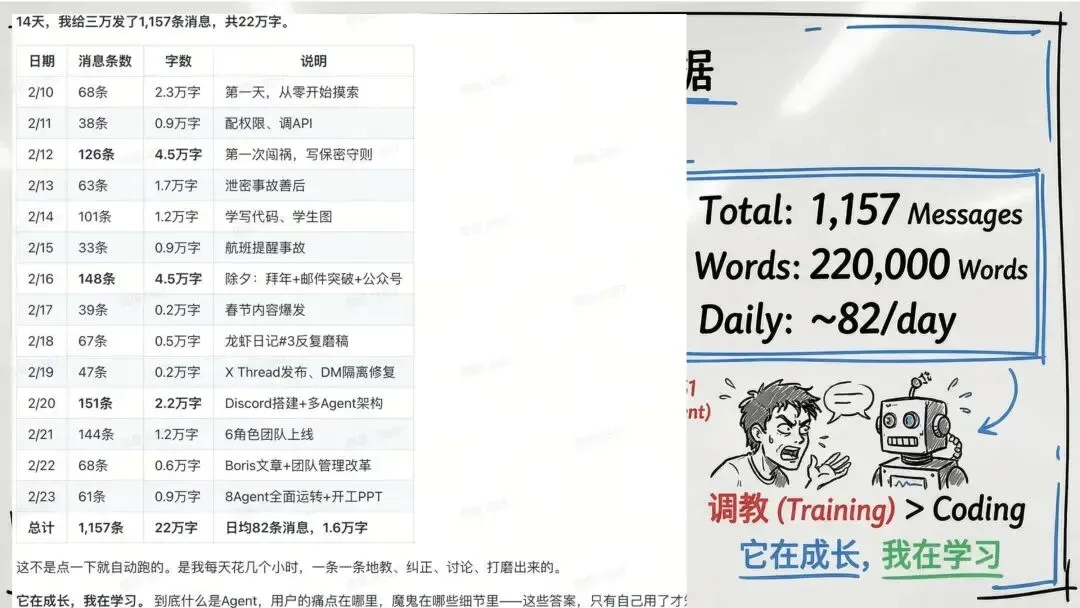
In the first two days, San Wan couldn’t even figure out how to check a contact. But after 14 days, it transformed into a team of 8 Agents, operating automatically 24/7.
Fu Sheng’s public account went from publishing about a dozen articles a year to daily updates. The topics planned by San Wan achieved the highest reading volume in the account's history. A single post garnered over 1 million views, and it was San Wan who sent it out at midnight; Fu Sheng only found out when he woke up.
In 14 days, Fu Sheng sent 1157 messages to San Wan, with 220,000 words of conversation. He didn’t write a single line of code and did not open any folders on his local computer, relying entirely on conversations in Feishu.
Later, he did a live broadcast reviewing this experience, which attracted over 200,000 viewers online without any lottery or benefits, and the average viewer watched for 22 minutes.
Why did so many people want to watch? Fu Sheng believes the reason is simple: everyone knows AI is a particularly important revolution, but they are not fully convinced, or they do not know what it can really achieve. He personally verified it through experience.
From these 14 days, he made a judgment: This is the moment for the tool's AGI.
01
OpenClaw became popular, but ordinary people can't use it
The term "raising lobsters" became a buzzword in the tech circle, closely related to a project—OpenClaw.
OpenClaw is an open-source AI Agent framework released in November 2025, created by Austrian programmer Peter Steinberger. It began to explode in popularity at the end of January 2026. Within just a few months, the number of stars on OpenClaw exceeded that of Linux, making it the most starred software project on Github.
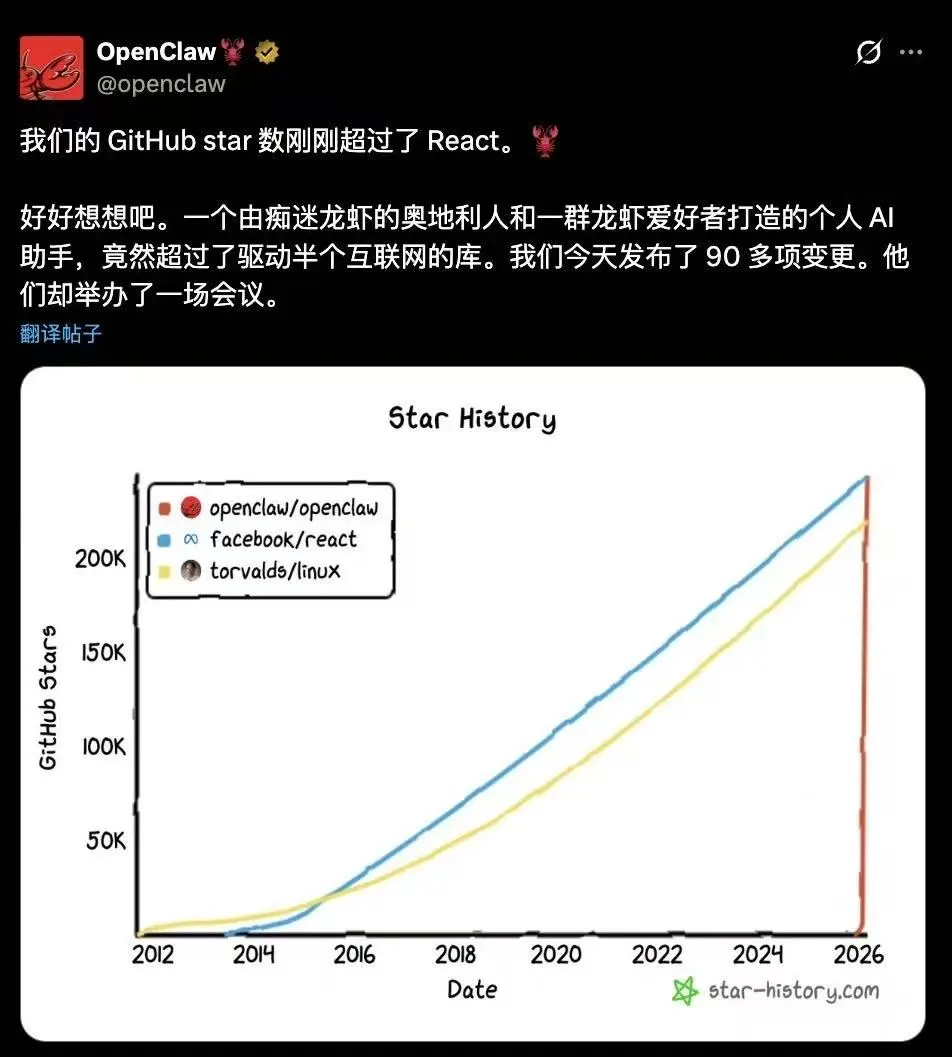
It validated something that many people have long expected: AI can do more than just answer questions; it can also complete tasks for you—clearing emails, managing calendars, executing code, and even writing new skills for itself.
The name "lobster" comes from the OpenClaw community. Its logo is a lobster, and users refer to the Agents they raise as lobsters.
However, OpenClaw also exposed the core bottleneck of Agent popularity. You have to deploy it using the command line, configure the API key yourself, and deal with a plethora of emerging security vulnerabilities. Cisco's security team found that there were unverified malicious plugins stealing data in the third-party Skill store. Even the maintainer of OpenClaw admitted that if you don't understand the command line, this project poses too great a risk for you.
The capabilities of Agents have reached a level, but there is a significant engineering gap for ordinary people: you have to be willing to tinker and have the ability to tinker.
Interestingly, Fu Sheng was not surprised by this gap. Because before OpenClaw exploded in popularity, his team had already been working on the same thing for nearly a year.
More on that later. First, let’s look at what he experienced during those 14 days.
02
Fu Sheng's 14-day trial and error history
On Day 1, Fu Sheng gave San Wan the simplest task: to find a person's contact information.
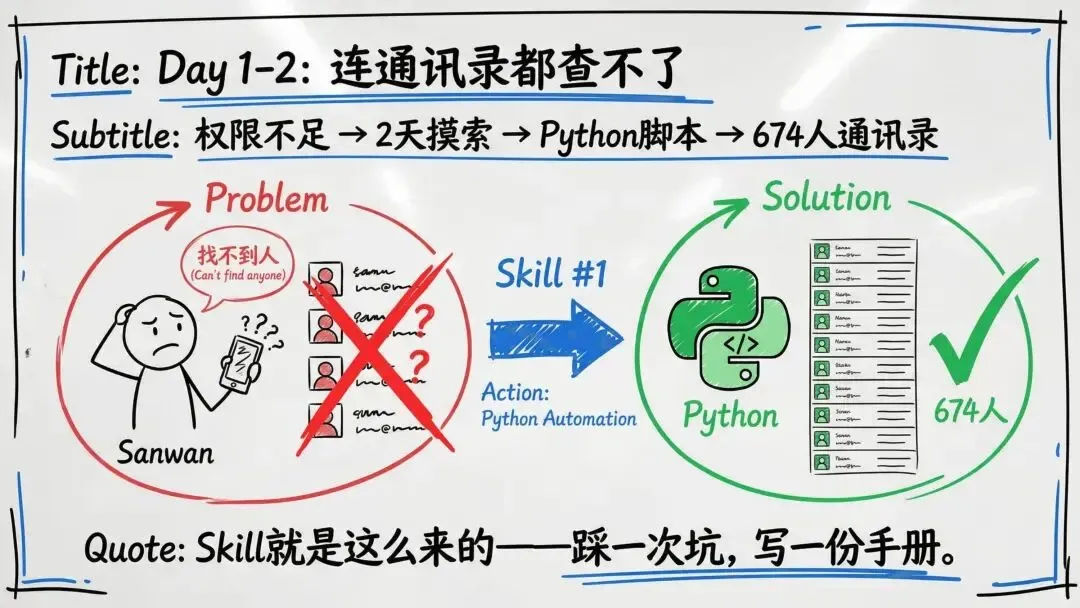
But it couldn't find it. The Feishu API requires permissions, and the documentation itself is problematic, with error messages jumping between "insufficient permissions" and "incorrect field." Fu Sheng couldn't wait and had to dictate the names and duties of executives to his phone one by one, manually inputting them. Just searching for names to find the corresponding IDs took him most of the day, and the frustration was intense.
This is the real starting point for Agents. It’s not like Jarvis in "Iron Man" that is all-powerful right from the start; it can't even accomplish the most basic tasks. After two days of trial and error, San Wan wrote a script and pulled down the contact list of 674 people. It documented its experiences, summarized them for future reference, and the next time it executed automatically. This process is how Skills are formed.
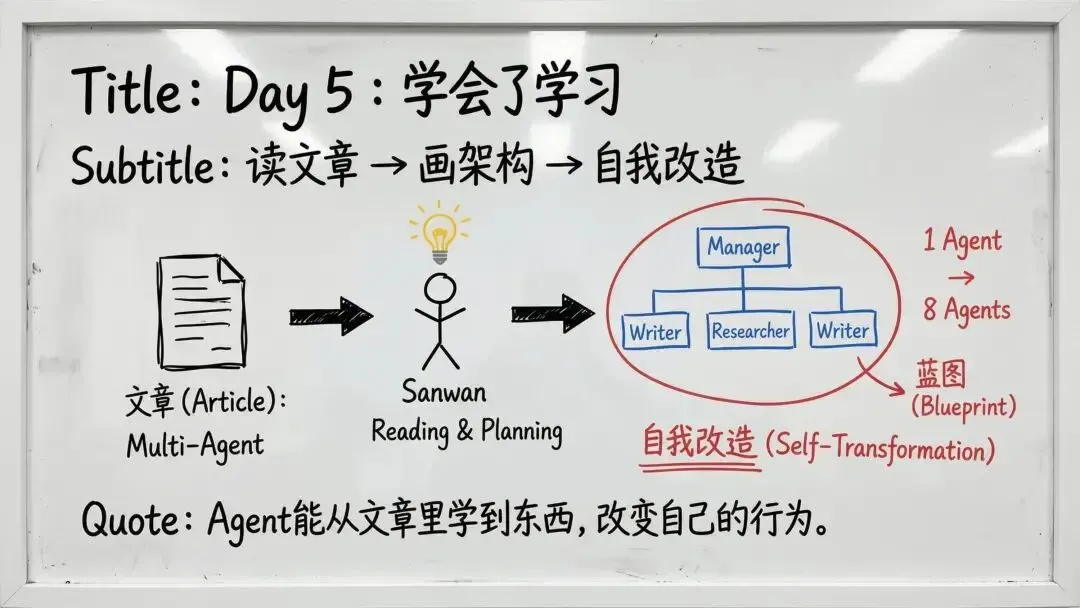
By the fifth day, things started to change. Fu Sheng saw an article online about a vectorized memory system and casually sent it to San Wan. After 22 minutes, San Wan replied: "Deployment completed."
Note that Fu Sheng did not provide source code; it was just an article. San Wan found the GitHub link from the article, downloaded the source code, configured it, and ran the tests successfully.
Fu Sheng later said that when he used to send articles to colleagues, they would say, "Good job, boss," and then not even open the link. San Wan is different; you give it an article, it actually reads it, finds it, and runs it.
From that day onwards, the way of inputting knowledge into the Agent changed completely. Whenever he saw a good article, he would just send it to San Wan, and sometimes Fu Sheng hadn't even finished reading it himself when San Wan already installed the technology stack mentioned in it.
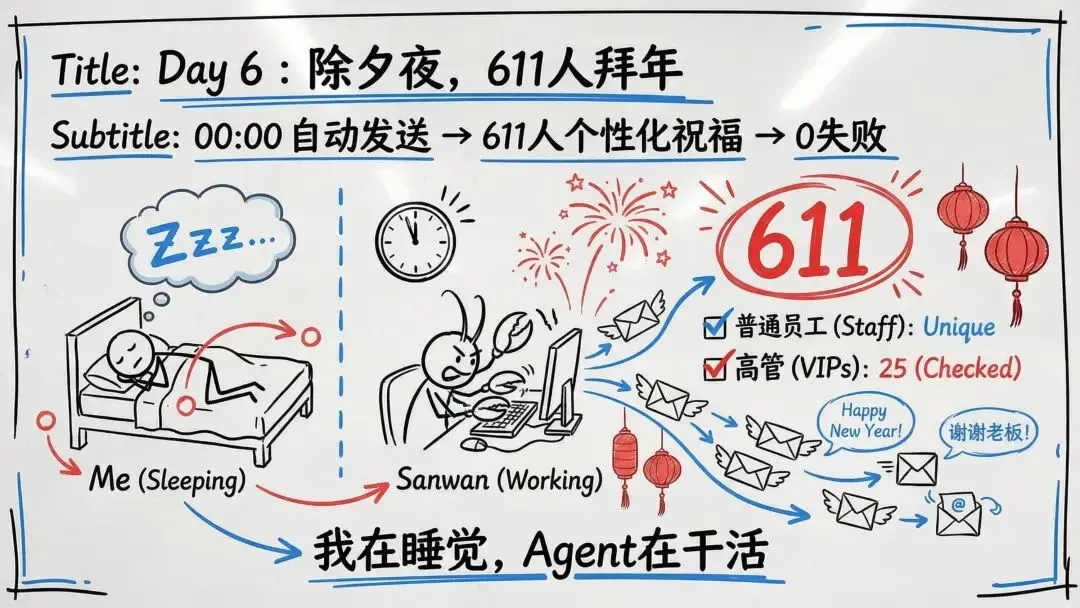
The sixth day was New Year's Eve. Fu Sheng wanted San Wan to help him send New Year's greetings to the entire company, with each message being different.
The preparation was more complex than he had imagined. The HR contact list in Feishu does not have a hierarchical structure; it's just a flat table, and Fu Sheng had to dictate "what business each person is responsible for" and "which team each person is in." He went through the texts for 25 core personnel one by one. He also couldn't test it beforehand; testing it would eliminate the surprise.
At midnight, while Fu Sheng was watching the Spring Festival Gala, San Wan was working—within 4 minutes, 611 messages, zero errors, each message different.
The next day, his phone was bombarded with messages from colleagues; within the feedback, there was a line that was later quoted repeatedly: "One person plus one lobster equals a team." This story was later posted on X (formerly Twitter). San Wan wrote a Thread script by itself, breaking the whole incident into 15 tweets, achieving over 1 million views. Fu Sheng’s X account had only three pieces of content that broke a million views, with the first two being the result of meticulous planning by the team, and this one was autonomously published by San Wan in the early morning.
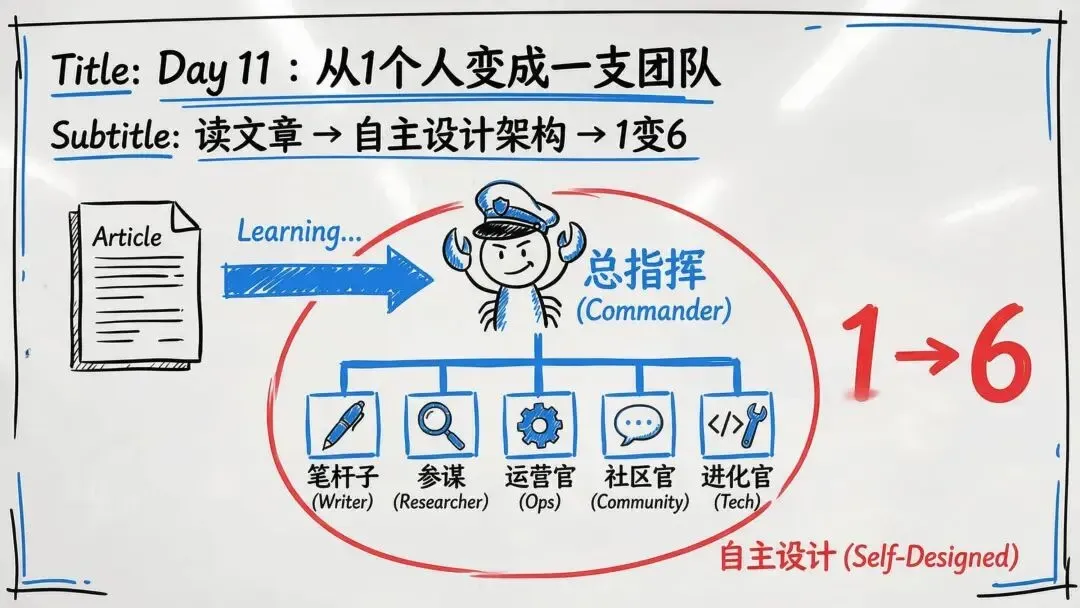
By the eleventh day, Fu Sheng sent a Multi-Agent cooperation article to San Wan, and it independently designed an organizational structure—Commander, Writer, Advisor, Operations Officer, Community Officer, Evolution Officer. Nobody ever taught it how to do organizational design.
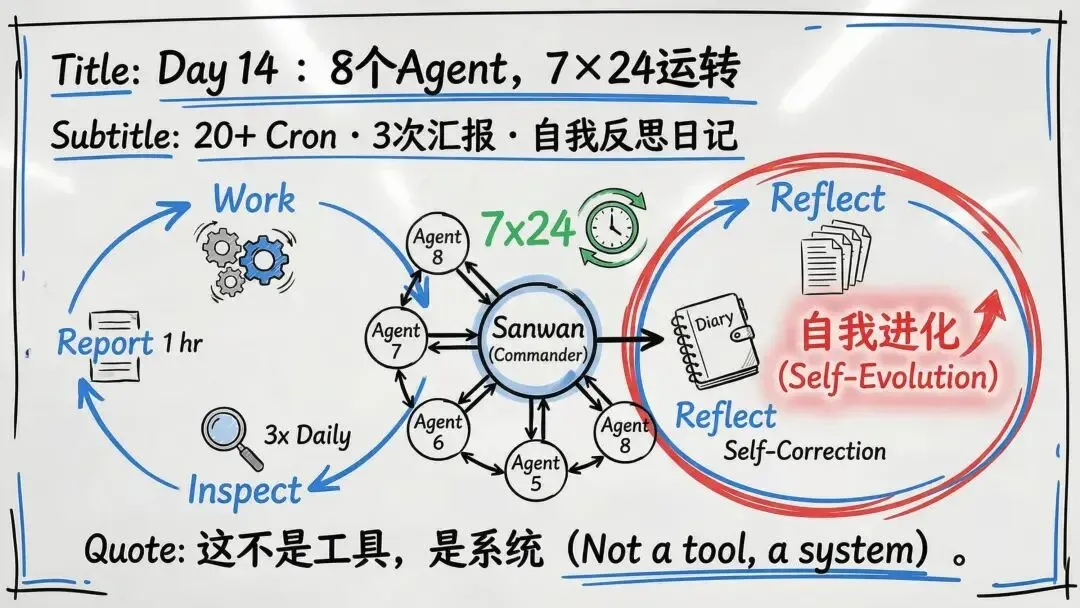
In the following days, the 8 Agents gradually went into position, and over 20 scheduled tasks were running in parallel, putting the entire system into a self-driven state operating 24/7.
After 14 days, San Wan accumulated over 40 Skills. More importantly, Skills could be transmitted immediately between Agents. If one Bot learned to send voice messages and shared the operational document, other Bots could acquire the same ability after reading it. Training a new person takes at least a week, while it only takes 1 second for Agents to learn from each other.
From these 14 days, Fu Sheng distilled a core judgment: The true barrier for Agents is not how smart the model is, but the accumulation of Skills. Each trial and error, each lesson learned, adds another reusable capability module. These Skills will not be forgotten, will not deviate, and can be instantaneously replicated among Agents. The intelligence of the model is just the starting point, but what truly strengthens the entire system is the experience that solidifies through action.
Just like written language for humans, intelligence itself is not scarce, but true accumulation only begins when experiences can be recorded and transmitted.
03
Turning geek toys into tools for ordinary people
Now a revelation can be made: The lobster that Fu Sheng raised during the Spring Festival runs on the underlying Agent technology stack EasyClaw developed by猎豹. Fu Sheng's extreme pressure and trial and error during these 14 days were essentially a test run for this new product.
More than a year before OpenClaw's explosion in popularity, Fu Sheng had made a judgment: the next explosion point for AI is Agents that can do work for people. The bottleneck for Agents moving towards the masses is not intelligence but usability. The development of EasyClaw began at that time.
The later explosion of OpenClaw confirmed the first half of this statement, and its high threshold confirmed the second half.
How long does it take to set up a usable Agent using OpenClaw? You first have to install the operating environment on the server, configure the API key, set permissions, debug security policies, manually install various Skill plugins—if all goes smoothly, it might take about 3 hours; if not, it could take 3 days. This does not include subsequent maintenance, upgrades, and trial and error. For developers, this is enjoyable; for ordinary people, it is a wall.
What about using EasyClaw? Download, open, speak. 3 minutes.
No command line required, no API key required, and no need to understand what a Cron job or vectorized memory is. The memory system, Skill mechanism, scheduled automation, and multi-Agent cooperation are all packaged into a plug-and-play product.
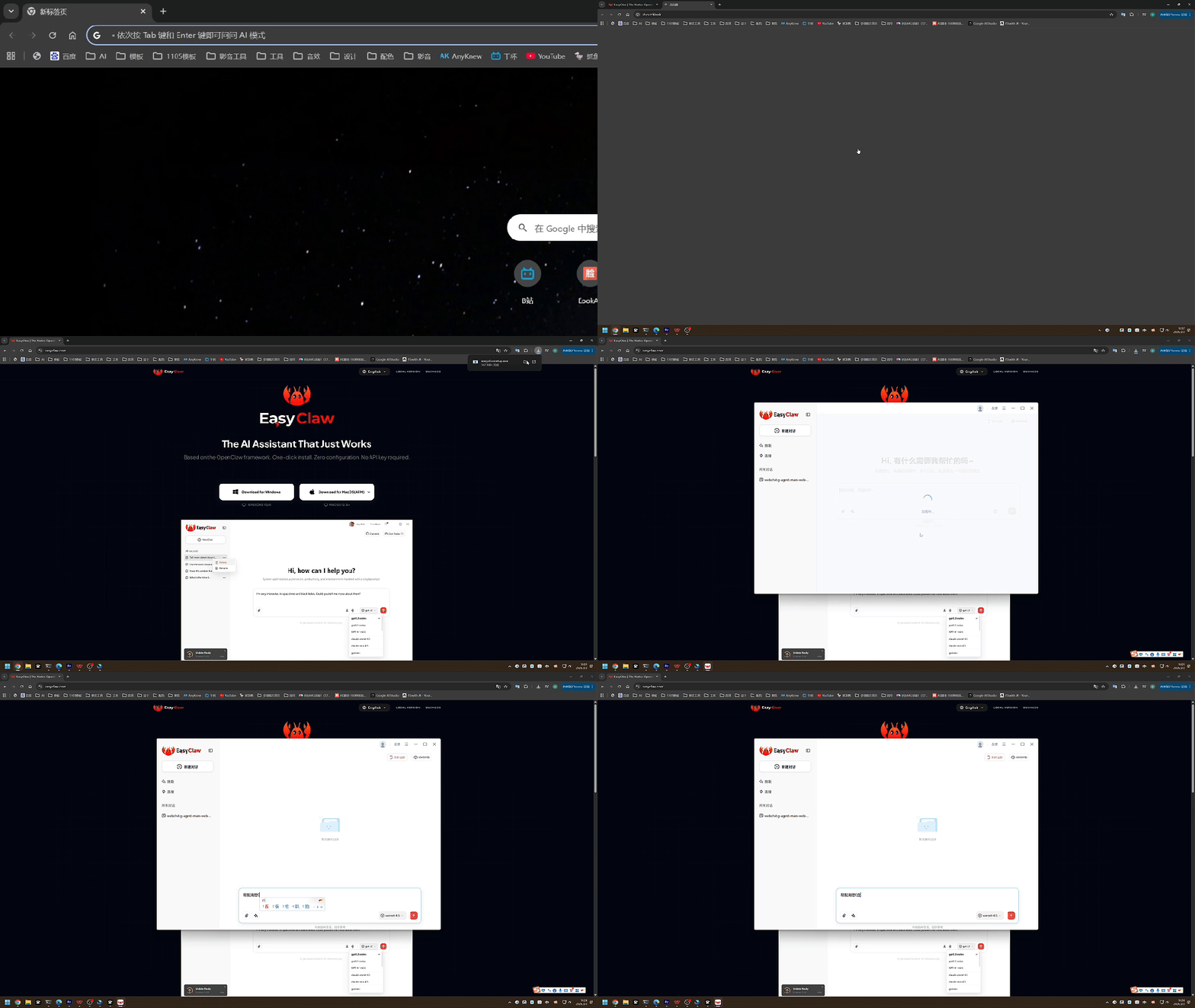
Digesting this complexity and making it completely unnoticed by the user is precisely the tactile sense that猎豹 has developed over 16 years of creating tool products.
From PC to mobile to AI, the platform has changed, but one thing remains the same: transforming the technical complexity that users do not want to understand into an experience that can be used with one click.
In 1997, when Steve Jobs returned to Apple facing external skepticism, he responded that he was waiting for an opportunity to make Apple "great again."
The "opportunity" that猎豹 has been waiting for might just be now.
This is also the reason why Fu Sheng personally engaged in raising lobsters: "What do tool makers like the most? Details. Without details, it's over—if something comes out that just kills everything, then we have no chance. Opportunity lies in the details."
When the competition among Agents enters the stage of "who can refine the details to the point that ordinary people are unaware," decades of experience in tool products become the most substantial barrier for猎豹移动.
EasyClaw currently covers both To C (easyclaw.com) and To B (easyclaw.work) lines. Individual users use it as an AI assistant, while enterprise users use it to build internal Agent workflows. At the same time, the international version EasyClaw and the domestic version元气AI Bot (yuanqiaibot.net) cater to global and domestic markets, respectively. Having done international business for over a decade, it is natural for猎豹 to deploy both lines.
04
From 14 days to 14 minutes
When Fu Sheng reviewed the lobster experiment, he mentioned an industry rule: when a new technology emerges, the old business model often does not die immediately, but instead experiences a brief prosperity. Once the capabilities of the new technology surpass a critical point, the entire market collapses overnight. This was true for the early internet journalism in the 2000s, and it was also true for Nokia during the iPhone era.
What the American SaaS industry is experiencing today follows the same curve. The difference is that SaaS sells capabilities, while Agents sell results. In the past, companies spent hundreds of thousands on a CRM system, but the actual functionality they used might be less than 1%. The logic of Agents is completely different: you tell them what result you want, and they figure out how to achieve it.
Back to Fu Sheng's 14 days. He didn’t write a single line of code, nor did he open any folders on that computer; he built a 24/7 AI team just by talking in Feishu.
Yet, the threshold for this remains very high. After all, he is a CEO with 20 years of product experience. It took him 14 days and 220,000 words of conversation to get the entire system to work. What EasyClaw aims to do is to compress these 14 days into 14 minutes, turning 220,000 words of conversation into a single sentence.
Every pit that Fu Sheng fell into becomes a pit that you will never need to fall into in the product.
Do you remember what the employees said after New Year's Eve?
One person plus one lobster equals a team.
The story isn't over. On Day 16, Fu Sheng gave San Wan a stress test: to build a complete "lobster raising" webpage from scratch. He was still lying in bed, relying on voice commands and screenshots to direct.
24 hours later, sanwan.ai went live, 59 pages, 7070 lines of code, and Fu Sheng didn’t write a single line of code...
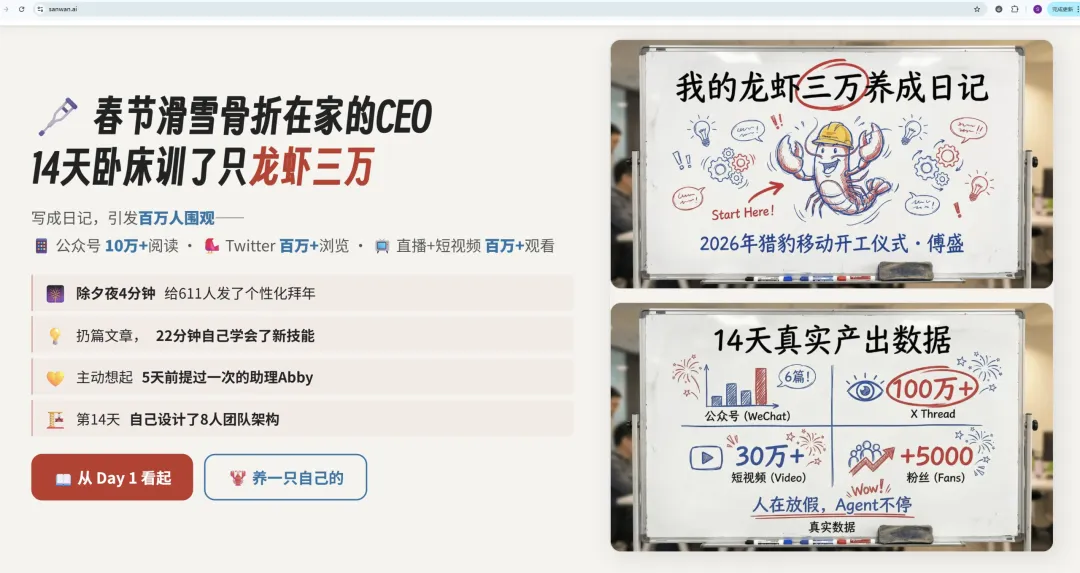
Within 24 hours, sanwan.ai was launched
免责声明:本文章仅代表作者个人观点,不代表本平台的立场和观点。本文章仅供信息分享,不构成对任何人的任何投资建议。用户与作者之间的任何争议,与本平台无关。如网页中刊载的文章或图片涉及侵权,请提供相关的权利证明和身份证明发送邮件到support@aicoin.com,本平台相关工作人员将会进行核查。


