Recently, Wall Street research institution Citrini Research released a thought experiment report titled "2028 Global Intelligence Crisis," arousing heated discussions in the market. The core deduction of the report points to an extremely ruthless logic of business reshuffling: AI Agents will completely eliminate the "friction" in human interactions, thereby destroying all old business empires built on information asymmetry and intermediary models.
Coincidentally, at the same time this Wall Street "final report" was going viral online, prominent Web3 figure Sun Yuchen also made eye-catching statements on social media. He defined 2026 as "the time when miracles happen," even urging young people: "If you can chat with AI, don’t chat with humans... Embrace the future with all your might!"
In the public eye, this might be seen as another one of Sun Yuchen's highly personal "traffic spectacles." However, if we strip away the emotional surface and contrast these statements with the macro deductions of the "2028 Global Intelligence Crisis," we will find a thought-provoking truth: the "collapse of the old order" that Wall Street fears in its macro model is precisely what Sun Yuchen promotes and attempts to embrace in the micro-action of the "Web4.0 New Era."
Faced with the same future, pessimists see a chasm, while Sun Yuchen sees a ladder to the singularity.
Computing power, electricity, and Token: AI and Crypto's fateful intersection
The "friction elimination" scenario depicted in the "2028 Global Intelligence Crisis" report is essentially a brutally cold de-intermediation revolution driven by AI.
The report sharply points out that when all-knowing AI Agents can instantly accomplish supply and demand matching, execute transactions, and provide services at almost zero cost, the moat upon which modern business relies will be completely breached.
For a long time, from traditional financial intermediaries, advertising distribution platforms, to law firms and consulting agencies that often charge high fees, countless business models essentially leech off human cognitive limitations, decision delays, and information blind spots. Once AI smooths out these artificially created "friction," these old empires will inevitably collapse like a line of dominoes.
This trend resonates remarkably with the "decentralization" banner raised by blockchain since its inception.
If the Web3 movement that emerged over a decade ago sought to dismantle the "trust monopoly" of centralized institutions through cryptography and distributed ledger technology; then today’s rise of AI Agents directly eliminates the necessity of "trust" itself in many scenarios in a more thorough and efficient way—because agents can not only automatically verify facts but also autonomously complete value exchanges.
A deeper connection lies in the fact that the material foundation supporting this dual revolution is entirely homogenous.
Whether it's AI-generated reasoning Tokens or crypto Tokens in blockchain networks, they hide a long-underestimated yet immensely solid physical truth: they are all digital embodiments of electricity.
Every reasoning of AI large models consumes real computational power; each confirmation of an on-chain transaction and each execution of a smart contract relies on the energy continuously burned by mining machines or validation nodes. Tokens are not magic; they are certificates of energy transformation, projecting value in the digital world as electricity traverses chips, algorithms, and protocols. Thus, this forms a perfect closed loop with Sun Yuchen's earlier assertion of "short-term chip shortages, long-term energy shortages, and an everlasting shortage of storage."
Consequently, we see two seemingly opposing yet fundamentally homogenous forces intersecting: on one side are capital elites foreseeing the collapse of their power structure in model deductions, and on the other side are crypto natives proactively welcoming a new civilized agreement of no intermediaries, no friction, and no redundancy in code and slogans. This narrative of the "post-intermediary era" co-written by AI and blockchain may just be beginning.
Why does AI inevitably choose Crypto for settlement?
However, this grand historical intersection does not merely dwell in philosophical and physical resonance. When the narrative lands on specific business operations, a very real question looms before AI: in this new world soon to be taken over by machines, who will provide these intangible "silicon-based lives" with financial services?
Centralized payment networks are designed for "humans."
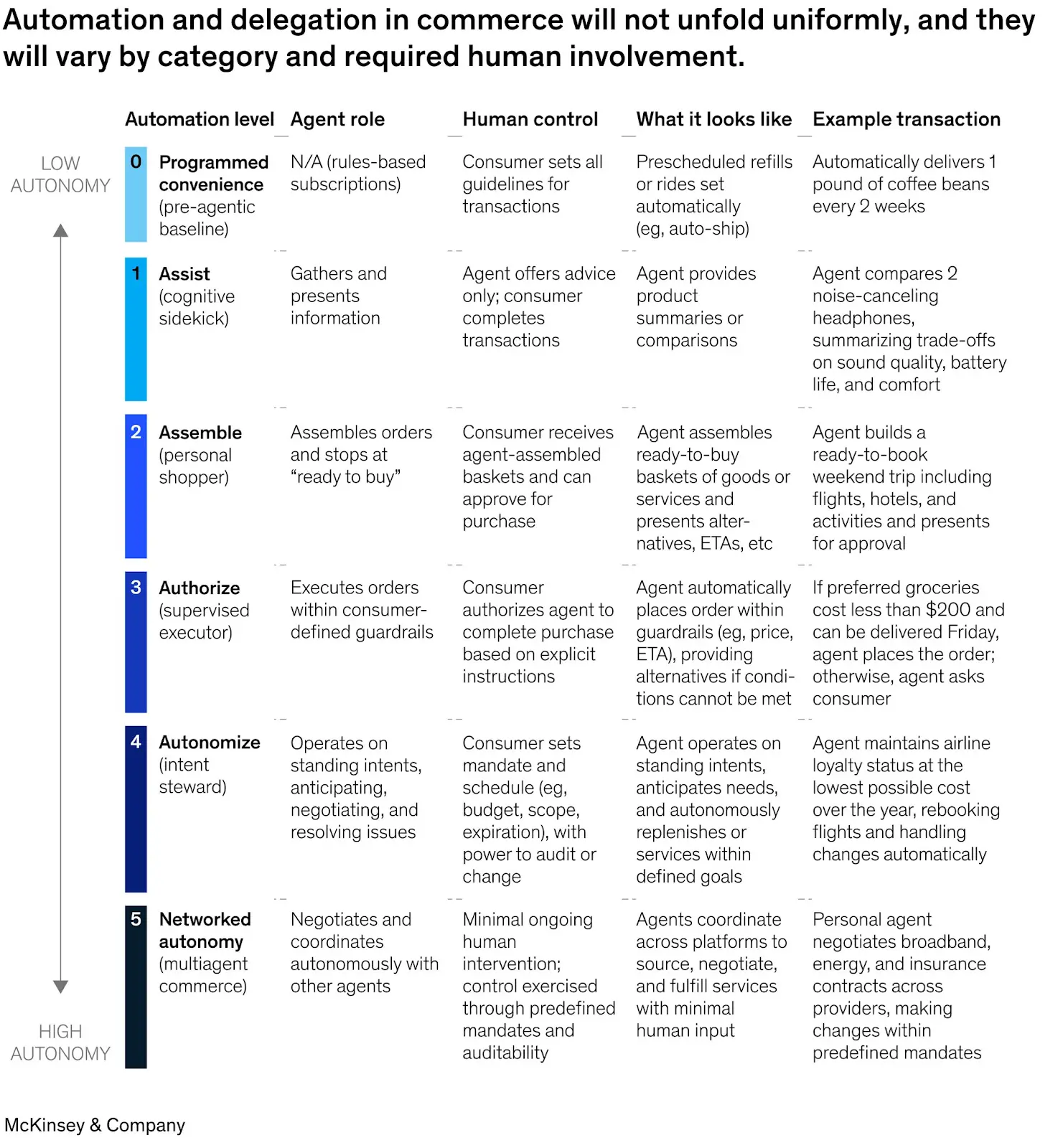
McKinsey classifies AI-driven business automation into six levels. Among them, levels 0 to 4 can still operate within the existing financial system since transactions are always linked to human identity. However, at level 5, agents begin to trade directly with other agents without human instructions. By this time, there is neither "human identity" to inherit nor can they rely on traditional KYC processes; payments must be programmatic, condition-triggered, settled in milliseconds, and the reputation of the agents should possess cross-platform portability. Therefore, blockchain becomes indispensable.
AI has no physical form and can't hold an ID to queue for KYC. For them, a string of asymmetric encrypted private keys constitutes an account; a blockchain that enables near-instantaneous payments with transaction fees nearing zero and supports programmable smart contracts is the perfect clearing center.
There is a very realistic deduction in the "2028 Global Intelligence Crisis": the space for price matching and information aggregation is ultimately limited. Once agents start transacting with each other, the most direct and effective route is to eliminate various transaction fees. They begin seeking faster and lower-cost payment methods than credit cards. Most ultimately choose to settle using stablecoins through the Solana or Ethereum layer-two networks, where transactions are nearly instantaneous, with fees as low as a fraction of a cent.
For this reason, crypto wallets will inevitably become the "native banks" of AI Agents.
This also completely shatters the long-standing stereotype about Crypto: issuing Tokens is by no means merely for secondary market speculation. In an AI-led future, crypto Tokens and peer-to-peer payments will truly serve as the underlying financial infrastructure for high-frequency collaboration between agents.
Sun Yuchen's AII in strategy: Where does the confidence and ambition lie?
Sun Yuchen's decision to bet on Web4.0 is backed by highly meticulous commercial logic and strategic intentions.
First, the "stablecoin hegemony" of TRON is the natural settlement layer of Web 4.0.
It is well known that the TRON network carries the largest USDT circulation in the world. As previously mentioned, the core of Web4.0 is the payment interaction between machines, and AI requires a payment network that is fast, low-cost, and highly liquid. The USDT payment network of TRON perfectly aligns with the underlying financial needs of AI Agents. Sun Yuchen just needs to establish a payment API on the TRON network that can be seamlessly called by AI to continue earning profits in the Web 4.0 era.

Second, finding the breakthrough point of the "post-Web3 era."
The traditional Web 3.0 has entered a game of existing stocks, lacking new breakout stories. Meanwhile, AI has become the most certain and financially significant growth sector in today's world. Sun Yuchen keenly realizes that the fate of Crypto must be bound with AI. By going "All in Web4.0," the traditional tech circle's AI funding and attention can be redirected back to the crypto market. TRON previously established a high AI development fund of up to 100 million dollars, which is already a clear signal for the layout of Web 4.0.
Third, creating a closed loop of "decentralized networks."
Sun Yuchen possesses BitTorrent (decentralized storage/transmission), the TRON public chain (underlying settlement), and a massive base of Huobi's crypto users. If he can further integrate decentralized computing power with AI models, he has the opportunity to create a full-stack infrastructure for Web4.0 that does not rely on Amazon AWS or Google Cloud.
The irony of history often lies in the fact that the guardians of the old order are still calculating the losses from the collapse of their walls, while the barbarians of the new world have long built their foundations on the ruins.
This transformation co-written by AI and crypto has not yet been completed, but the direction is clear. The true question is no longer whether AI will reshape business, but who can occupy the core position of infrastructure in this reconstruction ahead of time.
免责声明:本文章仅代表作者个人观点,不代表本平台的立场和观点。本文章仅供信息分享,不构成对任何人的任何投资建议。用户与作者之间的任何争议,与本平台无关。如网页中刊载的文章或图片涉及侵权,请提供相关的权利证明和身份证明发送邮件到support@aicoin.com,本平台相关工作人员将会进行核查。


