Author: Michel Athayde
Can dual currency winning really cross bull and bear markets?
We found through a real market backtest from 2020 to 2026:
For the same dual currency winning, just with different methods of selling Calls, the final profit difference reached nearly double.
The data tells us that the problem lies not in the strategy, but in human nature.
In the cryptocurrency market, “dual currency winning” (Wheel Strategy) is often regarded as a rental tool for crossing bull and bear markets. But how will different underlying execution logics reshape the long-term profit distribution?
To explore the truth, we placed Bitcoin and Ethereum into the complete bull and bear cycle from 2020 to 2026 for backtesting. In this sample, which includes significant collapses and epic bull markets, we compared two completely different ways of dual currency winning:
Standard Dual Currency Winning (Rolling Strike): Following the market. After acquiring the spot, each time sell the Call options (Covered Call) dynamically at 105% of the current price.
Cost Recovery Dual Currency Winning (Fixed Anchor): Anchoring cost. Once acquired at a high position, regardless of how much the current price drops, always stubbornly sell Calls at the “last acquisition's strike price” without ever giving up the chips until the cost is recovered.
This is no longer a simple confrontation between “selling strategy vs holding spot,” but a deep test about “how trading psychology changes long-term profit distribution.”
Core Data: Reevaluation of Risk and Returns
(Note: Backtest spans from 2020 to 2026, Put options rated annually at 30%, Call options rated annually at 25%, with 7-day expirations)
| Investment Strategy | Total Return Rate | Annualized (CAGR) | Maximum Drawdown | Sharpe Ratio |
| BTC Hold (Buy & Hold) | +1133.73% | 51.95% | -76.63% | 0.83 |
| BTC Standard (Rolling) | +859.43% | 45.72% | -42.74% | 0.929 |
| BTC Cost Recovery (Fixed) | +558.81% | 36.88% | -61.19% | 0.783 |
| --- | --- | --- | --- | --- |
| ETH Hold (Buy & Hold) | +2197.31% | 68.52% | -79.30% | 0.87 |
| ETH Standard (Rolling) | +1835.21% | 63.78% | -54.27% | 0.971 |
| ETH Cost Recovery (Fixed) | +626.74% | 39.13% | -64.87% | 0.724 |
| --- | --- | --- | --- | --- |
| 50/50 Hold Combination | +1665.52% | 61.30% | -77.80% | 0.85 |
| 50/50 Standard Combination | +1347.32% | 56.05% | -49.90% | 0.983 |
| 50/50 Cost Recovery Combination | +592.77% | 38.03% | -61.80% | 0.766 |
Facing this real data, we need to reevaluate two core propositions in trading.
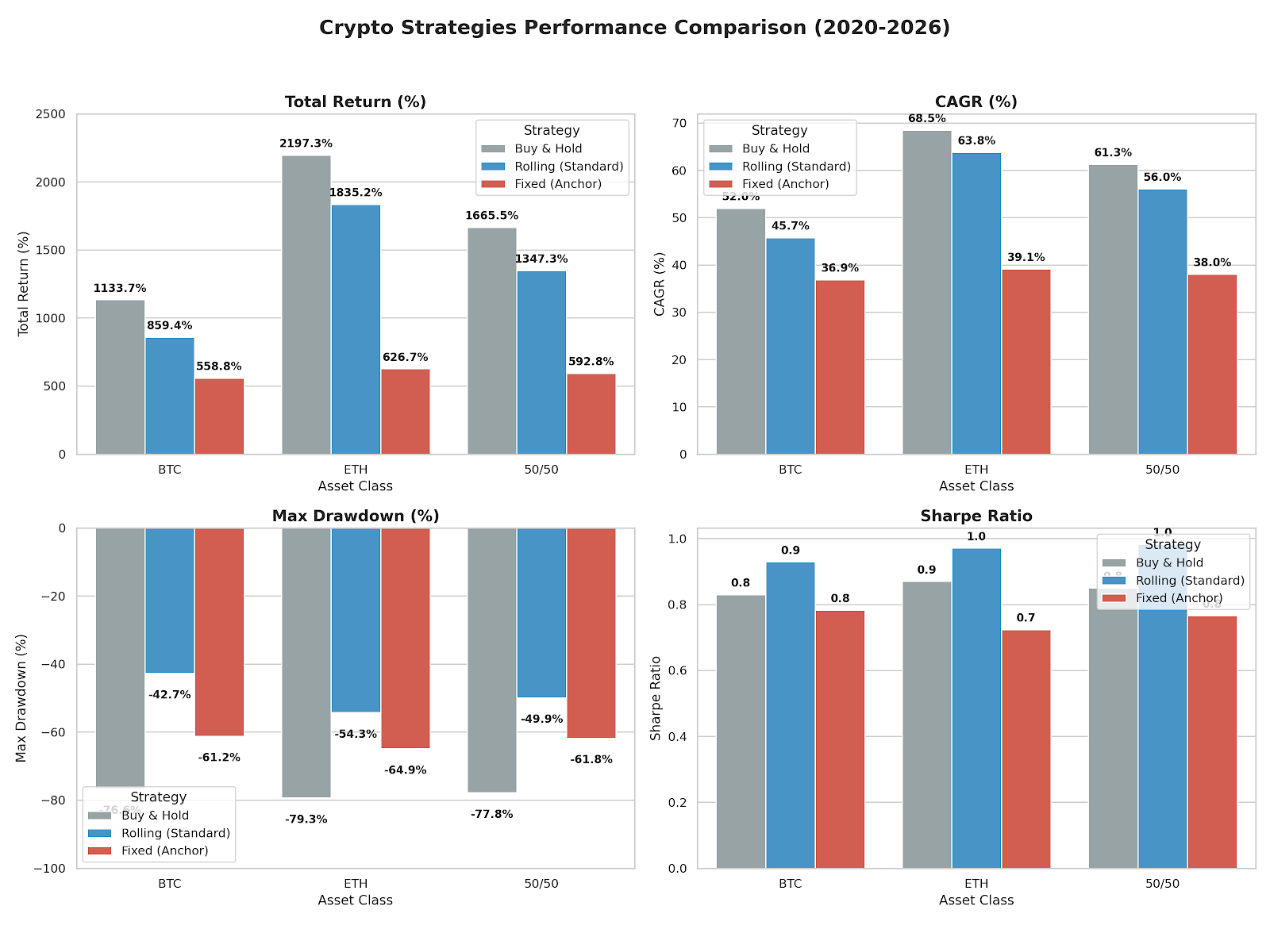
Risk and Return Balancing of Standard Dual Currency Winning
Many people mistakenly believe that the standard dual currency winning will be severely missed in a bull market, but the data proves that as long as a 5% upward buffer is preserved (spot price * 1.05), it shows a strong risk-return balancing capability throughout the complete bull and bear cycle.
In a 50/50 asset combination, its Sharpe ratio (0.983) overwhelmingly surpasses the buy and hold (0.85), compressing nearly -78% of deep drawdown to -49.9%.
Its advantage does not come from predicting the market, but from the mechanism of “continuously dynamically raising the strike price.”
With every change in the current price, the standard version ruthlessly adjusts its target. The Rolling essentially resets costs continuously in a bull market, while the Fixed Anchor constantly “confirms mistakes.” The standard version sacrifices a very small portion of excessive profit caps in exchange for a significant strategic depth that smooths the funding curve.
“Anchoring Cost” is the Most Expensive Psychological Placebo
The most thought-provoking aspect of the data is the complete defeat of the “cost recovery type (Fixed Anchor).” In terms of both returns and drawdown control, it is far inferior to the standard version.
This reveals the most common human weakness in trading: anchor effect. If you acquired at a high of 60,000, and still stubbornly hold the 60,000 Call when it drops to 30,000, you not only lose the “bleeding” ability of the option premium in a prolonged bear market but also, during a market V-shape reversal, you would helplessly watch the chips get cleared at 60,000, completely missing out on the subsequent major uptrend.
Cost recovery strategies may seem conservative, but they are actually using time to fight against trends. And in a trend-driven market, time often stands on the side of the trend. Being fixated on “not losing money to exit” is, in fact, the quickest way to perfectly miss the benefits of the larger cycle.
Conclusion
Markets are full of volatility, but data does not lie.
In trend assets like Bitcoin and Ethereum, the real risk is not the drawdown, but being limited in upward potential by one’s own psychological anchoring.
The standard dual currency winning tells us:
As long as you maintain dynamic adjustments and continuous rolling, a selling strategy can coexist with the trend.
And the cost recovery strategy reminds us:
The market will not change direction because of your cost price.
Discipline is far more important than recovering costs.
免责声明:本文章仅代表作者个人观点,不代表本平台的立场和观点。本文章仅供信息分享,不构成对任何人的任何投资建议。用户与作者之间的任何争议,与本平台无关。如网页中刊载的文章或图片涉及侵权,请提供相关的权利证明和身份证明发送邮件到support@aicoin.com,本平台相关工作人员将会进行核查。


