Host: Mr. Z (@168MrZ)
Guest: Dovey Wan (@DoveyWan)
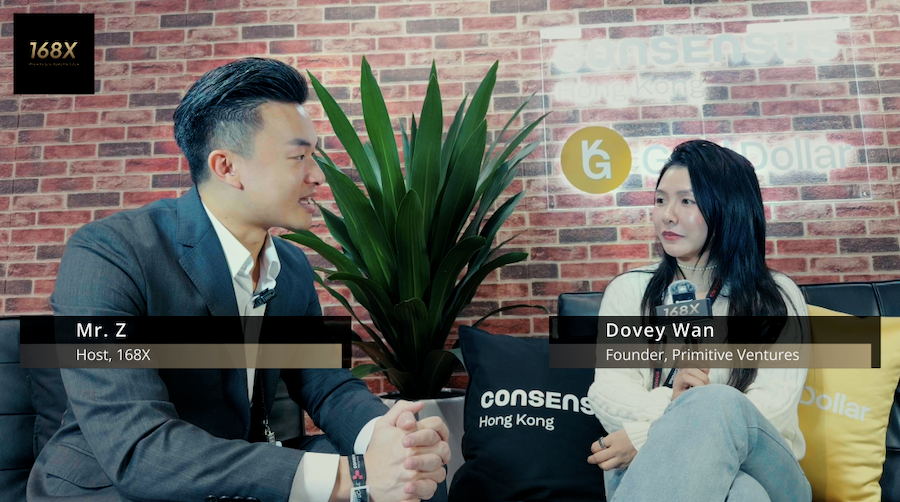
“Bitcoin can no longer keep up with ARKK — AI is siphoning off global liquidity, while the crypto market hasn’t even reached a true sense of desolation.” Dovey Wan, founder of Primitive Ventures, candidly analyzed, from her extensive experience across the tech and capital sectors in China and the U.S., the disruptive impact of AI on the global liquidity landscape, the existential crisis facing white-collar workers, and the ‘dull sensitivity’ survival philosophy during the crypto bear market in an exclusive interview on the East-West capital dialogue program “168X.”
With a technical background, Dovey Wan holds a master’s degree in information systems from Carnegie Mellon University and previously served as managing director at DHVC, where she led early investments in dozens of blockchain infrastructure projects including Dfinity, Cosmos, and StarkWare. In 2018, she founded the evergreen fund Primitive Ventures, which operates solely on its own capital without accepting external LPs, focusing on investing in crypto-native innovators and funding independent Bitcoin Core developers during deep winter. Today, Primitive Ventures' portfolio includes over 50 projects spanning various cutting-edge fields such as DeFi, zero-knowledge proofs, Bitcoin Layer 2, and AI infrastructure.
This article is a summary of highlights from the 168X program (@168X_Fortune) — a premier dialogue platform that deeply connects Eastern wisdom and Western innovation, focusing on exploring how technology, capital, and human wisdom can reshape the future of human civilization in cutting-edge fields like AI, blockchain, robotics, space technology, and bioengineering. The program is hosted by ex-banker Mr. Z.
The Great Divide of Liquidity: When Bitcoin can no longer keep up with ARKK
“In 2024, I repeatedly said on Twitter that the liquidity supply chain of Crypto itself has undergone significant structural changes,” Dovey stated bluntly.
She cited the relationship between Bitcoin and ARKK (ARK Innovation ETF) as an example —
Before the GPT moment, ARKK and Bitcoin exhibited highly similar trajectories: both were essentially “purely liquidity-driven assets, with only valuation expansion, not value expansion.”
However, after the GPT moment, AI growth stocks began to generate real earnings and cash flows. After the trial of the DeepSeek moment, the valuation logic of AI growth stocks became increasingly clear.
By mid-2025, a crucial divergence appeared: Bitcoin could no longer keep up with the gains of ARKK. This indicates that liquidity is rotating — funds are moving from purely valuation expansion assets to AI growth stocks that can be priced based on real cash flows.
Dovey pointed out that precisely because of this, Primitive Ventures began tracking TSMC (Taiwan Semiconductor Manufacturing Company) and SK Hynix among other AI core supply chain companies early on.
Moreover, she observed a significant trend: U.S. stocks are becoming “cryptified.”
Retail-driven, high-leverage traders dominate, and extreme volatility is present. Including the recent flash crashes in silver and gold, they exhibit characteristics similar to the crypto market. “Many of the models used by institutions in the past have become highly unsuitable,” she stated frankly. “The structure of trader profiles is also changing.”
Behind this lies a deeper driving force. Those white-collar workers squeezed out of traditional workplaces by AI are collectively flocking to the trading markets.
White-collar workers are like the horses pulling the carriage: Countdown to the five-year doomsday of AI
Dovey presented a shocking statistic: In the first half of 2025, the entire New York City added only 1,000 jobs.
“The finance folks are all unemployed,” she bluntly said. “Junior lawyers are also unemployed. So what can these people do? They have financial literacy, access to various financial instruments, and know-how — so they basically all become basement traders.”
This trend echoes an article she wrote during the GameStop event — when financial populism combines with cultural trends, the structure of market participants will undergo fundamental changes.
Dovey predicts that AI will become a new ideology. She has personally witnessed friends’ three-year-olds, who just learned to speak, chatting with AI every day because their parents cannot meet the child’s infinite curiosity.
“In the future, this world will become very strange, but many people are not ready for this.”
However, what truly worries Dovey is a deeper structural fracture.
Past economic models assumed that when the economy grows rapidly, employment would also grow. The Federal Reserve's dual mandate of “employment and inflation” is based on this assumption.
But AI may soon break this equation, leading humanity into a world where “super-fast growth + super-high unemployment rate” coexist.
Her judgment is very specific: Within five years, large companies in Silicon Valley will no longer need "specific function engineers"; accounting, the Big Four auditing firms, and a large number of paperwork-intensive service positions will also be replaced by AI within five years.
Even if these companies delay layoffs out of management inertia and social responsibility, once the burden of operational costs threatens their ecological standing, layoffs will become inevitable. Overall, within about ten years, the entire societal operational model will be fundamentally reshaped by AI productivity.
She provided a vivid example: after Musk took over Twitter and conducted large-scale layoffs, Twitter actually became better. She believes Google could still operate well even if it laid off a third of its engineers.
“For every individual, how to maintain resilience against AI and keep immunity to AI will be the most significant issue in the next decade,” Dovey summarized.
TSMC’s Geopolitical Game: How the “Pretty Girl” Protects Herself Between Two Big Brothers
Another thought-provoking topic during the interview was Dovey’s in-depth analysis of TSMC’s geopolitical strategy. Primitive Ventures not only allocated stocks of TSMC but also spent two to three years systematically studying the company.
“We love TSMC not just because it is a monopoly in wafer manufacturing, but also because its founder Morris Chang is extremely wise and has an excellent succession plan,” Dovey said. She even went to Taiwan specifically to buy the second volume of Chang’s autobiography, believing it contains a wealth of wisdom about business succession.
She analyzed the core paradox faced by TSMC: If the Arizona factory directly advances to 3 nanometers and does so quickly, TSMC will face the risk of being “undercut” — the U.S. can use TSMC as a major bargaining chip in negotiations with China, and once U.S. domestic capacity matures, the strategic value of TSMC as “Taiwan's national treasure” will greatly diminish.
For this reason, TSMC chose to cooperate with Japan to upgrade from 6 nanometers to 3 nanometers. This is a very clever strategic move. On one hand, they need to prevent the U.S. from undermining their position; on the other hand, progress on the U.S. side is inherently slow due to professional ethics and bureaucratic systems. For both public and private matters, TSMC needs to ensure an alternative path.
Dovey used a vivid metaphor to summarize Taiwan’s situation: “Taiwan is like a particularly beautiful girl, with two big brothers vying for her affection.” She believes that while the two big brothers are competing for her attention, this “girl” should immensely enhance her fundamentals — leveraging insights learned from the big brothers to start her own business so that even if the big brothers no longer vie for her, she can still thrive.
She extended this logic to a broader macro framework: in the past, Taiwan relied on military defense, but now AI and computing power are becoming a new type of national defense asset.
NVIDIA has set its overseas headquarters in Taipei, the “father-son” relationship between Jensen Huang and Morris Chang, and the manufacturing backflow policy promoted by Japan's new Prime Minister Sanae Takaichi — all these actions are reshaping the geopolitical power dynamics of the global semiconductor supply chain.
The Sense of Desolation has Not Arrived: SpaceX's Bloodletting, Dull Sensitivity, and Survival Rules in a Bear Market
When discussing market prospects, Dovey’s famously published article “Who is Paying for the Bull Market” was brought up by host Mr. Z. Facing the current pessimistic sentiment in the crypto market, her judgment was calm and sharp.
“The sentiment will definitely be lower, and prices will also be lower. A real bear market should be very quiet, and there should be a sense of desolation,” she said, “but right now, there are new dramas every day, and various conflicts continue. We are far from the point of desolation.”
She particularly pointed out a significant liquidity risk event in 2026: SpaceX’s IPO. According to reports, SpaceX plans to go public in mid-2026 with an estimated valuation of about $1.5 trillion, raising as much as $50 billion. If it materializes, it will be the largest IPO in human history.
“Just the IPO alone requires $1.5 trillion,” Dovey analyzed. SpaceX’s investors have held their positions for a long time and need to realize profits; coupled with the complex equity structure after its merger with xAI, this will be a ‘large-scale retail bloodletting event’ covering both private and public markets, causing a massive liquidity shock to the entire risk asset market.
She also observed that the market has begun to become extremely cautious: all good earnings reports are triggering profit-taking; trillion-dollar giants like Microsoft can swing up or down by 15%, “like meme stocks.”
The extreme volatility is changing the market ecology. The year 2026 will not be an easy year.
For different types of traders, Dovey provided distinctly different advice:
If you are a volatility harvesting trader, 2026 will be the “golden year” — companies like QRT and HRT are making substantial profits. But if you are a directional, subjective judgment trader, you need to be especially cautious.
As a long-term asset allocator like Primitive Ventures, she chooses to maintain a “dull sensitivity”: possessing adequate cash reserves, remaining relatively insensitive to short-term fluctuations, and patiently waiting for the true moment of desolation to arrive.
About Primitive Ventures
Primitive Ventures is a crypto venture capital firm led by Dovey Wan, operating entirely on its own capital without accepting external LP funds, investing in crypto-native innovations with 100% interest alignment. Its portfolio covers cutting-edge fields such as DeFi, zero-knowledge proofs, Bitcoin Layer 2, and AI infrastructure.
About 168X
168X is a premier dialogue platform that deeply connects Eastern wisdom and Western innovation, dedicated to exploring how technology, capital, and human wisdom can reshape the future of human civilization. The program focuses on cutting-edge fields like AI, blockchain, robotics, space technology, and bioengineering, engaging in dialogues with global leaders and thought builders to reveal the core drivers of future wealth and innovation through a unique dual perspective. The program is hosted by ex-banker Mr. Z.
X | YouTube | Apple Podcasts | Substack
免责声明:本文章仅代表作者个人观点,不代表本平台的立场和观点。本文章仅供信息分享,不构成对任何人的任何投资建议。用户与作者之间的任何争议,与本平台无关。如网页中刊载的文章或图片涉及侵权,请提供相关的权利证明和身份证明发送邮件到support@aicoin.com,本平台相关工作人员将会进行核查。


