Author: Pavel Paramonov
Translation: Blockchain in Plain Language

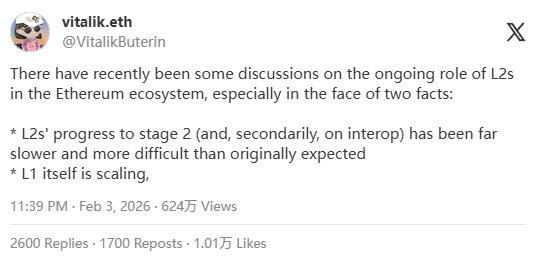
This article is mainly inspired by Vitalik's recent tweets about the state and changes in the market. While the entire market is declining, it is difficult to specifically blame any individual, and I do not intend to do so.
I have collaborated with many Ethereum teams and represented venture funds to invest in multiple protocols built on Ethereum. Overall, I used to be an enthusiastic fan of Ethereum and EVM-related matters.
Unfortunately, I can no longer say the same because I feel that Ethereum does not know where it is going (many people feel the same).
I do not want to discuss the price trends of ETH, but I cannot ignore the fact that the world's second-largest cryptocurrency behaves extremely erratically. No matter how the global market trend goes, ETH's performance resembles that of a stablecoin that is losing its peg.
This essay aims to explore what has happened to Ethereum over the past few years and why many people are losing hope or have already lost it. Ethereum has not lost to Solana or other competitors; Ethereum has lost to itself.
Summary of the Rollup-centric Roadmap
When Ethereum introduced the Rollup-centric roadmap, almost everyone was excited. The promise at the time was that Rollups (and Validiums) would take on the task of scaling, with end-user transactions occurring on Rollups, while Ethereum would serve as the validation layer, focusing on being L1 for Rollups instead of a user-facing L1.
Developing Rollups is much faster and easier than developing L1, so the vision of "thousands of Rollups" seemed very probable and optimistic.
Where did it go wrong?
It turns out everything went wrong. Endless debates, ideology overriding demand, continuous infighting within the community, identity crises, and the timing to abandon the "Rollup centrism" vision being too late.
Everything that could go wrong did go wrong. Most of the community once considered Max Resnick a completely incompetent villain, only to find that he was right about nearly everything.
During Max's time at Consensys, he proposed numerous suggestions on how Ethereum should progress, but faced only criticism with little support.
The dumbest peak was when the entire industry began debating whether a certain L2 is actually "Ethereum", for example:
View A: "Base is an extension of Ethereum, and we have made a significant contribution to the Ethereum ecosystem."
View B: "Base is not an extension of Ethereum; it is an independent entity."
What the hell are we discussing?
How can such dialogues lead Ethereum and its ecosystem toward a better future? Why do people seriously argue about what is core Ethereum and what is not? Don't we have more important issues to address?
This ideological discussion is not a discussion at all but rather a confrontation between two small circles trying to prove who is right. We do not need internal disputes (PvP); we need external expansion (PvE). We need to understand this is not a face-off between us, but a common challenge we face.
Unfortunately, many prefer to chase spiritual highs than to consider that their views might be wrong.
Technical Ideology Over User Needs
Based Rollups, Booster Rollups, Native Rollups, Gigagas Rollups, Keystore Rollups... Which one is better, what does the future hold, how do they connect? "This type is the future," "No, that type is the future."
All of these discussions... merely led to Arbitrum and Base continuing to win big.
Technical superiority offers advantages, but when you compare "apples to oranges" or "oranges to citrus," that advantage disappears. They are so similar that users do not care at all. Those outside the bubble do not care. One more precompile, one less precompile—you won't win because of that.
"Oh, we actually are 'Ethereum-aligned,' we have advantages, and we are very close to Ethereum, reflecting its core values, users will choose us."
I want to ask, which values? And what users will choose you?
@0xFacet became the first Rollup to reach Stage 2; they are the epitome of being Ethereum-aligned. But where are they? Where are their users, developers, technical KOLs, and those promoting Ethereum's ecosystem and alignment? How many of you have heard of Facet? How many applications are available on Facet?
I personally have no opinion about Facet; I respect its founders. But where have those who constantly say we need more "Stage 2" Rollups gone? I don't know, and neither do you.
Financial incentives are far stronger than technical incentives. I was a fan of Taiko, especially their research on Based Rollups. This model has many benefits: stronger resistance to censorship, neutrality, no sequencer failure risks, and L1 validators earning more money.
What is the trap?
The trap lies in the financials behind the model. You cannot force people to give up income for the so-called "alignment."
Arbitrum has promised centralized sequencers in the past, as have Scroll, Linea, zkSync, and Optimism. Where are they? Where are those sequencers?
Every Rollup team writes in their documentation: "We currently use a centralized sequencer but have a strong desire for decentralization in the future." Almost no one followed through. Metis followed through, but fortunately or unfortunately, people do not care about Metis.
Do I think they overcommitted to please influential ETH maximalists (Maxis)? Yes. Do I think they truly want to decentralize the sequencer? Definitely, but this does not make business sense.
Coinbase (Base) is legally obliged to make as much money as possible to create value for the company. Other teams are the same; why would you deliberately kill off your income source? It simply does not make sense.
Only about 5% of Base's revenue returns to Ethereum. Rollup has never been an extension of Ethereum.
Taiko once had days where it paid more in ordering fees to Ethereum than it collected from user transactions. Obviously, companies like Taiko have many other expenses besides paying Ethereum fees. The vision of Based Rollups or any "Ethereum-aligned" project is only achievable if the team is willing to forgo income.
I do not downplay the importance of decentralization, security, and permissionlessness. But when your only goal is to be "ideologically correct" rather than "user-centric," it all loses meaning.
Unsurprisingly, this weakness and commitment to "Ethereum alignment" has attracted a large number of speculators (grifters).
Consequences of the Rollup-centric Roadmap
Eclipse, Movement, Blast, Gasp (Mangata), Mantra: These protocols were never intended to be built for the long-term future. It is very easy to hide behind the guise of "Ethereum alignment," making Ethereum better, and introducing SVM to Ethereum.
They have all, to some extent, "rugged" the system. All Rollups realized their tokens are almost useless because they pay fees in ETH and their own tokens have little utility. Speculators realized that you can create a lot of hype around a Rollup-centric narrative and then monetize it by dumping worthless tokens to retail investors.
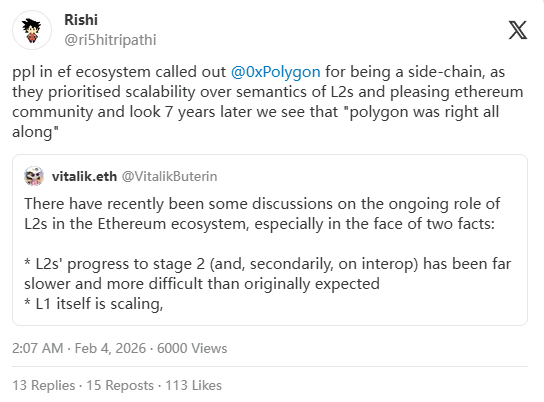
Ethereum has never acknowledged Polygon as a true L2, even though they have played a significant role in securing ETH's value. If you believe that Rollups are a "cultural" extension of Ethereum, then why not acknowledge a project that is closely tied to Ethereum's security and use?
Polygon was crucial to Ethereum during the 2021 bull market, contributing greatly to the growth of ETH as an asset. But true enough, it is not an L2 and does not deserve the praise of the Ethereum community. If Polygon were L1, its valuation would be much higher.
Even Paradigm, arguably the top VC contributing the most to the Ethereum ecosystem and even developed its own L2 (Ithaca), has turned to collaboration with Stripe to develop L1 (Tempo).
I think when your number one evangelists start building your competitors, it indicates you've done something wrong.
Ethereum Foundation (EF) Lacks Direction
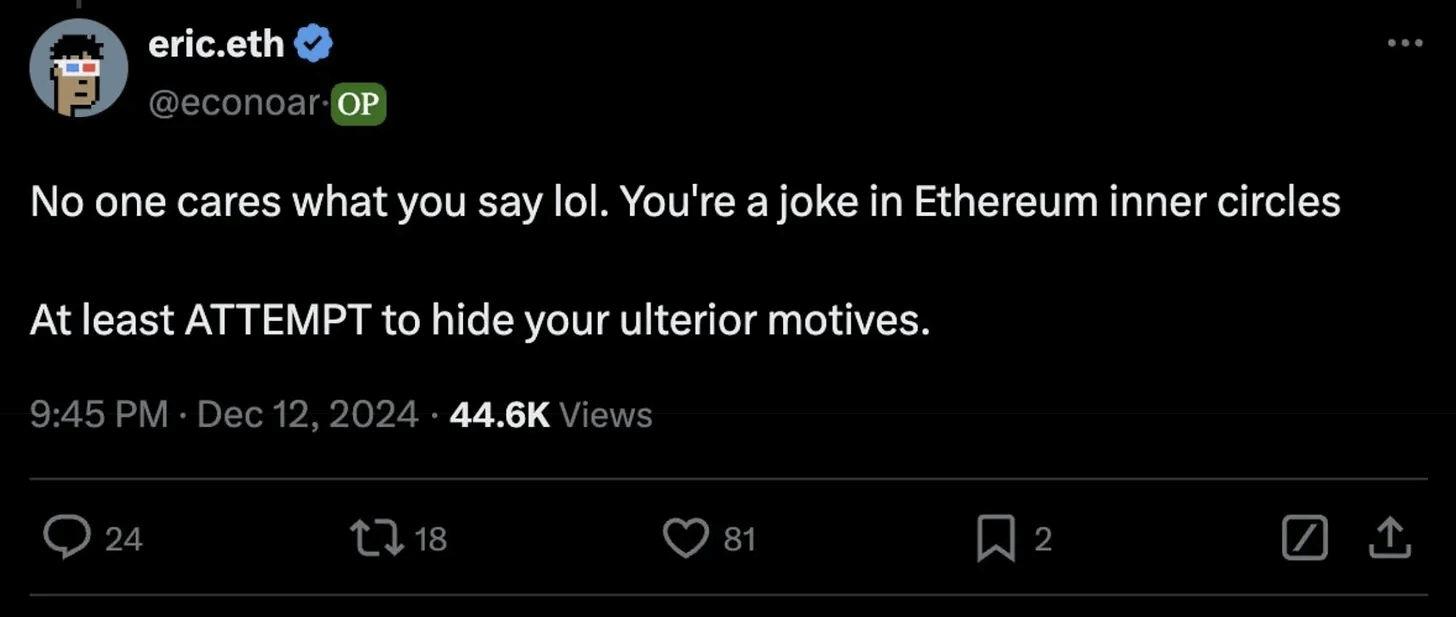
Though Ethereum is technically decentralized, it is culturally highly centralized around Vitalik. The inner circle of Ethereum truly exists. As people say, if you want to succeed, you just need to get the attention of those around Vitalik and a few influential VCs.
I am not saying you must agree with every word Vitalik says, but his views essentially define what is good and bad for Ethereum, and you cannot compete with that.
First, there is ultrasound money; due to EIP-1559 and the merge, ETH's economic model has become deflationary, believing it would serve as a better store of value than Bitcoin. But in 2024, ETH's annual inflation rate turned positive.
So, the vision of ultrasound money only lasted for three years? This makes it impossible to become a store of value. This narrative is dead, and it never was real, as ETH was never designed to be a store of value; that is Bitcoin's mission, and you cannot compete.
Next, Ethereum cannot decide whether its Token is a commodity (inapplicable due to dynamic supply changes and staking mechanisms) or more like a tech stock (inapplicable as income does not support valuations like tech companies).
Some argue ETH is not money at all. What on earth is this about? We need to settle on a direction. Ethereum cannot be several things at once—you either have a globally unified definition or you will fall behind.
Financial Incentives... Again Missing
I still cannot imagine that a chief engineer like Péter Szilágyi contributes to Ethereum and makes just about $100,000 a year. This person, who has been here from the start helping Ethereum grow from zero to a $450 billion market cap, has a salary that accounts for only 0.0001% of the market cap.
The most influential and successful protocol in crypto history (second only to Bitcoin) has not provided any incentives or equity. It is easy to hide behind the mantra of decentralization, open-source, and permissionless: "We are not here to make money; we are here to advance."
But you must incentivize even your most loyal warriors; otherwise, they will leave or take private deals.
Péter left, Danny Ryan left, and Dankrad Feist went directly to Tempo.
Justin Drake and Dankrad took advisory positions at EigenLayer in 2024 and received token allocations, resulting in the community starting to hate them.
Those who received "peanut salary" at EF (compared to FAANG and AI labs), merely for making money and helping a protocol wanting to improve Ethereum (even if it is not Ethereum itself), were attacked.
Are you all fools? Sometimes I feel that if you are an honest and diligent person at Ethereum, you lose the right to make money and are expected to work like a slave for "recognition" from Ethereum.
EF has been selling ETH to fund various operations and research. But maybe you should pay your researchers proper salaries first?
Zero Tolerance for Adaptability
“The first day. Ethereum will eventually win. The decentralized blockchain with the highest uptime.” We hear these words every day, just like we hear excuses from Ethereum daily.
Yes, Ethereum is both expensive and slow. But we have Rollups, use Rollups; Rollups are Ethereum!
Yes, ETH prices lag. But Ethereum has the largest developer ecosystem; we have a solid foundation that demand will follow.
Ethereum is the most decentralized! Solana is garbage; they have no client diversity.
Ethereum has 100% uptime! Solana is garbage; it has gone down several times.
Ethereum's network activity is lower than Solana's. That is because Solana's activity is all spam and dirt-dog gamblers. We are the ethical chain!
You know what, I am happy to see people realize their mistakes; it takes courage. But I think it might be too late. Ethereum has once again found the path it long needed to take, but progress remains slow.
EF has indeed seen some changes recently: new leadership, transparency in the treasury, reorganization of research and development, etc. EF has started hiring young and talented DevRel and marketing talents like Abbas Khan, Binji, and Lou3e.
But changes must be swift. Ethereum must sprint to prove everyone wrong.
Let's see if, after these reforms and changes at EF, we can once again see Ethereum becoming an exciting entity instead of a blind, delusional faith and a source of disappointment.
Article link: https://www.hellobtc.com/kp/du/02/6237.html
Source: https://research.hazeflow.xyz/p/what-happened-to-ethereum
免责声明:本文章仅代表作者个人观点,不代表本平台的立场和观点。本文章仅供信息分享,不构成对任何人的任何投资建议。用户与作者之间的任何争议,与本平台无关。如网页中刊载的文章或图片涉及侵权,请提供相关的权利证明和身份证明发送邮件到support@aicoin.com,本平台相关工作人员将会进行核查。


