Author: Jjay_dm, Wintermute OTC Trader
Translation: Deep Tide TechFlow
Deep Tide Guide: Wintermute is one of the largest cryptocurrency market makers in the world. This market update, written on February 23, is currently the clearest description of the current state of the cryptocurrency market.
It is not just a bullish or bearish view, but integrates the three threads of AI repricing, de-globalization, and Federal Reserve dysfunction into a unified framework and explicitly points out: cryptocurrency assets are currently being sold as "high beta growth assets," and whether this trend is a short-term rotation or a true paradigm shift is the most significant question to watch in 2026.
The full text is as follows:
📈 Market Update — February 23, 2026
BTC remains flat in the $64-67k range after a wave of liquidations, trading as a high beta asset, with price movements increasingly resembling some blue-chip altcoins. AI disruption and slow de-globalization have raised the core issues of the 2026 cryptocurrency market, and short-term pressures persist.
Paradigm Shift
Macro
For months, the market has been driven by micro catalysts: single tariff headlines, Federal Reserve officials' speeches, earnings report data. Reactions, repricing, and going to zero. However, this framework is crumbling. Citrini's recent article crystallizes the emotions that many investors have had but never clearly expressed into one judgment: we are in a paradigm shift.
The Federal Reserve has dominated market trends for most of this cycle; this is changing. The forces driving asset prices today are slower, harder to trade, and will not dissipate with a single policy shift. Tariffs will not disappear, AI is disrupting entire industries in real time, growth is slowing while inflation remains sticky. The effectiveness of the Fed's tools in responding to these forces is diminishing, and investors are beginning to question the "Fed/Trump put" that had previously supported the market — this expectation is what sustained the outperformance of growth stocks and momentum strategies (excluding crypto).
Two structural trading logics are running simultaneously and reinforcing each other:
AI repricing. The overlap of the 2025 fiscal year earnings reports with Anthropic's recent model releases forces the market to underwrite AI disruption risks in real time across industries. Software moats are being reassessed, growth valuation multiples are being compressed, and the intensity of capital expenditure on the hardware side is also being questioned. The easy trading of AI appears to have temporarily ended, replaced by a more chaotic and volatile situation.
De-globalization. Trump's shift from IEEPA to Section 122 of the Trade Act after the Supreme Court ruling is the clearest signal to date: tariffs are structural, not temporary. The government will always find mechanisms. Supply chains are continuing to fragment, input costs remain high, and geopolitical settlement risks are now a permanent feature of asset allocation.
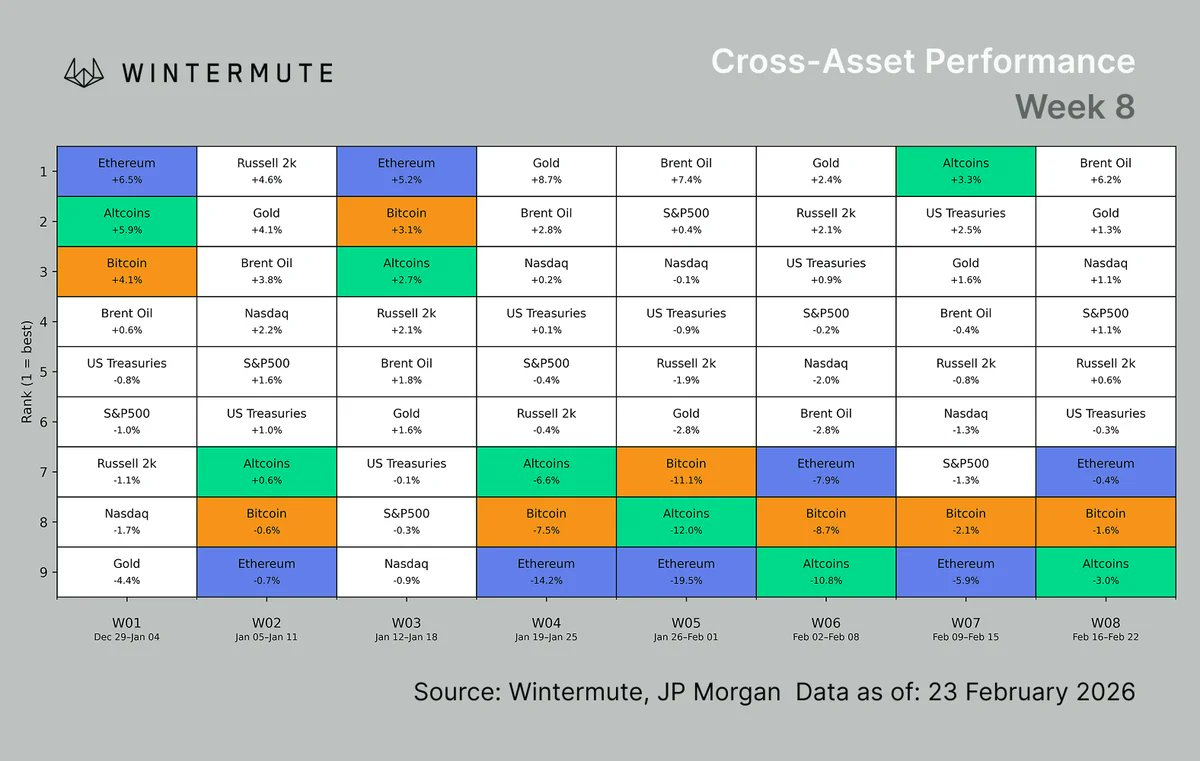
Both driving forces attack the same issue: the embedded valuation premium of globally integrated, software-leveraged growth companies. The rotation has gone quite deep. Gold, commodities, industrials, metals and mining, defense, and energy have outperformed the market. Value styles are effective, while growth stocks are being sold off. There is no clarity on interest rates, and no signals that can reverse this trend. The Federal Reserve can neither cut rates with sticky inflation nor tighten amid slowing growth, and this deadlock is itself the entire trading logic.
Digital Assets
Since the chain reaction of liquidations two weeks ago, BTC has repeatedly tested the $70k level without success. The lack of rebound buying indicates more than just the price range itself. Price movements are chaotic, liquidity is thin, and the range is narrowing and lacks direction. ETH fell below $1,900 this week, which is more significant at a psychological level than a technical one; the actual support level for ETH to focus on is around $1,600.
Institutional demand has not returned after stabilizing prices — this starkly contrasts with the situation in the $85-95k range, where institutional buying was quite obvious. The derivatives market also confirms the lack of directional judgment and trading willingness: the basis is at a multi-month low, put skew is rising and continues to rise, and open interest has been decreasing since October.
Trading desk activity is leaning towards selling, but a noteworthy signal emerged mid-week: high-net-worth individuals briefly showed a selective willingness to buy altcoins. In an overall defensive environment, this represents a small but significant spark of confidence that faded very quickly.
The latter half of the week became chaotic again, any buying intention quickly vanished, indicating that the market is not ready to reward those who positioned early. Marginal actions remain protective rather than aggressive.
Our Judgment
Slow at first, then suddenly. The market feels like it is integrating various narratives into a picture of a paradigm shift.
Right now, cryptocurrency assets are being sold off as high beta growth assets — falling alongside tech stocks and momentum strategies — while the current world sees the risk premium for growth assets rising and the Federal Reserve unable to act. The continued net outflows from ETFs confirm this reality, which is the short-term situation.
But looking further, a more interesting question arises: how sticky is this paradigm? The narratives surrounding stagflation, de-globalization, and the Federal Reserve deadlock no longer feel like short-term catalysts; they resemble a real repricing of the macro background — a pattern favoring hard assets, commodities, and value, rather than growth. Cryptocurrency assets are currently on the unfavorable side of this trade.
That said, we have seen similar situations before. Over the past decade, multiple rotations triggered by growth panic eventually reversed as risk appetite returned and the market found momentum direction anew. The difference this time lies in the structural nature of AI repricing and de-globalization. But it is still too early to call it a paradigm shift. The stickiness of this narrative is indeed the most important question for the cryptocurrency market in 2026 — we do not yet have an answer.
免责声明:本文章仅代表作者个人观点,不代表本平台的立场和观点。本文章仅供信息分享,不构成对任何人的任何投资建议。用户与作者之间的任何争议,与本平台无关。如网页中刊载的文章或图片涉及侵权,请提供相关的权利证明和身份证明发送邮件到support@aicoin.com,本平台相关工作人员将会进行核查。


