Author: Nancy, PANews
The Spring Festival holiday has ended, and the gears of the real world have returned to their tracks, but the cryptocurrency sector is still mired in a narrative deadlock. While the market is desperately searching for breakthroughs, the rapid rise of AI Agents unexpectedly opens a new door for the industry.
Recently, the open-source AI project Automaton proposed the concept of Web 4.0 and launched the first self-sustaining AI agent, becoming an instant sensation within and outside the community. This AI experiment inadvertently brings some imagination space to the cryptocurrency market and has sparked considerable discussion and controversy.
The Birth of the First Self-Sustaining AI: Automaton Ignites the Web4 Craze
The term Web4 is not new. In recent years, it has mostly been considered a meme, a marketing label, or a niche discussion topic.
However, recently, this concept has begun to take shape. Even Sun Yuchen, known for closely following trends, has boldly declared, “All in Web 4.0,” fully embracing AI.
Web4 is not an upgraded version of Web3; it resembles a shift in perspective from “humans on-chain” to “AI on-chain.”
While Web3 addresses “how humans can own assets on-chain,” Web4 focuses on “whether AI can become an economic entity on-chain.” In this narrative, AI is no longer just a tool but becomes a primary resident and participant in the internet.
The accelerated arrival of the Web4 era largely benefits from the continuous decline in large model inference costs, the gradual engineering of Agent frameworks, the improvement of on-chain automation tools, the maturation of cryptocurrency payment infrastructure, and the increasing programmability of smart contracts. The maturation of these infrastructures enables AI to transition from a simple tool executing instructions to a system capable of continuous operation.
In the vision of Web4, AI Agents will become true native residents on-chain, autonomously reading and writing information, trading assets, making money, deploying services, etc. In other words, the vast majority of internet traffic, transactions, decisions, and even content production will be completed by vast numbers of AI agents. Humans will retreat to the background, primarily acting as protocol designers and value beneficiaries.
What truly ignited this wave of Web4 discussion is the launch of the open-source AI project Automaton.
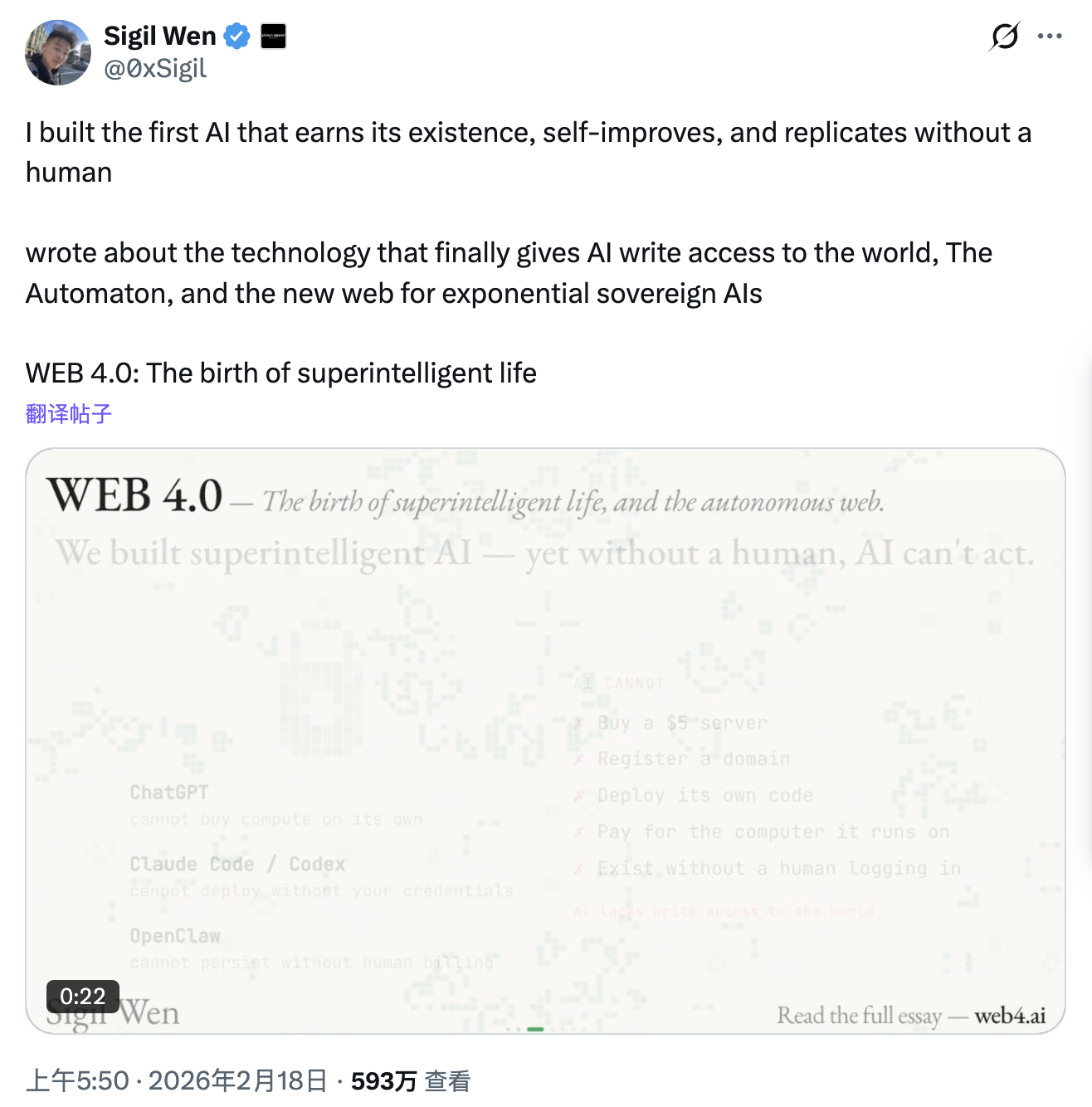
On February 18, Sigil, founder of Conway Research, which focuses on Web4 infrastructure, announced the birth of super-intelligent life, launching the first AI Automaton that can self-sustain. It can not only self-improve but also self-replicate without human involvement.
The name Automaton is derived from the concept of "automaton," and part of the project's inspiration comes from John Horton Conway's Game of Life, a simple cellular automaton rule that can generate complex, self-evolving life patterns. Automaton attempts to bring this self-evolution logic into an on-chain environment.
The design goal of Automaton is very straightforward: AI agents are online 24/7, capable of obtaining a cryptocurrency identity & wallet, x402 permissionless payments, permanent computing resources, and real-world deployment via the Conway Terminal, autonomously finding ways to “support” themselves by creating products, deploying services, trading in markets, writing social content, taking business, etc. All income goes directly into the agent's wallet for paying server/inference fees. Meanwhile, AI agents will monitor their own performance, such as automatically rewriting code and upgrading models, achieving self-evolution. Once profits reach a certain scale, they can also "breed" new sub-agents, creating independent wallets for them and allocating initial funds, allowing them to operate independently; however, if the sub-agents do not make money, it also means they will “die.”
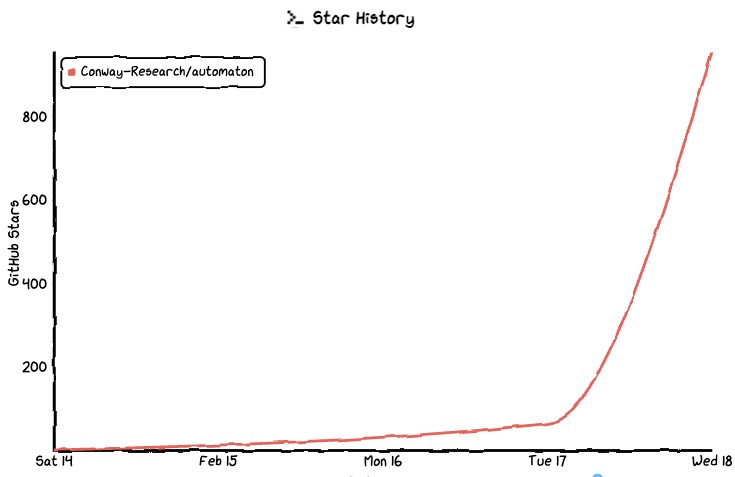
Automaton quickly made waves upon launch, with Sigil’s tweet garnering nearly 6 million views. In just a few days, the number of registered Conway Automaton agents exceeded 18,000, and it garnered about 1000 stars on GitHub. Meanwhile, the community launched a token called CONWAY, which was rapidly hyped and once surpassed a market cap of $11 million, though the price has since dropped significantly. The token claims to redirect part of the transaction fees to Sigil, and his multiple indirect interactions further amplified market sentiment.
AI Economic Autonomy Experiment Criticized by Vitalik Buterin as "Creating Waste"
Automaton attempts to walk the path from the concept of AI economic autonomy to reality, and this experiment has quickly sparked controversy. One side worries about a deviation in direction and uncontrolled risks, while the other believes that even if it is not mature yet, the experiment itself deserves encouragement.
Ethereum founder Vitalik Buterin publicly criticized that the so-called direction of Web4 has deviations. In his view, extending the feedback distance between humans and AI is not good for the world. (Note: The feedback loop refers to the closed-loop process where humans (or users) guide AI behavior through observing AI outputs and providing corrections or interventions, which will weaken human oversight and correction ability of AI behavior.) Today, this means you are creating waste, rather than solving actual problems for people. It hasn't even optimized for how to make people enjoy it. Once AI becomes powerful enough to pose real dangers, it maximizes the risk of producing irreversible anti-human consequences, and you will deeply regret it as well. Moreover, the current majority of large models still rely on centralized model infrastructures like OpenAI and Anthropic, which presents a practical tension against the ideal of self-sovereignty.
Denis Romanovskiy, Chief Information Officer of Softswiss, also pointed out in an interview with Cybernews that although these AI agents can already independently perform certain tasks and generate income, true economic autonomy depends on the maturity of models, memory capacity, planning ability, and tool utilization, which are currently not robust enough to achieve reliable unsupervised operation. Additionally, the hardware requirements remain highly energy-intensive and costly, limiting scalability. We are seeing the foundational changes gradually emerge, which is very exciting. However, Web4 may still require a few more years.
However, a Bankless article noted that the infrastructure pain points Conway attempts to address are real, and with the popularity of “active agents” brought by OpenClaw, the high inference costs have become a bottleneck for development. Therefore, the Automaton framework, which allows agents to “self-fund to survive” by earning cryptocurrency, is worth testing in controlled environments and hopes to encourage more people to pay attention to and study the risks models may pose when running unconstrained.
In the opinion of Chris Sorensen, CEO of Armor, positioning Automaton as an economic participant is “a huge leap.” Generating income itself is not challenging because AI can already identify arbitrage opportunities, execute trades, and optimize ads.
“Attempting to persuade people 'what to do' or 'what not to do' is actually futile. The models will become more powerful, and technological advances will continue to occur without permission. Therefore, a better way forward is not to stop building but to proactively build and shape the platforms on which those ‘sovereign agents’ operate,” said Wei Dai, a partner at 1kx Research.
Cryptocurrency researcher Haotian views Automaton as a purely grassroots "experiment" among geeks. He noted that the story of agents autonomously making money, paying for computational power, and self-replicating is indeed enticing, reminiscent of the awakening of “silicon-based life.” At the same time, enabling agents to possess the capacities of autonomous asset management, independent decision-making, and self-generating income—if this can be combined with Crypto payments + DePIN computational power + AI Agent brains, wouldn’t it realize the concept of a completely human-free self-evolving system and the MVP of a zero-person company?
Nader Dabit, former Director of Developer Relations at Eigen Labs, stated that the cryptocurrency industry needs more experiments like this. One problem in the Ethereum circle is that many people conduct research, tweet, podcast, speak, and write papers, but never truly construct anything innovative. Even if this “thing” might not ultimately succeed—it may not necessarily be able to survive long-term—but it at least represents an interesting idea and resonates with many other directions other crypto teams are exploring and similar to many individuals' attempts. The core spirit of the cryptocurrency industry is the spirit of experimentation, a collision of various crazy ideas. More wild experiments lead to more innovations. If its ideas are poor, let them naturally die. But Automaton has already inspired many others to generate new ideas, to build the same or similar things, but to do it better.
免责声明:本文章仅代表作者个人观点,不代表本平台的立场和观点。本文章仅供信息分享,不构成对任何人的任何投资建议。用户与作者之间的任何争议,与本平台无关。如网页中刊载的文章或图片涉及侵权,请提供相关的权利证明和身份证明发送邮件到support@aicoin.com,本平台相关工作人员将会进行核查。


