If we compare the cryptocurrency industry to a set of teeth, then the process of listing coins over the years resembles a process of "industry orthodontics." From the chaos of 2017 to the industrial assembly line of 2025, every method of token distribution in the market is essentially a correction of the structural deformities of the industry and a challenge to the chip structure.
In this process, the path pursued by projects for top liquidity has evolved from an early "volume game" to the current high-priced "bride price model"; exchanges, in order to survive, attract traffic and fees, and have also transitioned from the early listing logic to pricing logic.
How exchanges, projects, VCs, and traders mutually destroy and love each other; mutually slander and achieve each other.
For you, a million times.
Introduction
Teeth are a very "magical" organ in the human body. Why do I say this? Because teeth are the only organ in the human body that allows for deep customization, movement, and modification through physical and biological means after reaching adulthood.
This "plasticity" enables us to combat the misalignment caused by genetics and the wear and discomfort brought by time.
We generally think of bones as hard and fixed, and that teeth should be immovably anchored in the alveolar bone. But orthodontics (braces) actually utilizes the characteristic that bones are a "dynamic active tissue." When braces continuously apply a constant light force to teeth, the side of the alveolar bone under pressure feels the stress, causing the body to dispatch "osteoclasts" to absorb the bone here, making room for the teeth; while on the side left with gaps after the teeth move, the body will dispatch "osteoblasts" to fill in new bone.
Teeth "destroy" bone on one side while "rebuilding" bone on the other, thus achieving gradual movement within the skeletal structure.
This is something no other hard organ in the body can accomplish. After all, unless you are exceptionally gifted, you cannot shorten your femur or change the position of your ribs by applying pressure, but teeth can.
The rules and policies for listing coins are similar.
Part One: The Struggle and Transfer of Asset Pricing Power in Listing
This article divides the path of coin listing into four stages: baby teeth—teeth growth—malocclusion—orthodontics, with the core throughout these four evolutionary stages being: Who controls the pricing power of the assets.
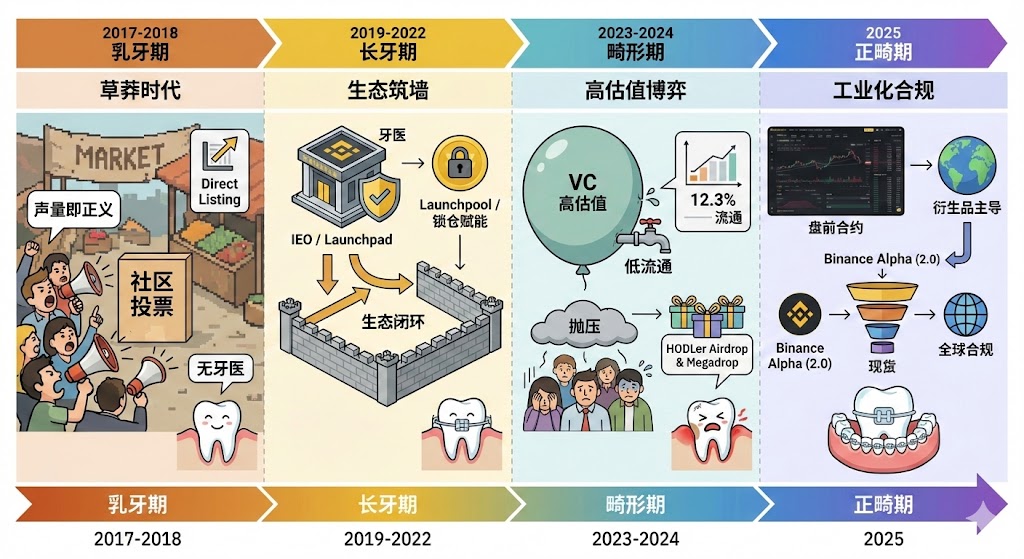
Stage One (Community Pricing)
Pricing power is in the hands of "callers" and grassroots communities. Traffic is king; the louder one shouts, the more rationality they hold. The result is that bad money drives out good money, and the market is filled with noise.
Stage Two (Exchange Pricing)
Exchanges regain pricing power through IEO/Launchpad, acting as "gatekeepers" and "investment banks." The credibility of exchanges becomes the core support for asset prices.
Stage Three (Collapse of VC Pricing)
VCs hold excessive pricing power in the primary market, leading to a lack of profitability in the secondary market. Exchanges are forced to intervene, attempting to "redistribute wealth" through coercive means (Airdrop), but this is merely a painkiller that treats the symptoms but not the root causes.
Stage Four (Market-oriented/Derivatives Pricing)
The money in market games is not in spot trading, so pricing power is transferred to more mature financial mechanisms. Through "contract trading" and pre-market trading, the market forms a fair price after sufficient competition, no longer relying on a single narrative or VC valuation reports.
Part Two: The Context, Logic, and Evolution of Listing Coins
Stage One: 2017-2018 "Baby Teeth Period"—Volume Equals Justice in the Grassroots Era
Core Path: Direct Listing, Community Voting
During this period, the industry was in a "no dentist" state. The logic of listing coins had a strong founder and community sovereignty color; as long as the project could galvanize fans, they could gain an entry ticket.
Context of the Era
This was the "Genesis" stage of crypto. The industry was still in a pure trading platform era, and users were mainly focused on convenience, speed, and cost-effectiveness of trading. Most mainstream exchanges at that time were slow and unstable, while newbie platforms gained a reputation by being "extremely simple," with no complex learning systems or social features, and interfaces designed entirely for experienced professional traders.
Reasons
Customer acquisition anxiety: Start-up platforms needed to attract traffic from competitors at a low cost and high efficiency. "Community voting" was not just about selecting coins, but also about competing for community belonging.
Regulatory vacuum: Global regulation had not yet intervened, and exchanges had very high decision-making freedom, with logic being extremely simple: more fans equated to guaranteed liquidity.
Gameplay: Represented by Binance's "monthly community voting for new listings," users could vote by paying a tiny token (like 0.1 BNB). Winning projects (like Zilliqa, Pundi X) almost obtained top traffic for free, but due to vote manipulation, the market became seriously misaligned, leading to a final abandonment.
Stage Two: 2019-2022 "Teeth Growth Period"—Building Ecological Walls and Premium Issuance
Core Path: IEO (Initial Exchange Offering), Launchpad, Launchpool, Direct Listing
The industry begins to wear an orthodontic appliance called "ecology." Exchanges are no longer just intermediaries but become "dentists" with deep due diligence capabilities.
Context of the Era
After the ICO bubble burst in 2017, fraud and technical vulnerabilities tarnished industry credibility. The market needed a safer and more credible fundraising method. Simultaneously, the arrival of DeFi Summer (2020) established "liquidity mining" as an industry consensus.
Reasons
Credit Repair: Exchanges introduced "bank-level" due diligence through Launchpad, acting as industry dentists, filtering projects with serious teams and technology, upgrading the ICO model to a more secure IEO.
Ecological Closed Loop: To secure user retention, platforms forced the empowerment of their local tokens (like BNB) through Launchpool, allowing users to earn new coins by "holding" rather than "grabbing," thus reducing participation risk.
2019-2020 (IPO Frenzy):
Launchpad (like BitTorrent) introduced a pricing issuance model. Project parties not only had to pass technical reviews but also accept "pricing recommendations" from exchanges to ensure that a certain "wealth effect" exists post-listing.
2021-2022 (Locked Incentives):
Launchpool became mainstream, empowering platform coins, indicating a shift from "buying new coins" to "mining new coins." Users exchanged locked platform coins for new coins distribution, forcibly binding project interests with the platform ecosystem.
Stage Three: 2023-2024 "Malocclusion Period"—High Valuation, Low Circulation Games and Mechanism Upgrades
Core Path: HODLer Airdrop, Launchpool
Context of the Era
Venture capital (VC) returned to the market on a large scale, giving rise to numerous projects valued in hundreds of millions with extremely low circulation (median only 12.3%). This structure left retail investors in the secondary market with almost no profit margin, continuously pressured by unlocks. At the same time, with exorbitant fines, CZ in jail, the focus shifted from "barbaric growth" to "global compliance and stability."
Reasons
Conflict of Pricing Power: VC-driven projects peaked upon listing, stripping the market of price discovery functions. Exchanges, to protect their ecosystems, must correct through coercive measures and "return power to the people."
Compliance Pressure: Starting from May 2024, rules clearly favored small and medium-sized projects with high distribution ratios, requiring project parties to lower the float, aiming to curb VC manipulation of pricing.
Corrective Measures: Implementing HODLer Airdrops and Megadrops targeting long-term holders, forcibly distributing "bride prices" directly to retail investors.
This represents the most painful "periodontitis" phase in the industry's orthodontic process. VCs spawned a large number of "peak upon listing" projects, with median token circulation dropping to 12.3%, and Binance's industry report indicates about $155 billion potential sell pressure from new projects in 2024 alone.
Due to VC manipulation of pricing, retail investors bought at highs as listings peaked, resulting in a significant drop in market confidence. Poor performance in the secondary market caused trading volume in spot trading to shrink.
To maintain the attractiveness of platform tokens, attract traffic, and trading demand, platforms began aggressively promoting HODLer Airdrops and Megadrops. Listing policies gradually shifted towards small and medium-sized projects and high distribution ratios.
Starting in the second half of 2024, exchange contract mechanisms underwent significant upgrades, beginning to support a wider range of small coins and new perpetual contracts, allowing risk hedging and early pricing through derivatives even before spot liquidity matured. The sources of traffic and revenue for exchanges also shifted towards perpetual contract trading.
Stage Four: 2025 "Orthodontics Period"—A Multi-layered, Industrialized Compliance Matrix
Core Path: Binance Alpha Airdrop, Pre-Market Trading, Web3 Wallet Integration
Context of the Era
The year 2025 is known as the "year of cryptocurrency industrialization." The total market value of digital assets exceeds $4 trillion, and Bitcoin becomes a macro asset. Perpetual contracts have become dominant in the derivatives market, accounting for over 75% of global crypto derivative transaction volume.
Reasons
Shift in Pricing Power: The market is no longer driven by narratives and calls but by ETF flows, corporate earnings, and protocol revenues.
Efficiency Optimization: Futures First trading allows pricing through derivatives before new coins go live. Data from 2025 shows that the transformation cycle for this path shrinks to 14 days, making it the fastest route to mainstream visibility.
Pre-Market Contracts: This represents the most important mechanism change of 2025. "Pre-market contract trading" introduces the ability for users to trade perpetual contracts with up to 5x leverage based on external price feeds even before tokens officially list on the spot market.
Small Coins' Depth of Liquidity: Because contract trading and pre-market trading attract substantial traffic and draw in many small market makers, they significantly enhance the gaming space and liquidity for small coin contracts. This allows new coins, such as ESP, AZTEC, and KITE, which have not yet gone live on the spot market, to quickly establish derivative liquidity, becoming the fastest path to mainstream visibility, with an average cycle from listing to the official issuance of coins being about 14 days.
Binance Alpha (2.0): As a "pre-list token selection pool," projects must first go through a round of "monster hunting" to prove their performance in the secondary market (including price trends and trading volume) before gradually upgrading from contracts to spot.
Part Three: Power Transition from "Grassroots" to "Industrialized Orthodontics"
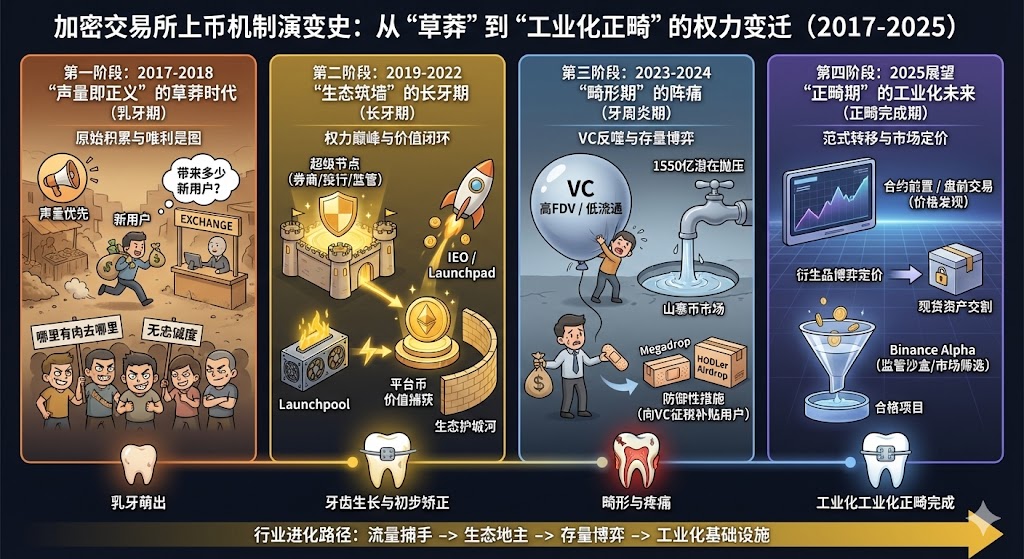
Stage One: The Grassroots Era of "Volume Equals Justice" (2017-2018)
This was the "primitive accumulation" period for exchanges. They had almost no ability to discern the quality of projects and did not need to. They only needed to answer one question: "How many new users can this coin bring me?”
This model cultivated the first batch of "profit-driven" cryptocurrency users, who had no loyalty to either platforms or projects, going wherever there was profit, laying the groundwork for the tragic liquidity mining that followed.
Stage Two: The Teeth Growth Period of "Ecological Walls" (2019-2022)
Exchanges achieved a peak of power, becoming the top of the food chain. They were no longer just venues for trading but became super nodes that integrated the roles of broker, investment bank, and regulator. IEO became the best tool for exchanges to monetize brand premium.
The transition from "buying new coins" to "mining new coins" (Launchpool) was extremely ingenious. It successfully forced the interests of external projects to be funneled to platform token holders, completing the value capture loop for platform tokens. This was the most critical step for exchanges in building their "moat."
Stage Three: "Growing Pains" of the "Malocclusion Period" (2023-2024)
This was a backlash against the excessive expansion of VCs in the previous bull market. Projects with high FDV and low circulation were essentially systematic harvests of retail investors by VCs exploiting information asymmetries and financial advantages.
The aforementioned "potential sell pressure of $155 billion" is an astonishing figure. This explains why, when Bitcoin hit new highs, the altcoin market was lifeless. The market not only lacked new capital but was continuously drained by unlocks of old projects.
This reflects the helplessness of exchanges, knowing full well they are all pits yet continuing to list to maintain competitiveness. Megadrop and HODLer Airdrop seem like innovations but are actually defensive measures forced upon exchanges to maintain ecological activity by "taxing" VCs and subsidizing users. This is a painful "stock game."
Stage Four: The "Industrial Future" of the "Orthodontics Period" (Outlook for 2025)
During this stage, the industry finally realized that relying solely on the spot market along with simple IEOs, airdrops, and KOL rounds could no longer support the increasingly complex capital demands and community pressures.
In this stage, contracts replaced spot trading as the main price discovery method along with pre-market trading.
Firstly, this represents a huge paradigm shift. Previously, it was "first the asset, then the derivatives"; in the future, it will be "first derivatives pricing, then spot asset delivery." This greatly accelerates the price discovery process. The true value of a project does not need to await the moment of listing and subsequent volatility, but is anticipated during the long and short battles in pre-market contracts.
The emergence of Binance Alpha also provides a pre-window for "industrial coin listing." Alpha is effectively a "talent show sandbox" or "decentralized selective market." It requires projects to prove their liquidity and resilience in the harsh reality of the market to earn "regularization" qualifications. This replaces the manual due diligence of the second stage with market mechanisms.
Part Four: The Evolution of Listing Fees: From Listing Fee—Road Money—Bridal Price
This section does not target any specific exchange but narrates based on publicly available information.
The evolution of the "listing fee" in these four stages fundamentally reflects a process of power transition in the industry: from the initial "paying the platform road money" to the current "spending everything to attract traffic." We can observe how the industry has evolved step by step through this perspective of "bride price."
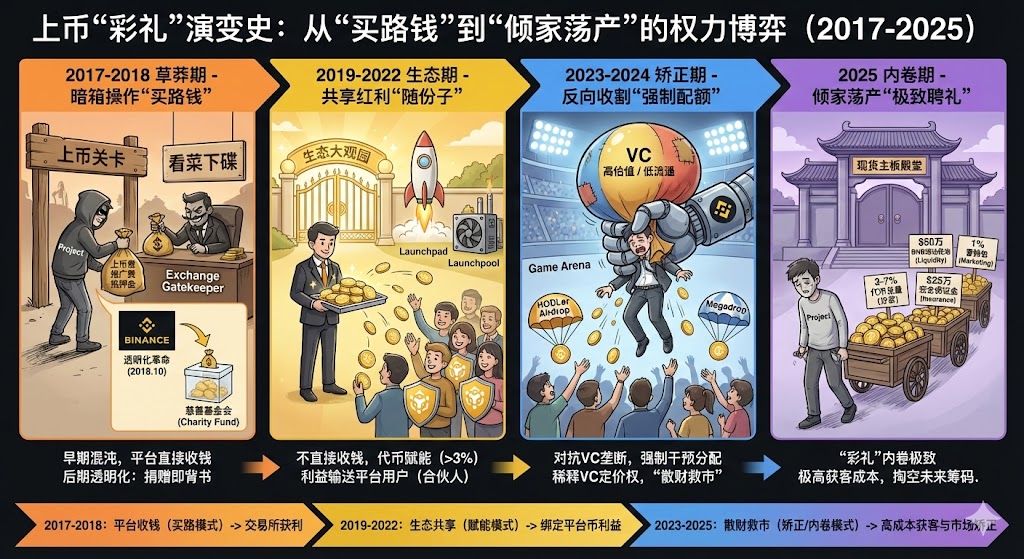
The following discusses the models of listing fees in the four stages:
Stage One (2017-2018): From "Road Money" to "Bridal Price"
In the early chaotic period, rumors of exorbitant listing fees circulated endlessly, with various exchanges in a state of "see what you're served," charging fees under numerous names: listing fees, event fees, promotion fees, deposits, etc.
In October 2018, Binance carried out a transparency revolution by announcing that all listing fees would be donated 100% to charity. Listing fees shifted from "direct income for the platform" to "credibility endorsement for the brand."
Stage Two (2019-2022): "Ecological Dividend" Exchanges of Interests
During this period, the direct money-collecting model was abandoned. What replaced it was "eco-empowerment," where project parties needed to allocate tokens to the platform's users (mainly platform token holders).
For example, Binance utilizes Launchpad for pricing issuance or Launchpool for liquidity mining.
Though nominally there were no "listing fees," project parties must allocate a certain percentage of tokens (usually over 2-3% of the total) as distribution chips. This portion no longer flows into the exchange's pocket but into the hands of "partners" that can support the platform ecosystem.
Stage Three (2023-2024): "Mandatory Quotas" to Counter VC Monopolies
As "high valuation, low circulation" tokens ran rampant, exchanges began to forcibly intervene in benefit distribution. At this time, Binance saw a famous rumor about "x% token listing fee," sparking significant industry debate. The official response later stated that the stated project tokens were not for exchanges but required project parties to allocate them for user airdrops and community rewards.
Following HODLer Airdrops, Launchpool, Megadrop, and other initiatives, project parties were compelled to conduct large-scale token distributions at the initial stage of listing to "dilute" VC's pricing power.
Stage Four (2025 and Beyond): "Destructive Bride Prices" of Inverted Value
By 2025, the "bride price" for entering the spot mainboard had reached its extreme of internal competition. The following phenomena emerged:
Distribution ratio increase: The average distribution ratio stabilizes between 3% to 7% of the total token supply. (From alpha to spot)
Margin mechanism: In addition to tokens, project parties typically also must pay a security deposit of around $250,000 (refundable after 1-2 years), and prepare at least $500,000 in BNB to form a liquidity pool.
Marketing package: About 1% of the supply is allocated for platform marketing.
From 2017 to 2025, the logic of listing fees underwent three major shifts:
2017-2018: The platform collects payment (road money).
2019-2022: Ecological sharing (empowerment).
2023-2025: Financed rescue (correction).
Current "listing fees" have completely evolved into a customer acquisition cost. To exchange for liquidity on top-tier platforms, the value of tokens paid often exceeds their total financing. This "bride price model," while ensuring users' initial returns, also leads many projects to nearly deplete their growth chips by "wedding day."
Part Five: What Should Industry Participants Say?
This text is not only a reflection on history but also an evolution report on the survival philosophy of exchanges and project parties.
It showcases how exchanges represented by Binance have adjusted their position through different cycles: from the initial "traffic catcher," evolving into "ecological landlords," and after encountering the crisis of "VC harvesting," ultimately choosing to evolve into an "industrialized financial infrastructure."
Future coin listings will no longer be a simple "bell-ringing ceremony" but rather a complex, multi-layered financial engineering. For project parties, the era of merely writing white papers and pulling in VC funding is entirely over; for retail investors, the window for getting rich easily through blind IPOs has also closed. What is required in the future is a better professional trading ability and an understanding of derivative tools.
What? You say the listing rules of exchanges are tough?
Aren't teeth quite tough as well??
Correction takes time.
For you, a million times.
Afterword
The cover features "The Kite Runner," and I highly recommend everyone take the time to read the original work. (Watching the movie is also fine)
After watching the movie and then returning to this text, your feelings may change—what does it mean to mutually destroy and achieve each other? What does it mean to "be a good person again?"
免责声明:本文章仅代表作者个人观点,不代表本平台的立场和观点。本文章仅供信息分享,不构成对任何人的任何投资建议。用户与作者之间的任何争议,与本平台无关。如网页中刊载的文章或图片涉及侵权,请提供相关的权利证明和身份证明发送邮件到support@aicoin.com,本平台相关工作人员将会进行核查。


