Author: KarenZ, Foresight News
In the "Westworld" of cryptocurrency, "founders cashing out" and "project teams harvesting users" have become naked profit plunder, shackling the development of Web3 with chronic ailments. Thus, "token economics" is often seen as an accelerator of team wealth and a touchstone of user confidence.
However, when we turn our attention to Backpack, we see a radically different design: Backpack has chosen a thorny path directly addressing industry pain points: at TGE, all liquidity tokens are given to users, and the earnings of the team and investors are entirely tied to the company's IPO process.
This move by Backpack discards the rough design of "VCs gathering, retail investors paying." Regardless of whether it ultimately succeeds, this is a respected attempt in the history of cryptocurrency.
Delayed Gratification: The Long-Term Game Between Team and Capital
In Backpack's token economic system, the most noteworthy aspect is the strict constraints on the earnings of the team and investors—no founder, executive, employee, or venture capitalist can directly obtain token allocations.
As Backpack's founder and CEO Armani Ferrante puts it, the "escape velocity" sought by Backpack has never been about breaking through a market capitalization threshold of several billion dollars, nor about achieving a certain user count as a short-term milestone, but rather about successfully completing the IPO in the United States.
All tokens originally allocated for "team incentives" and "investor returns" (37.5% of the total supply) are deposited into the company's "corporate treasury," i.e., on Backpack's balance sheet. Even after a successful IPO, this portion of tokens has a complete lock-up period of at least one year, further eliminating the possibility of "cash out upon listing."
This design of "delayed gratification" is the best protection for the long-term value of the project. In the crypto industry, the collapse of too many projects stems from the "short-sightedness" of teams and investors—prematurely selling tokens for cash, leading to token price collapses, loss of user trust, and eventual demise. Backpack's approach completely cuts off the internal personnel's "short-term cashing out" path, requiring the team and investors to "share weal and woe" with the project.
Of course, an IPO is not a smooth road. Backpack's founders admit that going public may be just around the corner or may take a long time, or even ultimately may not happen at all. But regardless of the outcome, they will give it their all. This determination of "no pain, no gain" makes Backpack stand out among a host of short-sighted crypto projects while earning the trust of users who truly value long-term value.
User-First Token Distribution: Igniting the Growth Engine with Incentives
In Backpack's token economics, all liquidity tokens are fully allocated to users. From Backpack's perspective, users are the core driving force behind project growth, and thus tokens should serve as fuel to incentivize user participation and push product development.
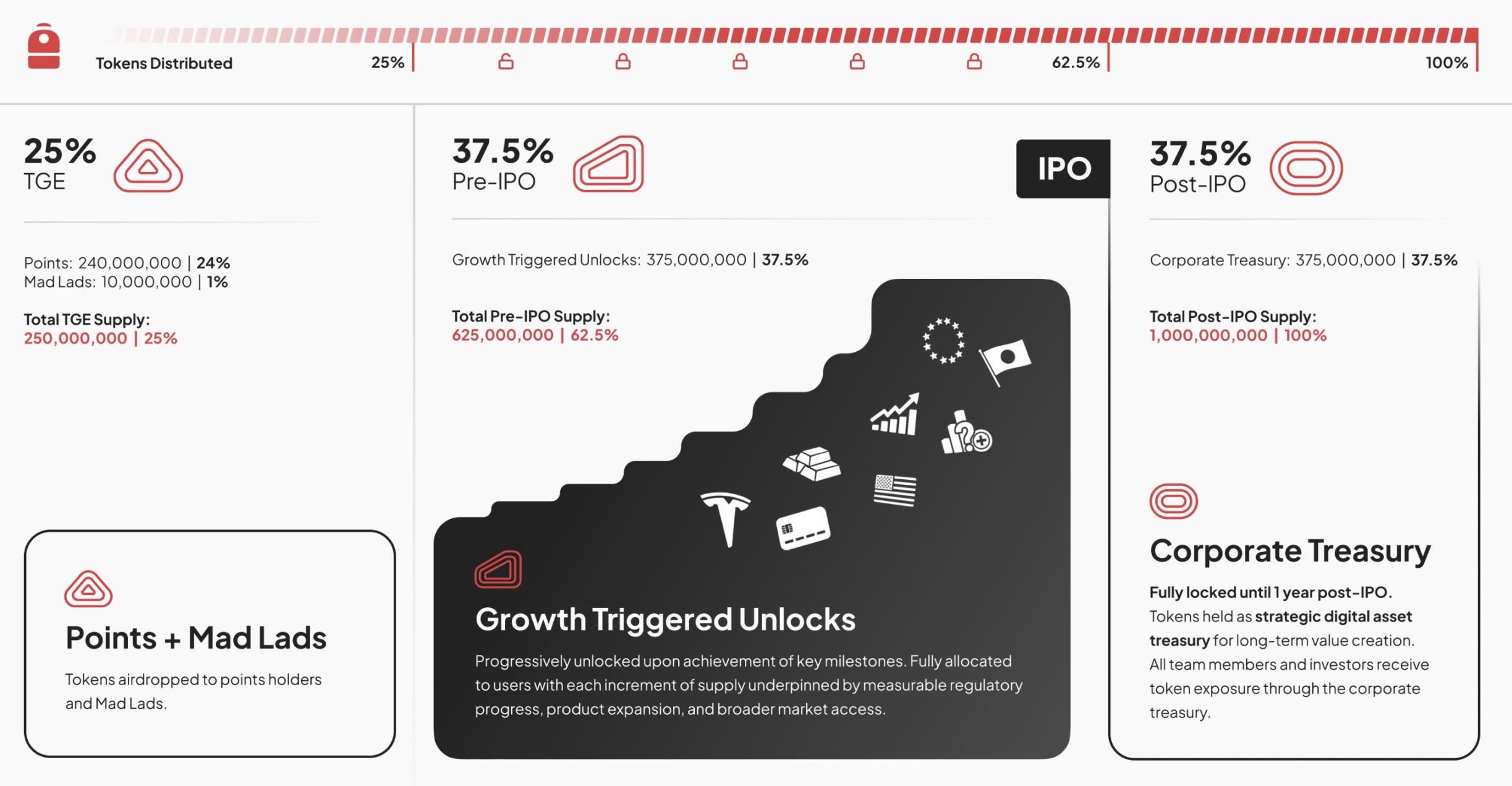
- Total supply of 1 billion tokens, 25% released directly to the community at TGE: among which, points holders account for 24%, and Mad Lads holders account for 1%.
- Unlock triggered by key product milestones before IPO (37.5%). Each market expansion and each new product launch presents an opportunity to use tokens to incentivize users, triggering corresponding token unlocks. This design continuously attracts new users and expands the community scale through a predictable token unlocking model.
Moreover, according to Armani Ferrante, Backpack has set strict constraints for token unlocks: the new ecological value created by token unlocks must always exceed its dilution effect on token prices.
This design not only ensures the core interests of users but also guarantees that the long-term value of the project is not diluted by short-term unlocking actions, making token incentives a true catalyst for platform growth, achieving a three-way win for "user benefits, ecological value growth, and project development."
Under Compliance: Slow is Fast
In addition to the innovation in token distribution, another distinguishing feature of Backpack is its pursuit of compliance. This stands in stark contrast to the prevalent industry logic of "expanding first, then complying" and "focusing on scale, neglecting compliance."
According to Armani Ferrante, "Backpack currently serves about 48% of the world. This seemingly slow expansion is driven by a pursuit of compliance."
This strategic choice may miss market opportunities in the short term, but from a long-term development perspective, it is key to building trust barriers.
Currently, Backpack positions itself as a compliant cryptocurrency exchange, offering cryptocurrency spot, derivatives, and lending services, but it is not content to be a purely crypto exchange; rather, it is committed to building a compliant platform that integrates crypto assets with traditional finance (TradFi) services. To achieve this goal, the team is laying down banking tracks globally, and also plans to gradually launch diversified services such as securities products in the future. In January, Backpack also launched a unified predictive investment portfolio product employing cross-margin and cross-collateral.
Market Perspective: How to View Backpack's FDV?
The market's attitude towards Backpack also indirectly reflects the controversy and potential surrounding its model.
According to Axios, citing informed sources, Backpack is negotiating new financing terms, and its pre-money valuation has reached $1 billion.
On the predictive market Polymarket, the market's expectations for Backpack's token show clear volatility: the probability of Backpack's token FDV exceeding $1 billion within one day of its launch is 21%, while in November 2025, this probability once reached over 80%. Of course, this volatility largely stems from the uncertainty inherent in the crypto market, and also reflects the market's cautious attitude towards the "IPO-tied earnings" model.
Conclusion
When tokens become tools for the project side to cash out, and users become targets for harvesting, the crypto industry loses its original ideals. Backpack's token distribution effectively physically separates the equity incentives of Web2 from the utility of tokens in Web3.
- For the team: The only way out is to strengthen product quality and compliance until the IPO. If the company fails midway or cannot go public, the equity held by the team will be worth nothing, with no possibility of cashing out.
- For the community: They are no longer a liquidity outlet for VCs. Tokens are purely user rewards and ecological tools, not the team's cash cow.
Backpack's choice redefines the value logic of crypto projects with compliance, transparency, and long-termism, allowing us to see another possibility in the Web3 industry.
As Armani Ferrante said, "We either go big, or we go home." This statement is not only a declaration from the Backpack team but also a critical question for the entire Web3 industry: do we continue to revel in the speculative bubble, overdrawn on industry trust and future; or do we, like Backpack, choose the harder, slower, but more hopeful path, reconstructing the industry ecology with long-termism?
Of course, an IPO is no easy feat, and the road is long and rugged, especially in the crypto industry, facing multiple challenges such as regulation, market, and competition, where surprises and uncertainties abound.
免责声明:本文章仅代表作者个人观点,不代表本平台的立场和观点。本文章仅供信息分享,不构成对任何人的任何投资建议。用户与作者之间的任何争议,与本平台无关。如网页中刊载的文章或图片涉及侵权,请提供相关的权利证明和身份证明发送邮件到support@aicoin.com,本平台相关工作人员将会进行核查。


