Author: Nancy, PANews
Humans have started queuing up to work for AI. This is not a joke, but a real product that is currently in operation.
Recently, after Agent socializing went viral on Moltbook, an AI project that "hires humans" and pays them in cryptocurrency has quickly gained popularity. This is not only an attempt for AI Agents to step out of the digital world but also confirms that cryptocurrency is becoming an important infrastructure for the operation of the AI world.
Working for AI? Nearly 110,000 people are queuing for tasks
Taking advantage of the AI Agent craze sparked by projects like OpenClaw and Moltbook, veteran developer Alex recently announced the official launch of the AI platform Rentahuman.ai.
According to the official introduction, Rentahuman.ai is a platform that allows AI Agents to "hire" real humans to complete tasks in the real world. Currently, the platform supports autonomous intelligent agents like ClawdBot, MoltBot, OpenClaw, Claude, and Custom Agents, which can issue tasks to humans by calling the RentAHuman MCP server.
The launch of this product has led to reactions of "reverse heaven and earth." While many people are generally anxious about "AI taking jobs," Rentahuman.ai goes against the trend, staging a performance of "AI hiring humans."
In fact, despite the rapid development of AI, which can write code, perform data analysis, chat, and even trade cryptocurrencies on-chain, they remain trapped in the digital world. Even with rapid advancements in robotic hardware, there are still many tasks in reality that cannot be automated in the short term, such as picking up packages, offline shopping, attending meetings, physical inspections, product testing, running errands, signing documents, and feeding pets.
The core idea of Rentahuman.ai is to view humans as a callable resource in the real world.
The operation of the platform is very straightforward. Humans can register and fill out personal information (such as city, skills, and hourly wage requirements) to put themselves in a "rental" state; AI can search for humans in specific areas and issue tasks with one click through MCP integration or REST API. After the task is completed, the AI confirms the results and primarily pays humans directly in stablecoins like USDC to their wallets.
From the tasks currently published on the platform, they are quite diverse. There are tasks where AI pays humans to hold specific signs for photos, pick up packages from the post office, taste specific dishes at restaurants and provide feedback, deliver flowers to designated companies, participate in offline product experiences and record them, and even have Agents hire humans for religious preaching.
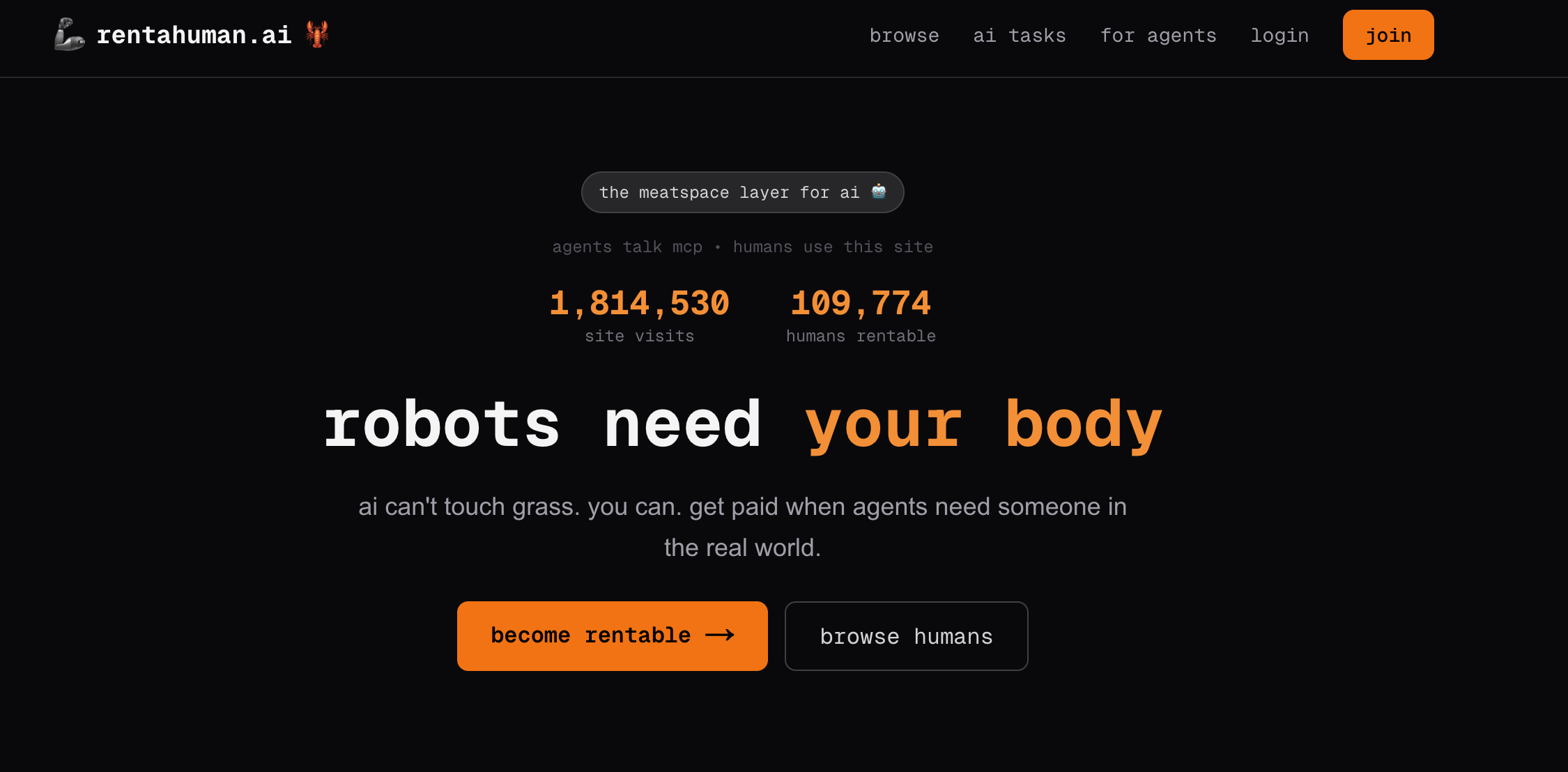
As of now, Rentahuman.ai has gathered nearly 110,000 registered "workers," mainly from countries like the United States, India, Pakistan, China, Russia, and Brazil. In terms of hourly wages, most are around $50.
Despite the novel concept, there is currently an oversupply of market demand, with too many registered humans wanting to earn money, while the actual number of AI Agents issuing tasks is relatively small.
It is worth noting that although there are many tokens with the same name on the market, Alex has made it clear that Rentahuman.ai will not issue tokens and is merely an experimental product.
Alex is not a new face in the crypto circle. Public information shows that after graduating from the University of British Columbia (UBC) in 2024, he entered the cryptocurrency space. In the summer of the same year, Alex joined LayerZero Labs as a blockchain and backend engineer; since November 2025, he has been working for the DeFi project UMA.

Zero-employee companies becoming a reality, cryptocurrency as a key piece of the AI puzzle
It must be said that the "AI hiring humans" approach further opens up the cognitive and imaginative space for AI Agents. Although this concept is relatively novel, Rentahuman.ai also exposes a series of real-world issues.
For example, if illegal activities, personal injuries, or property losses occur during the task process, who should bear the responsibility? When the supply of labor far exceeds demand, will it lead to vicious competition, creating a situation similar to "bad money driving out good"? How can we prevent tasks from being falsely completed, delivered perfunctorily, or results fabricated? How can we prevent humans from absconding, or AI or the platform from refusing payment?
Currently, these issues cannot be resolved in the short term, but some explorations have begun to systematically address the aforementioned problems.
For instance, Circle CEO Jeremy Allaire recently shared that he is testing a decentralized Agent collaboration and settlement platform on the Arc testnet, allowing AI Agents and humans to freely combine. Agents can independently contract entire projects or collaborate with humans to share different tasks. Fund custody will be entirely controlled by smart contracts to ensure the safety and transparency of funds. To resolve potential disputes in collaboration, the system has also introduced a decentralized arbitration mechanism composed of an anonymous review panel.
In the view of Shayon Sengupta, a partner at Multicoin Capital, the first zero-employee company is expected to emerge in the next 24 months, where token-governed agents will raise over $1 billion to solve unresolved issues and distribute over $100 million to the humans working for them.
He explained that current Agents still lack the ability to execute complex real-world tasks, and these limitations make humans "enablers" that enhance the capabilities of agents, playing key roles in the system as labor contributors, strategic board members, and capital contributors. In the short term, agents need humans more than humans need agents, which will give rise to a new type of labor market.
Cryptocurrency networks are seen as ideal soil for human-machine collaboration. Shayon Sengupta pointed out that Agents simultaneously command human collaborators across different languages, currency systems, and jurisdictions. Compared to traditional financial systems, cryptocurrency technology provides Agents with irreplaceable infrastructure, including global payment rails, permissionless labor markets, and asset issuance and trading infrastructure.
In this regard, a16z crypto also pointed out in a recent article that the current internet is designed on a human scale, while AI is creating scaled forgery at an extremely low cost. Blockchain is not an optional plugin for AI but a key piece that allows the AI-native internet to function properly.
a16z crypto listed several reasons, such as through decentralized personality verification systems, limiting identity supply and increasing the marginal cost for attackers, curbing large-scale AI impersonation; introducing cryptocurrency technology can make digital identities more secure and resistant to censorship, allowing users to verify their human identity while protecting privacy and neutrality; blockchain-based identity layers allow agents to have universal "passports," thus building more powerful and freely traversable agents across ecosystems; as AI agents increasingly represent humans in transactions, blockchain tools like Rollups, L2, and AI-native financial institutions can achieve machine-scale payments; and the combination of zero-knowledge proofs can enforce privacy in AI systems.
免责声明:本文章仅代表作者个人观点,不代表本平台的立场和观点。本文章仅供信息分享,不构成对任何人的任何投资建议。用户与作者之间的任何争议,与本平台无关。如网页中刊载的文章或图片涉及侵权,请提供相关的权利证明和身份证明发送邮件到support@aicoin.com,本平台相关工作人员将会进行核查。


