Under the global wave of digital currencies, Singapore is becoming an "outbound hub" for international crypto institutions. Whether it is stablecoin issuance, digital asset trading, or institutional-level custody and payment clearing, global fintech companies are seeking compliant and stable pathways here.
Behind this is a systematic regulatory framework established by the Monetary Authority of Singapore (MAS): a clear legal framework, a comprehensive licensing system, and a regulatory philosophy that balances risk and innovation, making Singapore stand out among major jurisdictions worldwide. Unlike the fragmented regulation in the United States and the high compliance costs in Europe, Singapore offers a predictable and operable compliance pathway.
This series of reports will systematically interpret Singapore's digital asset ecosystem from five dimensions: regulatory framework, licensed institutions, financial institution practices, international cooperation, and institutional advantages, helping you understand how its system attracts global institutions while providing references for the Asia-Pacific and global markets.
Regulatory Framework and Main Licensing System
(1) Core Regulatory Authority
The Monetary Authority of Singapore (MAS) is the unified regulatory authority for digital assets and financial markets in Singapore, fully responsible for the regulation of payment systems, digital currencies, fintech, and related financial services. MAS implements a management model that combines functional regulation and risk-oriented regulation for digital asset activities through a combination of legislation and licensing systems.
(2) Regulatory Laws and Overall Framework
1. Payment Services Act (PSA)
The Payment Services Act is the foundational legal framework for digital asset regulation in Singapore. This act defines digital currencies/cryptocurrencies as "Digital Payment Tokens (DPTs)" and includes related services such as payment, exchange, transfer, and custody within the payment services regulatory system.
The act specifies the following core requirements:
- Digital payment token services must operate under a license;
- Establish anti-money laundering (AML) and counter-terrorism financing (CFT) obligations;
- Clarify compliance standards for capital adequacy, customer asset segregation, risk management, etc.;
- Ensure financial stability and consumer protection through ongoing regulation.
2. Financial Services and Markets Act (FSMA)
The Financial Services and Markets Act further expands Singapore's regulatory boundaries for digital asset activities based on the PSA. Unlike the PSA, which primarily targets "services provided to local customers in Singapore," the FSMA extends its regulatory scope to all institutions registered in Singapore or having a business presence that conducts digital asset-related business based in Singapore, even if their clients are located overseas. Specifically, any entity engaging in the issuance, trading, matching, custody, or related services of digital currencies through a Singapore entity falls under the regulatory scope of the FSMA.
This law will officially take effect in 2025, and MAS has made it clear that any institution established in Singapore that only provides digital asset services to overseas clients must obtain the corresponding license within the specified timeframe, or face hefty fines or even criminal liability, effectively closing the regulatory gap for using Singapore as an "offshore channel."
(3) License Types and Regulatory Division of Labor
Currently, Singapore's core licenses for the crypto asset sector mainly include the DPT (Digital Payment Token Service) license under the Payment Services Act and the DTSP (Digital Token Service Provider) license.
1. Licenses under the Payment Services Act (DPT System)
According to the Payment Services Act, entities involved in digital payments, remittances, electronic money, or cryptocurrency services must hold one of the following licenses:
(1) Standard Payment Institution (SPI) license — applicable to smaller payment service providers;
(2) Major Payment Institution (MPI) license — applicable to institutions involved in larger transaction volumes, cross-border payments, or digital asset services.
It is important to note that currently, only MPI licensed institutions are permitted to conduct digital payment token (DPT) related business, while SPI licensed institutions have not yet obtained this authority.
Therefore, what is commonly referred to in the industry as the "DPT license" essentially refers to the MPI license that includes the scope of digital payment token services.
2. DTSP License (Digital Token Service Provider)
According to the Financial Services and Markets Act, entities that do not hold a DTSP license are prohibited from providing any digital token-related services to overseas clients through their business presence in Singapore. The DTSP license primarily targets digital asset institutions that provide "external services," with a broader regulatory scope and stricter compliance requirements than the DPT system.
After the implementation of the DTSP new policy, Singapore conducted a systematic cleanup of crypto enterprises characterized by "establishing local entities but lacking substantive operations." Except for a few institutions with genuine business and compliance capabilities, most non-compliant enterprises must cease related operations or relocate their entities out of Singapore by June 30, 2025, effectively creating a round of regulatory clearance.
Industry analysis suggests that if an institution is already under the following regulatory frameworks, it typically does not need to apply for a separate DTSP license:
(1) Already holds a license under the Payment Services Act;
(2) Has obtained an exemption under the Payment Services Act;
(3) Already holds relevant licenses under the Securities and Futures Act or the Financial Advisers Act.
It should also be noted that the "DTSP licensed institutions" referred to in current media reports mostly correspond to "MPI license holders that include digital payment token services" in MAS's public information system, rather than independently published DTSP licensed entities.
As of now, MAS has not publicly disclosed the complete list of DTSP license holders, and relevant information is mainly reflected through regulatory documents and policy explanations.
Singapore's Digital Asset Licensing System
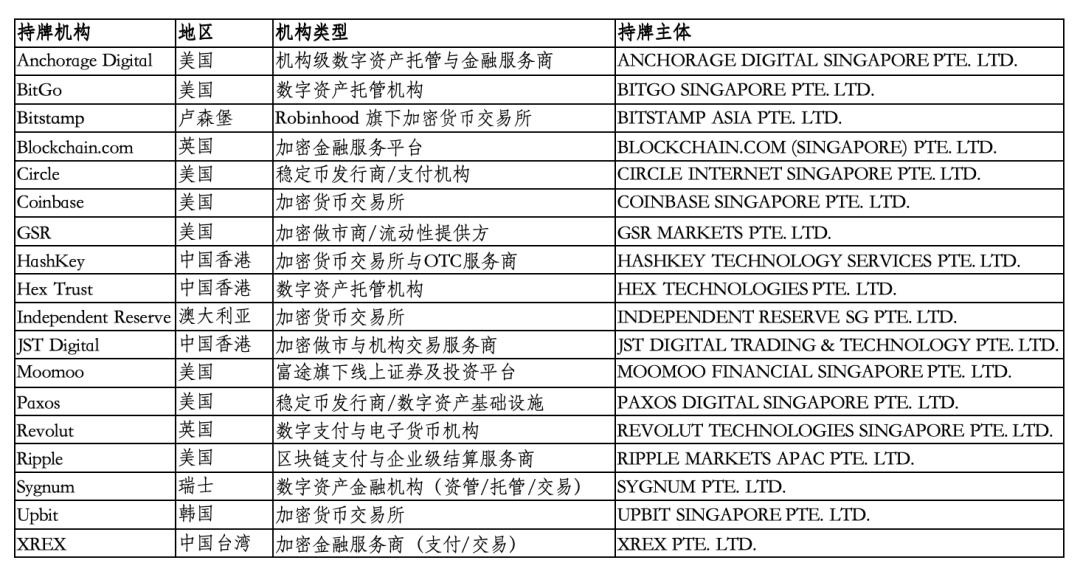
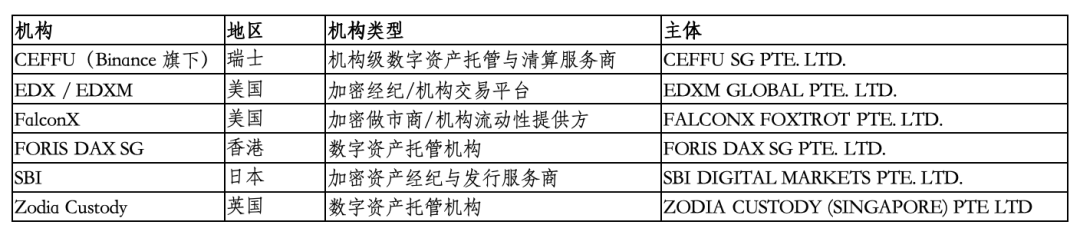
As of the date of writing, MAS has issued MPI licenses that include the scope of Digital Payment Token Service business to 36 institutions with international backgrounds.
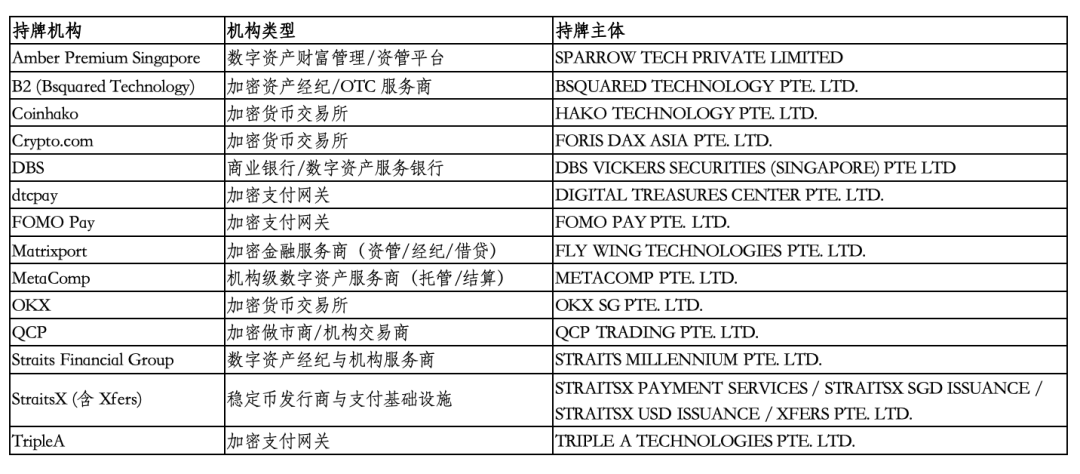
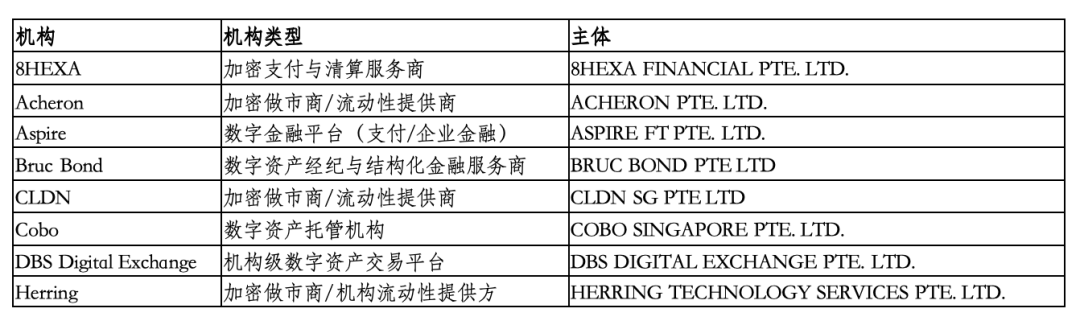
From the composition of licensed entities, some institutions, although having backgrounds from the United States or other overseas locations, or being held by multinational groups, must operate under a locally registered legal entity as the licensed entity when conducting related business in Singapore. The relevant compliance obligations, regulatory responsibilities, and business scope are all borne by the Singapore entity to MAS under the Payment Services Act, reflecting Singapore's consistent regulatory principle of "territorial regulation and entity responsibility."
(1) Global Institutions MPI Licensing/Exemption Status
1. Licensing Status (List sorted A-Z)
2. Exemption Status (List sorted A-Z)
3. Unique Business Developments
- In December 2025, Coinbase launched a prediction market feature in the U.S., which is not applicable to Singapore users.
- In November 2024, Paxos Singapore and DBS Bank issued the USD stablecoin USDG.
(2) Local Institutions MPI Licensing/Exemption Status
1. Licensing Status (List sorted A-Z)
2. Exemption Status (List sorted A-Z)
3. Unique Business Developments
In December 2025, the cryptocurrency platform Crypto.com announced a partnership with Singapore's largest bank, DBS Group, to enhance fiat payment capabilities, allowing local users to more conveniently use SGD and USD deposit and withdrawal services. In the same month, StraitX announced plans to launch its Singapore dollar stablecoin XSGD (issued in 2020) and USD stablecoin XUSD on the Solana public chain in early 2026.
- In November 2025, Grab and StraitsX developed a digital wallet that supports stablecoin payments.
- In September 2025, OKX Singapore launched stablecoin payment features at GrabPay merchants.
- In August 2025, DBS Bank Singapore launched tokenized structured notes on Ethereum. In the same month, Volkswagen Singapore partnered with FOMO Pay to support digital currency payments.
At this point, we have outlined the regulatory framework, core laws, and licensing system for digital currencies in Singapore, as well as the composition of licensed institutions and market structure. It can be seen that Singapore is not simply "crypto-friendly," but has built a robust and attractive digital asset ecosystem through clear systems and strict licensing management.
In the next article, we will continue to delve deeper, helping you understand how local financial institutions participate in digital asset practices, international cooperation and innovation trends, and the practical significance of Singapore's system for global institutions.
*The content of this article is for reference only and does not constitute investment advice. The market has risks, and investment should be cautious.
免责声明:本文章仅代表作者个人观点,不代表本平台的立场和观点。本文章仅供信息分享,不构成对任何人的任何投资建议。用户与作者之间的任何争议,与本平台无关。如网页中刊载的文章或图片涉及侵权,请提供相关的权利证明和身份证明发送邮件到support@aicoin.com,本平台相关工作人员将会进行核查。


