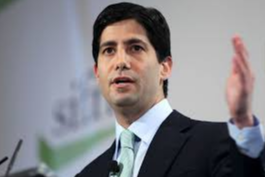
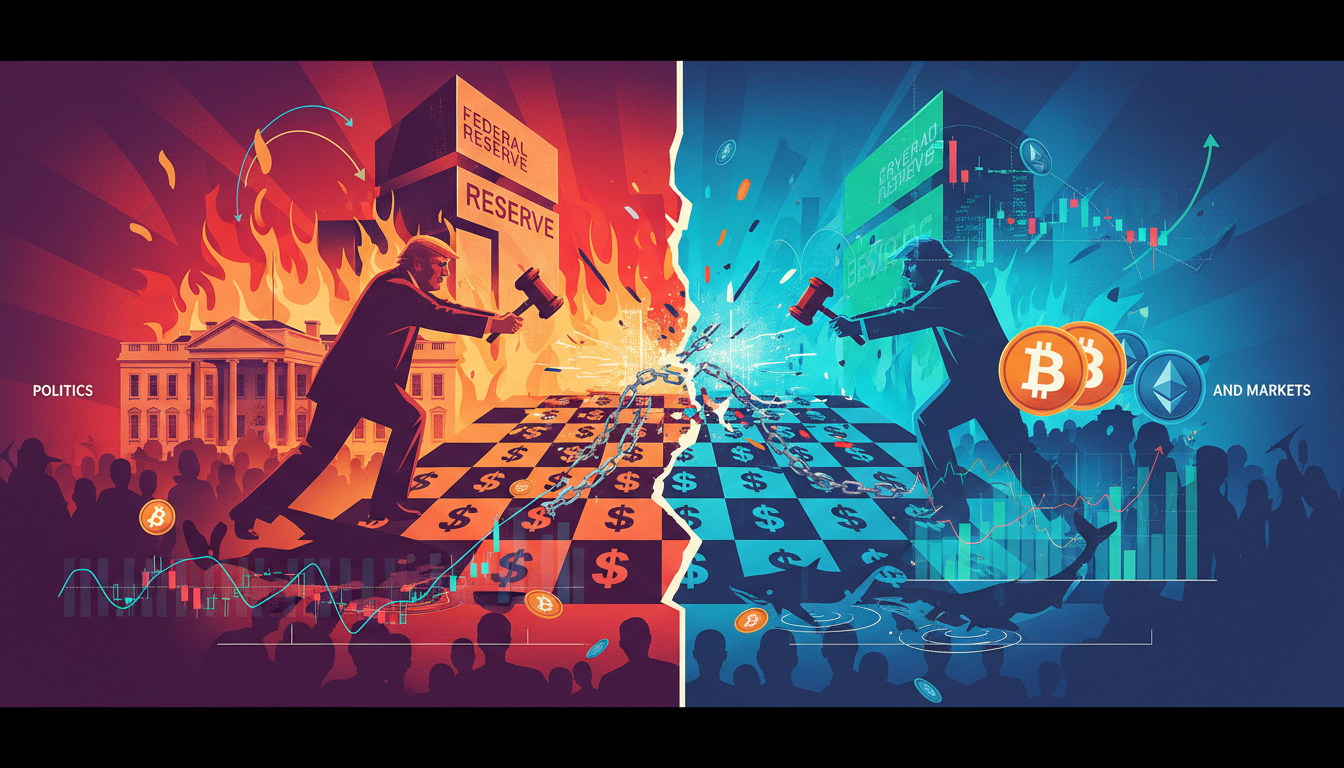
This week, the attention of the U.S. political arena and financial markets has refocused on the position of the Federal Reserve Chair—news of Trump's nomination of former Federal Reserve Governor Kevin Warsh to serve as the next chair has sparked multiple narratives simultaneously. On one side, the Senate has made it clear: no discussion of new nominations will take place until the Justice Department concludes its investigation into current Chair Powell, leading to a procedural deadlock; on the other side, debates are heating up regarding the independence of the Federal Reserve and whether monetary policy will accelerate its shift under Trump's leadership. From traditional assets to crypto assets, the market is trying to understand: if a seemingly "personnel change" appointment could trigger future interest rate cuts, balance sheet reductions, and regulatory attitudes, to what extent will it rewrite risk preferences and the pricing framework of the crypto market?
Judicial Investigation as a Bargaining Chip: Senate Hits the Procedural Pause Button
● The starting point of the partisan struggle is the judicial investigation into Powell. Public information shows that Senator Elizabeth Warren and Republican Senator Tillis have rarely stood on the same side, jointly demanding that the Justice Department first provide clarity on Powell's related investigation before advancing the new chair nomination. This stance is not merely a matter of procedural purity but transforms the judicial investigation itself into a political bargaining chip: until the outcome is clear, any nomination discussion is seen as political pressure on the current chair, akin to "judging before the trial."
● For the Democrats, delaying the process can blunt Trump's direct influence on the Federal Reserve over time while emphasizing the narrative of "regulation and accountability" through the investigation issue; meanwhile, some Republican members are using the same investigation to pressure Trump for more bargaining space—on one hand, not denying Warsh's qualifications, and on the other, using "procedural compliance" as a banner to retain leverage on future monetary and regulatory issues. Thus, the investigation is no longer just a legal issue but is embedded in the intricate calculations of party and personal power.
● The procedural obstruction brings about a highly uncertain timeline and potential policy vacuum risks. As long as the Justice Department has not provided a clear conclusion, the Senate has reason to hit the pause button on the confirmation hearing, leaving the future direction of the Federal Reserve in a state of "difficult consensus and hard-to-anchor expectations" for a considerable time. For risk assets that rely on forward guidance for pricing, this uncertainty itself is an invisible tightening: businesses and investors find it harder to make medium- to long-term plans regarding interest rates and liquidity, exacerbating volatility and risk-averse sentiment.
Warsh Returns to the Center of Power: Hawkish Shadow and "Crypto-Friendly" Imagination
● Kevin Warsh is not a stranger; he previously served as a Federal Reserve Governor and has long been active in the whirlpool between monetary policy and Wall Street. The market generally categorizes him as a "relatively hawkish" figure—this label is more of a summary of viewpoints rather than an academic conclusion derived from detailed voting records and speech quantification. However, in the current sensitive phase of inflation, interest rates, and asset prices, even being "perceived as more hawkish" is enough to amplify its symbolic meaning in market pricing.
● Briefing information indicates that the claim that Warsh has participated in crypto-related investments is still in a "to be verified" state, with no authoritative disclosure of specific projects, funding scale, or timing. For now, it can only be cautiously marked as second-hand information rather than established fact. Even so, this point has already been quickly incorporated into the narrative by some commentators: the potential new chair of the Federal Reserve has intersections with the crypto capital market at the "asset level," which will naturally be amplified in the crypto discourse that values symbolic significance.
● Against this backdrop, the market begins to imagine Warsh as a potential "crypto-friendly faction"—even in the absence of clear public statements, the narrative chain has already been constructed: Trump is labeled as "relatively friendly to crypto," and Warsh is seen as part of his monetary policy and financial regulatory layout, with both bundled as key figures in the "Trump era's crypto-friendly team." This expectation itself has not yet been validated by policy documents and actual decisions but has been frequently cited in social media and research reports, amplifying the symbolic impact of his ascension on the crypto field.
Anxiety Over Rate Cuts and Balance Sheet Reductions: Stress Testing Risk Assets Amid Monetary Shifts
● The current mainstream market consensus surrounding the Federal Reserve roughly focuses on the path expectation of "two rate cuts" and the debate over balance sheet reduction rhythm: some institutions expect the Federal Reserve to make slight rate cuts twice within the next year to address slowing economic momentum and tightening financial conditions; meanwhile, opinions on when and how aggressively to slow the balance sheet contraction are not uniform. Some worry that continued balance sheet reduction will accumulate pressure on the credit side, while others believe it is a necessary cost to leave room for the next round of balance sheet expansion.
● Under this baseline expectation, if Warsh takes office and is viewed as continuing or even strengthening the "hawkish" path—such as emphasizing "zero tolerance" for inflation and maintaining high sensitivity to asset price bubbles—then risk assets, including stocks and crypto, will theoretically face greater valuation compression pressure. Higher and longer real interest rates mean an increase in discount rates and liquidity premiums; in such an environment, narrative-driven, cash flow unstable, or forward-looking asset classes often become the first to be sold off.
● It is essential to repeatedly emphasize that the above path extrapolation and asset price impact currently remain at the level of market extrapolation and scenario analysis, rather than established facts. The briefing did not provide any immediate price curves or concrete evidence of large fund migrations on-chain, nor do we have data on Bitcoin or other assets' specific points and amplitudes before and after the nomination news. In other words, what traders are pricing now is more about potential changes in future centers or volatility ranges rather than already established policies—this also determines that the current volatility resembles a discount on the "story" rather than a reaction to "data."
Intra-Party Divisions: From "Qualified Candidates" to Full-Scale Blockades
● Senator Warren's public criticism adds a distinct political color to this nomination battle. She bluntly stated: "Anyone who disagrees with Trump cannot become the chair of the Federal Reserve." This statement not only denies the legitimacy of Trump's intervention in Federal Reserve personnel matters but also implies that the future monetary policy decision-making body may increasingly resemble an extension of presidential will rather than a consensus institution formed around data and professional judgment. This statement reinforces market concerns about the erosion of the Federal Reserve's independence.
● Republican Senator Tillis's statement presents another kind of contradictory tension. On one hand, he publicly acknowledges that "Warsh is a qualified candidate," affirming him based on professional background and qualifications; on the other hand, he clearly states that he will oppose all nomination confirmations at this stage. This seemingly contradictory position is, in essence, a way to enhance the party's bargaining power on key issues through collective resistance—someone can be "qualified," but in the chess game of politics and procedures, any confirmation vote can become a bargaining chip.
● When the Democrats strengthen institutional checks on Trump in the name of independence and accountability, and a split stance emerges within the Republican Party of "recognizing the individual but not this game," the neutral image of the Federal Reserve as a technocratic institution becomes difficult to maintain. External doubts about its policy continuity and ability to avoid short-term political interference begin to deepen: how much of future interest rate decisions will be based on inflation and employment data, and how much will be driven by political cycles and electoral interests? Such doubts directly translate into a discount on global asset holders' confidence in the dollar and U.S. Treasuries as "risk-free anchors."
The Imagination Space of the Crypto Market: From Personal Labels to Narrative Trading
● Within the crypto market, a completely different discourse system is taking shape: the so-called "Trump era's crypto-friendly team." Warsh's nomination has been quickly incorporated into this long-term favorable expectation—supporters believe that from regulatory relaxation, tax treatment to ETF approvals and custody frameworks, a monetary and financial regulatory team more willing to engage with and even participate in the crypto industry will reshape the United States' position in the global crypto landscape over the years. This expectation does not rely on immediate policies but uses "personnel signals" as the starting point for long-term trends.
● Some market views even link Warsh to statements like "Bitcoin is the new gold," reinforcing his image as aligned with "hard assets" and "de-trust" values. It should be noted that such specific wording is marked in the current materials as to be verified and second-hand references, making it impossible to confirm who proposed it, when, and in what context, nor can it be confirmed whether Warsh truly holds similar views. However, in narrative logic, these vague and even unverified labels are still used to construct a long-term story of "resonance between the Federal Reserve's senior management and Bitcoin's values."
● Meanwhile, the briefing clearly states that there is currently a lack of reliable data on the immediate prices of Bitcoin or other crypto assets and on-chain fund flows, making it impossible to prove that the nomination news immediately triggered a certain level of fund migration or trend reversal. In this information gap, "narrative trading" often precedes the fundamentals: funds may preemptively position or reduce holdings based on story expectations, while the real regulatory rules, monetary paths, and institutional allocations often take months or even longer to gradually reveal themselves. For the crypto market, this means greater emotional elasticity and more frequent repricing—stories can change overnight, while reality can only slowly materialize.
Appointment in Limbo: The Long-Term Tug-of-War Between Federal Reserve Independence and Crypto Narratives
Surrounding Warsh's nomination, three intertwined narrative mainlines have formed: first, the procedural tug-of-war starting with the judicial investigation—under the joint pressure of Warren, Tillis, and others, the unresolved investigation into Powell has become a prerequisite that must be addressed before any personnel arrangements; second, the political conflict shaped by partisan confrontation and intra-party fractures, pulling the position of Federal Reserve Chair into a larger power struggle; third, the market expectations in this tug-of-war are being pre-priced, with long-term imaginations from rate cuts, balance sheet reduction paths to the "crypto-friendly team" being continuously amplified and revised in the absence of a clear timeline.
It is foreseeable that the debate over the independence of the Federal Reserve will not end with any single hearing or the appointment of any chair. As long as Trump is in office, the game of monetary policy and crypto policy will repeatedly play out within the triangular structure of "White House demands—Congressional checks—Federal Reserve professional judgment." For the crypto market, what is truly worth tracking is not just "who sits in the chair," but the next few moves: when the Senate will initiate and advance the confirmation hearing, how Warsh himself will publicly express his views on inflation, asset prices, and the crypto industry if confirmed, and whether the Federal Reserve will deviate from the current consensus path of "two rate cuts + debate over balance sheet reduction rhythm" in the coming year.
These nodes will gradually test the long and short narratives that the market has already traded—whether the hawkish or dovish labels are accurate, whether the "crypto-friendly" symbolism translates into substantial benefits in regulation and liquidity, or if it is just another political event that is quickly digested. Until then, all judgments about prices and trends remain scenario extrapolations rather than fixed destinies.
Join our community to discuss and grow stronger together!
Official Telegram community: https://t.me/aicoincn
AiCoin Chinese Twitter: https://x.com/AiCoinzh
OKX Benefits Group: https://aicoin.com/link/chat?cid=l61eM4owQ
Binance Benefits Group: https://aicoin.com/link/chat?cid=ynr7d1P6Z
免责声明:本文章仅代表作者个人观点,不代表本平台的立场和观点。本文章仅供信息分享,不构成对任何人的任何投资建议。用户与作者之间的任何争议,与本平台无关。如网页中刊载的文章或图片涉及侵权,请提供相关的权利证明和身份证明发送邮件到support@aicoin.com,本平台相关工作人员将会进行核查。