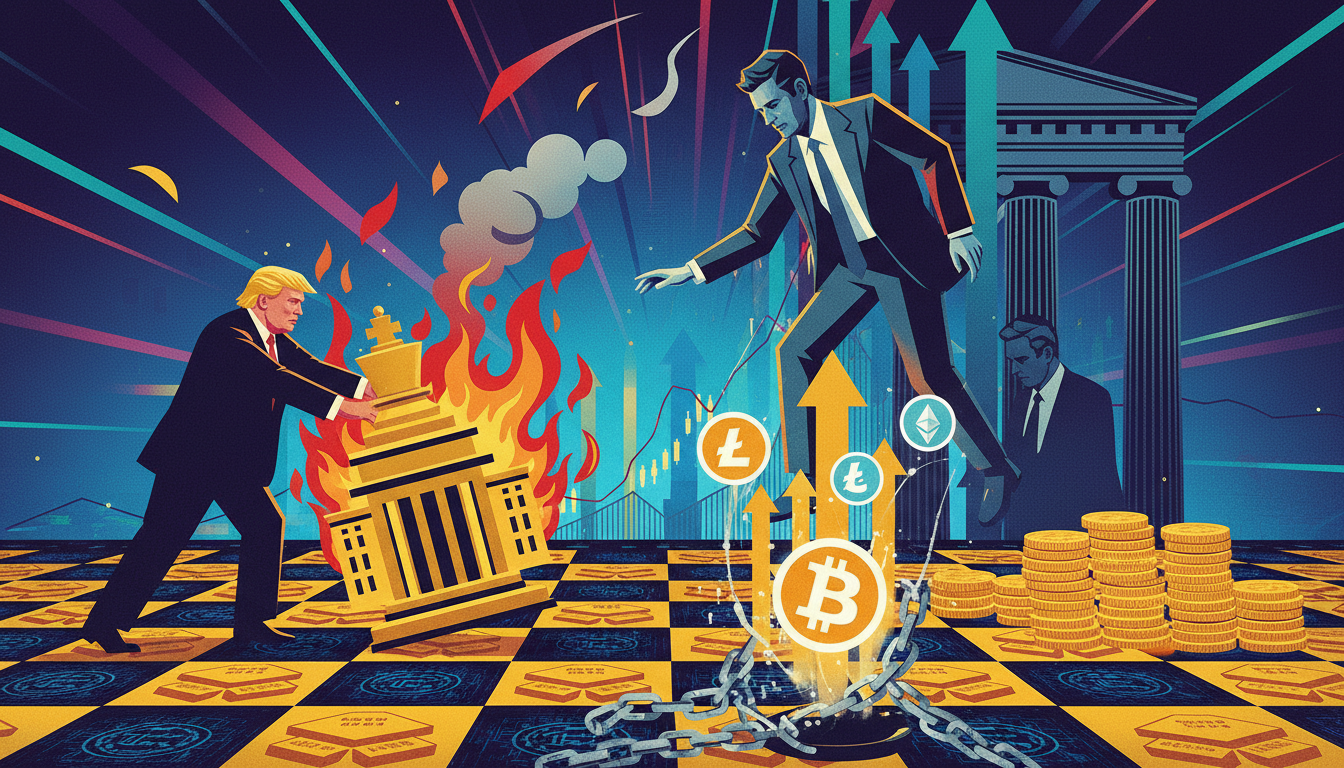
This week, the focus of U.S. politics and monetary policy has been pulled back to Washington—Trump has officially nominated former Federal Reserve Governor Kevin Warsh to replace Powell as the next Federal Reserve Chair. This appointment signals not only the trajectory of interest rates and balance sheets for the coming years but also raises tensions in the crypto market due to Warsh's unconventional views on monetary policy and his previous statement that "Bitcoin is the inspector of monetary policy." The political hand is once again reaching for the sensitive red line of the Federal Reserve's independence, amplifying the excitement around a "crypto-friendly" Fed. Meanwhile, data from a single source indicates that a large whale has increased its position by 6,494.93 ETH long positions (with a nominal value of about $17.79 million), while CME's interest rate futures show a 15.3% probability of a rate cut in March. The linkage between macro trading and crypto positions is beginning to surface—whether this marks the start of a new crypto bull market narrative or is an overconsumed political gamble remains a suspense that the current market has yet to answer.
White House Changes Fed Leadership: Political Hand Reaches for Monetary Core Again
● The timing of the nomination itself is a signal: At a time when inflation has not fully returned to long-term targets and a soft landing for the economy still requires fine-tuning, Trump's proposal to replace Powell with Warsh is seen as another attempt by the White House to dominate monetary policy. The gradual rate hikes and balance sheet reduction framework during Powell's era, along with compromises on inflation and employment, have been criticized as "too technocratic"; Warsh's more conservative stance and sensitivity to central bank power suggest potential revisions and denials of the existing path.
● Changes in the Federal Reserve Chair directly affect the direction of interest rates and balance sheet policies: Historically, changes in the chairperson often lead to market reassessments of the pace of rate hikes, starting point for rate cuts, and balance sheet size. Current CME data shows that the market assigns only a 15.3% probability of a rate cut in March, and this low pricing is inherently filled with uncertainty; once Warsh takes office, the Fed's tolerance for inflation and its attitude towards tightening financial conditions may be reinterpreted, triggering fluctuations in the yield curve and risk asset valuations.
● A renewed test of the Fed's independence is occurring: This nomination led by Trump is seen by many observers as the White House "inserting itself" into the monetary core again. Although U.S. law formally guarantees the Fed's independence, once the chairperson's selection carries obvious political implications, the market will naturally question whether political considerations will overshadow technical assessments in future decisions. This skepticism serves as both a stress test for the system itself and an invisible inquiry into the credibility of the dollar and its status as a global reserve currency.
● Market expectations have been priced in, but the path remains highly uncertain: Research briefs indicate that the market has "priced in Warsh's expected appointment," meaning some funds have already positioned themselves for the "Warsh era," but key information such as the completion status of the formal nomination process and intra-party consensus is still lacking. The details of internal Republican disagreements have not been made public, and the Senate hearing and voting process also contain variables, leading to significant political event risks embedded in all trades based on "Warsh's inevitable ascension."
Bitcoin Inspector: How Warsh Could Disrupt Traditional Fed Narratives
● Warsh's statement that "Bitcoin is the inspector of monetary policy" breaks traditional boundaries of central bank narratives: Warsh publicly describes Bitcoin as an external supervisory force on monetary policy, which is in stark contrast to the attitudes of most central bank officials who view crypto assets as sources of risk and speculative tools. In his narrative, Bitcoin is not merely a speculative target but a market feedback mechanism against fiat currency expansion and central bank balance sheet inflation, providing a "mirror reflection" for the Fed's decisions.
● His experience as a Federal Reserve Governor at the age of 35 has shaped his "outlier" label within the Fed: Warsh served as a Federal Reserve Governor from 2006 to 2011, taking office at just 35 years old, significantly younger than the average age of traditional governors. He is familiar with the operational logic of Washington but is not entirely constrained by the path dependency of older central bank bureaucrats. This "young yet seasoned" background allows him to propose non-consensus views on monetary and financial innovation issues, including a redefinition of Bitcoin's role.
● If "Bitcoin supervising the Fed" becomes a symbolic narrative, it will reconstruct the coordinates of the relationship between crypto and central banks: In traditional narratives, Bitcoin is portrayed as a "shadow currency" in opposition to central banks; however, if the future Fed Chair openly acknowledges its external supervisory attributes, Bitcoin could partially transform from an external adversary to a recognized constraint within the system. This symbolic shift will push regulators from "suppression and containment" to "recognition and framing," redrawing the boundaries between crypto assets and fiat currency systems.
● For this reason, the divergence of positions is simultaneously amplified between the crypto and traditional central bank factions: For some crypto investors, a Fed Chair who recognizes Bitcoin's "supervisory" role means that the future regulatory environment may be more predictable, potentially opening new avenues for compliance and institutional entry; for traditional central bank advocates, this stance is seen as a loosening of the existing narrative of monetary sovereignty, raising concerns that excessive endorsement could undermine the central bank's authority in inflation management and financial stability.
Wall Street's Tentative Bets: Whale Long Positions and Rate Cut Pricing Resonance
● A single source indicates that a whale has increased its position by 6,494.93 ETH long positions, with a nominal scale of about $17.79 million: This change in position is substantial enough to be considered "meaningful noise." However, it is important to emphasize that the research brief clearly states that this data comes from a single source, and we lack synchronous on-chain flow and broader position distribution information, so it can only be viewed as a tentative bet by local participants rather than a consensus trend across the entire market.
● Intertwined with this is CME's pricing of monetary policy—the probability of a rate cut in March is only about 15.3%: This indicates that mainstream interest rate traders still view "longer high rates" as the baseline scenario. However, the decision by crypto whales to increase their ETH long positions at this moment may be betting on a tail scenario: if political intervention strengthens and Warsh becomes more sensitive to economic and market performance, the pace of rate cuts may shift towards easing, with growth and high-beta assets being the first to receive valuation repricing.
● The complex scenario of whale bets is an overlay of "looser monetary policy + friendlier regulation": From a trading logic perspective, on one hand, it reflects expectations of a downward shift in future rate peaks and a relaxation of financial conditions; on the other hand, it anticipates that with the "Bitcoin inspector" taking over the Fed, the entire crypto industry will transition from regulatory hostility to institutional inclusion. The amplification of ETH long positions is likely designed as a combination option for the next phase of "macro easing + narrative shift."
● However, relying solely on a single source and lacking real-time market data, it cannot be simply equated with a trend reversal: The research brief clearly warns that we currently do not have precise data on price fluctuations, volatility, and net inflows on-chain, making it impossible to verify the proportion of this ETH position within a larger flow. Therefore, viewing it as evidence of "whales collectively bottoming out" carries significant risk. For investors, a more reasonable approach is to consider this as an event-driven signal sample rather than the ultimate answer to trend sector rotation.
Congressional Blockade: Warren Leads the Opposition Front
● Warren's statement, "The nomination should not proceed until the investigation is complete," clearly shows the Democratic camp's hardline stance: This statement is both a challenge to Warsh himself and a pressure tactic directed at Trump and the Republican Party. Warren has long held a tough position on Wall Street regulation and consumer protection issues, and she remains highly vigilant towards a Fed Chair candidate who is relatively open and more inclusive towards crypto, clearly conveying the signal that "there will be no easy passage."
● Congressional hearings, ethical reviews, and potential conflict of interest investigations are institutional tools that can slow down or even block the nomination: Before officially taking office, Warsh must undergo a series of procedures, including public hearings and asset and interest reviews. Any doubts regarding his professional experience or conflicts of interest could be amplified into political leverage, providing legitimacy for "delay tactics." For the market, this means there is substantial uncertainty regarding whether and when Warsh will truly take over as Fed Chair.
● Why are Democrats particularly wary of a relatively crypto-friendly Fed Chair: On one hand, the crypto industry is still viewed by a significant portion of Democrats as a potential threat to financial stability and consumer protection within the U.S. regulatory framework; on the other hand, in the context of electoral politics, a central bank leader chosen by Trump who is more open on crypto issues could be packaged as a symbol of "new financial freedom," contrasting sharply with the Democrats' advocacy for strict regulation, naturally triggering stronger impulses to block.
● The partisan struggle directly exacerbates short-term uncertainty regarding the path of interest rates and regulatory direction: Before Warsh's appointment is finalized, the market must simultaneously face two layers of uncertainty—who will steer the Fed and whether the future regulatory logic for crypto assets will continue the current hardline approach or soften under the new Chair's influence. The longer the partisan tug-of-war timeline, the more difficult it becomes for interest rate futures and crypto assets to converge on risk premiums, with volatility more likely to be driven by political news rather than economic data.
Rewriting the Crypto Narrative: From Confrontation with the Fed to "External Checks"
● The Bitcoin narrative is evolving from "an heretical asset opposing central banks" to "being viewed by a few officials as an external supervisory tool": The core story of early Bitcoin was "decentralization, anti-inflation, and resistance to fiat currency overexpansion," naturally placing it in opposition to the Fed. Warsh's description of it as "the inspector of monetary policy" implies that in some elite discourses, Bitcoin is beginning to be seen as a feedback mechanism—its price response to fiat currency credibility is used to evaluate the successes and failures of central bank decisions.
● A Fed Chair who publicly acknowledges Bitcoin's role will reshape regulatory imagination and compliance frameworks: If Warsh ultimately takes office, any public statements he makes regarding Bitcoin could be cited and dissected by regulators, financial institutions, and even other central banks. Regulatory bodies may shift from "how to isolate risks outside the system" to "how to allow this external indicator to exist within a controllable framework," prompting various institutions to adjust their compliance strategies for custody, trading, and asset allocation accordingly.
● Expectations and concerns coexist within both the crypto community and traditional finance: Crypto practitioners hope to leverage the symbolism of a "friendly Fed Chair" to push for further openings in areas such as ETFs, custody, and bank-enterprise cooperation; on the other hand, they worry that excessive absorption by the system could weaken their original counter-cyclical and adversarial attributes. Within traditional finance, banks and asset management firms are eager for the profit opportunities presented by new asset classes but fear sudden inconsistencies in regulatory standards, increasing compliance uncertainty.
● Recent market sentiment has already begun to bet on Warsh's appointment, influencing the interaction between narratives and asset pricing: Research briefs indicate that the market has "priced in Warsh's expected appointment," meaning that some price fluctuations in mainstream assets like Bitcoin and Ethereum are already reflecting the potential outcomes of this political event. The results have yet to materialize, but the narrative is already driving prices, creating a situation where "stories precede data," making the short-term performance of crypto assets more susceptible to the winds of Washington rather than on-chain fundamentals.
Trading Warsh, Not Data: The Washington Exam for Crypto Investment
The Warsh nomination event overlays political appointments, monetary policy, and Bitcoin narratives into a single storyline: Who will steer the Fed not only determines the trajectory of interest rates and balance sheets but also redefines the position of crypto assets within the global financial system. Currently, we lack precise market reaction data and do not see the full picture of intra-party struggles; the real risk lies in investors betting too early and too deeply on a story that has yet to materialize, packaging political expectations as already established macro trends.
For crypto investors, the focus of this round of testing has shifted from "just watching the market" to "must understand the Washington game." The change in the Federal Reserve Chair is less an extension of macro data and more a redistribution of institutional and power configurations. Without understanding the power logic behind nominations, hearings, reviews, and votes, it is difficult to assess the degree to which related narratives are discounted in prices, and even harder to determine when the key points of emotional peaks and expectation shifts occur.
Moving forward, there are roughly three paths regarding Warsh: First, the nomination passes smoothly, he officially takes over as Chair, and the Federal Reserve makes a mild but clearly directional adjustment in monetary policy and crypto regulation, potentially providing a round of "institutional endorsement" for Bitcoin and Ethereum sentiment; Second, the nomination is delayed for a long time, with political tug-of-war keeping the market in suspense, causing risk assets to experience increased volatility through repeated cycles of "expectation—disappointment—re-expectation"; Third, the nomination ultimately fails, with Powell's path or another more traditional candidate taking over, forcing the market to quickly remove the "Bitcoin inspector" narrative from asset pricing, which may lead to a sentiment pullback in risk appetite for Bitcoin and Ethereum. Regardless of the path, what truly needs to be traded is no longer a single macro data point, but the entire political and institutional narrative surrounding Warsh.
Join our community to discuss and become stronger together!
Official Telegram community: https://t.me/aicoincn
AiCoin Chinese Twitter: https://x.com/AiCoinzh
OKX Benefits Group: https://aicoin.com/link/chat?cid=l61eM4owQ
Binance Benefits Group: https://aicoin.com/link/chat?cid=ynr7d1P6Z
免责声明:本文章仅代表作者个人观点,不代表本平台的立场和观点。本文章仅供信息分享,不构成对任何人的任何投资建议。用户与作者之间的任何争议,与本平台无关。如网页中刊载的文章或图片涉及侵权,请提供相关的权利证明和身份证明发送邮件到support@aicoin.com,本平台相关工作人员将会进行核查。