整理:A Fish CoolFish
Source: Hoover Institution
Note: The original video was recorded in May 2025.
Host: Welcome to "Extraordinary Insights." I’m Peter Robinson. Kevin Warsh was born in upstate New York, graduated from Stanford University, and later earned a law degree from Harvard University. Early in his career, Mr. Warsh worked on Wall Street and in Washington. In 2006, President George W. Bush appointed him to the Federal Reserve Board, where he served until 2011. Notably, Mr. Warsh was a Fed governor during the 2008 financial crisis, which is considered the most severe financial storm in over half a century. Today, Mr. Warsh splits his time between New York and Stanford: he works at an investment firm in New York while serving as a fellow at the Hoover Institution at Stanford University.
Kevin, welcome back.
Kevin Warsh: It’s great to be back. You deliberately omitted the most important thing—I happen to work at the investment firm of the greatest investor in history, Stan Druckenmiller. But I appreciate your attempt to keep it low-key. I just wanted to brag about my friend and partner.
Host: Go ahead, you’ll have to bring him on the show sooner or later. Alright, Kevin, the first question: The Federal Reserve, established over a century ago, is the only institution in the U.S. tasked with maintaining the value of the dollar.
Criticism of the Federal Reserve
Host: I want to quote two statements. The late legendary investor Charlie Munger once said, "Destroying the monetary system would have unimaginable consequences." The second quote is from your speech in April this year at the "Group of Thirty" bankers organization. I’ve extracted several of your descriptions of the current Federal Reserve: institutional drift, failure to fulfill statutory duties, exacerbating federal spending, and an expanded role with poor performance. Kevin Warsh, how dare you criticize this sacred institution—the pillar upon which we rely daily to maintain the value of our income and expenditure currency. What do you think you’re doing?
Kevin Warsh: In the central banking system, we are trained to keep our criticisms to ourselves. Clearly, I haven’t done a good enough job. Peter, I emphasized in the same occasion that this is more like a love letter than a cold critique. Perhaps you didn’t take it as a love letter. Current officials probably haven’t grasped it either. I intentionally downplayed the mushy language. I call it a love letter because, as you said, this institution is crucial. I call it a love letter because if the institution can reform itself, it will bring great benefits to both the institution and the country. But that also means it’s time to get everything back on track.
One more thing to add: this is the third attempt in the U.S. to establish a central bank. The reason it’s the third time is not because the first two were successful—in fact, they both ended in failure.
Peter, this isn’t like winning a third Super Bowl trophy and getting more courageous. The root of the first two failures was the loss of public trust and the ability to deliver on promises. This isn’t a history lesson, but think about the Jacksonians of the past—they believed that the central bank at the time was only focused on the special interest groups on the East Coast while ignoring the plight of the people in the Midwest.
This is similar to my concerns today. This central bank has been around for a century. If it can reform itself, it will surely welcome another glorious century. Otherwise, I am deeply worried.
Host: I’m an outsider, and you’re a seasoned central bank president and investor. I have a few basic questions to clarify, but let me set the stage first.
The Federal Reserve, established in 1913, has the power to set interest rates and regulate the money supply to achieve price stability. Nobel laureate Milton Friedman said in 1994 that no institution has such a high public status yet performs so poorly as the Federal Reserve. Friedman pointed out that the Fed presided over a doubling of prices after World War II and financed the inflation of the 1970s. He believed the Fed did more harm than good and advocated for its abolition. Kevin, why do we need the Federal Reserve?
Kevin Warsh: Friedman was my teacher and had a huge impact on generations of students. I’ve studied his correspondence with former Fed chairs like Paul Volcker and Alan Greenspan in the Hoover Institution archives.
What’s most astonishing in Friedman’s letters is his constant examination of his own a priori assumptions. During Volcker’s and Greenspan’s tenures, he found some policy shifts reassuring. I don’t think he believed the Fed was a terrible institution; he thought they had good times and bad times, with both mistakes and achievements. I can only speculate what he would say if he saw the great inflation of the past six years. He would certainly issue a warning, and the Fed would likely not listen.
Inflation is a "Choice"
Peter Robinson: Friedman asserted, "Inflation is always and everywhere a monetary phenomenon." Since inflation stems from money, and the Fed controls the money supply, the ultimate responsibility for inflation must lie with the Fed. When Carter appointed Volcker, we were experiencing the worst inflation since the Civil War. By the time Paul Volcker left office, the inflation rate had dropped to around 2%. So, does Milton Friedman argue that the Fed is always responsible?
Kevin Warsh: Yes, inflation is a choice. Congress revised the law in the 1970s, making the Fed the institution responsible for prices. Yet in the past five or six years of great inflation, what have we heard? Blame Putin, blame Ukraine, blame the pandemic, and blame supply chains.
Milton would be furious to hear such claims. These factors can cause price changes, but that’s not inflation; that’s just a one-time fluctuation in the price of certain goods. True inflation is when these price fluctuations create a self-reinforcing cycle—high prices lead to higher prices. This means inflation will eventually permeate every household table and every boardroom because decision-makers cannot predict future price levels.
This isn’t about Putin; it’s about the Fed. We love to shift blame, saying, "It’s not my fault; it’s someone else’s fault." The central bank can push the price level to any height and target any inflation rate. We may not agree with their methods, but blaming others, in my view, runs counter to a solid understanding of economic history.
Host: In our subsequent discussions, we need to repeatedly emphasize that inflation is the result of human choice, and maintaining the stability of the dollar is also a controllable choice. Volcker successfully achieved this in our lifetime. This is not just talk—we’ve experienced inflation, and the Fed ultimately brought it under control.
Kevin Warsh: They did bring inflation under control. But then… I suspect this is just the cyclical rhetoric that economists often use, and they became complacent about the controllability of inflation. After experiencing the so-called "Great Moderation" period—where price stability lasted for over a generation—I think some in the industry mistakenly believed it was a piece of cake, even concluding that inflation was completely controllable, given how adept we had become. We may all have become a bit complacent about this discipline, but economics is not that simple. It was the crises of 2008 and 2020 that made me realize we had let our guard down.
Host: You’ve mentioned this concept several times; let’s define it. The so-called "Great Moderation" began in the mid-1980s when the Fed, under Volcker’s leadership and with President Reagan’s support, brought inflation down to very low single-digit levels. After that, inflation remained in that range for a long time, the economy continued to expand, and there were only two quarters of recession in the next quarter-century until the crisis of 2008. Is my understanding correct? Is this the period you refer to as the "Great Moderation"?
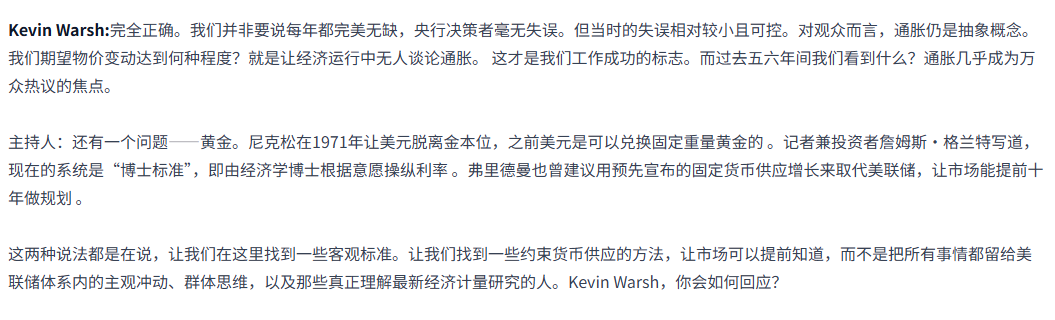
Kevin Warsh: I believe there is no "status quo" to return to; the gold standard is a thing of the past. We must deal with the issues at hand. There should be a third option between "let the machine run" and "let the central bank president act on a whim."
As a central bank president, one must resist impulse. Economics is not a perfect understanding; otherwise, we would be physicists or mathematicians. Our understanding of how the economy operates is far from complete. If we truly understood its laws, we could design precise economic models, but the reality is that the economic system is ever-changing and full of astonishing dynamics. That’s why I cannot assert that there are perfect economic laws.
The 2008 Financial Crisis
Host: You served during the 2008 financial crisis when the unemployment rate reached 10%. The Fed responded by injecting massive liquidity into the system, doubling its balance sheet from $1 trillion to $2 trillion. You strongly supported this decision; why?
Kevin Warsh: Friedman believed that the core of monetary policy and inflation lies in money, but in modern academia, this is almost considered heresy. They lean more towards Keynesianism and hardly mention the word "money" in discussions. In fact, if you look at the minutes of the Fed meetings, you’ll find that the term "money" appears very infrequently. You have to sift through a lot to find that word.
When I was 19 or 20, sitting around a round table (a bit larger than this moment) with a few classmates, I asked Friedman a question—probably trying to show off my understanding of a certain field, but I was actually only half-informed. He replied, "Kevin, the only thing we can understand in economics is the basic principles. The rest is all made up." At that time, I thought, "Peter, is this old man confused? Maybe he’s past his prime." It wasn’t until the financial crisis hit that I realized he was right; no one could predict it because all real knowledge is in the introductory economics course.
At least in the introductory economics course—before those elite departments were dominated by economic schools of thought—we said that money is related to monetary policy. I still believe this principle today.
Host: By the way, as we speak, it has been nearly twenty years since that financial crisis erupted. What was it like at that time?
Kevin Warsh: I was 35 then; it was the calm before the storm. Bernanke was a very powerful battlefield commander, and we were fighting like we were in the trenches. He was always open to the few who could sit around the table and debate the situation fiercely, and he was more tolerant of heretical views. But looking back at the darkest days of the crisis—we could only grade our response as passing. We could have taken more action earlier; we made many mistakes, but we also had successes.
The deterioration of the real economy was much faster than historical experience; stock prices in the financial markets plummeted by 60% to 70%. Perhaps the most alarming was the Treasury bond auctions. At least in the initial stages, market participants were absent, and the bid-ask spreads continued to widen. We were worried that the American economic system was on the brink of collapse.
Host: As I recall, injecting liquidity into the system and providing funds to the market were emergency measures aimed at keeping the exchanges running and ensuring the market functioned normally. The theoretical basis for this was that maintaining market operations, keeping the market open and functioning normally, and providing enough money for people to buy and sell was the most effective and direct response at the time. Is this a legitimate rationale?
Kevin Warsh: The central bank was created to respond to panic. The panic of the past (what we now call a deep recession or financial crisis) is essentially a state of market failure. When there is a price gap between buyers and sellers, the central bank must intervene with sufficient funds (that word appears again) to restore market operations. Its duty is not to set prices but to ensure that buyers and sellers can complete transactions.
Our job is to provide liquidity and be the backstop. That is the "extreme authorization" in emergencies. But we had a commitment: after the crisis, we would exit the game. We would return to being a rather boring central bank, only appearing on page B12 of the newspaper—with six brief news items informing that the Fed decided to raise or lower interest rates by a quarter of a percentage point. But from that moment until now, the central bank has always occupied the front page. I believe its role has exceeded the expectations of the founding fathers and has gone beyond what the founders of the central bank could accept.
Host: Let’s review the timeline from 2008 to the present: QE1 occurred in 2008. We just discussed how the Fed's balance sheet expanded from less than a trillion to over two trillion. QE2 was implemented in 2010, raising the Fed's balance sheet to nearly three trillion. QE3 started in 2012, expanding the Fed's balance sheet to four trillion dollars. QE4 was initiated during the COVID-19 lockdown in 2020, which needs some discussion because it was an emergency situation. By the end of the pandemic in 2022, the balance sheet had reached nine trillion dollars. Subsequently, the Fed reduced it to seven trillion dollars. As you said, today the Fed's balance sheet is nearly an order of magnitude larger than when you joined in 2006.
Kevin Warsh: The massive printing of money during peacetime changed everything. It was almost a signal to other members of Congress: we can do this, and so can you. Let’s return to the essence of quantitative easing. QE1—by the way, when we initially tried to package it as "credit easing," that term only worked for a week; it was our preferred phrasing. But the term QE came uninvited.
The situation at that time was roughly as follows: Secretary Paulson planned to issue bonds on Monday and Tuesday; should we buy them on Thursday and Friday? While I’m reluctant to disclose the secrets of the meeting room, I remember someone bluntly saying, "This is just like a Ponzi scheme." What else could save us from the global financial crisis? Many explanations were given. The Bank of Japan had implemented a similar small-scale operation about a decade ago, but it was far less extensive. We were uncertain about the effects at the time, but it turned out to be effective. It was indeed a radical move at that time. Now, if you open an economics textbook, even an introductory one, it is regarded as standard operating procedure. At that time, it was akin to a gamble. But we were in an era of gambling, so we went all in.
QE1 was radical, but we believed we should pull back after the crisis. I resigned in early 2011 because I opposed QE2. My colleagues, including Chairman Bernanke, whom I greatly respect for his strategic abilities, decided to continue implementing quantitative easing. At that time, the Fed believed it was a "free lunch." Look around: asset prices were rising, the market was flush with liquidity, and the economy was improving. My goodness, if we withdraw the policy, the consequences are unpredictable. In a sense, they violated the consensus that had been reached initially. Can we really foresee the consequences in various scenarios?
Host: Herbert Stein once said that nothing can last forever. The question is—essentially, we have been operating a Ponzi scheme. The Fed and the Treasury issue government bonds, and the Fed buys them directly. This is almost equivalent to directly starting the printing press. Yet the global market continues to buy U.S. Treasury bonds. In other words, why has the international market not punished the U.S. to this day?
Kevin Warsh: I would rather play the U.S. card than any other country in the world. I believe we are on the brink of a productivity explosion; U.S. economic growth is crucial, and it can mitigate these debt risks more than any other means. If we can grow one percentage point more than the budget office predicts, it would bring in $4.5 trillion in revenue. This is the remedy for resolving the debt crisis.
Quiet the Printing Press, Lower the Interest Rates
Host: The interest on the debt now exceeds defense spending. How should the Fed reduce its $7 trillion balance sheet?
Kevin Warsh: Two policy tools: interest rates and the balance sheet. If we let the printing press quiet down a bit, we can have lower interest rates. Many central bank practitioners insist that the balance sheet is unrelated to monetary policy. But if the balance sheet expansion was related to monetary policy, then it should also be related during the balance sheet reduction. We must face the essence of these two tools. I believe real economic growth is key to achieving fiscal revenue, equitable distribution, efficiency improvements, and economic growth. Due to the inflation caused by balance sheet expansion, we must reduce its size.
We cannot do it all at once. I hope the Treasury and the Fed can reach a consensus, just like the agreement they reached in 1951. Who is responsible for what? Who manages interest rates? The Fed. Who manages the fiscal accounts? The Treasury. The current boundaries of responsibility have become blurred. When the president takes office, the Treasury Secretary should act as the head of the fiscal authority, rather than ambiguously transferring responsibilities to the Fed—this will only introduce political factors into the Fed, which I believe will interfere with its normal operations.
In my view, we should reduce the central bank's balance sheet, and unless a crisis erupts, the Fed should exit these markets. This operation will effectively curb inflation.
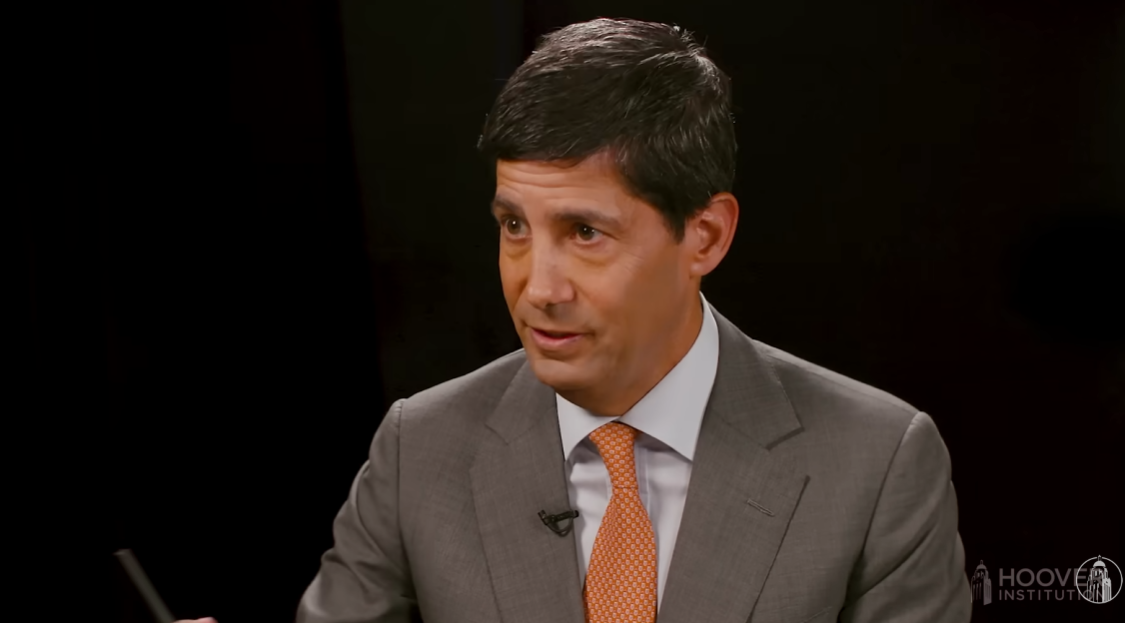
Host: The financial crisis changed the global landscape, and the COVID lockdown exacerbated the turmoil. For over a decade, fiscal irresponsibility and distorted market monetary policies have continued to ferment. Now even financial experts like James Grant and Ray Dalio are questioning the entire monetary system, and young entrepreneurs are flocking to the Bitcoin market due to their loss of trust in the dollar. Kevin, something fundamental has ended and cannot be reversed. How do you view this perspective?
Kevin Warsh: This view is incorrect; I am not one to give up easily. We are on the eve of a productivity explosion, and AI will bring about tremendous changes. The overall implementation of public policy does not need to pursue perfection. You, I, and our colleagues may be able to conceive perfect trade policies, regulatory policies, or tax policies. But perfection is not a necessary condition. We just need to make policies slightly better than the status quo, and if monetary and fiscal policies return to a reasonable track, the U.S. economy will thrive.
This is not a return to Reaganism. We need to formulate new economic policies in the new world to inspire the American spirit and promote individual freedom and liberation. The key is to restore the original functions of institutions like the Fed—these important institutions should remain observers most of the time and only intervene in emergencies.
Host: So the Fed doesn’t need a revolution, just some kind of "repair" and adjustment?
Kevin Warsh: Exactly. It’s like restoring a great golf course: being true to the original architectural concept but not being bound by its literal interpretation. When you mentioned Bitcoin, I sensed a somewhat condescending attitude—as if saying it’s ridiculous for people to buy Bitcoin and similar things.
Host: But didn’t Charlie Munger criticize Bitcoin a few years before he passed away? He called it evil, partly because it would undermine the Fed's ability to manage the economy.
Kevin Warsh: It may bring market discipline and may signal to the world that certain mechanisms need repair.
Bitcoin Doesn’t Bother Me; It’s Not a Substitute for the Dollar
Host: Doesn’t Bitcoin make you feel anxious?
Kevin Warsh: Bitcoin doesn’t make me uneasy. I just mentioned Marc Andreessen—he was the one who showed me that white paper. That was the original white paper. How I wish I could have understood Bitcoin and the disruptive nature of this new technology as clearly as he did at that time. Bitcoin doesn’t trouble me. I see it as an important asset that can help policymakers discern right from wrong in their decisions. It is not a substitute for the dollar. I believe it often serves as an excellent overseer of policy-making.
To elaborate on what Charlie Munger and others might have intended, a wide variety of securities are currently emerging. Many—if not most—of their trading prices are severely disconnected from their true values. So how did Charlie and his close friend Warren discuss this? Innovators, imitators, and the incompetent coexist. There are indeed innovators who drive the development of new technologies. What I try to convey to entrepreneurs and bankers is that the core technology that Marc showcased (or attempted to showcase) in the white paper is essentially just software—just the latest software that gives us unprecedented capabilities. Can software be used for good or evil? Of course, just like all software has dual aspects. Therefore, I do not make such assertions.
If there is one last point, it is that these technologies are developing here. I’m not just referring to the Stanford University campus; I’m talking about top engineers from all over the U.S. and the world, including China and Europe. Even now, they still come to the U.S. trying to build these things. I believe building it here will bring us more opportunities.
免责声明:本文章仅代表作者个人观点,不代表本平台的立场和观点。本文章仅供信息分享,不构成对任何人的任何投资建议。用户与作者之间的任何争议,与本平台无关。如网页中刊载的文章或图片涉及侵权,请提供相关的权利证明和身份证明发送邮件到support@aicoin.com,本平台相关工作人员将会进行核查。


