Author: Yan Waizhi Yi, Wall Street Insights
In the past, silver was referred to as "the poor man's gold" not because it was truly inexpensive, but because the market never took its scarcity seriously.
With ample supply, adjustable inventories, and diverse uses— for a long time, the market firmly believed that regardless of demand fluctuations, silver could always be quickly replenished. Because of this, it could be traded repeatedly as a shadow of gold, yet it was almost never seriously allocated.
However, this premise has been shattered by reality.
Since 2021, the global silver market has experienced a physical supply-demand gap for several consecutive years. Unlike the short-term tensions magnified by financial cycles in the past, this gap directly stems from the industrial side: key sectors such as photovoltaics, electrification, and high-end electronics have rapidly expanded their demand for silver, while supply has been nearly unable to accelerate.
Even more critically, the silver supply system is highly insensitive to price signals.
Over 70% of global silver production comes from by-products of other metals, with production rhythms determined by the investment cycles of copper, lead, and zinc, rather than the silver price itself. This means that even if prices rise, supply cannot quickly increase; when inventory buffers are continuously consumed, the market faces not just temporary fluctuations, but persistent constraints.
It is at this moment that silver begins to truly break free from the narrative of "the poor man's gold." It is no longer just a cheap substitute for gold during its rise, but is becoming a material that is continuously consumed by key industries and is difficult to replace.
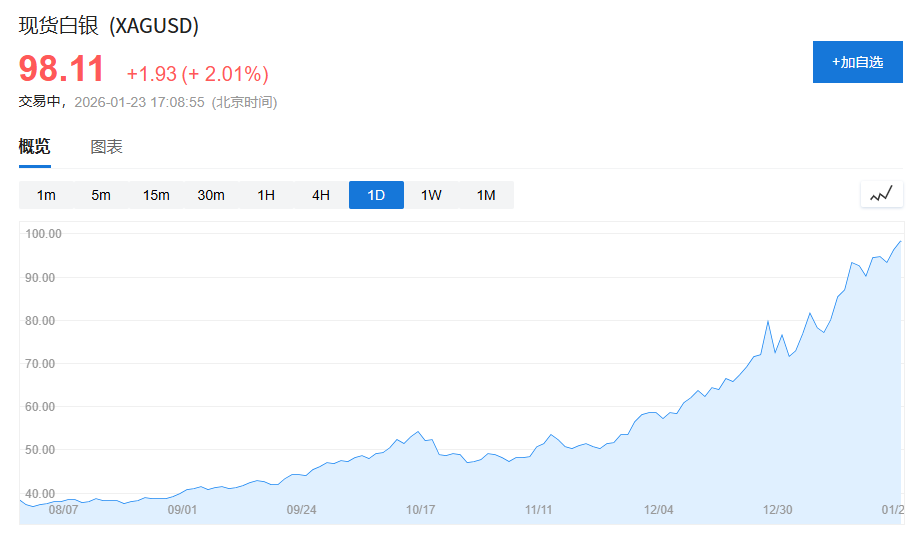
(Silver prices are approaching $100 per ounce, while in mid-October last year, the price was only $50/ounce, nearly doubling in three months.)
1. Silver's "Identity Dilemma": Caught Between Gold and Industrial Metals
To understand why silver has been long undervalued, one must first grasp its "identity dilemma."
In the modern commodity system, assets can roughly be divided into two categories:
One category is credit-based assets, with gold as the typical representative. The value anchor of gold does not come from industrial use, but from the credit system and reserve demand. Even in the weakest demand years, the net purchases of gold by global central banks can still account for 15%-25% of total annual demand, providing a stable foundation for its price.
The other category is growth-based assets, such as copper, crude oil, and iron ore. These metals almost lack financial attributes, with their prices primarily driven by economic cycles, infrastructure, and manufacturing investments.
Silver, however, is caught right between these two.
According to the "World Silver Survey 2025," the total global demand for silver in 2024 is projected to be 1.164 billion ounces (approximately 36,200 tons), of which:
- Industrial demand: 681 million ounces, accounting for about 58%;
- Jewelry and silverware demand: 263 million ounces, accounting for about 23%;
- Investment demand (silver bars, coins, ETFs): approximately 191 million ounces, accounting for about 16%.
The problem is that the behavioral patterns of these three types of demand are completely different:
Industrial demand relies on the industrial cycle, jewelry demand is highly price-sensitive, while investment demand is easily influenced by macro sentiment.
This structural split has led to a long-term lack of a stable, singular, dominant pricing anchor for silver.
The result is reflected in prices, with silver being long forced to adhere to gold pricing.
A straightforward indicator is the gold-silver ratio. Over the past half-century, the historical center of the gold-silver ratio has been around 55-60; however, between 2018 and 2020, this ratio once broke 90, and during the peak impact of the pandemic, it even approached 120.
Even with silver's industrial demand reaching a historical high in 2024, the gold-silver ratio has still long maintained in the range of 80-90, significantly above the long-term average.
This does not mean silver is "useless," but rather that the market is still pricing silver using the financial logic of gold.
2. Silver's Repositioning: From "Diverse Uses" to "Locked by Industry"
The real change is not starting from the financial market, but quietly occurring from the industrial side.
In a nutshell, the current change is: silver is transitioning from a diversely used industrial metal to a functional material locked by key industries.
1. Photovoltaics: Silver Becomes "Indispensable" for the First Time
Photovoltaics are the most critical link in the changing demand structure for silver.
In 2015, the global newly installed photovoltaic capacity was about 50GW; by 2024, this number has exceeded 400GW, growing more than eightfold in less than a decade.
The industry is indeed continuously "de-silvering." The amount of silver used per watt has decreased from about 0.3 grams in the early days to around 0.1 grams under current mainstream technology.
However, the speed of expansion in installed capacity far exceeds the decline in unit usage.
According to the "World Silver Survey 2025," the actual demand for silver from the photovoltaic industry in 2024 is expected to reach 198 million ounces, an increase of over 1.6 times compared to 2019, accounting for about 17% of total global silver demand.
More critically, silver's position in photovoltaics is not "easily replaceable." In terms of key indicators such as conductivity efficiency, long-term stability, and reliability, silver remains the optimal choice in terms of overall performance. Technological advancements change the usage, not the position.
This gives silver, for the first time, a large-scale, rapidly growing, and price-insensitive source of demand.
2. Electric Vehicles and AI Infrastructure: Modest Usage, but High Replacement Difficulty
If photovoltaics bring certainty in demand scale, then electric vehicles and digital infrastructure bring a change in the nature of demand.
A traditional fuel vehicle uses about 15-20 grams of silver on average; while a new energy vehicle typically uses 30-40 grams of silver.
Against the backdrop of limited overall growth in global automobile sales, the penetration rate of new energy vehicles has risen from less than 3% in 2019 to nearly 20% in 2024, structurally boosting silver demand.
At the same time, the demand for silver from data centers, AI servers, and high-end electronic devices is more reflected in their irreplaceability rather than absolute usage.
In 2024, the demand for silver in the electrical and electronic sectors is expected to reach 461 million ounces, setting historical highs for several consecutive years.
These application scenarios are relatively insensitive to price but are extremely sensitive to supply stability.
3. The Reality of Supply: Silver is Not a Metal That Can Be Increased by Price Rise
In stark contrast to the certainty on the demand side is the rigidity on the supply side.
In 2024, global silver mine production is expected to be about 820 million ounces, with a year-on-year growth rate of less than 1%.
More importantly, over 70% of global silver production comes from by-products, primarily dependent on lead, zinc, copper, and gold mines. This structure has seen little substantial change over the past two decades.
Primary silver mine production is only about 228 million ounces, accounting for less than 30%, and is still in a long-term downward trend.
This means that silver production is not determined by the silver price, but is dominated by the investment cycles of base metals.
4. From Cyclical Shortages to Structural Tightness
Looking back at history, silver has not been without bull markets, but past trends were mostly derivatives of financial cycles.
The difference now is that since 2021, the silver market has experienced a physical supply-demand gap for several consecutive years.
According to the "World Silver Survey 2025," the average annual supply-demand gap for silver globally from 2021 to 2024 is about 150-200 million ounces, with a cumulative gap approaching 800 million ounces.
Moreover, the visible inventory of silver itself is not abundant. Currently, the global available inventory can only cover about 1-1.5 months of consumption, significantly below the 3-month safety line typically considered for commodities.
Once a large amount of silver enters photovoltaic components, electrical equipment, and infrastructure, it is very difficult to return to the circulating market.
5. Silver is No Longer Just a Shadow of Gold
Silver has not suddenly become scarce; it has simply, for the first time, met three conditions simultaneously:
Real and sustained demand scale Key uses are difficult to replace Supply growth is highly constrained
In the past, these three points never appeared simultaneously.
While the market still understands silver through the lens of "the poor man's gold," the industrial chain has begun to reassess it using the standards of key functional materials.
Silver may still fluctuate, but one thing is certain: it is no longer just a shadow of gold.
And this is the most important and easily underestimated underlying change in this round of market dynamics.
免责声明:本文章仅代表作者个人观点,不代表本平台的立场和观点。本文章仅供信息分享,不构成对任何人的任何投资建议。用户与作者之间的任何争议,与本平台无关。如网页中刊载的文章或图片涉及侵权,请提供相关的权利证明和身份证明发送邮件到support@aicoin.com,本平台相关工作人员将会进行核查。


