Author: Merrick, Stablehunter Contributors
This article will deeply analyze the rise, evolution, and potential reconstruction of the global information ecosystem by the decentralized prediction market platform Polymarket.
I will attempt to deconstruct how Polymarket addressed the core issue of liquidity by transitioning from an Automated Market Maker (AMM) to a Central Limit Order Book (CLOB) technology, and how it established its position as a "truth machine" by defeating mainstream polling agencies through the "neighbor adjustment method" in the 2024 U.S. presidential election.
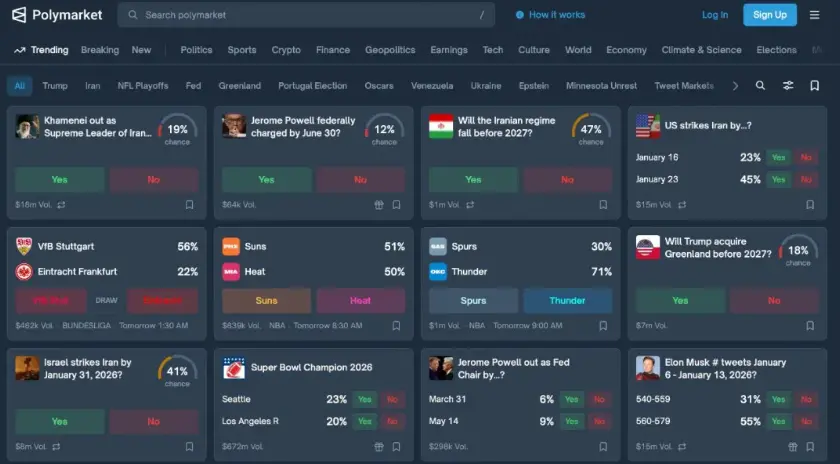
What prediction markets truly excel at is not providing you with a definitive "truth," but compressing a multitude of dispersed information, emotions, positions, and interests into a constantly changing, readily quotable "price." Once this price can be referenced, it will, in turn, influence public opinion, behavior, and even, in certain scenarios, the direction of events themselves.
I. Starting with Trump's Election
In November 2024, FBI agents raided the home of Polymarket founder and CEO Shayne Coplan. This was because Polymarket had predicted Donald Trump's overwhelming victory with an almost provocative accuracy weeks in advance of the 2024 U.S. presidential election, while mainstream media polls were still emphasizing a "tight race."

This action caused a significant stir in the cryptocurrency community and among prediction market enthusiasts. It was not just a law enforcement action but was widely interpreted as a symbolic conflict: a political game between the outgoing Biden administration and this emerging, uncontrolled "truth machine." Shayne Coplan later posted on X (formerly Twitter), expressing a typical Silicon Valley rebellious tone: "Being woken up that morning was really frustrating… Clearly, this is political retaliation."
At that time, Polymarket was no longer just a niche crypto gambling site. In 2024, it processed over $3.7 billion in election-related trading volume, becoming an information source that could not be ignored by global political observers, Wall Street traders, and even ordinary voters. It represented the rise of a new epistemological system: one that no longer relied on expert interviews, telephone polls, or centralized media narratives, but instead depended on "real money," distributed ledgers, and collective wisdom.
In this new order, truth is not published by authoritative institutions but is "discovered" by thousands of decentralized individuals through buying and selling contracts. Every click on "Buy Yes" or "Sell No" is a vote on the future, a correction of reality perception. The rise of Polymarket is essentially an epic leap of the concept of "Information Finance" from theory to reality.
II. Pricing Truth and the Epistemological Crisis
The history of prediction markets predates the internet. As early as the 16th century in Europe, bets on papal elections and the outcomes of succession wars formed early informal markets through letters, pamphlets, and tavern conversations in London and Paris. These early attempts revealed a simple truth: when interests are at stake, people's judgments about the future are often more accurate than official statements.
In 1945, Hayek published his landmark paper "The Use of Knowledge in Society." In it, he proposed a revolutionary idea: the core economic problem facing society is not the physical allocation of resources (which is an engineering problem) but the "utilization of knowledge." This knowledge is not concentrated in the hands of a single expert or planning bureau but is dispersed among countless individuals—knowledge about specific times, places, personal preferences, hidden technologies, and rapidly changing market conditions.
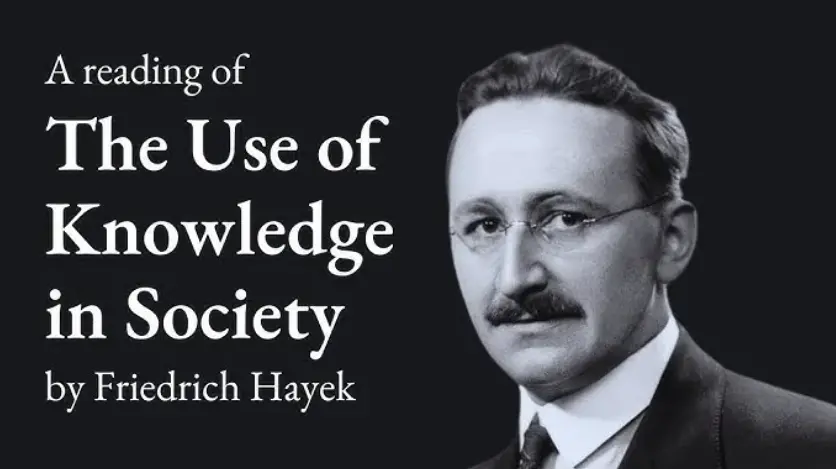
Hayek argued that the price system is not just a tool for allocating resources but also an efficient mechanism for transmitting information. When the price of tin rises, whether due to a mining disaster or a surge in demand, only a few people in this vast system need to know the specific reason. For most users, the change in this single indicator, the price, is sufficient to convey all necessary information: conserve tin.
The core philosophy of prediction markets is based on this: if prices can reflect the supply and demand of goods, can we create a "synthetic asset" whose price specifically reflects "information"? If we can trade stocks on "Trump winning," then the price of that stock (e.g., $0.60) directly encapsulates the fragmented information about the election situation held by thousands of participants—including insider information, grassroots observations, economic data models, and even casual conversations at a gas station in a swing state. Polymarket is essentially the digital embodiment of Hayek's ideas in the 21st century.
The theoretical validation of modern prediction markets began with the Iowa Electronic Markets (IEM), established at the University of Iowa in 1988. IEM allowed users to trade on political elections and economic indicators with very low limits (usually $500). Despite the minuscule scale of funds, IEM demonstrated astonishing predictive capabilities in every U.S. presidential election, with its long-term accuracy significantly outperforming traditional Gallup polls. The existence of IEM proved the applicability of the Efficient Market Hypothesis (EMH) in the realm of political forecasting, meaning that market prices can aggregate information more effectively than any single expert.
Human society is currently facing a profound epistemological crisis. As the information cocoon effect caused by social media algorithms intensifies, and the pollution of the internet's information ecosystem by AI-generated content becomes more prevalent, traditional consensus-building mechanisms—whether based on authoritative media institutions or statistical polling—are showing unprecedented fragility. In this context, prediction markets, as a form of "epistemic technology," have returned to the historical spotlight. They should not be simply viewed as a gambling tool but understood as a market-based epistemological mechanism grounded in Hayek's theory of dispersed knowledge: by requiring participants to bet with real money (Skin in the Game), market prices can filter out cheap rhetorical noise and aggregate private information dispersed throughout society, thereby approaching the truth of the future through the price discovery mechanism.
III. Augur: An Experiment in Decentralized Fundamentalism
Launched in 2015, Augur is one of the earliest ICO projects on Ethereum, embodying the crypto community's entire fantasy of a "decentralized truth machine." The design philosophy of Augur is one of complete decentralization, which is particularly evident in its dispute resolution mechanism.

Augur does not rely on centralized administrators to input the results of events but instead uses a game-theory-based mechanism: users holding REP tokens report results by staking their tokens. If the reported results align with the consensus, they are rewarded; if they contradict the consensus (i.e., attempting to lie), their REP will be forfeited.
Although Augur V1 and V2 technically achieved decentralization, its commercialization was extremely bleak, primarily because it overlooked the fundamental laws of financial markets and user experience:
High transaction costs and inefficient order books: Augur initially adopted an on-chain order book model. During the high gas fees on the Ethereum mainnet from 2017 to 2020, creating, modifying, or canceling an order could cost tens of dollars. This high friction cost made frequent trading and market-making impossible, leading to extreme liquidity shortages.
Long resolution cycles: To ensure the security of decentralization, Augur's dispute resolution process was designed to be extremely lengthy. Confirming the final outcome of a market could take weeks or even months. For users accustomed to instant settlement in lottery betting, this capital lock-up is unacceptable.
Complex entry barriers: Users not only needed to hold the highly volatile ETH as fuel but also needed to understand the REP staking mechanism, which directly excluded the vast majority of ordinary users.
IV. The Explosion of Polymarket: The Resonance of Timing, Location, and People
Entering the 2020s, prediction markets finally welcomed their "iPhone moment." The rise of Polymarket was not due to a single factor but rather the result of the iterative development of technical architecture, the maturation of payment infrastructure, and changes in the macro social environment.

Early decentralized exchanges (DEX) commonly adopted Automated Market Maker (AMM) mechanisms (such as Uniswap's CPMM or Gnosis's LMSR) because AMMs could provide basic liquidity in the absence of professional market makers. However, AMMs faced serious capital efficiency issues in prediction markets: when the probability of a certain outcome approaches 0 or 1, AMMs require extremely large liquidity pools to maintain low slippage in trading and cannot support complex strategies like limit orders.
Polymarket made a crucial technical decision: to abandon AMMs and shift to a hybrid decentralized Central Limit Order Book (CLOB) model:
Off-chain matching, on-chain settlement: Polymarket's order matching occurs on high-performance off-chain servers, making its trading experience (response speed, order cancellation) nearly indistinguishable from centralized exchanges (like Binance), completely avoiding the delays and gas fee issues of on-chain transactions.
Non-custodial settlement: Although matching is centralized, the settlement and custody of funds are still executed atomically on the Polygon chain through smart contracts. This architecture retains the smooth experience of Web2 while preserving the asset security of Web3.
Introduction of professional market makers: The CLOB model allows professional market-making institutions like Wintermute to participate, providing deep liquidity. This enables Polymarket to handle trades of hundreds of thousands of dollars without significant slippage, paving the way for institutional capital entry.
Another secret to Polymarket's success lies in its "hiding" of underlying blockchain technology.
USDC-based: Polymarket chose USDC, a compliant dollar stablecoin, as its settlement currency. This means that traders' profits and losses are entirely based on the accuracy of their event judgments, without bearing the price risk of cryptocurrencies themselves.
Low costs of Polygon Layer 2: By being built on the Polygon sidechain, Polymarket can subsidize gas fees for users through meta-transactions, achieving a "zero gas" trading experience. Users are almost unaware of the blockchain's existence during operations, only needing to interact with the chain when depositing and withdrawing.
V. Evolution of the Business Model and Growth Flywheel
To maintain long-term operations and incentivize liquidity, Polymarket began adjusting its business model. According to data from early 2025, Polymarket has started to introduce a "Taker-only" fee model in some short-term high-frequency markets (such as 15-minute cryptocurrency price predictions).
By charging fees to Takers who withdraw liquidity (with the highest rates when probabilities approach 50%) and returning these fees to liquidity-providing Makers, Polymarket effectively curbed the delayed arbitrage bots targeting its zero-fee model while incentivizing thicker order book depth. This refined economic model design marks its transition from "burning money to acquire customers" to "sustainable financial infrastructure."
At the same time, its product form is essentially a "hot information flow": if you look closely at its interface, it resembles a "list page that turns global hot topics into tradable content" rather than a trading terminal.
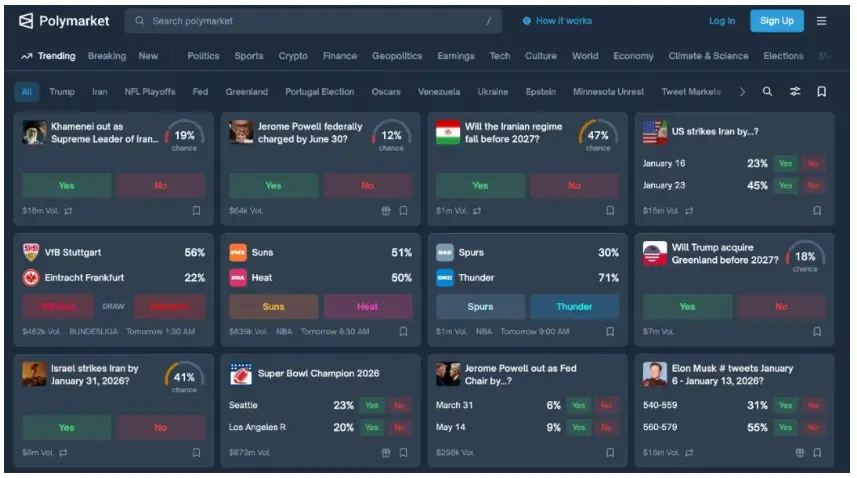
Its growth flywheel is very clear:
Hot events arise → Markets are created → Price snapshots spread (this is key) → New users flock in → Liquidity deepens → Prices appear more "accurate" and quotable → More dissemination
Currently, the situation is two-sided, and there are also risks within this flywheel:
Credit paradox: The controversy in 2025 surrounding "whether trading volume is inflated" has cast a cold shadow over the industry. If the heat indicators themselves are false, how much signal value does the platform retain?
Manipulation risk: This is the most frightening—when prices can influence narratives, it attracts funds to manipulate prices. For example, during a tight election race, if a backer deliberately drives down the odds of the opponent, creating the illusion that "the opponent has no chance," it can cut off the opponent's funding sources. At this point, the market is no longer a "noise-filtering machine" but has turned into a "battleground for public opinion."
Additionally, there is a very important attention factor here. In the age of attention, the most common question is not "who is right," but "who does the market think has a better chance of winning."
Polymarket's price curve is naturally suited for screenshots and sharing. It replaces complex situational analysis with a single number, making discussions seem "decided." This is the true reason for its breakout: it transforms complex narratives into a tradable, shareable curve.
VI. Evolution of the Market Landscape: The Duel Between Polymarket and Kalshi
As prediction markets move from niche to mainstream, the market landscape underwent significant differentiation between 2024 and 2025. Currently, a confrontation has formed between the "offshore/decentralized" faction represented by Polymarket and the "onshore/compliant" faction represented by Kalshi.
For most of 2024, Polymarket held over 95% market share due to its no KYC requirement, global accessibility (theoretically restricting U.S. IPs), and a rich long-tail market. However, entering 2025, the situation reversed.
According to data from DeFiRate and Dune Analytics, by January 2025, Kalshi's weekly trading volume surpassed $2 billion, exceeding Polymarket's $1.5 billion, with its market share climbing to 60%.
This brings us to Kalshi's regulatory green light: after winning a key lawsuit against the CFTC, Kalshi was finally allowed to legally launch election prediction contracts. This legal victory opened the door for compliant entry of institutional funds in the U.S.
Polymarket's strategy: Continue to leverage offshore advantages by offering more diverse, controversial, or long-tail markets (such as geopolitical conflicts, cryptocurrency technical details) and maintain community loyalty and speculative enthusiasm through token issuance and airdrop expectations.
Kalshi's strategy: Deepen the U.S. compliant market, not only partnering with media like CNBC for data collaboration but also developing risk-hedging products for enterprises (such as inflation data prediction contracts), attempting to establish prediction markets as a legitimate financial derivatives exchange.
VII. In Conclusion
The ultimate fate of prediction markets is not merely to be "a better casino." The concept of "Information Finance" proposed by Ethereum founder Vitalik Buterin paints a grander picture: prediction markets will become the infrastructure for human society to obtain high-confidence information, deeply reconstructing media, scientific research, and governance models.
Vitalik believes that information finance is the third social organization technology following "markets (exchanging goods)" and "democracy (voting decisions)." Its core lies in designing a market to incentivize participants to reveal information based on the facts you want to know.
In the future, AI agents based on large language models (LLMs) will become the main market makers and traders in prediction markets. AI can continuously monitor millions of data sources worldwide and make millisecond-level bets in thousands of micro-markets (such as "the probability of rain on a certain street next Tuesday").
From the regretful exit of Intrade to the idealistic setbacks of Augur, and now to the dual rise of Polymarket and Kalshi, the evolution of prediction markets is a grand narrative of humanity's attempt to quantify the future and eliminate uncertainty through technological means. We are on the eve of an explosion of "Information Finance," as prediction markets evolve from marginal gambling tools to the core cognitive infrastructure of human society. For entrepreneurs, this is not just about technological transformation but also about how to find new paradigms of value creation in the interplay of humanity, regulation, and truth.
免责声明:本文章仅代表作者个人观点,不代表本平台的立场和观点。本文章仅供信息分享,不构成对任何人的任何投资建议。用户与作者之间的任何争议,与本平台无关。如网页中刊载的文章或图片涉及侵权,请提供相关的权利证明和身份证明发送邮件到support@aicoin.com,本平台相关工作人员将会进行核查。


