Connecting to third-party Perps is mostly a low ROI business. Whether from user growth revenue, platform commission earnings, or stability investments, it doesn't count as a good business.
Author: Shijiu Jun
Hyperliquid is undoubtedly the annual hot topic. This time, let's take an insider's view to connect the events and see how wallets, exchanges, DEXs, and AI trading are battling it out here!
1. Background
In 2025, I basically researched all the Perps (perpetual trading platforms) available in the market and witnessed the hype market's fivefold growth and subsequent halving (9->50+->25).
In the ups and downs, was it really left behind by competitors? Or was it due to the development of hip3 and builder fees reducing the platform's revenue concerns?
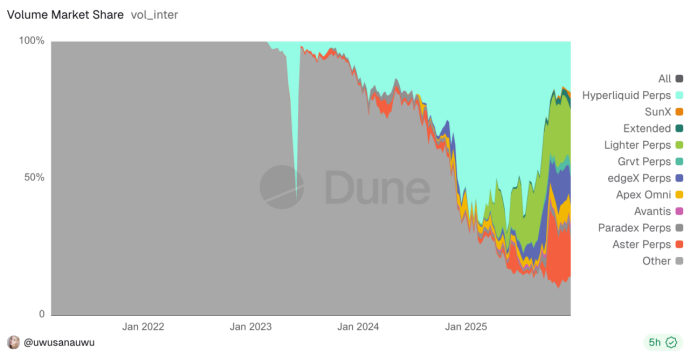
The Perps track itself is also seeing a surge of competitors. Recently, Aster, Lighter, and even Sun Ge have entered the field, pushing the sunPerps that shake the track, with their promotional Twitter space even setting a new high for online attendance at a web3 industry conference.
From the image below, we can see the so-called chaotic battle among the heroes. Interestingly, this is also a rare process of an established market being divided.
Recalling the competition among all DEXs during the DeFi Summer, including Uniswap, Balancer, Curve, and many Uniswap fork projects like Pancakeswap, etc.
The current situation of Perps is just like that moment of DeFi Summer. Some want to build platforms, some want to aggregate others, some want to challenge the leaders, and some want to take a share of the profits.
In this year, various wallets have been rushing to launch perpetual trading capabilities at DEX entrances, with Metamask and Phantom leading the way. Last week, Bitget also announced its integration, while other startup products like Axiom, BasedApp, and XYZ (using hip3), along with multiple AI trading platforms, are also trying to get a piece of the pie through integration.
Thus, the wallet track is undergoing a new round of covert battles.
Everyone is eager to integrate Hyperliquid's perpetual trading capabilities. Behind this, is it the dividend of technological openness, the temptation of rebate mechanisms, or just a true reflection of market demand? Why have some leading platforms remained inactive? Have early adopters seized the market?
2. Ecological Origin, Builder Fee and Referral Mechanism
Hyperliquid's rebate mechanism mainly includes Builder Fee combined with Referral (rebate).
I have always believed that this is a very disruptive mechanism. It allows DeFi builders (developers, quantitative teams, aggregators) to charge additional fees as service income when placing orders on behalf of users. The total fees remain unchanged when users place orders on these platforms and the official website.
Its essence is similar to the hook mechanism of Uniswap V4, where it uses its own order book (or liquidity pool) as infrastructure to provide access to various upstream platforms. This way, it can more easily attract user groups from different platforms, while different traffic platforms (wallets) also have a more comprehensive ecological product to serve their users' diverse needs.
This mechanism has already brought some projects over ten million dollars in dividend income since its initial launch, showing significant early effects, but has since continued to decline.
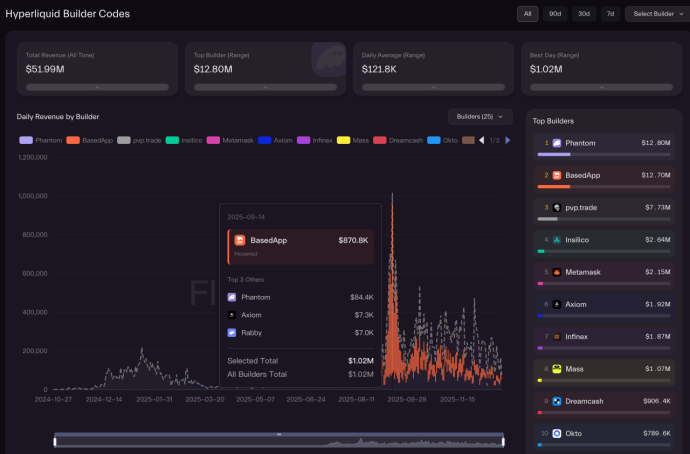
From the chart, we can also see many thought-provoking points.
• Why is the revenue difference between Metamask and Phantom, despite their user base not being less, five times?
• Why is there a significant revenue gap between BasedApp and Axiom? Where is Jupiter?
• Is a 12M dividend income considered a lot or a little? Is it short-term or long-term?
• Do platforms that only lightly integrate HypeEVM or native coins suffer losses?
• Why are Bn, okx, and others not included?
3. Open Strategy of PerpDex
To answer these questions, we must first understand how various platforms are integrated.
3.1 Open API Integration Method
In fact, each Perps has opened their APIs, which are very comprehensive. Almost every platform has its own definition, but the provided modules are generally as follows: query types (account status, positions, orders, market data, candlestick charts, etc.), trading types (placing orders, canceling, modifying, leverage adjustment, withdrawals, etc.), and subscription types (WS real-time price push, order book, position changes).
Because this system itself requires these APIs to provide market-making for market makers, while the user side only needs to change the trading direction. However, users cannot connect like market makers, so some control measures must be added.
Thus, a throttling mechanism is necessary. Hype's is based on a dual throttling of address + IP, which can dynamically adjust the throttling threshold with trading volume. High concurrency may face throttling challenges.
The advantage of this official API solution is the quick integration without the need to build nodes, low data latency, and good state consistency.
But the disadvantages are also obvious: it may face IP/region restrictions, is easily affected by throttling, and while throttling is less of an issue for individual users, it becomes difficult for the platform, as user numbers can increase at any time, making dynamic scaling challenging.
There are also update issues. It should be noted that app code modifications have version release restrictions. If the official API is upgraded or changed, throttling can occur, and the app side has no control. Besides becoming a traffic provider, they also have to bear customer complaints and risks.
3.2 Read-Only Node Integration Method
Hyperliquid has a dual-chain structure, with EVM and core chains integrated into one program and closed-source encapsulated, making it difficult for outsiders to crack and read specific content. The official only supports project parties to deploy this read-only node (which can access orders, candlestick charts, transaction data, but does not support sending transactions).
Moreover, not all historical data is open, and the data volume is enormous: in just two days, it can increase by about 1T+ of data. After a year, without archiving historical data, the cost itself is hard to cover the revenue.
If the project party adopts the deployment of read-only nodes to reduce the frequency of reading the official API and thus reduce throttling issues, this is currently the official recommended approach.
However, adopting this solution also comes with many technical challenges: there may be occasional block drop phenomena, huge storage requirements, and missing historical data. Additionally, the data method of the nodes must be modified.
I believe the biggest problem is the consistency issues brought about by this half-open mechanism.
For example, if I place an order using the candlestick data from a read-only node, but the node itself is delayed (which can happen probabilistically), I can only place orders using the official API, which has no delay. Here, the data between the two may be inconsistent, making it very likely that my market order will be executed at a price I do not want.
So, who is responsible? Does the platform earn enough to cover the compensation here? How much cost does the platform need to enhance stability? Is it appropriate to directly shirk responsibility?
3.3 Market Choices
This presents a divergence, as each platform has different practices.
• Metamask, as a typical representative of a tool-oriented positioning, directly adopts the front-end integration of open APIs, even open-sourcing the integration code, bringing rapid online efficiency through a simple and straightforward approach. I rarely see such a conservative leading wallet platform taking such quick market action.
• The same approach is also taken by Rabby, Axiom, and BasedApp.
• Trust Wallet has also integrated Perps, but it connects to the BN series Aster platform, clearly giving a green light to its own products. However, how internal commissions are divided is uncertain.
• Phantom, which rose from the meme wave on Solana, emphasizes the pursuit of experience. It adopts a read-only node integration method, where even order operations must be relayed through the backend, rather than the client directly contacting the official API to place orders.
In fact, there are some amazing products in the market that have made different choices.
For example, Trade.xyz is currently the highest trading volume platform on Hip3, not pursuing the existing market's red ocean battle but directly developing stock trading capabilities.
VOOI Light is also quite capable (in engineering), being a cross-chain perpetual DEX based on intent, with its core being the simultaneous integration of multiple Perps DEXs, effectively taking multiple paths of the above platforms through engineering efforts. However, the downside is that it gets stuck in the complexity of multi-access reserves, leading to a less smooth experience.
Finally, I have recently experienced several AI trading platforms, almost all of which are open API integrations + backend integration solutions with multiple Perps. The experience feels very cutting-edge, with some using pure LLM large model text interactions, while others use AI decision-making + following traders (where the underlying can also link with Tee custody solutions like Privy), achieving the ability to assist in Perps trading without passing private keys to the project party.
The battle for private key custody can be detailed in: The Covert War of Blockchain Wallets in 2025: What Are They Competing For?
Different solutions bring different experiences, which can somewhat explain the differences in final rebate effect data.
4. Reflection
The previous social login can only solve recovery issues but cannot address automated trading issues.
4.1 Complexity of Reserves
This aspect is often the most overlooked. The complexity of Hyperliquid far exceeds expectations; it is not simply "integrate and use."
Various platforms initially optimistically viewed it as an aggregation DEX approach, but they overlooked that it is not a Lego model. Once integrated with Hyperliquid, if the market declines later, will the functionality still remain? How many wallets are now taking down previously established protocols? And will users who opened accounts on those platforms go back to the official platform?
Additionally, if Hyperliquid does not become popular, and perhaps Aster or Lighter does, will they migrate to the new platform? Each platform's APIs are not entirely consistent; how will migration and parallel operation be handled?
To smooth these out inevitably increases the complexity of the experience.
Ultimately, if users want to use a large and comprehensive entry point, why not use the official one itself?
Front-end integration brings rapid experience and coverage, but it seems Metamask has suffered a silent loss, earning little while providing its user traffic for free.
The high-quality experience brought by back-end integration is currently the core point of Phantom's maximum earnings, but it also incurs huge costs. Ultimately, the ROI (return on investment) may only be known to them.
4.2 Why Can't Total Revenue Break Through Higher Levels?
In fact, looking back at our own (focusing on advanced Perps players) preferences for using platforms like Hyperliquid, we still prefer a complete official entry and tend to operate more on PC. The main reason is that we can visually see advanced features like take profit/stop loss settings, chart monitoring, and margin modes. After all, this track is inherently populated by high-end players.
The demand for mobile usage is to "monitor market changes anytime and anywhere, manage position risks and prices, rather than conduct complex analyses."
Thus, Phantom's advantage has declined after bringing in new users for the initial experience, as it still focuses on the mobile end.
On the other hand, BasedApp, which has both an app and a web entry, caters to both demands. However, due to competition from the official entry on the web, the upper limit is not significant.
Moreover, Hyperliquid's own app will be launched soon, so this market will become increasingly limited.
It can only be said that structural differences determine the value of integration, but the magnitude of that value depends on the depth of integration. Ultimately, the ceiling of this model is still determined by competition within the industry, and the users contributed by entry platforms are hard to maintain on the original platform.
If wallets can provide advanced features on mobile (advanced charting, alerts and notification systems, auto trading), then there would indeed be differentiated value. We can see that Phantom is quickly updating and launching various advanced features to retain this segment of users.
The breakthrough lies in AI trading, auto trading (trading modes not available officially), and aggregating multiple Perps, which are also the paths of DEX. However, there are issues with multi-platform reserve fund scheduling that are difficult to resolve, and the efficiency of AI losing money is too high. Even with the current industry-standard private key custody methods (like Prvy, TurnKey), it still belongs to the realm where users who know will naturally know, and those who don't cannot learn.
4.3 User Growth and Ecological Niche Supplement
Of course, many platforms' original intention is to accept that they do not make money. After all, relying on transaction fees is like fishing for scraps in the soup. However, if they can attract users who use Perps or meet the perpetual trading needs of existing users, it is also a good ecological niche supplement.
We can draw conclusions from analyzing on-chain data points of HL, as this group is actually quite small.
From the chart below, the user engagement of various integrations only reflects a daily active user count of a few thousand, totaling just over 10,000 to 20,000.
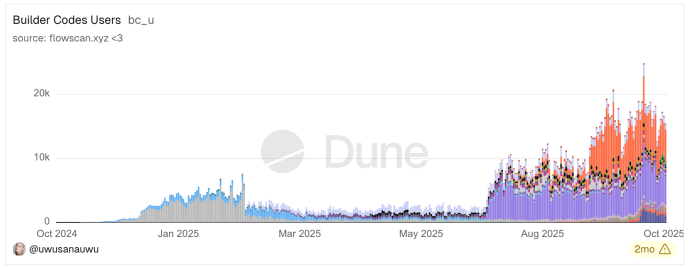
Moreover, looking at Hyperliquid's monthly active users, its revenue is essentially based on a whale service model, typical of the contract trading market's Matthew effect and inverted pyramid capital structure.
Currently, HL has about 1.1 million total wallet addresses, with 217,000 monthly active users and 50,000 daily active users. The key point here is that the top 5% of users contribute over 90% of the open interest (OI) and volume, forming a typical pyramid structure.
The top 0.23% of users (with funds over $1M, totaling over 500 individuals) control 70% of the open contracts ($5.4B), with over 100 top users having an average position of $33M, and their OI is 920 times that of the user proportion.
In contrast, the bottom 72.77% of users (150,000 users) contribute only 0.2% of the contract volume, with an average position of just $75.
This structure indicates that the contract market is essentially a battleground for professional institutions and high-net-worth individuals. While a large number of retail investors constitute the user base and activity, their capital volume is almost negligible.
This structure reflects a very counterintuitive reality: indeed, Hyperliquid itself has high revenue, having quickly risen to one of the most profitable exchanges in just one year.
However, its revenue essentially comes from high-end players and whales, motivated by either anti-censorship, transparency, or quantitative trading drives.
The significance of various platforms' integrations is that they only bring in regular users, so there needs to be a long-term user education process to potentially shift users who play Perps in CEX to the homogenized competition of Web3 Perps.
5. In Conclusion, Is Integrating Perps Really a Good Business?
Generally, projects need to adapt to the market, but when a platform reaches its peak popularity, the market can adapt to it. Currently, Hyperliquid enjoys such treatment, but it may not be able to maintain this status, even though the recent surge in trading volume from other competitors can be explained by expectations of new airdrops, leading to non-genuine trading results.
Moreover, many of HL's initiatives are relatively correct. Compared to many past platforms that often think about doing everything themselves and reaping all the benefits, I specifically criticize OpenSea for creating a mandatory royalty system that forces the market to follow the leaders. Each time incurs fixed high costs, interfering with the liquidity of goods and affecting the true pricing of the market, ultimately turning countless NFTs into heirlooms.
In HL, it has opened up EVM and various DEX Perps APIs, so we quickly see a plethora of derivatives in the market.
RWA assets, especially U.S. stocks and gold, are becoming new traffic entry points and differentiation growth areas in the current Perp DEX field. TradeXYZ has accumulated a perp volume of $19.1B, with a weekly average of $320M and a daily average of $45.7M, which is the best proof.
Hyperliquid's generosity in airdrops and buybacks is also evident; many times, pursuing staking HYPE and ADL profits can yield promising returns.
After all the twists and turns, the competition among the leading platforms is for them to worry about. Returning to this year's covert battle of wallet integrations, connecting to third-party Perps is mostly a low ROI business. Whether from user growth revenue, platform commission earnings, or stability investments, it doesn't count as a good business.
It can be imagined that after seeing the real revenue situation post-integration, many platforms will still be reluctant to give up the dividends of the Perps track and will turn to self-research and extensive user acquisition promotions. The battle for the track is not over and will continue to burn for another year, but only new users brought in from non-CEX will be truly effective users.
免责声明:本文章仅代表作者个人观点,不代表本平台的立场和观点。本文章仅供信息分享,不构成对任何人的任何投资建议。用户与作者之间的任何争议,与本平台无关。如网页中刊载的文章或图片涉及侵权,请提供相关的权利证明和身份证明发送邮件到support@aicoin.com,本平台相关工作人员将会进行核查。


