Restoring the most authentic anxieties, desires, and survival rules of Web3 workers.
Written by: Deep Tide TechFlow
When Xiaohongshu was still spreading the "get-rich-quick myth" and "annual salary of a million" in Web3, what is the true background of the crypto industry?
Through 506 questionnaires, we had an honest conversation with practitioners, and the results were surprising, even somewhat cruel: there is no gold everywhere; over 70% of people earn less than $4,000 a month, which is overall lower than in developed regions like Europe and the United States. Even a quarter of people are in a "paid labor" loss state; there are also no comprehensive protections, with nearly half having experienced layoffs, and most did not receive N+1 compensation.
Yet, despite this, over 80% of people choose to stay and continue. Is it because of the 70% freedom of remote work? Or is it because of the shared dream of "retiring with $5 million"?
In this report, we attempt to restore the most authentic anxieties, desires, and survival rules of Web3 workers through cold data.
This content is part of the questionnaire results from "Web3 Recruitment and Job Seeking 2025 Year-End Review: Who is Making Money, Who is Paying to Work?" For the full report, please check:
https://www.techflowpost.com/article/detail_29702.html
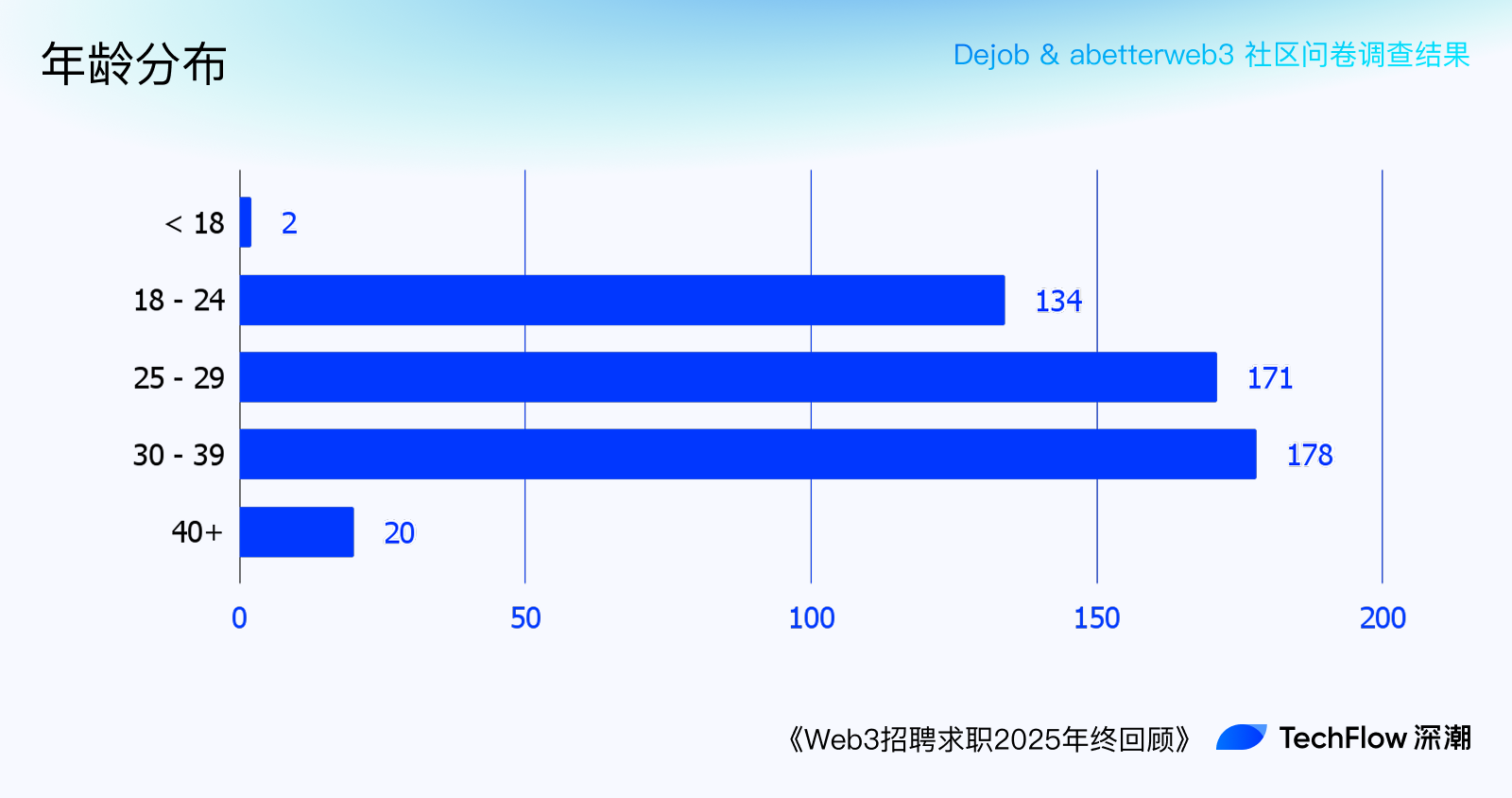
In terms of age distribution, the 18-29 age group is indeed the majority, but there are also a significant number of middle-aged and young practitioners (over 30 years old). This may be related to the less severe "35-year-old barrier" in the Web3 industry. Compared to internet companies, Web3 companies value experience, ability, and efficiency more, and each company prefers seasoned professionals who can "plug and play" to quickly build products.
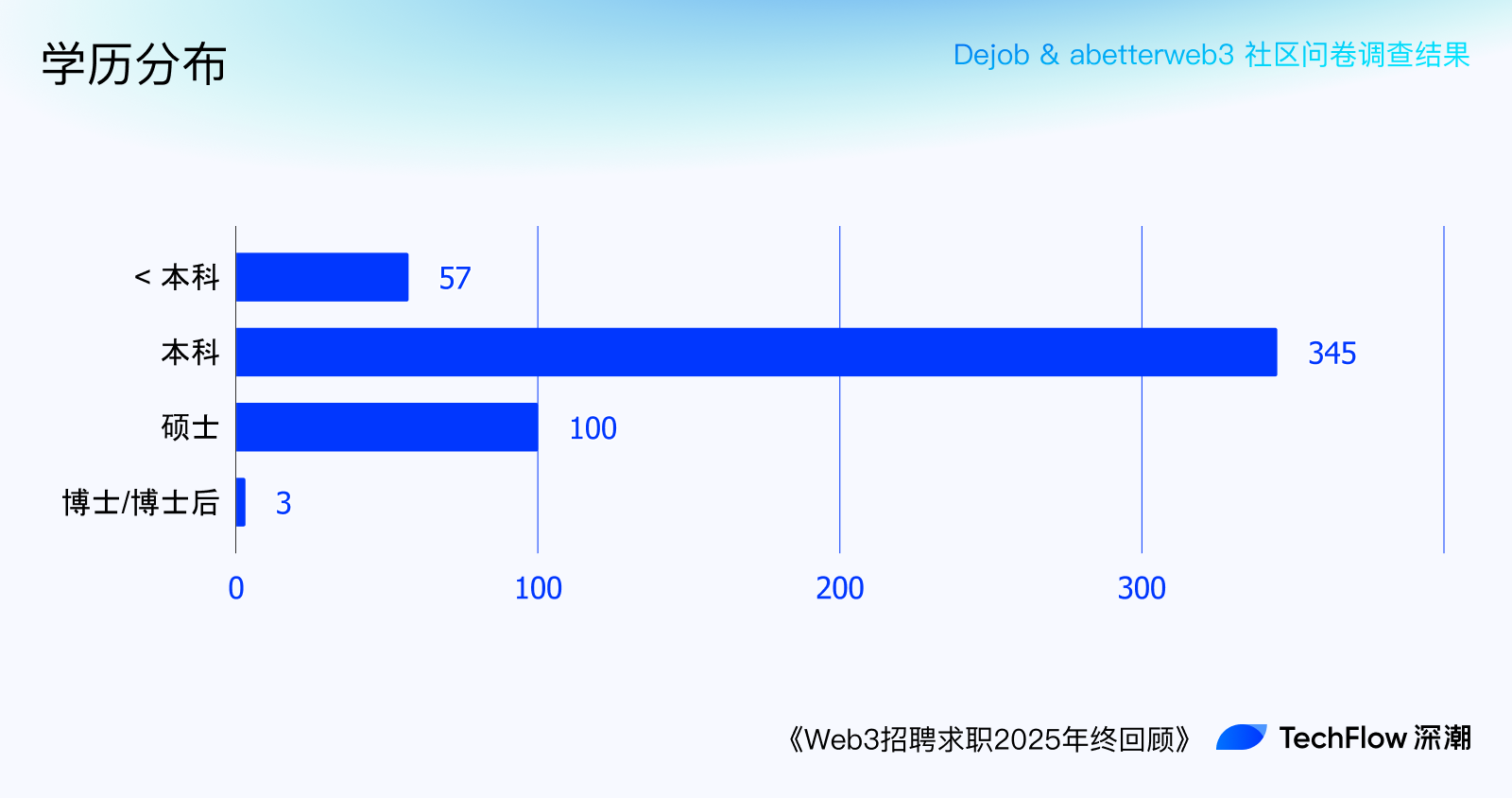
The distribution of educational background is consistent with the previous talent data statistics, primarily consisting of undergraduates, with some below undergraduate level and others holding master's or doctoral degrees, though the proportion of master's and doctoral degrees is not high.
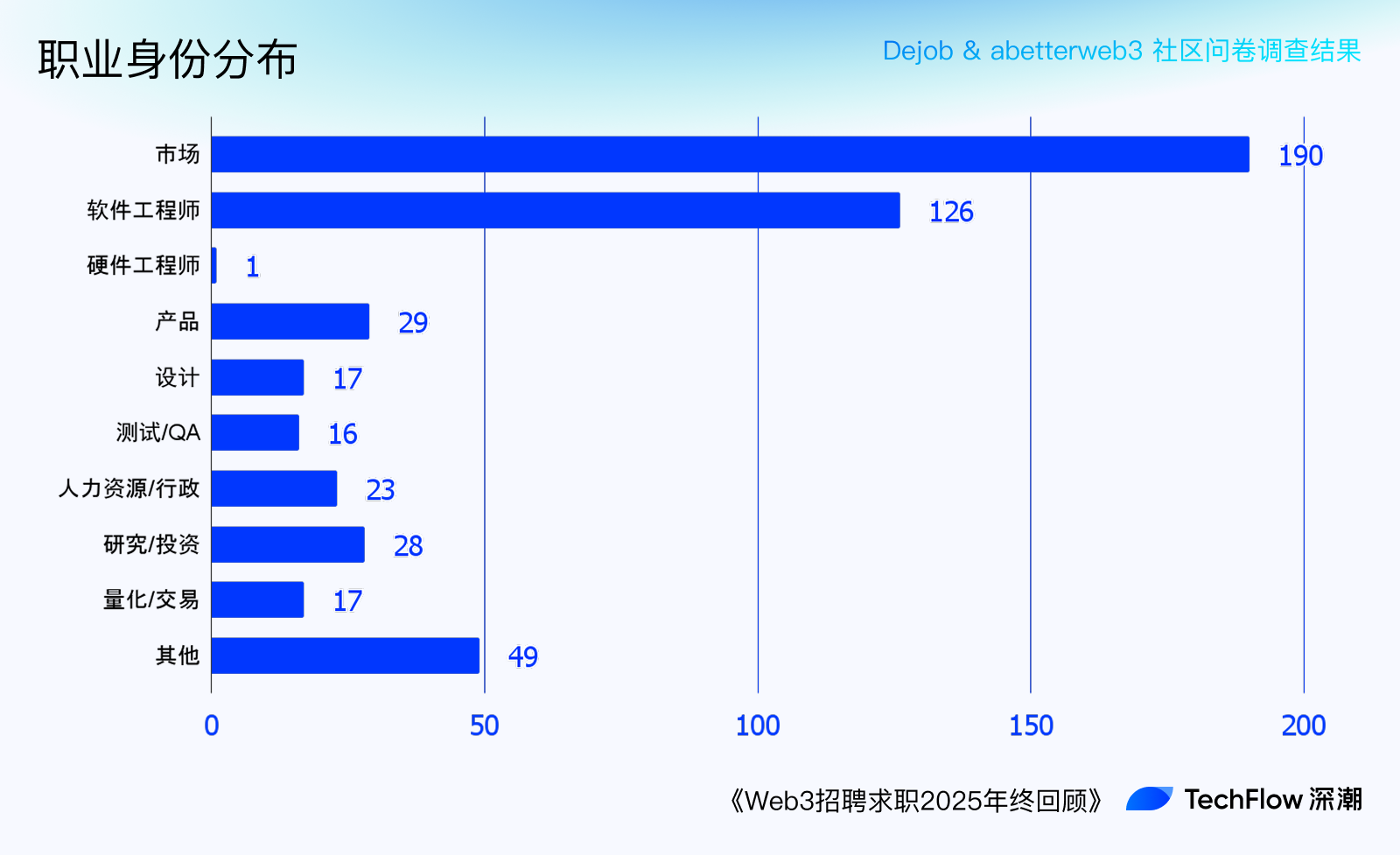
In terms of professional identity, the largest group is in market roles (operations/BD/customer service, etc.), followed by developers (front-end/back-end/smart contracts/blockchain, etc.). Next are product, human resources, investment research, design, trading, etc. In the "other" submissions, there were many mentions of risk control & security, KOLs, etc.
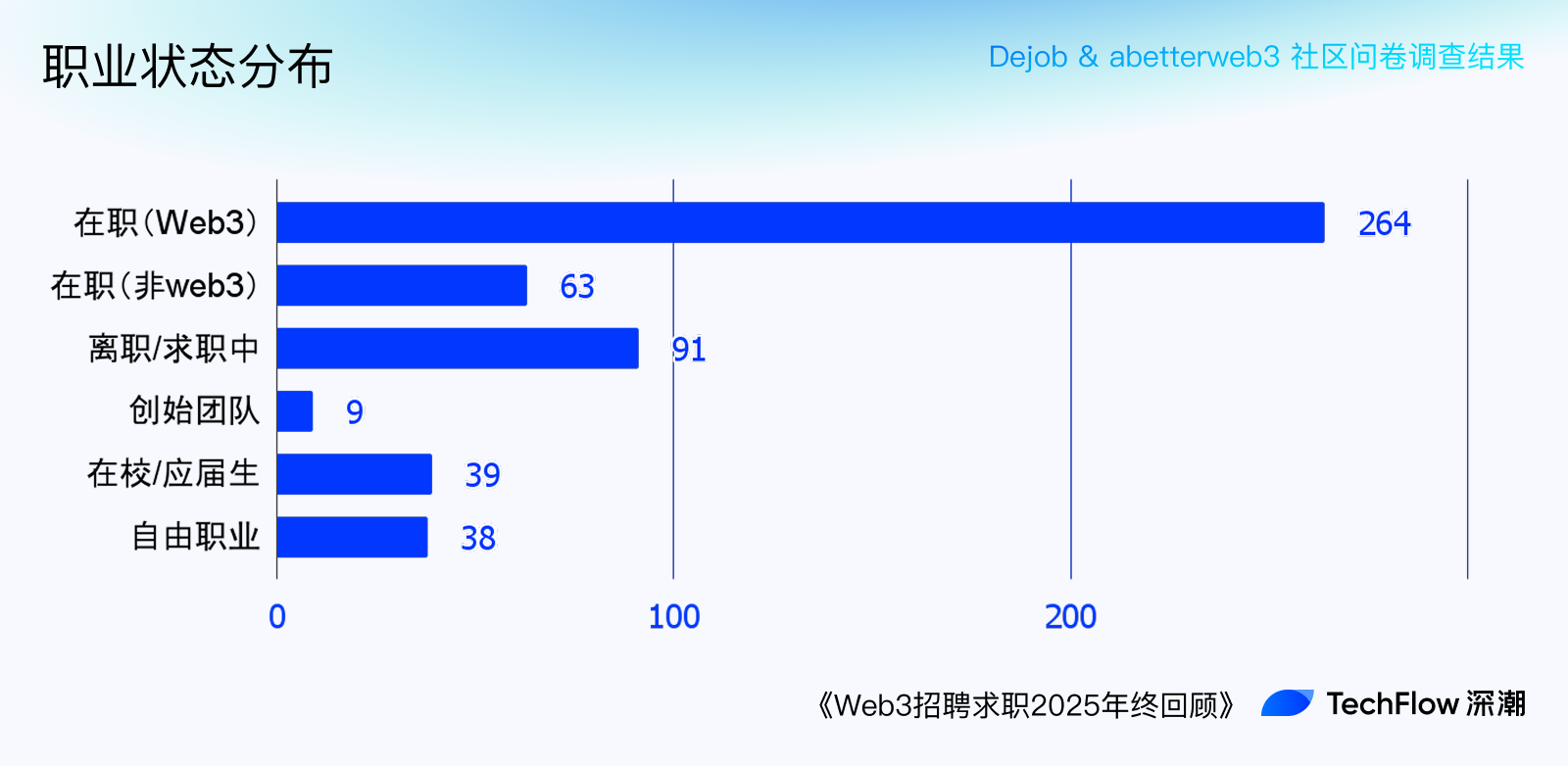
Regarding employment status, only 52% of respondents are currently employed in Web3. Over 30% are in a more flexible life situation. This indicates that market conditions have affected many people's employment status; on the other hand, it may also be because certain unique business models in Web3 have allowed some individuals not to need to work to obtain cash flow, such as KOLs and traders.
More than half of the submissions indicated they had worked at exchanges, followed by studios/communities, DeFi, media, wallets, and other common business types. Both talent and job providers are gathering towards exchanges with an absolute Matthew effect. This also reflects the current industry dilemma to some extent: apart from exchanges, the revenue capacity of other business models generally decreases from C-end—tools—underlying layers.

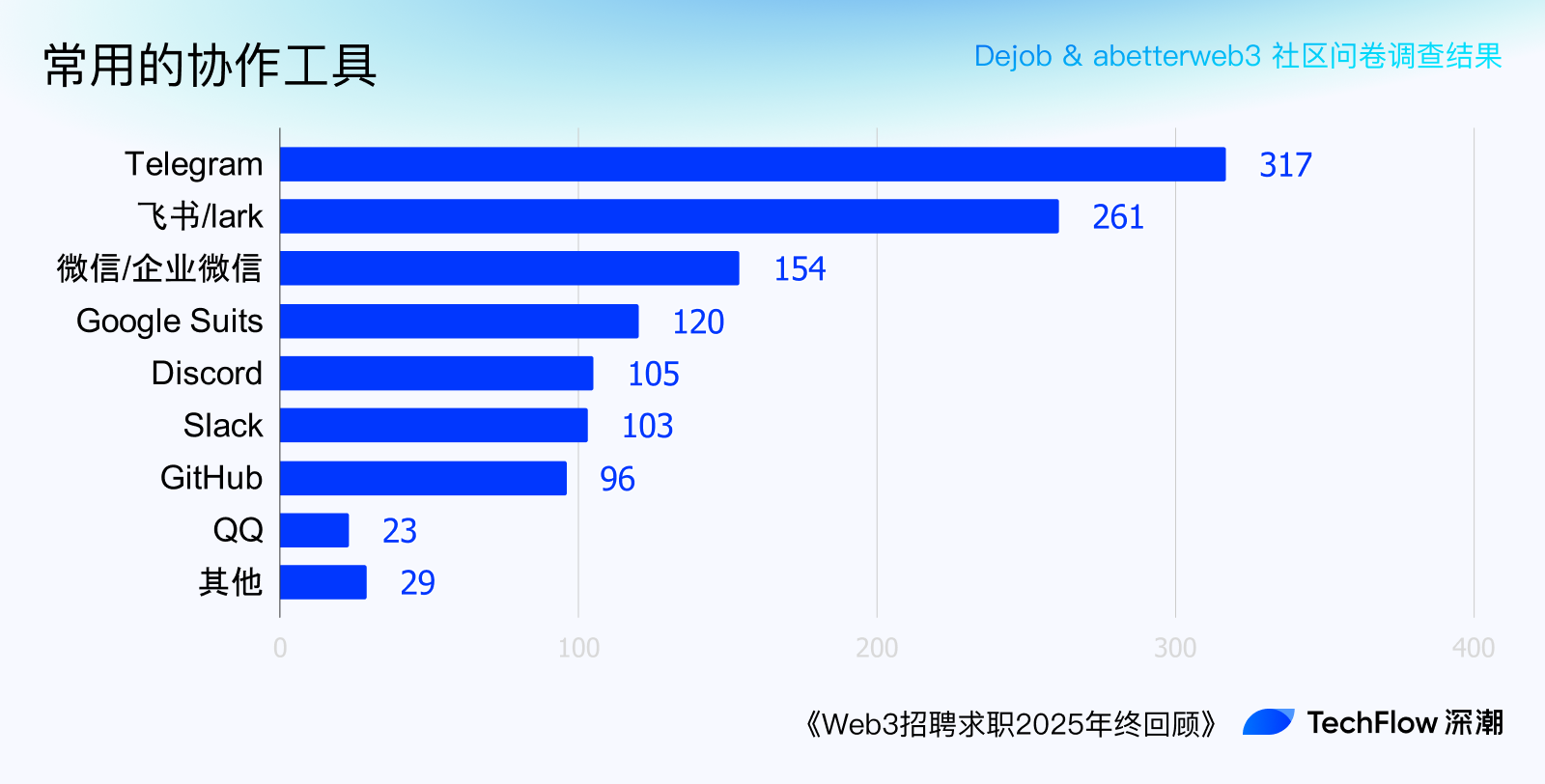
In terms of remote collaboration tools, since this survey took place in a Chinese vertical Web3 recruitment community, Telegram is favored by most companies for its confidentiality and usability, followed by domestic mainstream tools like Feishu and WeChat, and finally foreign companies' commonly used tools like Google Suites, Discord, Slack, etc.
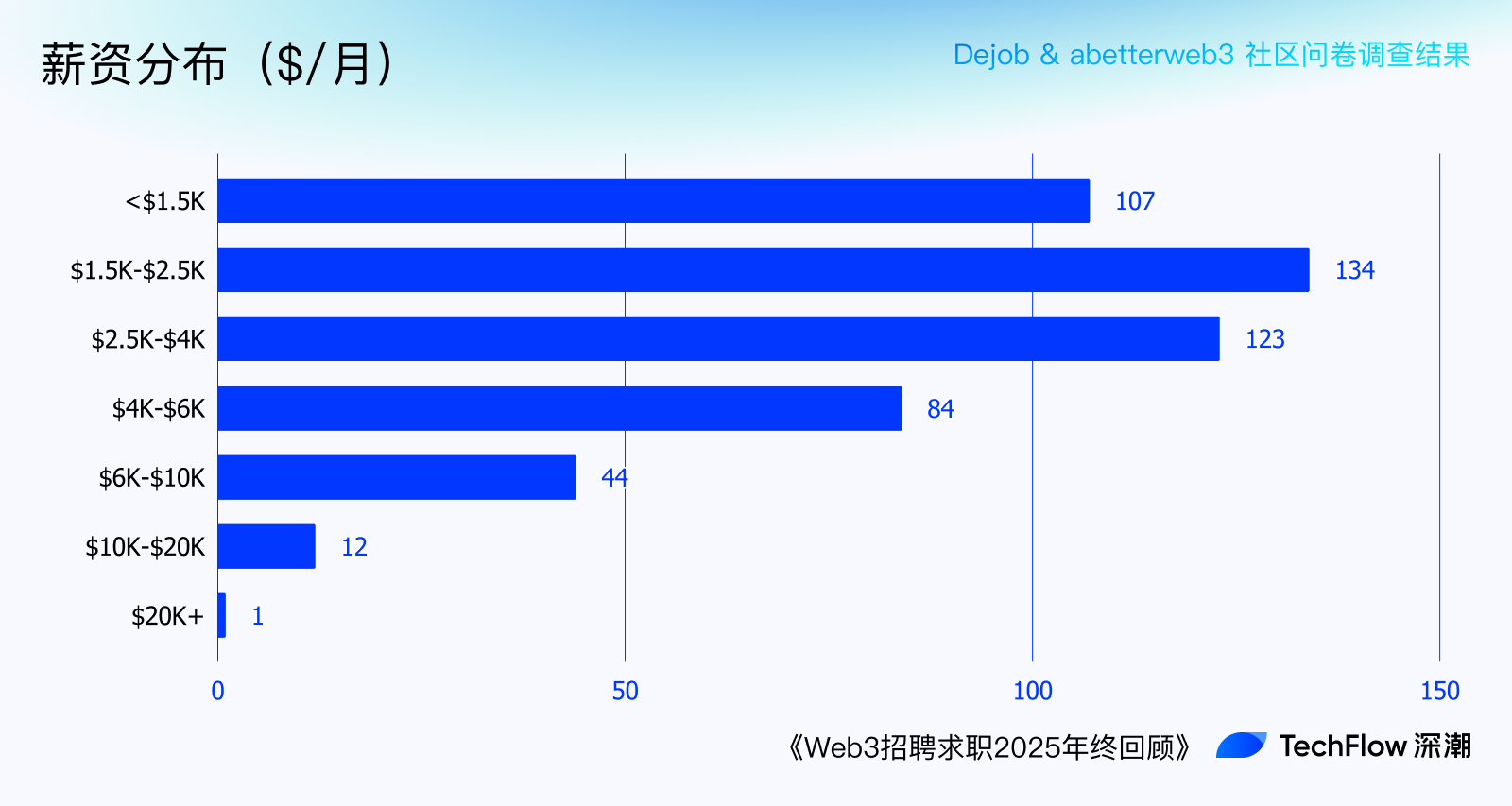
Regarding income levels, contrary to the get-rich-quick myth circulated outside, most Web3 individuals earn less than most leading internet companies, and there is a severe lack of long-term incentives (tokens/token rights), year-end bonuses, and severance compensation.
Over 70% of people earn less than $4,000 a month (equivalent to 28,000 RMB), and the monthly salary of $10,000 frequently seen on Xiaohongshu is indeed rare.
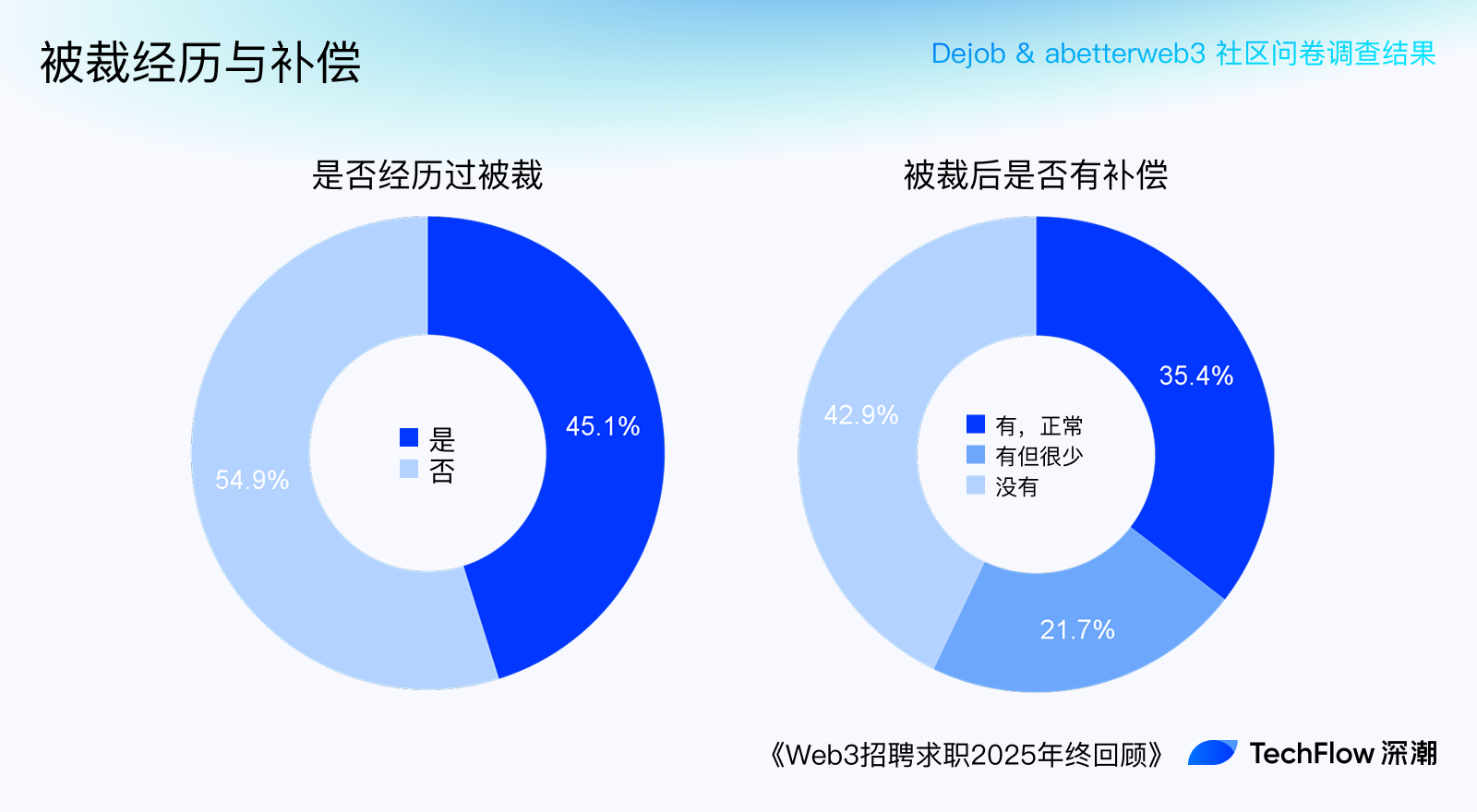
Nearly half of the respondents have experienced layoffs, and 40% of those laid off reported no compensation, while 21% indicated that even if there was compensation, it fell far short of the legal standards (such as N+1).
Almost half of the respondents indicated they had not received a year-end bonus; even those who did generally received only 1-3 months' worth, which is roughly on par with most internet companies outside of the Web3 industry.

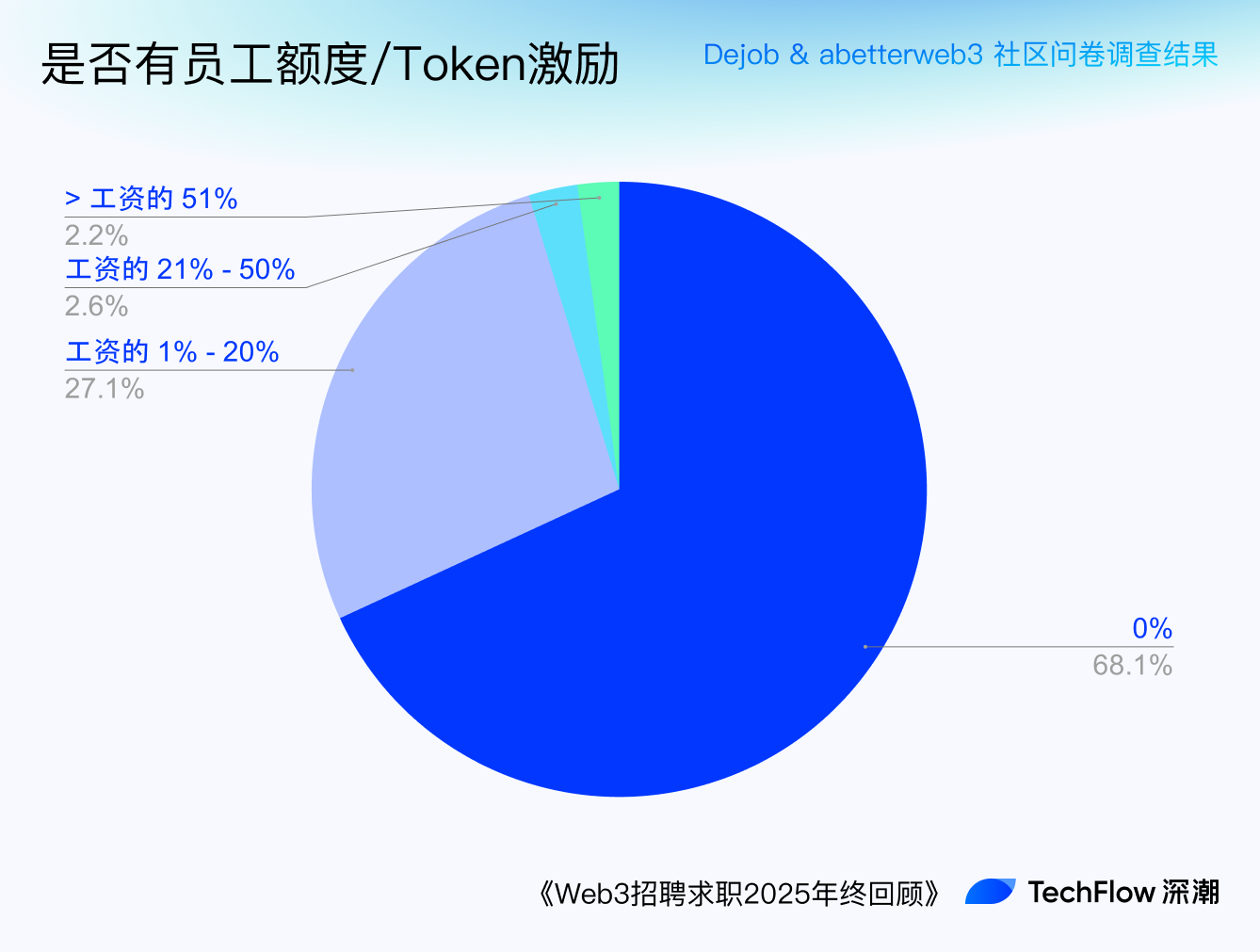
In terms of the well-known "upward channel" token incentives, nearly 70% of practitioners reported never receiving any. Even when they did, very few received more than 20% of their salary.
Even a quarter of people reported that their overall wealth accumulation after entering the crypto space was a "loss," indicating a "paid labor" state; other respondents mostly accumulated around $100K (equivalent to 700,000 RMB) in wealth.

However, on the other side of what seems to be a hopeless income level, the strong remote work culture in Web3 can be said to provide some relief for many workers. Nearly 70% of respondents indicated that their companies support remote work, and another 15% reported support for hybrid work, meaning that while there is an office, attendance is not mandatory, or there are several days a week when employees can work from home.

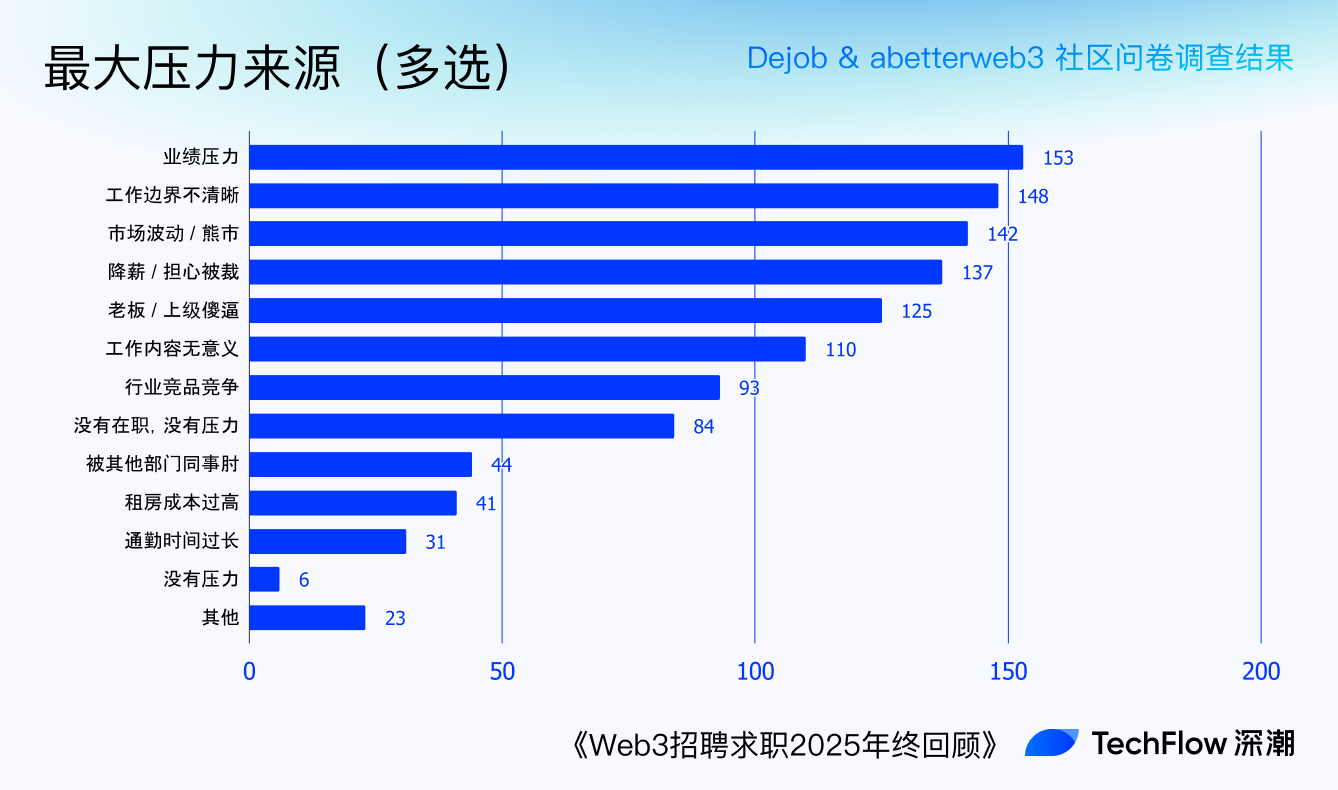
Remote work can indeed alleviate the pain of working to some extent. In the question about the "biggest source of stress," 31 responses chose "commuting time is too long." Other leading sources of stress included product growth, work boundaries, market fluctuations, fear of layoffs, and difficult bosses.
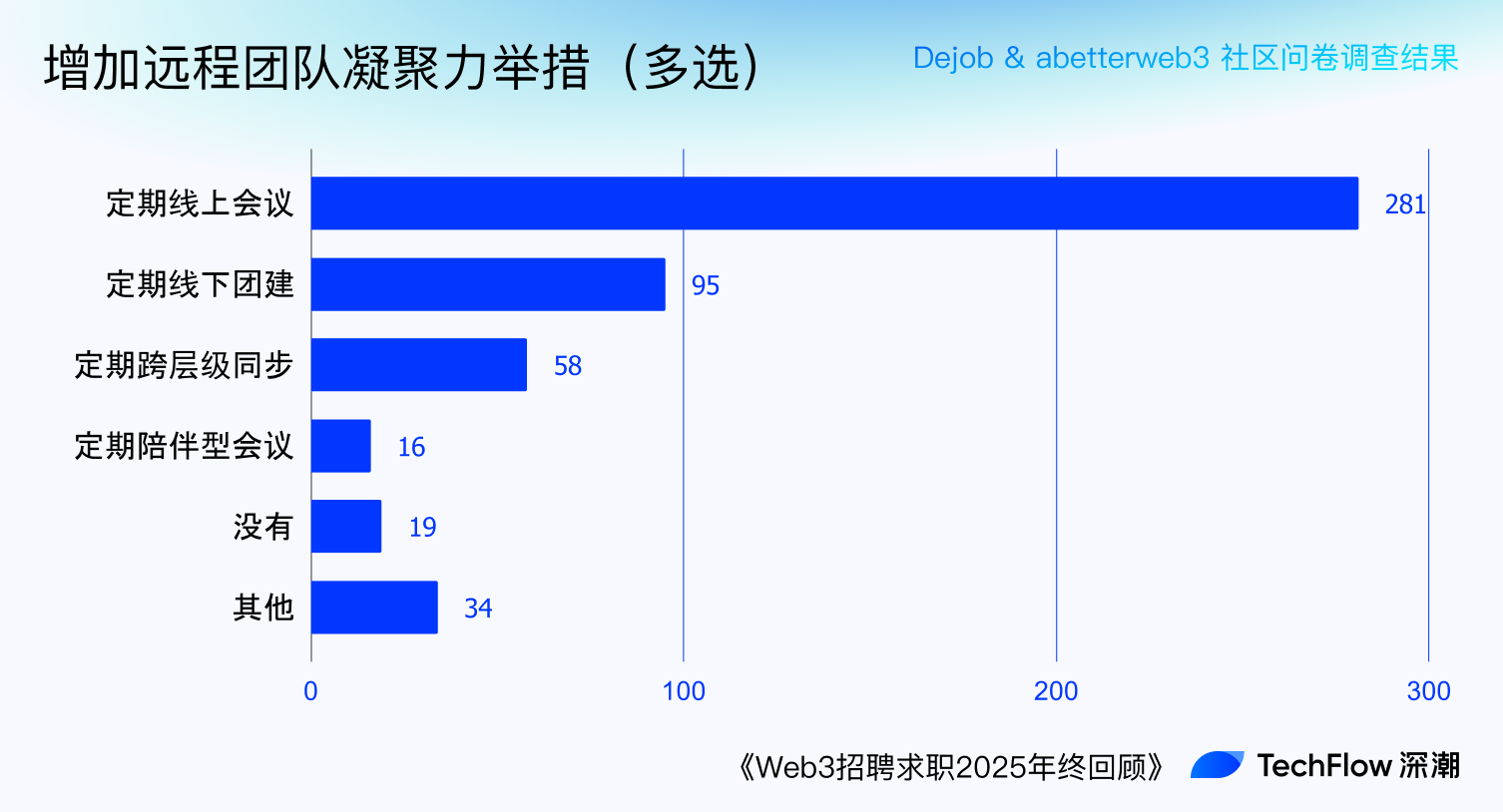
To maintain the psychological health of employees as social animals, many companies have also taken measures to sustain team cohesion.
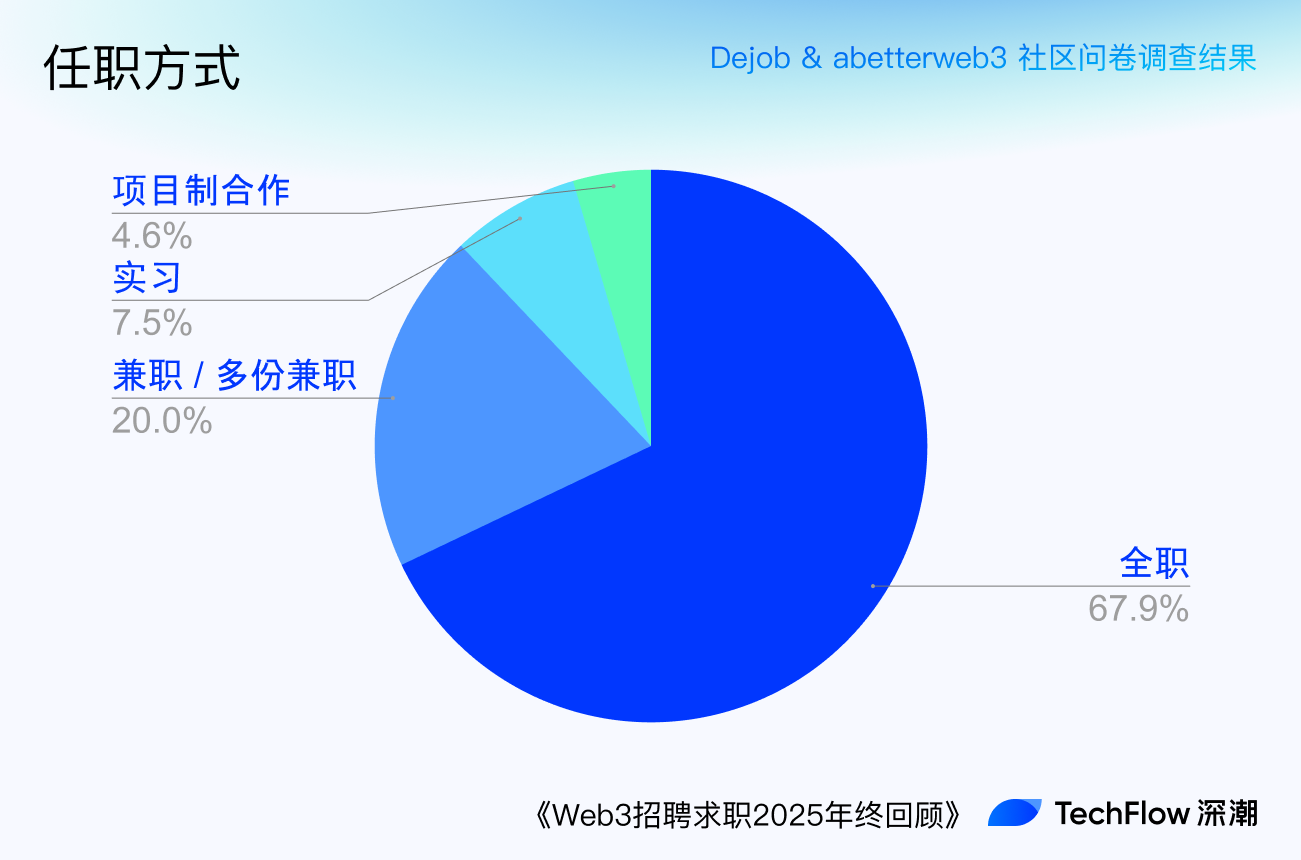
Under the combined effects of low income and instability, many people choose to take on multiple jobs. In the responses, 20% indicated they have side jobs. This also reflects the technology-oriented culture of most Web3 companies, where as long as problems can be solved and abilities are adequate, they do not interfere with employees' lifestyles and income methods.
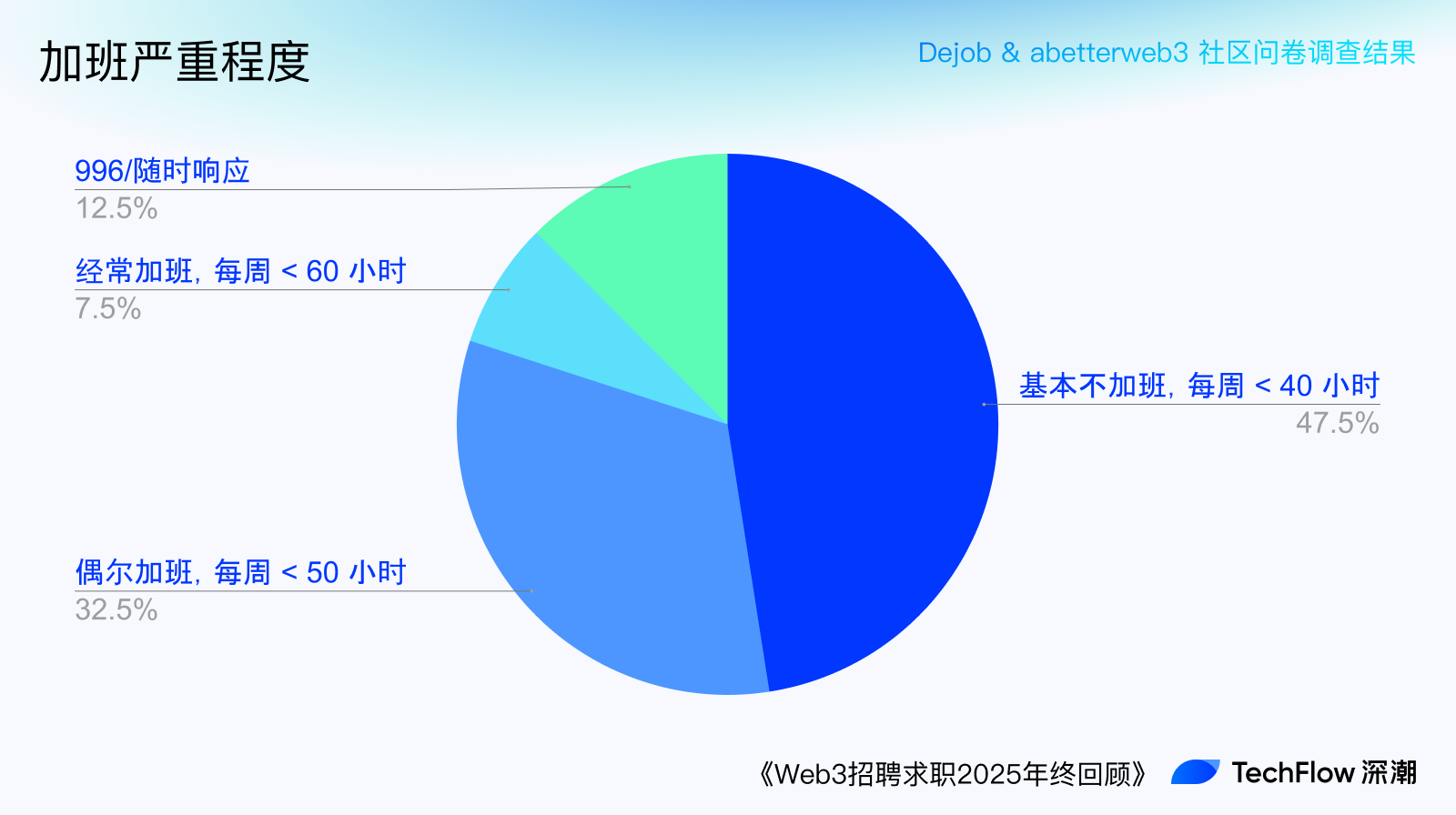
Regarding overtime intensity, 80% of people work approximately 40-50 hours a week. Thus, the overtime intensity in Web3 is considerably less than the 996/007 sweatshops of Web2.
When it comes to job hopping, over half of the respondents want to change companies, with 30% planning to switch within 3-6 months. However, about a quarter of people are satisfied with their current situation, and 8 individuals have found "dream companies" they hope to work at for a lifetime.

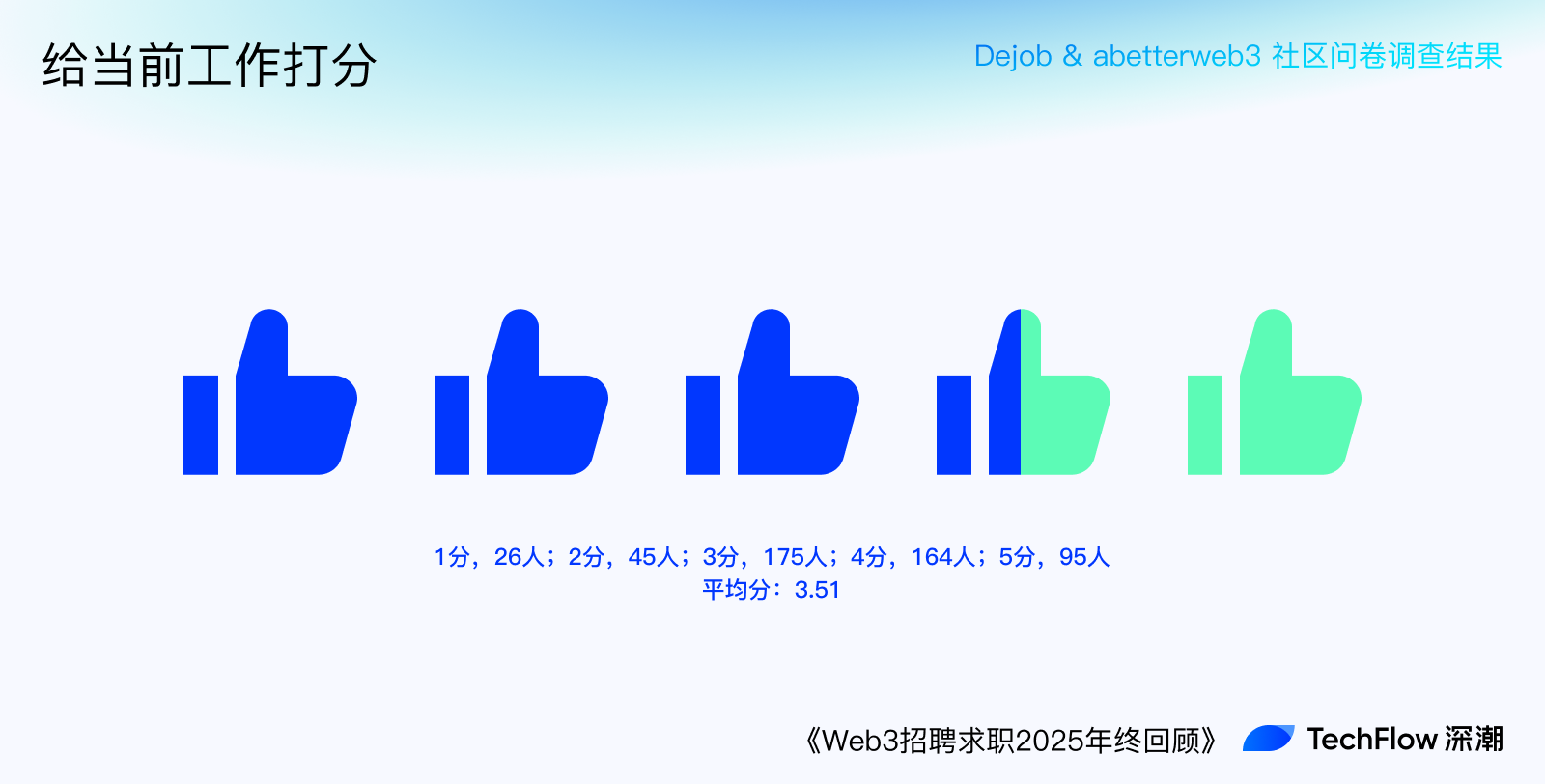
Considering factors like not much overtime, the ability to work remotely, and the option for side jobs, many people have given their current work a positive evaluation. In the section for rating their current job, the average score was 3.51.
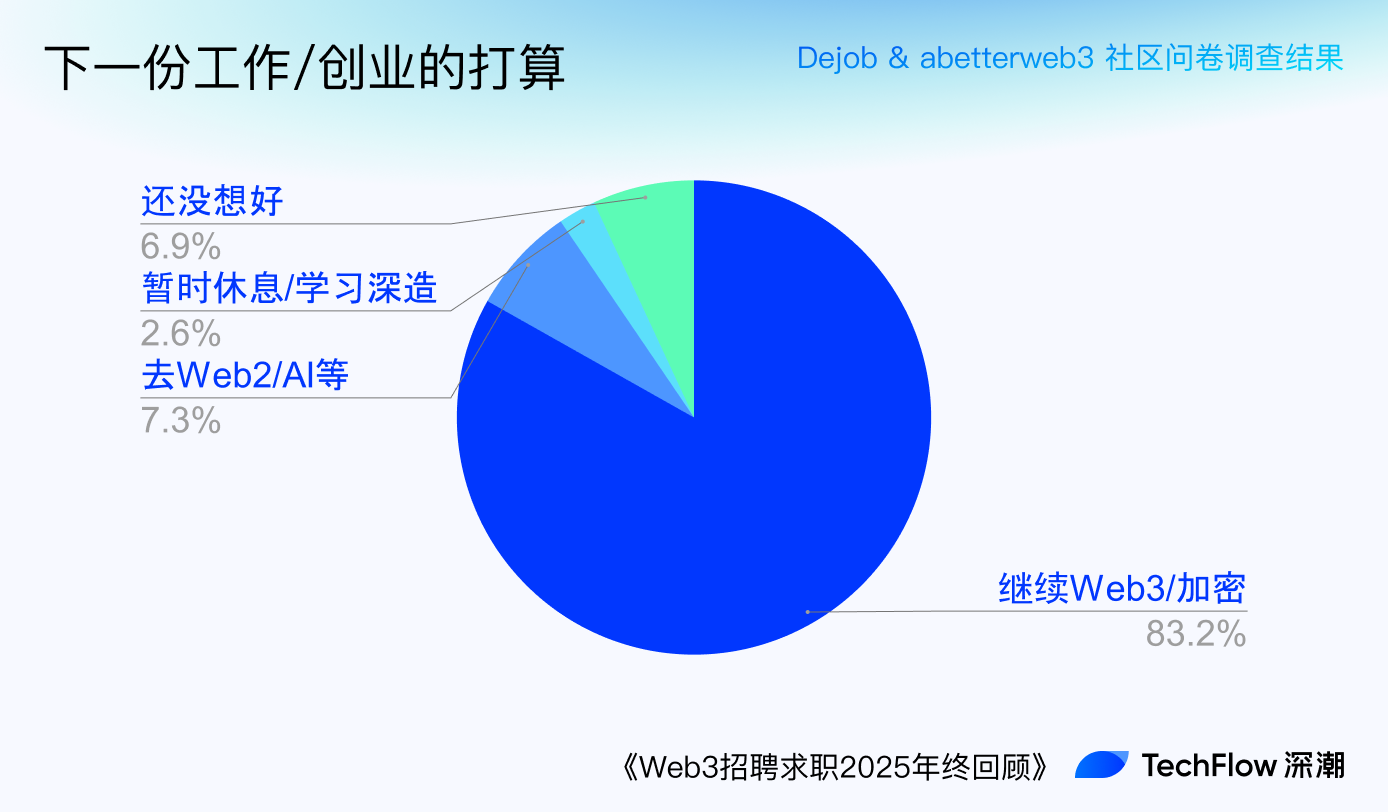
Regarding whether the next job will still be in the crypto space, over 80% chose to stay, while 7% chose to leave.
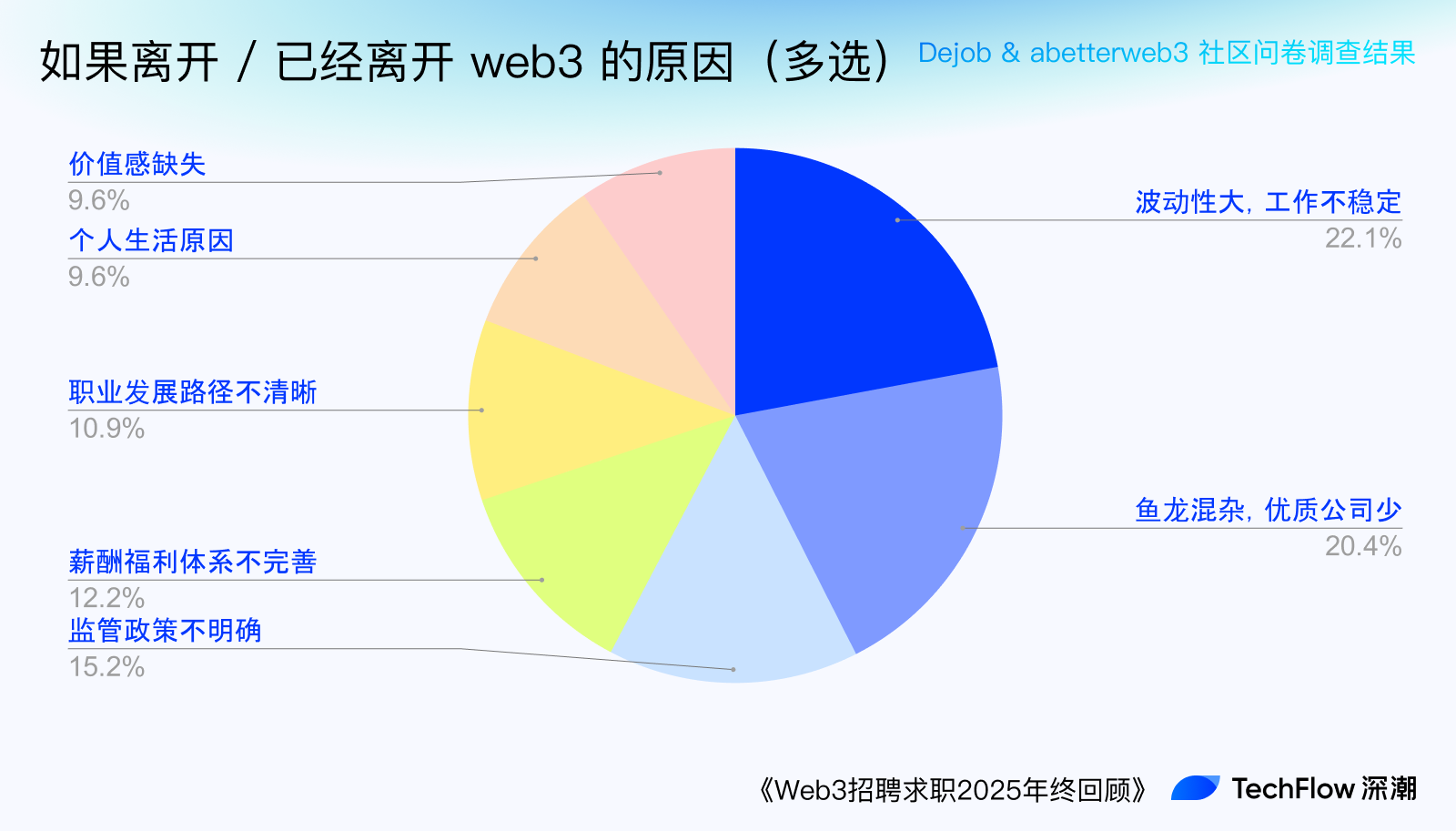
In the reasons for leaving, the choices reflect the industry's most authentic indifference within.
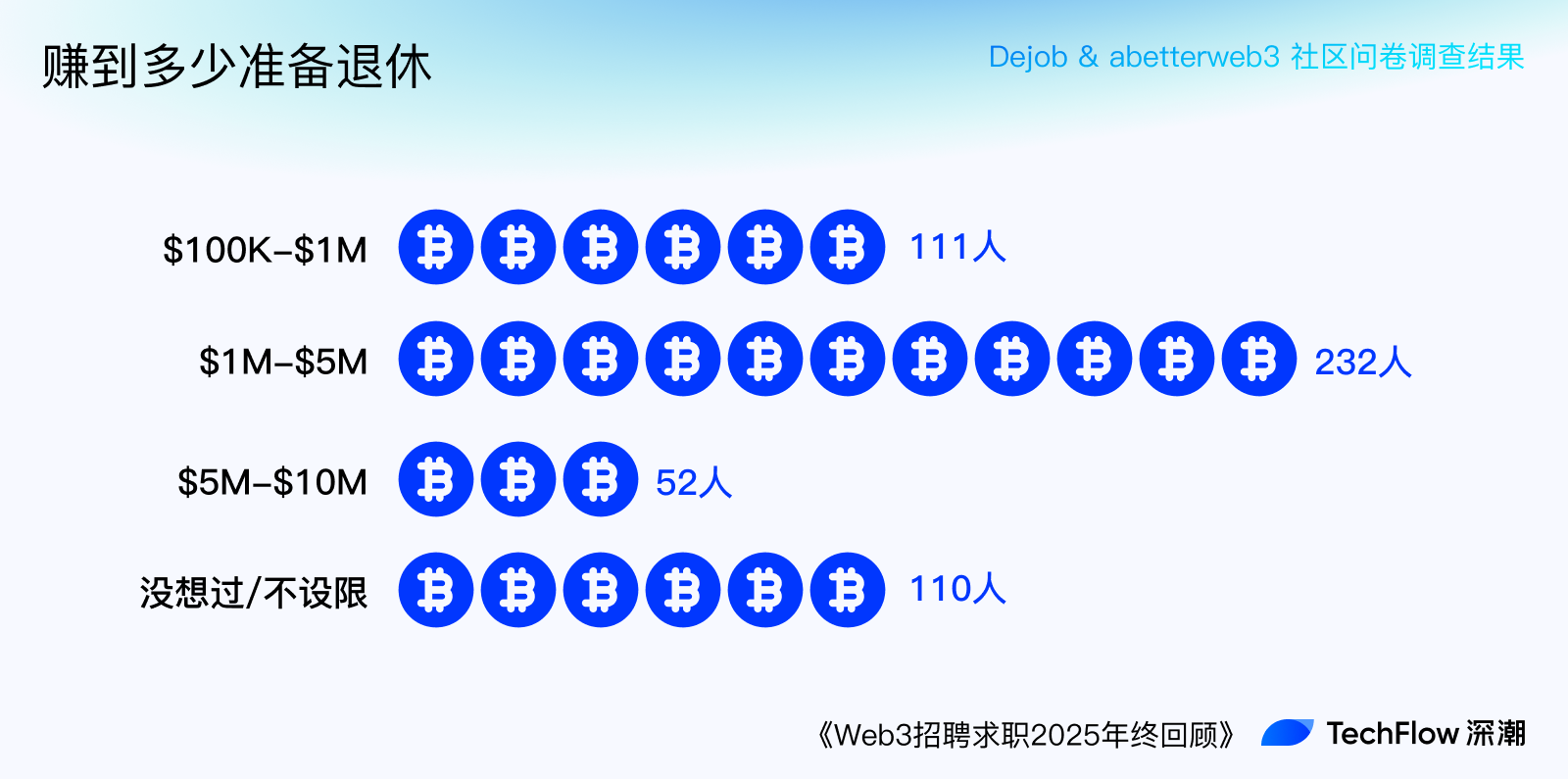
But all the preparations are for early retirement. When asked "At what wealth level would you consider resigning?", the vast majority chose $1M - $5M (equivalent to 7 million to 35 million RMB). This may indeed be the wealth limit that a person can achieve through working. However, 20% of people chose "no limit," reflecting their confidence in their own abilities.
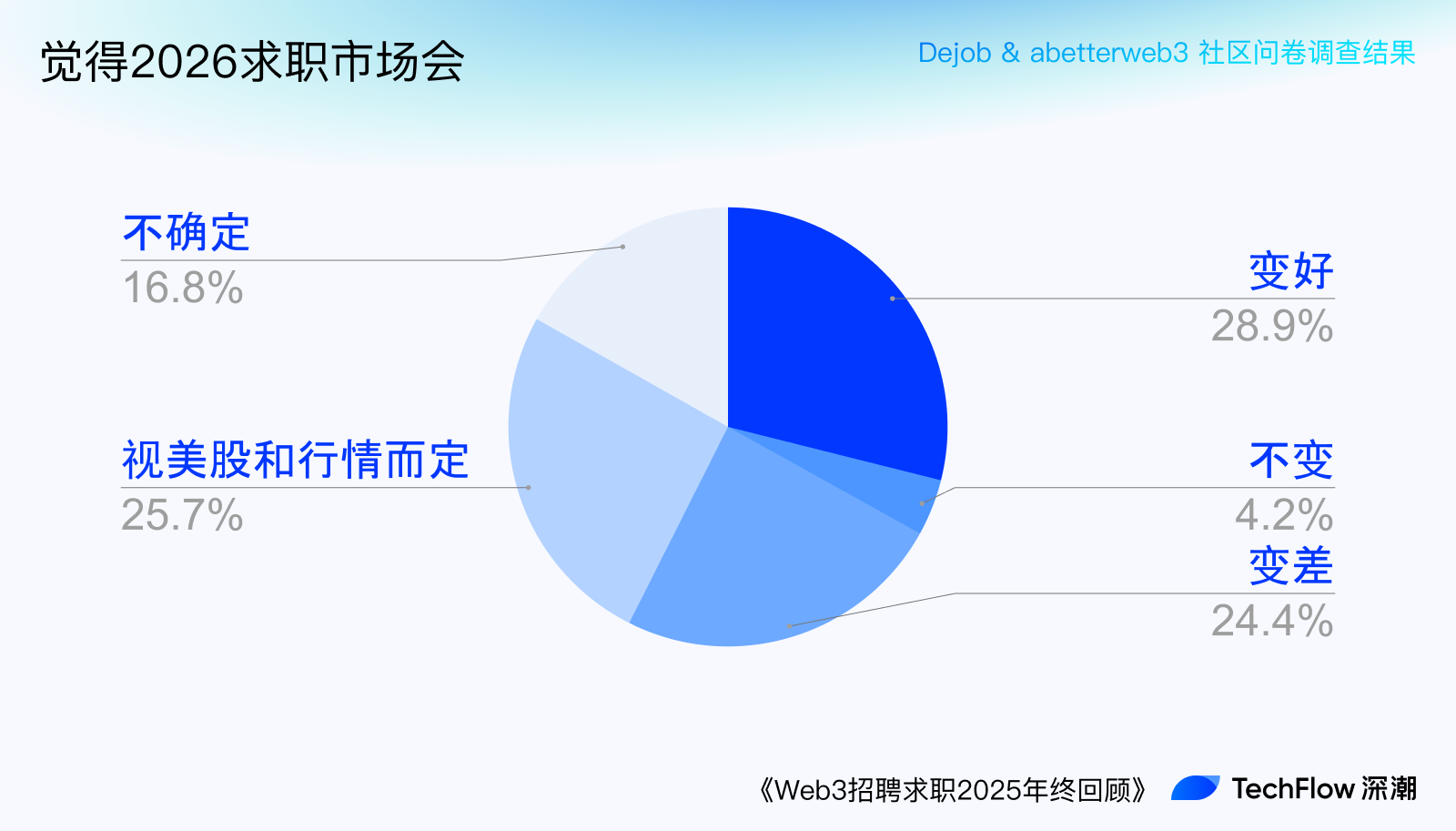
As for whether they are optimistic about the job market in 2026, only 28% of people believe it will improve, while most hold a pessimistic or wait-and-see attitude.
Truthful Words Section 👀
In addition to the above questions, we also added a few optional questions to gather some job seekers' most authentic views on current industry companies (for entertainment purposes only).
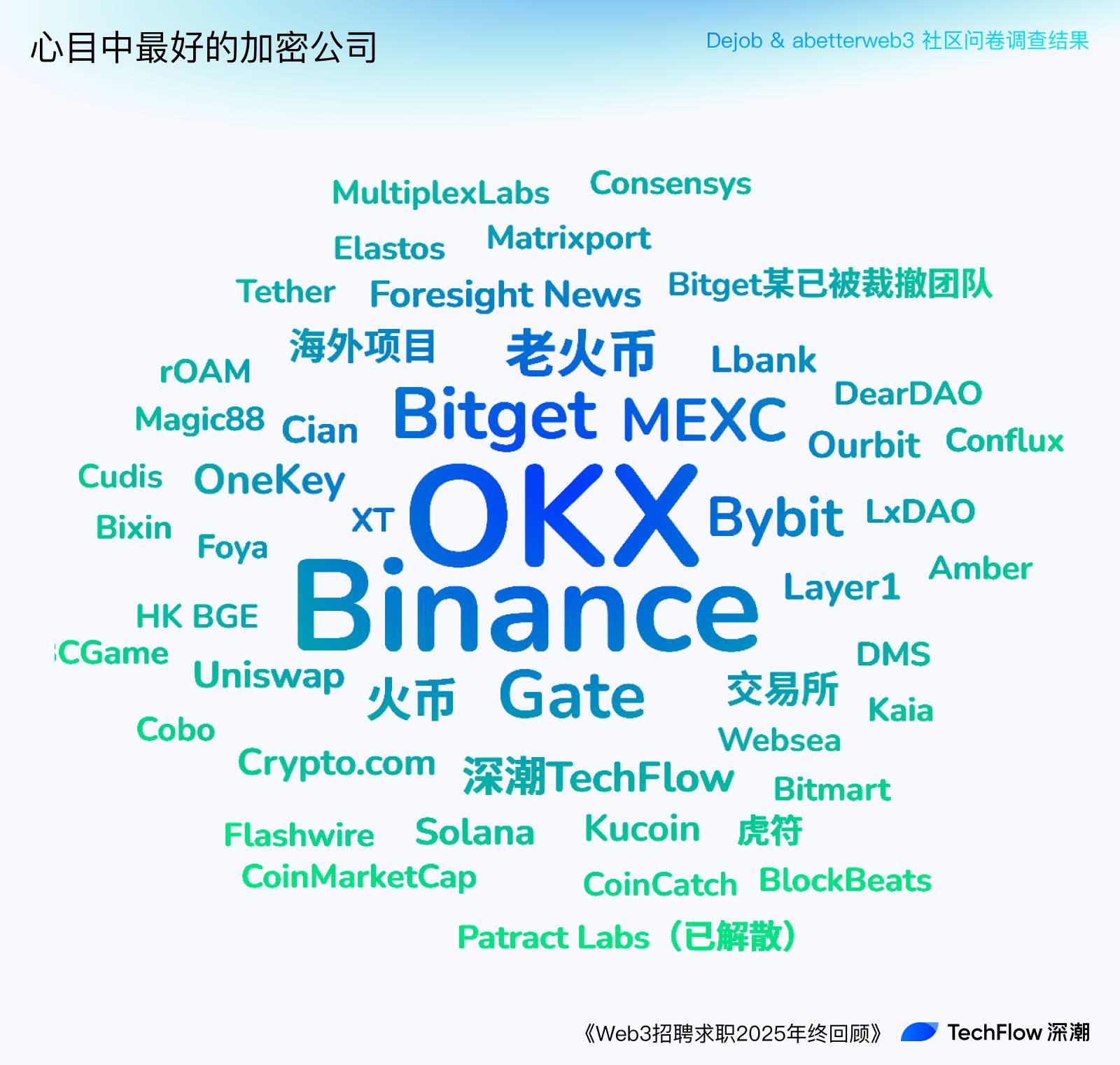
In the question "What is the best crypto company in your opinion?", the top ten companies are:
- OKX(26), Binance(23), Bitget(10), Gate(9), MEXC(7), Bybit(6), Old Huobi(5), Huobi(4), Deep Tide TechFlow(3), OneKey(3)
Surprisingly, some teams that have already disbanded were also mentioned, such as Huobi during Li Lin's time, a certain disbanded team from Bitget, and the now-defunct Consensus Labs. Perhaps these dream companies are worth remembering for a lifetime.
In the question "What is the worst crypto company in your opinion?", the top ten companies are:
- Gate(43), Bitget(13), OKX(12), MEXC(8), Huobi(7), Binance(5), WEEX(5), CoinW(2), Kucoin(2), Lbank(1)
Some exchanges appear on both the best and worst lists. This may indicate that the internal business lines of exchanges are vast and complex, and the working experiences of different departments and leaders can vary significantly.

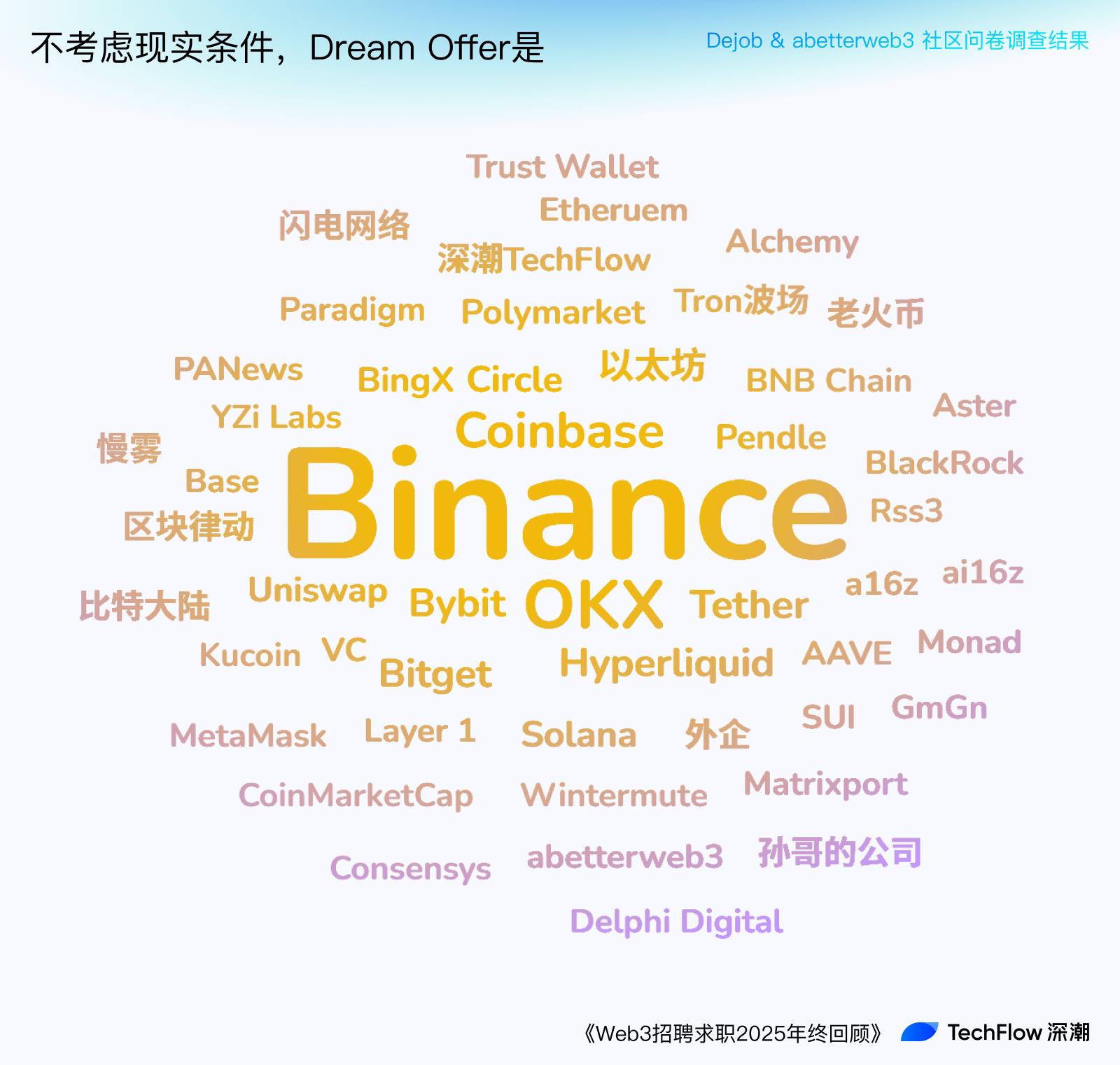
In the question "If you didn't consider real-world conditions, which company would you most like to join?", the top ten companies are:
- Binance(177), OKX(50), Coinbase(25), Hyperliquid(11), Bybit(11), Bitget(10), Tether(10), Circle(6), Solana(5), Ethereum(5)
As the industry leader, Binance unsurprisingly ranks first. As the "Tencent of the crypto world," Binance has both the filter of outsiders and the role of a prestigious resume within the industry, truly supporting individual career development. The on-chain newcomer Hyperliquid, as a non-exchange company, made it into the top 10, reflecting the strength of its community and people's desire for non-exchange products. Besides the leading exchanges, the names of foreign companies and overseas infrastructure have significantly increased in this answer, which also reflects most job seekers' admiration for foreign companies and disappointment with Chinese teams.
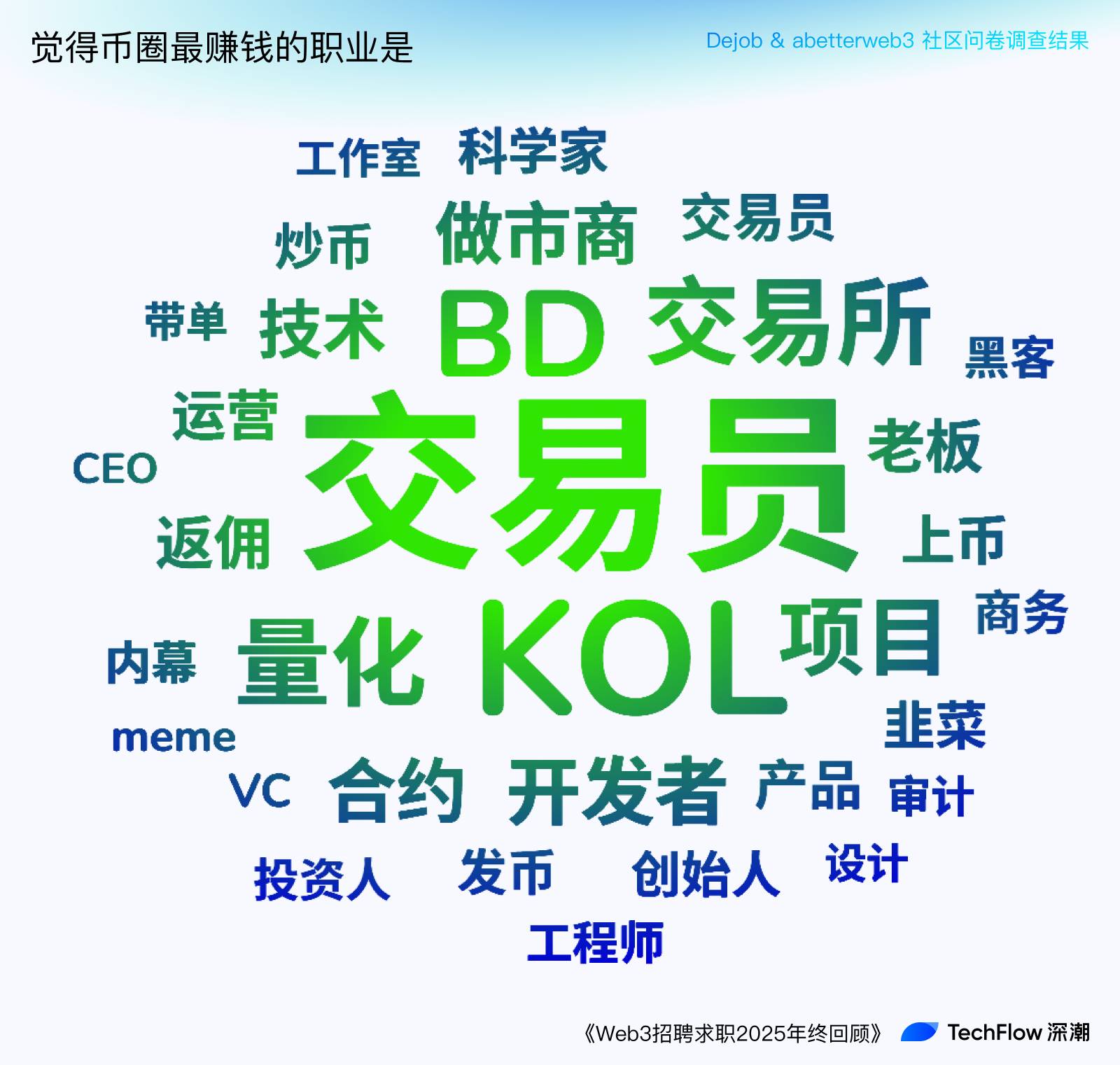
In the question "What do you think is the most profitable profession in the crypto space?", the high-frequency keywords are:
- Trader(85), KOL(68), BD(47), Exchange(32), Quant(32), Project(27), Developer(20), Contract(17), Market Maker(16), Technology(14)
Traders rank first, likely because the volatile market in the past two years has made many realize that regardless of the company or profession, it might be better to directly engage in the game themselves; KOLs follow closely, likely because they have the opportunity to access primary tokens from project parties, possess information advantages, or can directly influence specific assets for profit. Pure technical positions, which are far from the market, were also mentioned, perhaps because in the eyes of most non-developers, "technology" is an indispensable part of achieving leaps as "super individuals."
免责声明:本文章仅代表作者个人观点,不代表本平台的立场和观点。本文章仅供信息分享,不构成对任何人的任何投资建议。用户与作者之间的任何争议,与本平台无关。如网页中刊载的文章或图片涉及侵权,请提供相关的权利证明和身份证明发送邮件到support@aicoin.com,本平台相关工作人员将会进行核查。


