Metaphysics is no longer a fringe culture, but a common psychological need.
Written by: Umbrella, Deep Tide TechFlow
AI fortune-telling is no longer a novelty; face analysis, choosing seats for mahjong, anything can be calculated.
However, the approach in the cryptocurrency world is different, directly incorporating fate into K-line charts.
On December 13, a blogger specializing in crypto metaphysics, @0xSakura樱花, released something new: an application called "Life K-line."
By inputting birth information, the AI generates a K-line chart from ages 1 to 100 based on the Eight Characters, with red and green candles depicting your life fortune.
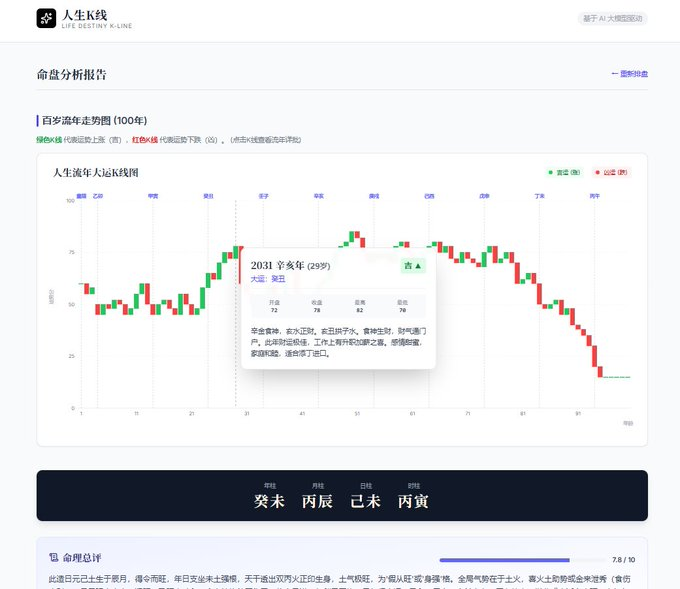
This thing went viral on Twitter. The initial tweet garnered over 3.3 million views, and within three days, the website and API call volume exceeded 300,000. People began to share images frantically, with many claiming that the generated K-line closely matched their past life trajectories.
Even more fantastical, this tool, clearly labeled "for entertainment purposes only," saw a token with the same name appear within 24 hours of its launch.
Why can an entertainment-based fortune-telling tool resonate so strongly in the crypto space?
Behind this is a long-standing undercurrent of trading metaphysics, as well as a concentrated release of collective anxiety in the crypto community.
The Metaphysical School in the Trading Industry
It's not surprising that cryptocurrency traders believe in metaphysics. Wall Street is the same.
W.D. Gann was one of the most famous market analysts of the 20th century and the person who most deeply integrated mysticism with technical analysis on Wall Street, using astrology to predict market trends.
Soros admitted in "The Alchemy of Finance" that he would gauge market risk based on the severity of his back pain. When the market is about to reverse, his back would hurt intensely.
However, these stories have long remained in the realm of "legend," with few openly admitting to using metaphysics to guide their trading.
In private, one might arrange feng shui, wear lucky beads, or consult masters for market analysis, but it cannot be known to peers, or else it would be seen as unprofessional.
The crypto world has broken this taboo.
In this inherently mysterious industry, metaphysics seems to fit naturally; some will predict BTC's fortunes for the coming year based on their birth charts, while others will decide whether to open positions based on their daily fortunes.
Moreover, discussions about metaphysics in the crypto industry seem to have increased in recent years, with more and more people either trusting or joining the ranks of metaphysical trading out of curiosity. Numerous cryptocurrency bloggers on Twitter have emerged, each with their unique metaphysical analysis.
The explosive popularity of "Life K-line" is a manifestation of this.
A large number of users engage in discussions about their "life trajectories" in the community, whether seriously or jokingly. They do not feel they are being "superstitious"; they are simply using a more interesting way to communicate their feelings of uncertainty with peers.
The position of metaphysics among traders has changed, from a secret on Wall Street to an open topic on crypto social media.
Why is metaphysics more popular in the crypto industry?
Why do crypto traders need metaphysics?
The answer to this question can be roughly divided into three reasons.
Psychological Compensation for Uncertainty Anxiety
The crypto market is a perfect environment for generating anxiety.
Trading occurs 24/7 year-round, with no circuit breaker; sudden surges and drops can happen in an instant.
Here, a tweet from a major influencer can cause a cryptocurrency's market value to evaporate by hundreds of millions or even tens of billions of dollars, and founders of well-packaged projects may disappear overnight.
Traders are constantly facing "unknown risks," and the most terrifying aspect is not the "risk" itself, but the "unknown."
Economist Frank Knight pointed out in 1921 that risk is quantifiable probability (like rolling dice), while uncertainty is unquantifiable unknowns (like whether war will break out tomorrow).
Humans are inherently afraid of "uncertainty." When they cannot quantify risk, they instinctively create "false certainties" to alleviate anxiety.
Metaphysics is the best vehicle for this false certainty.
When direction is unclear, opening today's trading calendar at least provides a clear indication.
Within the crypto community, crypto astrologer @AstroCryptoGuru, with 51,000 followers, predicts based on Bitcoin's "birth chart" (the time of the genesis block on January 3, 2009) combined with planetary cycles:

Saturn signals correspond to bear markets, while Jupiter signals correspond to bull market peaks. He claims to have successfully predicted the peak of the bull market in December 2017, the bear market in 2022, and the high point of BTC in 2024.
This method of binding specific dates to celestial events provides traders with clear "waiting signals" during market confusion, even if that signal comes from space.
"Don't trade during Mercury retrograde, the full moon will cause a crash, the birth chart shows next year will be a BTC bull market"—these directions do not require complex technical analysis or reading obscure white papers; one only needs to believe in "destiny."
A 2006 study by the University of Michigan found that stock market returns in 48 countries during full moons were 6.6% lower than during new moons.
This is not because the moon truly affects the market, but because collective superstition influences traders' behavior. When enough people believe "the full moon will cause a crash," they will sell off in advance, and thus the crash actually occurs.
In the crypto space, this collective anxiety can be even more intense, especially during bear markets, where all "fundamental analysis" and "value investing" become jokes, making metaphysical analysis seem more reliable.
Thus, traders need metaphysics not because it is accurate, but because it provides an explanation; even if that explanation is false, it is easier to accept than the uncertainty that seems endless.
Cognitive Bias Leading to Self-Reinforcement
Why does metaphysics always "seem effective"?
The reason metaphysics can continue to thrive in the crypto space is not only because it alleviates anxiety but also because it "seems genuinely useful."
This is not due to the accuracy of metaphysics itself, but rather the cognitive biases of the brain reinforcing themselves.
The most typical example is confirmation bias: when you believe "the full moon will cause a crash," you will remember all instances of crashes following a full moon while ignoring those days when the market surged or remained flat after a full moon. When your "Life K-line" indicates this year is a bull market, you will attribute every small rise to "the birth chart coming true," while explaining drops as "short-term corrections that do not affect the overall trend."
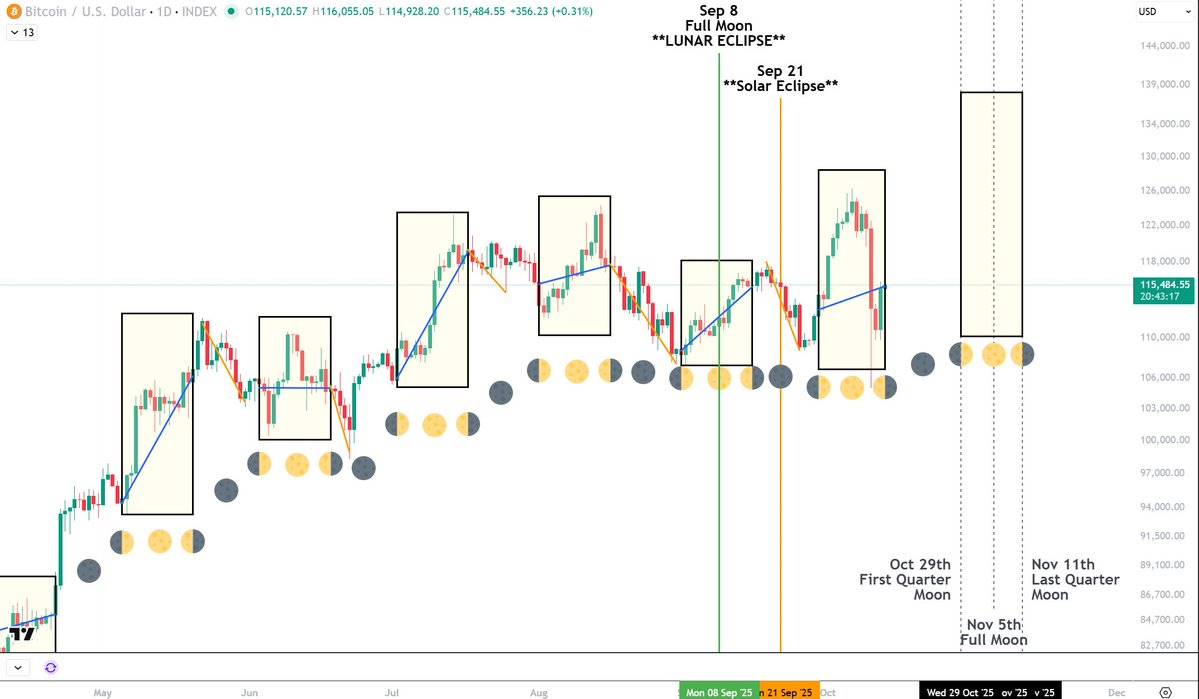
Image source @Drazzzzz
In the crypto social media environment, this bias is amplified several times.
A tweet like "I followed the tarot card's advice to go long on ETH contracts and made 20% in three days!" is likely to be widely retweeted, liked, and shared.
However, traders who lost money following tarot card advice will not post, nor will they be seen.
Thus, the information flow in the entire community is filled with cases of metaphysical predictions coming true, while failed cases are filtered out.
Similar cases are everywhere on Twitter. For example, when @ChartingGuy predicted a blood moon in March this year, regardless of whether the market rose or fell, there was always room for interpretation: "peaked early," "delayed fulfillment," "needs to align with other planetary angles."
If BTC indeed retraced during that time, the tweet would be repeatedly cited as a "divine prediction."
When BTC plummets, traders urgently need a reason. We look through social media, where technical analysis says "broke support," macro analysis says "Japan raised interest rates," but these explanations are too complex and uncertain.
Metaphysics provides a simple and clear answer: "Saturn retrograde, the crypto market enters a bear cycle."
This explanation requires no understanding of market conditions, policies, or data; it only requires belief that celestial movements influence the market. Thus, it spreads rapidly and becomes a consensus.
More critically, the vagueness of metaphysics ensures it can never be falsified.
The master says not to trade during Mercury retrograde; if you lose, it's because you didn't heed the master's advice; if you gain, it's because the birth chart is special, suitable for counter-trend trading. The tarot cards indicate significant fluctuations soon, and whether it rises or falls, it counts as fulfillment.
This characteristic of being explainable in any way allows metaphysics to remain undefeated in the crypto space.
Thus, traders are not superstitious; rather, their brains are processing information in the most energy-efficient way: remembering what is useful, ignoring what is not, and using simple explanations to replace complex analyses.
Metaphysics is popular not because it is accurate, but because it always seems accurate.
The Social Attribute of Metaphysics
Another reason metaphysics is popular in the crypto space is that it has become a form of social currency.
Discussing technical analysis can lead to disagreements, but discussing metaphysics has no right or wrong, only resonance. The question "Is your Life K-line accurate?" is widely discussed, not because everyone truly believes, but because it is a topic anyone can participate in, requiring no professional threshold.
There is an example that can well demonstrate the existence of the demand for metaphysics.
Previously, our readers kept asking if we could add a feature to check fortunes. As more people asked, we actually created a "Today's Fortune" section on the website.
It may not be used to make real decisions, but everyone wants a common topic, a daily ritual for mental reassurance.
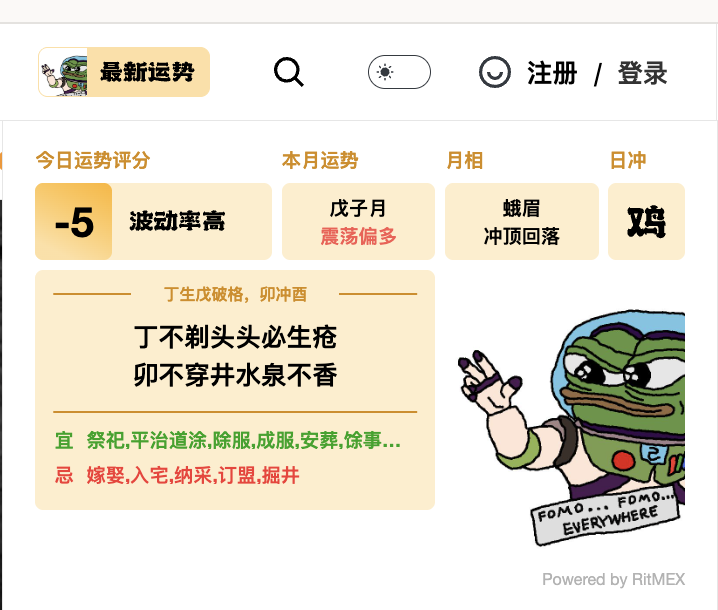
Image source Deep Tide TechFlow Official Website
When you say in a group, "It's Mercury retrograde today, I'm not opening positions," no one will question you with "that's unscientific"; instead, someone will reply, "Me too, let's avoid this wave together."
The essence of this interaction is actually confirming that each other's anxiety is reasonable.
A Pew Research survey in 2025 showed that 28% of American adults consult astrology, tarot, or fortune-telling at least once a year.
Metaphysics is no longer a fringe culture, but a common psychological need. The crypto space has simply transformed this need from "private use" to "public display."
In this market without authoritative answers, metaphysics provides not answers, but companionship.
So, is your Life K-line accurate?
The explosive popularity of "Life K-line" lies in its ability to articulate what every trader feels but dares not admit: our sense of control over the market may be as fragile as our sense of control over fate.
When you see your "Life K-line" indicating this year is a bear market, you won't actually liquidate your positions. But you will feel a little less self-blame during losses and a bit more comfort during missed opportunities:
"This isn't my problem; it's just that my birth chart cycle is off."
In this 24/7, year-round, uncertain market, what we truly want to predict is not our life trajectory, but a psychological support that allows us to stay at the table.
免责声明:本文章仅代表作者个人观点,不代表本平台的立场和观点。本文章仅供信息分享,不构成对任何人的任何投资建议。用户与作者之间的任何争议,与本平台无关。如网页中刊载的文章或图片涉及侵权,请提供相关的权利证明和身份证明发送邮件到support@aicoin.com,本平台相关工作人员将会进行核查。


