This is the worst year for sentiment, but not the weakest year for the system.
Author: Merkle3s Capital
This article is based on the annual report "The Crypto Theses 2026" published by Messari in December 2025. The full report exceeds 100,000 words, with an official reading time of 401 minutes.
This content is supported by Block Analytics Ltd X Merkle 3s Capital. The information in this article is for reference only and does not constitute any investment advice or invitation. We are not responsible for the accuracy of the content and do not bear any consequences arising from it.
Introduction | This is the worst year for sentiment, but not the weakest year for the system
If we only look at sentiment indicators, the crypto market in 2025 could almost be sentenced to "death."
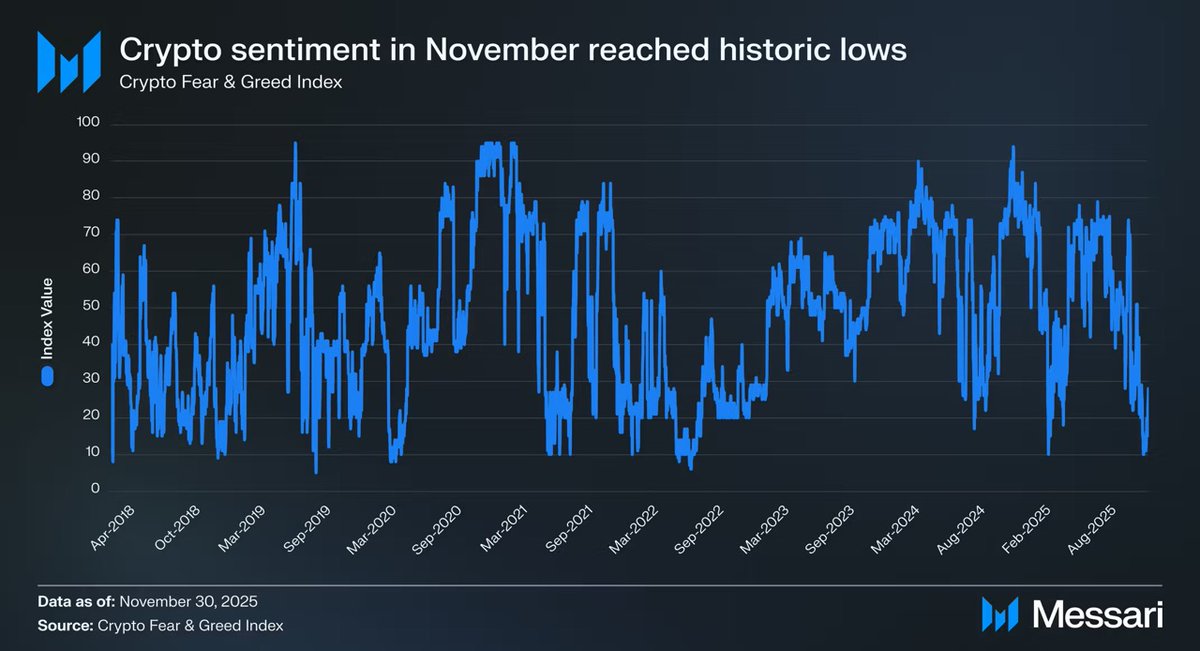
In November 2025, the Crypto Fear & Greed Index fell to 10, entering the "extreme fear" zone.
Historically, there have been very few moments when sentiment has dropped to this level:
In March 2020, a liquidity crunch triggered by the global pandemic
In May 2021, a series of leveraged liquidations
In May-June 2022, the systemic collapse of Luna and 3AC
In 2018-2019, an industry-wide bear market
These periods all share a commonality: the industry itself was failing, and the future was highly uncertain.
But 2025 does not fit this characteristic.
There were no major exchanges misappropriating user assets, no Ponzi projects worth hundreds of billions of dollars dominating the narrative, the total market cap did not fall below the previous cycle's peak, and the scale of stablecoins actually reached a historical high, with regulatory and institutional processes continuing to advance.
On the "factual level," this is not a year in which the industry is collapsing.
However, on the "emotional level," it may be the most painful year for many practitioners, investors, and long-time users.
Why did sentiment collapse?
Messari provides a striking comparison at the beginning of the report:
If you were involved in crypto asset allocation from a Wall Street office, 2025 might be the best year since you entered the industry. But if you were staying up late in Telegram or Discord, watching the market and searching for Alpha, this is probably the year you miss the "old times" the most.
The same market, two almost completely opposite experiences.
This is not a random emotional fluctuation, nor a simple bull-bear switch,
but a deeper structural misalignment:
The market is changing participants, but most people are still participating in the new system with old identities.
This is not a retrospective of market trends
This article does not intend to discuss short-term price movements, nor does it attempt to answer the question of "will it rise next?"
It is more like a structural explanation:
Why, while the system, capital, and infrastructure are continuously strengthening,
does market sentiment slide to historical lows?
Why do many people feel they have "chosen the wrong track," yet the system itself has not failed?
In this 100,000-word report, Messari chooses to start from a very fundamental question:
If crypto assets are ultimately a form of "money," then who deserves to be treated as money?
Understanding this is the prerequisite for grasping the complete collapse of market sentiment in 2025.
Chapter 1 | Why is sentiment unusually low?
If we only look at the results, the sentiment collapse in 2025 is almost "incomprehensible."
In the absence of exchange failures, systemic credit collapses, or core narrative bankruptcies, the market has provided sentiment feedback close to historical lows.
Messari's judgment is very direct: this is an extreme case of "sentiment being severely decoupled from reality."
1. Sentiment indicators have entered a "historical anomaly zone"
The Crypto Fear & Greed Index falling to 10 is not an ordinary pullback signal.
In the past decade, this value has only appeared in a few rare moments, and each occurrence was accompanied by real and profound industry-level crises:
Breakdown of the funding system
Collapse of the credit chain
Market skepticism about "whether the future exists"
But these problems did not occur in 2025.
There were no failures of core infrastructure, no mainstream assets liquidated to zero, and no systemic events sufficient to shake the legitimacy of the industry.
From a statistical perspective, this sentiment reading does not match any known historical template.
2. The market has not failed; what has failed is the "personal experience"
The collapse of sentiment does not stem from the market itself, but from the subjective experiences of participants.
Messari repeatedly emphasizes a neglected fact in the report:
2025 is a year where institutional experiences far exceed those of retail investors.
For institutions, this is an extremely clear, even comfortable environment:
ETFs provide low-friction, low-risk allocation channels
Digital Asset Trusts (DAT) have become stable, predictable long-term buyers
Regulatory frameworks are beginning to clarify, and compliance boundaries are gradually becoming visible
But for many participants under the old structure, this year has been exceptionally harsh:
Alpha has significantly decreased
Narrative rotation has failed
Most assets have long-term underperformed BTC
The relationship between "effort" and "results" has been completely broken
The market has not rejected people; it has simply changed the reward mechanism.
3. "Not making money" is misread as "the industry is failing"
The true trigger point for sentiment is not the price drop, but the cognitive dissonance.
In previous cycles, the implicit assumption in crypto was:
As long as you are diligent enough, early enough, and aggressive enough, you can achieve excess returns.
But 2025 systematically broke this assumption for the first time.
Most assets no longer gain a premium for "telling a story"
L1 ecosystem growth no longer automatically translates into token returns
High volatility no longer means high returns
The result is that many participants begin to develop an illusion:
If I haven't made money, then there must be a problem with the entire industry.
And Messari's conclusion is precisely the opposite:
The industry is becoming more like a mature financial system, rather than a machine that continuously generates speculative dividends.
4. The essence of sentiment collapse is identity misalignment
Taking all phenomena into account, Messari provides only one implicit answer:
The collapse of sentiment in 2025 is essentially an identity misalignment.
The market is leaning towards "asset allocators," "long-term holders," and "institutional participants"
But many participants still exist with the identity of "short-term Alpha seekers"
When the system's reward logic changes, but the participation method does not adjust in sync, sentiment is bound to collapse first.
This is not a personal capability issue, but the friction cost of switching roles in the era.
Summary | Sentiment does not tell you the truth
The market sentiment in 2025 truly reflects the pain of participants, but does not accurately reflect the state of the system.
Sentiment collapse ≠ industry failure
Increased pain ≠ value disappearance
It only hints at one thing:
Old participation methods are rapidly becoming ineffective.
And understanding this is the prerequisite for entering the next chapter.
Chapter 2 | The true root of sentiment collapse: the monetary system is failing
If we only stay at the level of market structure, the sentiment collapse in 2025 is still not fully explained.
The real issue is not:
Alpha has decreased
BTC is too strong
Institutions have entered
These are just surface phenomena.
Messari provides a deeper judgment in the report:
The collapse of market sentiment fundamentally stems from a long-ignored fact — the monetary system we are in is continuously pressuring savers.
A chart that must be acknowledged: global government debt is out of control

This chart is not a macro background decoration, but the logical starting point for the entire Cryptomoney argument.
Over the past 50 years, the ratio of government debt to GDP in major global economies has shown a highly consistent and almost irreversible upward trend:
🇺🇸 United States: 120.8%
🇯🇵 Japan: 236.7%
🇫🇷 France: 113.1%
🇬🇧 United Kingdom: 101.3%
🇨🇳 China: 88.3%
🇮🇳 India: 81.3%
🇩🇪 Germany: 63.9%
This is not the result of governance failure in any one country, but a common outcome across systems, political structures, and stages of development.
Whether in democratic countries, authoritarian states, developed economies, or emerging markets, government debt has long outpaced economic growth.
What this chart truly indicates is not "high debt," but "savings being systematically sacrificed"
When government debt grows faster than economic output, the system can only maintain stability through three means:
Inflation
Long-term low real interest rates
Financial repression (capital controls, withdrawal restrictions, regulatory intervention)
Regardless of which path is taken, the ultimate cost will be borne by the same group of people:
Savers.
Messari uses a very restrained but weighty statement in the report:
When debt grows faster than economic output, the costs fall most heavily on savers.
Translated, this means:
When debt outpaces growth, savers are destined to be the sacrificed party.
Why did sentiment collapse in 2025?
Because 2025 is the year when an increasing number of participants first clearly realized this fact.
Before this:
"Inflation is just temporary"
"Cash is always safe"
"Fiat currency is stable in the long run"
But reality is continuously denying these assumptions.
When people discover:
Working hard ≠ wealth preservation
The act of saving itself is continuously shrinking
The difficulty of asset allocation has significantly increased
The collapse of sentiment does not come from Crypto, but from the erosion of confidence in the entire financial system.
Crypto is simply the place where this shock is first perceived.
The significance of Cryptomoney is not "higher returns"
This is also a point that Messari repeatedly emphasizes but is easily misinterpreted.
Cryptomoney does not exist to promise higher returns.
Its core value lies in:
Predictable rules
Monetary policy not subject to arbitrary changes by a single institution
Assets can be self-custodied
Value can be transferred across borders without permission
In other words, what it provides is not a "money-making tool," but:
In a high-debt, low-certainty world, it re-empowers individuals with monetary choice.
The collapse of sentiment is actually a form of "awakening"
When you place this debt chart alongside the market sentiment of 2025, you will find an counterintuitive conclusion:
The extreme pessimism in sentiment does not mean the industry is failing; rather, it signifies that more and more people are beginning to realize that the problems of the old system are real.
The issue with crypto has never been that it is "useless."
The real problem is: it no longer generates easy excess returns for everyone.
Summary | From Sentiment to Structure, and Then to Money Itself
This chapter addresses a fundamental question:
Why, in the absence of a systemic collapse, does market sentiment fall to historical lows?
The answer lies not in the candlestick charts, but in the structure of money.
The collapse of sentiment is a surface phenomenon.
The breakdown of paradigms is a process.
The imbalance in the monetary system is the root cause.
This is precisely why Messari chose to start the entire report from "money" rather than from "applications."
Chapter 3 | Why Only BTC is Treated as "Real Money"
If you've read this far, a question naturally arises:
If the problem lies in the monetary system, then why is the answer BTC and not something else?
Messari's judgment in the report is exceptionally clear:
BTC is no longer in the same competitive dimension as other crypto assets.
1. Money is not a technical issue, but a consensus issue
This is the first key to understanding BTC.
Messari repeatedly emphasizes a fact that is easily overlooked by engineers:
Money is a social consensus, not a technical optimization problem.
In other words:
Money is not about "who is faster"
Not about "who is cheaper"
And not about "who has more functions"
But about who is long-term and stably treated as a store of value.
From this perspective, Bitcoin's victory is not mysterious.
2. Three years of data have already written the answer on the face of it
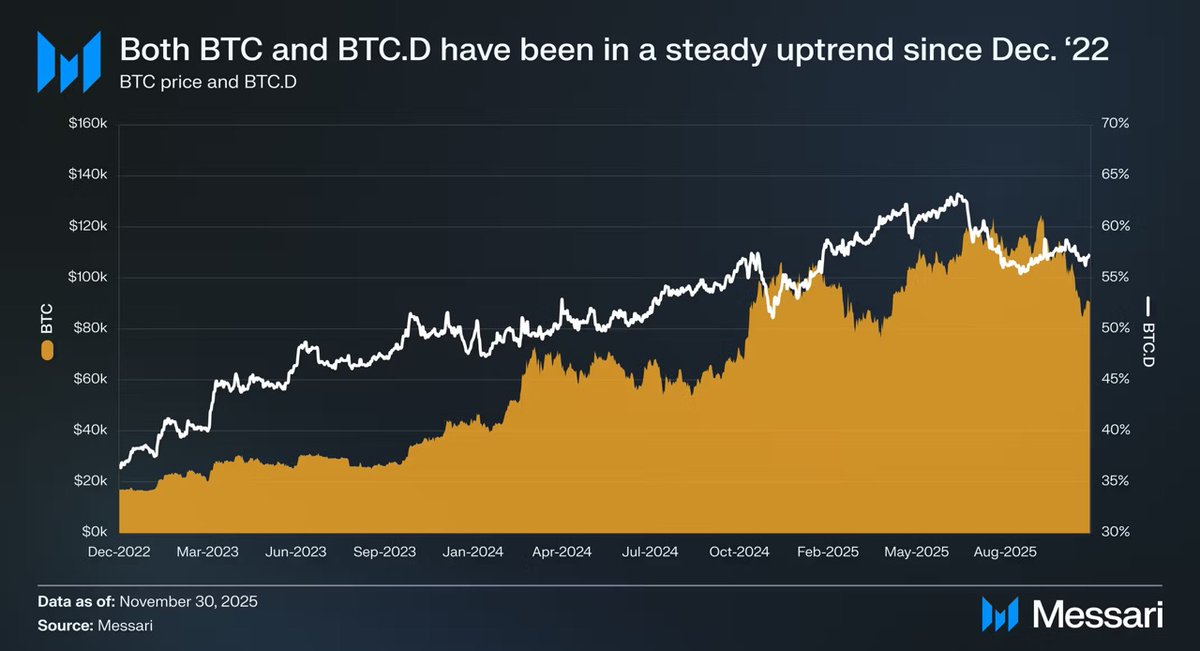
From December 1, 2022, to November 2025:
BTC increased by 429%
Market cap rose from $318 billion to $1.81 trillion
It entered the top ten in global asset rankings
More importantly, the relative performance:
BTC.D rose from 36.6% to 57.3%
In a cycle where "theoretically altcoins should soar," funds have continuously flowed back to BTC.
This is not a random result of a market cycle; it is the market reclassifying assets.
3. ETFs and DATs are essentially "institutionalizing consensus"
Messari's evaluation of ETFs is very restrained, but the conclusion is significant.
A Bitcoin ETF is not simply "new buying pressure"; it fundamentally changes:
Who is buying + Why they are buying + How long they can hold
ETFs turn BTC into a compliant asset.
DATs make BTC part of corporate balance sheets.
National reserves elevate BTC to the level of a "strategic asset."
When BTC is held by these roles, it is no longer:
"A high-volatility risk asset that can be discarded at any time"
But rather:
A monetary asset that must be held long-term and cannot be easily mismanaged.
Once money is treated this way, it is hard to revert.
4. Why BTC becomes more "boring," the more it resembles money
This may be the most counterintuitive point of 2025.
BTC has no applications.
No narrative rotation.
No ecosystem stories.
Not even "new things."
But precisely because of this, it meets all the characteristics of "money":
It does not rely on future promises.
It does not need a growth narrative.
It does not require continuous delivery from a team.
It only needs to avoid mistakes.
And in a high-debt, low-certainty world, "not making mistakes" itself is a scarce asset.
5. BTC's strength is not the market's failure
Many people's pain comes from an illusion:
"BTC's strength indicates something is wrong with the market."
Messari's judgment is exactly the opposite:
BTC's strength is a sign that the market is becoming more rational.
When the system begins to reward:
Stability
Predictability
Long-term credibility
All strategies relying on "high volatility for high returns" will become increasingly painful.
This is not a problem with BTC; it is a problem with the way of participation.
Summary | BTC Did Not Win; It Was Chosen
BTC did not "defeat" other assets.
It was simply validated by the market in an era where the monetary system is continuously failing as:
The asset that needs the least explanation
The asset that relies the least on trust
The asset that requires no future promises
This is not the result of a market cycle,
But a confirmation of roles.
Chapter 4 | When the Market Only Needs One "Money," L1 Stories Begin to Fail
After confirming that BTC has been chosen by the market as the "main Cryptomoney," one unavoidable question arises:
If money already has an answer, then what is left for Layer 1?
Messari does not provide a direct conclusion, but after reading this part, a trend becomes very clear:
L1 valuations are being forced to shift from "future narratives" back to "real constraints."
1. A cruel but real fact: 81% of market cap is in the "money" narrative
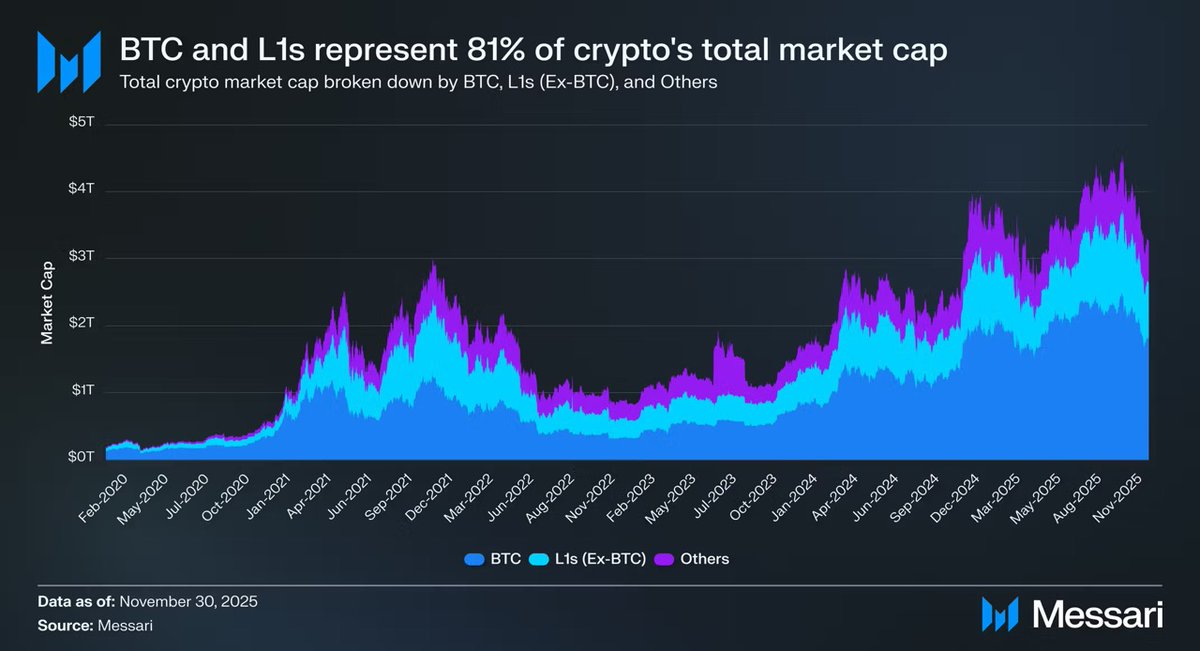
As of the end of 2025, the total market cap of the crypto market is approximately $3.26 trillion:
BTC: $1.80 trillion
Other L1s: approximately $0.83 trillion
Other assets: less than $0.63 trillion
In total:
About 81% of the market cap of crypto assets is priced by the market as "money" or "potential money."
What does this mean?
It means that the valuation of L1 is no longer based on the "application platform" pricing logic,
But rather on the "does it qualify to be money" pricing logic.
2. The problem is: most L1s do not qualify
Messari provides data that is very direct and very cold.
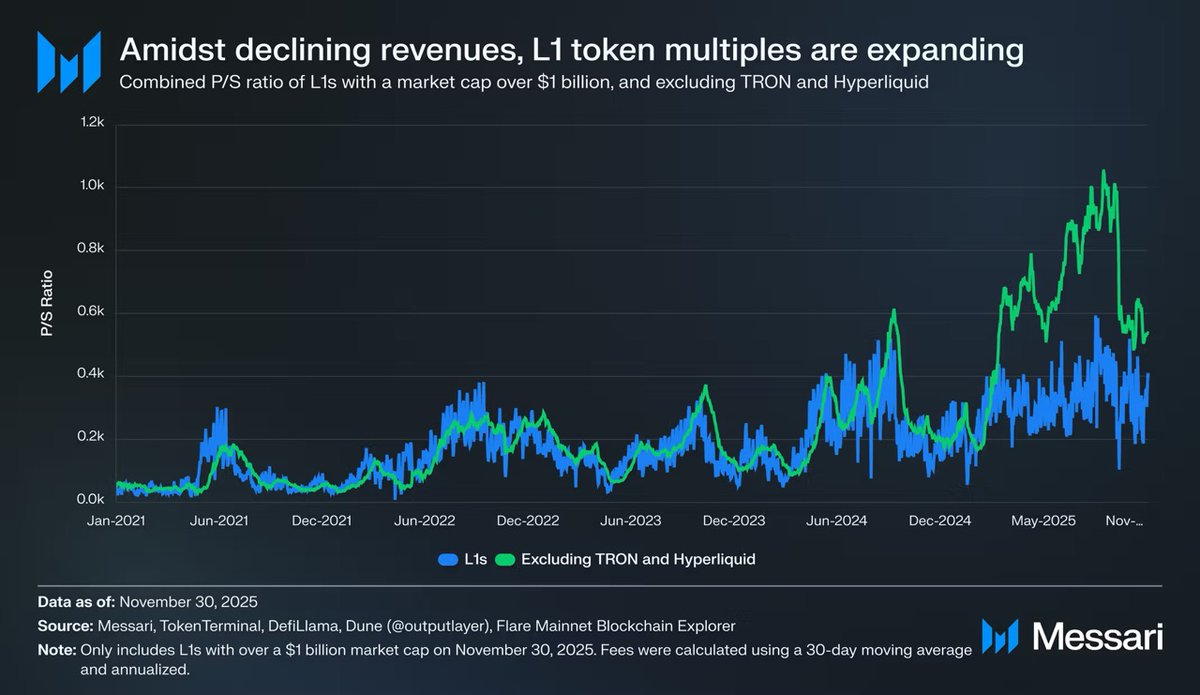
After excluding outliers like TRON and Hyperliquid with abnormally high revenues:
The overall revenue of L1 continues to decline
But the valuation multiples are continuously rising.
The adjusted P/S ratios are as follows:
2021: 40x
2022: 212x
2023: 137x
2024: 205x
2025: 536x
Meanwhile, total L1 revenue during the same period:
2021: $12.3 billion
2022: $4.9 billion
2023: $2.7 billion
2024: $3.6 billion
2025 (annualized): $1.7 billion
This is a gap that cannot be reasonably explained by "future growth."
3. L1 is not "undervalued," but "reclassified"
Many people's pain stems from a misunderstanding:
"Is L1 being unfairly punished by the market?"
Messari's judgment is exactly the opposite:
The market has not unfairly punished L1; it is reducing their "monetary imagination space."
If an asset:
Cannot store value stably
Cannot be held long-term
And cannot provide certain cash flows
Then it ultimately has only one pricing method left:
High beta risk asset.
4. The example of Solana actually explains everything
SOL is one of the few L1s that outperformed BTC in 2025.
But Messari points out a devastating fact:
SOL's ecosystem data grew 20-30 times
Its price only outperformed BTC by 87%
In other words:
To achieve "significant excess returns" in front of BTC, L1 needs an order-of-magnitude level of ecosystem explosion.
This is not a matter of "not trying hard enough," but rather that the return function has been rewritten.
5. When BTC Becomes "Money," the Burden on L1 Becomes Heavier
This is a structural change that many people do not realize.
Before BTC had a clear monetary status:
L1 could tell the story of "becoming money in the future."
The market was willing to pay in advance for this possibility.
But now:
BTC has solidified its position.
The market is no longer willing to pay the same premium for "the second money."
Thus, L1 faces a more difficult question:
If you are not money, then what exactly are you?
Summary | The Problem with L1 is Not Competition, but Positioning
L1 did not "lose to BTC."
What they lost is:
In the dimension of money,
The market no longer needs more answers.
And once the "money narrative" is lost, all valuations must reaccept the constraints of reality.
This is the direct source of the emotional collapse of many participants in 2025.
免责声明:本文章仅代表作者个人观点,不代表本平台的立场和观点。本文章仅供信息分享,不构成对任何人的任何投资建议。用户与作者之间的任何争议,与本平台无关。如网页中刊载的文章或图片涉及侵权,请提供相关的权利证明和身份证明发送邮件到support@aicoin.com,本平台相关工作人员将会进行核查。


