MiniMax is expected to set a record, becoming the AI company with the shortest time from establishment to IPO.
Source: Machine Heart
Unexpectedly, the pace of IPOs for large model startups has become so rapid.
On Sunday evening, it was reported that the well-known domestic AI startup MiniMax (Xiyu Technology) published its post-hearing information package (PHIP) version of the prospectus on the Hong Kong Stock Exchange, marking a critical sprint phase in its listing process.

Founded in December 2021 and headquartered in Shanghai, MiniMax was established by former SenseTime executive Yan Junjie and others, focusing on the research and development of general artificial intelligence technology (AGI) that integrates text, speech, and visual multimodal fusion. The company is well-known for its foundational large models MiniMax M1 and M2, as well as AI-native products like MiniMax Voice, Hailuo AI, and Xingye.
The company is poised to break records, becoming the AI company with the shortest time from establishment to IPO.
As a global leader in multimodal large models, MiniMax has systematically disclosed its business layout, user scale, financial data, and future strategy for the first time in its prospectus, showcasing its strong momentum and unique positioning in the global AI arena.
Over 200 Million Users, Over 70% of Revenue from Overseas
MiniMax is a dual-driven company centered on "large models + AI native applications." The company states that its open platform has become "one of the largest enterprise-level and developer open platforms in the world," supporting rapid deployment across various industries such as smart terminals, healthcare, cultural tourism, and finance.
The prospectus shows that as of September 30, 2025, MiniMax has over 212 million individual users from more than 200 countries and regions, as well as over 100,000 enterprises and developers from more than 100 countries. Among them, the average monthly active users of AI native products grew rapidly from 3.144 million in 2023 to 27.622 million in the first nine months of 2025, demonstrating strong user stickiness and growth momentum.
This vast user base is distributed across the globe: MiniMax disclosed in its prospectus that its overseas market revenue contribution exceeds 70%, indicating significant achievements in international expansion and cross-market commercialization.
Financial data shows that MiniMax achieved revenue of $53.437 million in the first nine months of 2025, a year-on-year increase of approximately 174.7%, reflecting a high-speed growth trend. Revenue primarily comes from two major segments: subscriptions and in-app purchases of AI native products, as well as open platform and enterprise services.
MiniMax adopts the "model as a product" concept, and its efficient operations have led to a healthy financial cycle: its accounts receivable turnover days are only 38 days, far below the average level of 60-90 days in the AI or SaaS industry, demonstrating excellent cash flow capability and business operational efficiency.
In the To C aspect, MiniMax directly serves global consumers through native products like Hailuo AI, Xingye/Talkie (AI social), and MiniMax Voice. As of September 30, To C revenue grew by 181% year-on-year, and the number of paying users skyrocketed 15 times in less than two years.
In the To B aspect, MiniMax empowers multiple industries through its open platform, providing leading model capabilities to enterprises and developers via API. Its open platform processes over a trillion token requests daily, with To B revenue achieving a high growth of 160% during the same period, and a gross margin of 69.4%, showcasing strong profitability.
MiniMax has also established a collaborative ecosystem with leading technology companies both domestically and internationally. Overseas, its models are launched on the global AI platforms of the three major cloud providers: Amazon, Google, and Microsoft; providing video and voice technology for LinkedIn, Monks (a digital creative company), etc. Domestically, MiniMax's technology serves the core products of giants like Alibaba, Tencent, ByteDance, Xiaomi, and Kingsoft Office, and provides humanoid interaction capabilities for humanoid robots like Zhiyuan Robot. This extensive and deep industrial integration proves the practicality and reliability of its technology.
The prospectus indicates that MiniMax's adjusted net loss is nearly flat compared to the same period last year in 2025, effectively narrowing losses amid rapid growth. This is attributed to a diversified revenue model and efficient expense input—by September 2025, the company's R&D expenditure increased by 30% year-on-year, while sales and marketing expenses decreased by 26%.
Full Modal AI Technology Layout
MiniMax's success is built on a clear and efficient path: its forward-looking "full modal" technology matrix establishes a solid underlying competitive advantage.
MiniMax is one of the few large model companies that have focused on full modal model research and development since its inception. Since its establishment, MiniMax has undergone intensive technology iterations, achieving breakthrough progress in models for speech, video, and text, frequently attracting attention in the tech industry.
Starting in 2023, MiniMax launched the first domestic speech large model based on the Transformer architecture, Speech 01, and in 2024, it released the upgraded version Speech 02, ranking first in comprehensive performance. As of now, MiniMax's speech model has helped users generate over 220 million hours of speech.
In August 2024, MiniMax released the video generation model Video 01 and the video generation product Hailuo AI. In June 2025, it launched the upgraded version Hailuo 02, ranking second in the AA video arena. To date, MiniMax's video model has helped creators generate over 590 million videos.
In October 2025, MiniMax released and open-sourced the next-generation text large model MiniMax M2, ranking among the top five globally in Artificial Analysis and first in open source, marking the first time a Chinese open-source large model has entered the global top five.
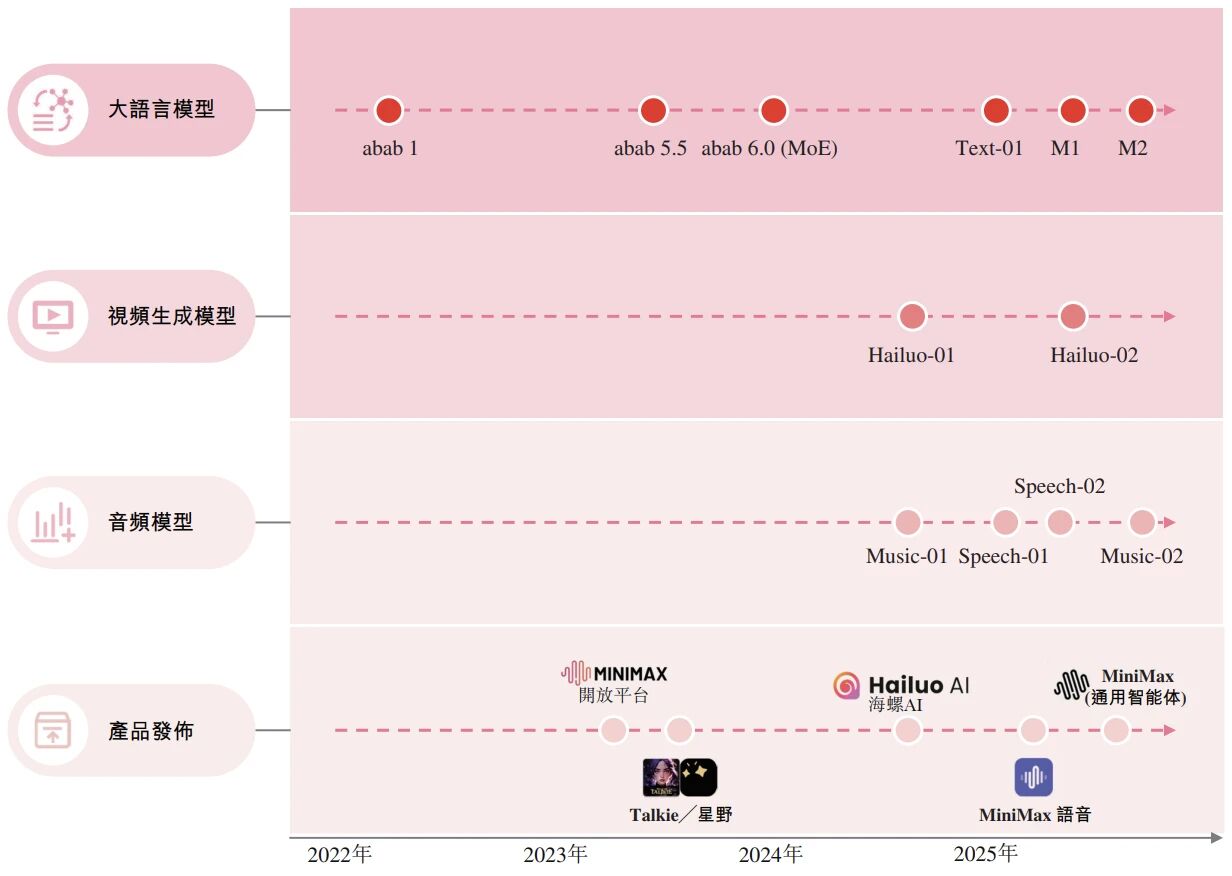
It is evident that its R&D is not a single-point breakthrough but a systematic advancement across four key modalities: text, video, speech, and music, forming a complete and mutually coordinated technology matrix.
Among them, the newly released and open-sourced next-generation text large model MiniMax-M2 on October 27 this year is particularly noteworthy.
This large model has an inference speed nearly twice that of Claude Sonnet 4.5, with performance comparable but priced at only 8% of its cost. At the AWS re:Invent 2025 event in December, Amazon announced that its fully managed generative AI cloud service Amazon Bedrock has incorporated MiniMax-M2 as a representative of domestic models.
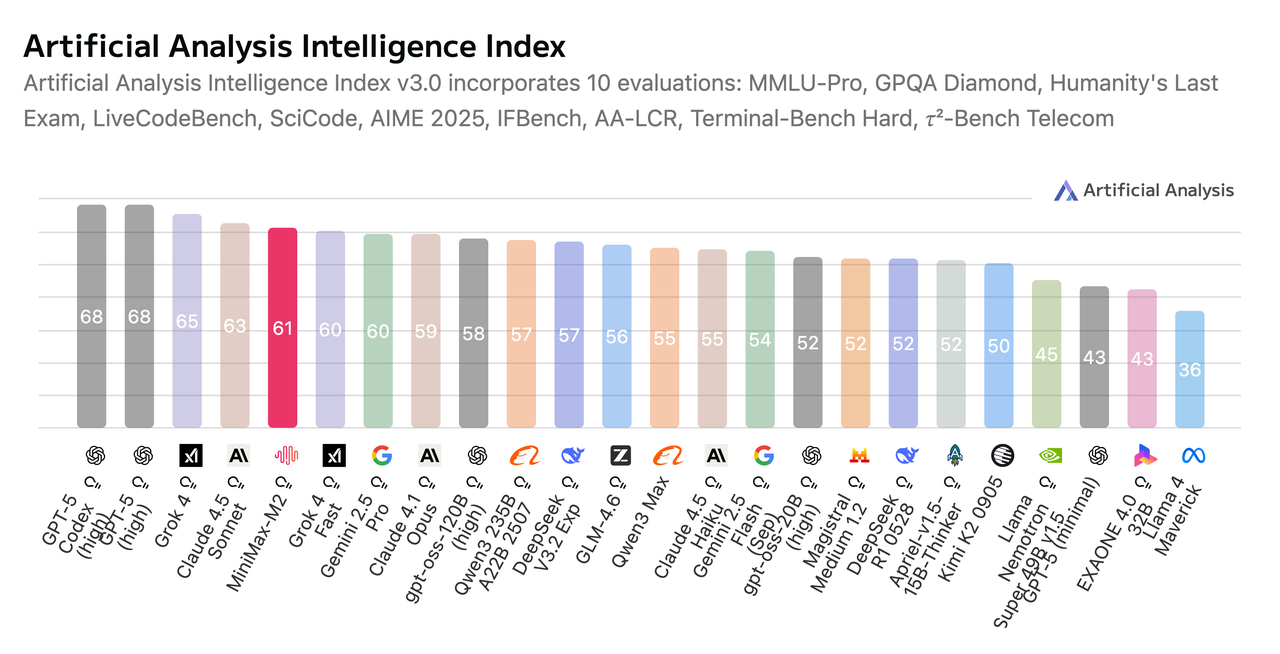
MiniMax-M2 not only excels at planning and executing long-chain tool invocation tasks stably but also coordinates calls to Shell, browsers, Python code interpreters, and various MCP tools.
The key technology used in MiniMax M2, "Interleaved Thinking," has been widely discussed in the overseas AI research community. This technology allows the model to continuously accumulate contextual understanding in a "think-act-reflect" closed loop and adjust strategies in real-time based on feedback. This work style, closer to that of real engineers, significantly enhances MiniMax M2's agent execution capabilities, making it more capable of planning in complex tasks, executing robustly, and self-correcting reliably, thus forming its most recognizable core advantage.
During the release of the M2 model, it quickly climbed to the top position in domestic model token usage on the global model aggregation platform OpenRouter, ranking third in programming scenarios for global token usage.
Significant R&D Investment, Pursuit of Ultimate Efficiency
Like most AI large model companies, MiniMax is currently in a phase of sustained high R&D investment, rapidly iterating large models, and has not yet achieved profitability.
In the first nine months of 2025, the company's net loss reached $186 million (adjusted net loss, Non-IFRS measurement), with adjusted net loss only slightly increasing by 8.6% despite revenue experiencing explosive growth of over 170%. The losses primarily stem from R&D expenditures, changes in the fair value of financial liabilities, and listing-related expenses.
Among them, R&D expenditures in the first nine months of 2025 reached $180 million, equivalent to 337.4% of total revenue; the R&D expense ratio has decreased from over 2000% in 2023 to 337.4%. This change reflects both the operational leverage brought by the rapid expansion of revenue scale and the company's continued investment in key inputs such as model iteration and infrastructure.
It is noteworthy that alongside massive R&D investments, MiniMax demonstrates outstanding organizational and business efficiency.
The company's overall employee size is approximately 385, with about 300 in the R&D team, accounting for nearly 80% of the total workforce. Core members come from top global tech companies like Microsoft, Google, Meta, and Alibaba.
Its R&D and product teams are predominantly young, mainly composed of "post-95s," and have attracted a large number of "post-00s" engineers. This structure aligns well with the current AI R&D paradigm—having a natural understanding of new tools, automated processes, and agent-based, AI-native work methods, significantly amplifying the output per unit of labor.
In terms of R&D model, the company operates with no more than three layers of administrative command under the CEO, project-oriented, and "minimalism" greatly shortens the implementation path, allowing the company to maintain a high cost-effectiveness ratio in a competition that is highly intensive in computing power and capital investment.
From its establishment to September 2025, MiniMax has cumulatively spent $500 million, achieving:
A leap from leading in single modality to leading in full modality.
Three modalities in the international first tier, with breakout products.
Breakthroughs every year, continuously stepping up.
The losses in the first nine months of this year ($186 million) are still less than the single-quarter investment flow expenses of some major internet companies' large models.
This efficiency advantage is also reflected in recent financial trends.
In the first nine months of 2025, the company's R&D expenses grew by only about 30% year-on-year, while revenue growth reached 174.7%, and sales and marketing expenses decreased by 26%, which is uncommon for an AI company still pursuing high-speed growth.
This "scissors gap" indicates that the core driving force behind growth is not simply "burning money for scale"—more comes from improvements in model capabilities, the spread of product reputation, and the release of organizational efficiency, rather than relying on large-scale investment flows and market subsidies.
Led by "Post-95s"
From the information disclosed in the prospectus, the composition of MiniMax's board of directors is highly consistent with its characteristics of being "youthful and highly technology-driven."
The average age of the four executive directors is only 32 years old (all "Post-95s"), which is extremely rare in the history of companies listed on the Hong Kong Stock Exchange.
They are deeply embedded in the company's frontline R&D and business advancement, serving as the relevant direct responsible persons, including:
Company founder & CEO Yan Junjie (36 years old), COO Yun Yeyi (31 years old), head of large language model research and engineering Zhao Pengyu (29 years old), and head of visual model research and engineering Zhou Yucong (32 years old).
Non-executive directors and independent non-executive directors primarily assume roles in governance, supervision, and institutional checks and balances.
This board composition aligns well with a young AI company that is still in a phase of rapid technological evolution, led by its founders and engineering system, and is consistent with its overall strategy emphasizing long-term technological investment and high organizational efficiency.
MiniMax states in its prospectus that the funds raised from this IPO will primarily be used for the following purposes:
Approximately 70% for R&D over the next five years, including large model upgrades and AI native product development;
Approximately 30% for working capital and general corporate purposes.
The company expresses its commitment to advancing the vision of "continuous improvement in intelligence accessible to everyone," enhancing social productivity and individual quality of life through technological inclusivity.
The Story of AGI Should Be Young
MiniMax's sprint to the Hong Kong Stock Exchange signifies more than just the capitalization of another AI unicorn. It is telling a younger story about AGI.
In this young team, a group of individuals is creating entirely new types of ventures with AI-native thinking, making their story bold enough—firmly betting on multimodality and globalization. This reckless sprint is destined to be fraught with challenges and opportunities, but perhaps it is also the right way to AGI.
As reflected in MiniMax's prospectus performance, with the continuous development of technology and business, this company will continue to break through and fulfill its long-term vision: Intelligence with Everyone.
免责声明:本文章仅代表作者个人观点,不代表本平台的立场和观点。本文章仅供信息分享,不构成对任何人的任何投资建议。用户与作者之间的任何争议,与本平台无关。如网页中刊载的文章或图片涉及侵权,请提供相关的权利证明和身份证明发送邮件到support@aicoin.com,本平台相关工作人员将会进行核查。


