Author: Arkham
Compiled by: Felix, PANews
Many market observers have described the multi-year "cycles" of Bitcoin prices, which align with Bitcoin's halving events. These patterns, collectively referred to as the "four-year cycles," have become significant psychological events that influence the thinking of crypto observers and traders. This article will explore the various stages of the four-year cycle and the situations of past Bitcoin cycles. Additionally, it will examine whether Bitcoin cycles still exist.
Typical Four-Year Cycle
Market observers believe that the standard Bitcoin cycle begins with what is commonly referred to as the "accumulation" phase. They speculate that this phase starts after the crash following the peak of the previous cycle. During this period, price volatility and on-chain activity are relatively low, and market sentiment tends to be neutral or negative. It is called the accumulation phase because long-term Bitcoin holders begin to buy in large quantities. Therefore, the price characteristics of this period are marked by a gradual recovery.
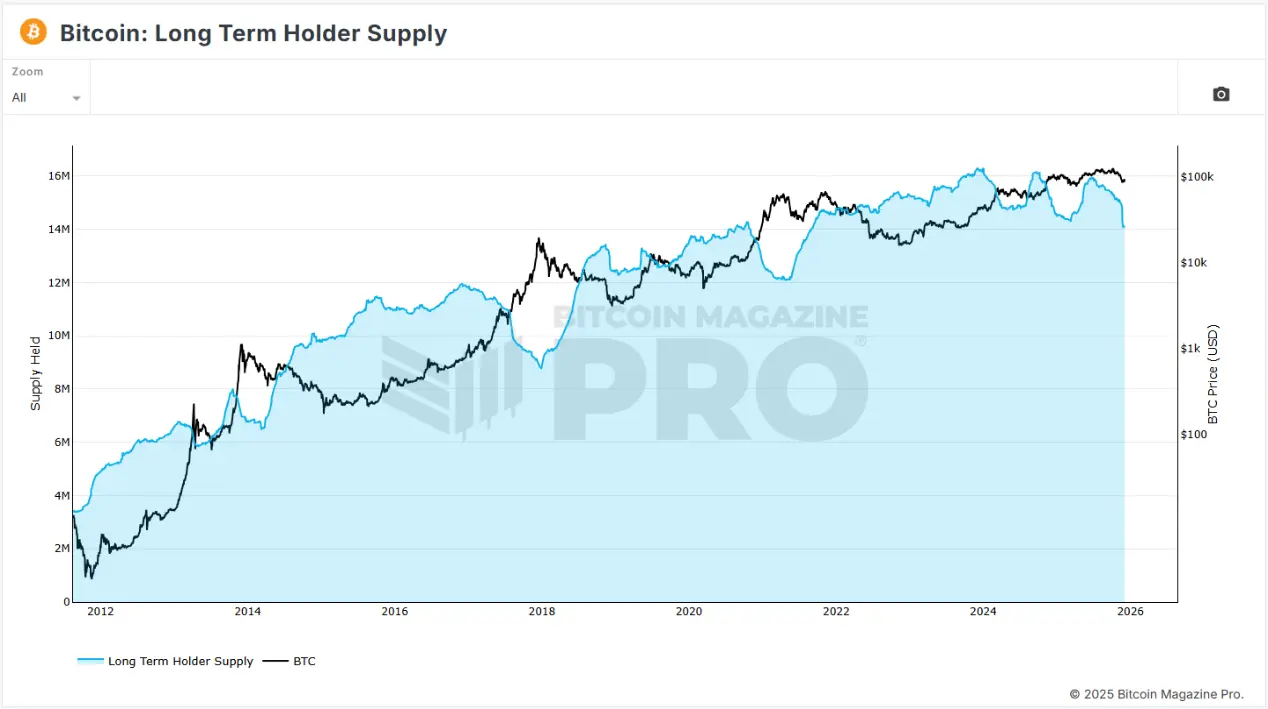
Bitcoin price vs. long-term holder holdings
On-chain analysis shows that some investors are steadily accumulating, but most retail investors remain wary of the previous crash and are uninterested in purchasing Bitcoin.
The accumulation phase typically lasts 12 to 15 months, after which the market cycle usually enters a new bull market. This often occurs before the halving, as the prices of Bitcoin and other crypto assets begin to rise in anticipation of the halving. The market starts to digest the positive news of future supply reduction, and market sentiment shifts from neutral to optimistic. Liquidity begins to recover, and media attention increases accordingly.
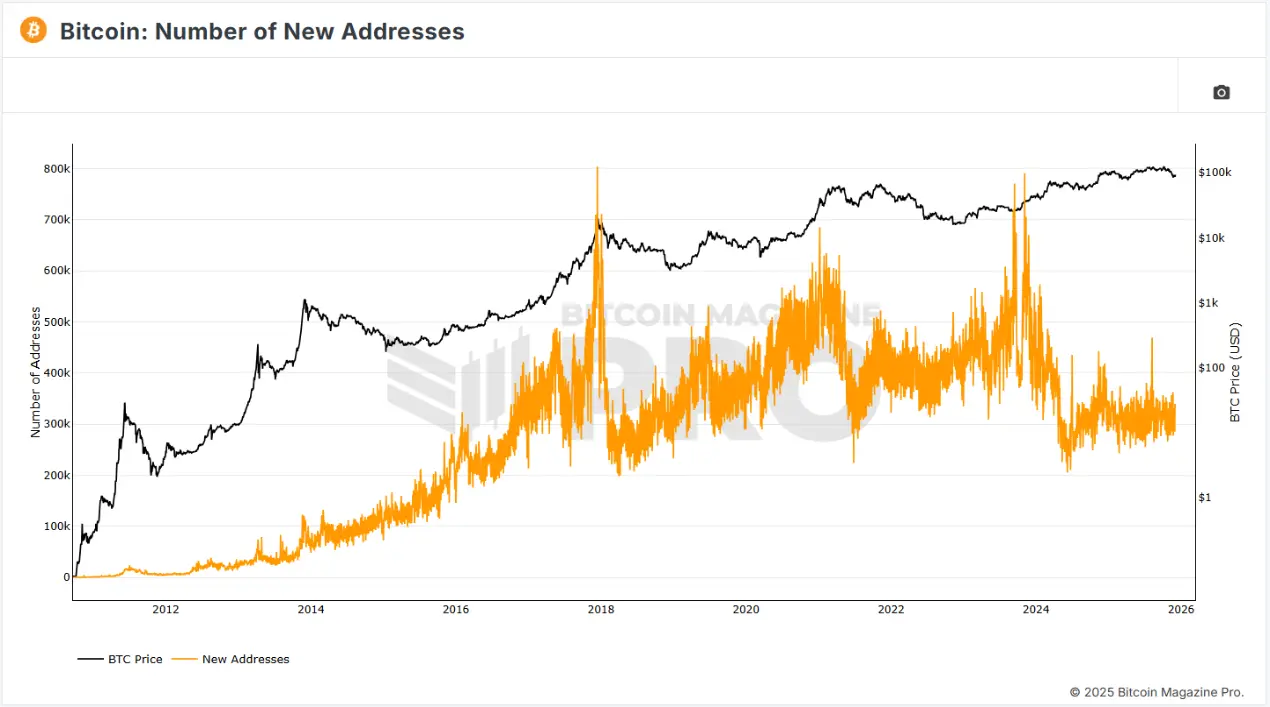
Bitcoin price vs. number of new addresses
Once the halving occurs, the bull market often rises parabolically, with prices starting to climb, sometimes slowly and sometimes explosively. Retail investors flood into the market, and traders begin to invest heavily. Historically, this is when new all-time highs are often set, as a new wave of investors enters the market. Some investors increase leverage to chase the highs, leading to more extreme price volatility.
Previous bull markets lasted about 12-18 months and typically ended with a sharp price decline. Leveraged traders are liquidated, altcoins experience larger declines, sentiment turns negative, and a bear market begins. During this phase of the cycle, many participants sell at a loss and cash out with their remaining funds. Eventually, the dust settles, and the market bottom slowly forms. Overall market activity and excitement significantly decrease from the peak, but steadfast builders continue to move forward, quietly advancing the development of new products and innovations.
Halving
To fully understand the theory of the four-year Bitcoin cycle, one must first thoroughly understand the concept of halving and its impact on Bitcoin prices.
Bitcoin halving is a significant event that reduces the mining reward (paid in BTC) for adding new blocks to the Bitcoin blockchain by half. This occurs every 210,000 blocks, approximately every four years. In 2009, the reward for adding new blocks was 50 Bitcoins per block. It has halved four times since then. The halving in 2024 will set the current mining reward for new blocks at 3.125 Bitcoins. Assuming the four-year rhythm continues, halving will persist until the total supply reaches the cap of 21 million, around the year 2140.
Halving is a way for Satoshi Nakamoto to ensure Bitcoin's scarcity. Bitcoin was born during the 2008 financial crisis, partly to address the inflation caused by central bank bailouts and the issuance of fiat currency. Most governments and their associated fiat currencies continuously adjust monetary policies, making it difficult for holders to establish long-term confidence in the value of their fiat currencies.
The halving mechanism of Bitcoin mimics that of gold, making it scarcer. As gold reserves deplete, the difficulty of mining gold gradually increases, while Bitcoin achieves this through mathematical means. As the new supply of Bitcoin decreases, its scarcity increases. Historically, Bitcoin's price has typically risen with each halving, thanks to supply and demand dynamics. Therefore, some supporters believe that the transparency and consistency of halving make Bitcoin a powerful store of value asset.
Review of Past Cycles
2013
Bitcoin was born in 2008, and 2013 marked its first cycle. It was primarily driven by the tech community of the time, such as internet forums and cryptography meetups. This cycle also gained some early media attention, with coverage around topics like the first real-world transaction using Bitcoin (buying two pizzas for 10,000 Bitcoins) and "Is Bitcoin digital gold?"
During this cycle, Mt. Gox was the largest Bitcoin exchange. In 2014, Mt. Gox handled over 70% of global Bitcoin transactions. However, in 2014, Mt. Gox suspended trading and closed its website, later revealing that 850,000 Bitcoins were missing. Since Mt. Gox was a major source of Bitcoin liquidity, this event led to a significant decline in market trust in Bitcoin, causing prices to drop by 85% and marking the start of a bear market.
2017
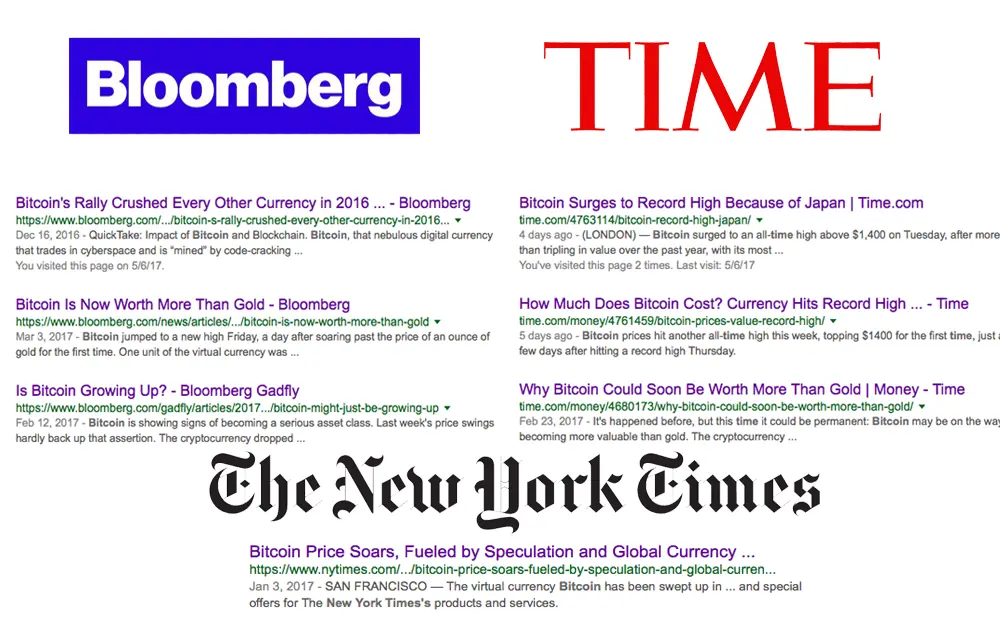
2017 was the cycle in which Bitcoin became popular among retail investors. With the launch of Ethereum in 2015, smart contracts and their revolutionary potential entered the public eye. Ethereum's price skyrocketed from $10 to $1,400 during this cycle. This period was also marked by an ICO frenzy, with thousands of ERC-20 tokens launched, and investors poured money into any token with a white paper. Bitcoin's price also surged due to the influx of new investors, rising from $200 to $20,000 in just two and a half years. The industry was frequently covered by mainstream media (see the image above).
Ultimately, the ICO boom that drove Bitcoin's price up significantly became a catalyst for the crash. In ICOs, investors exchanged their Ethereum or Bitcoin for the cryptocurrencies of new projects. Many project teams, having accumulated large amounts of Ethereum, began to sell these tokens for cash, creating selling pressure. The U.S. SEC also began to crack down on ICOs, labeling them as "unregistered securities offerings" and filing lawsuits against many projects, many of which were Ponzi schemes and scams. In this environment, over-leveraged investors either panic sold or were forced to sell as prices began to plummet, causing Bitcoin's price to crash by 84% to $3,200.
2021
The 2021 Bitcoin cycle coincided with monetary expansion during the COVID-19 pandemic. Governments worldwide sought to restart economies stalled by the pandemic, with fiscal stimulus as their solution. The surge in global liquidity propelled Bitcoin to new heights in 2021. Another characteristic of this cycle was Bitcoin's transformation from an "internet currency" to a more significant "macro asset." Companies like Strategy and Tesla purchased billions of dollars worth of Bitcoin, while payment apps like PayPal and CashApp began supporting Bitcoin transactions. The DeFi boom of 2020 and the NFT boom of 2021 attracted a large number of retail participants in this cycle. Retail and institutional investors together drove up cryptocurrency prices, with Bitcoin peaking at $69,000.
The end of this Bitcoin cycle was marked by the collapse of several well-known protocols and companies in the industry. First, the Luna stablecoin UST depegged, evaporating $60 billion in a short time. Companies and institutions like Voyager, Celsius, BlockFi, and Three Arrows Capital, with direct or indirect exposure to Luna, bets on market direction, and interconnections, ultimately declared bankruptcy. BlockFi subsequently restructured and obtained a credit line from FTX. Eventually, with the collapse of FTX, BlockFi also declared bankruptcy.
FTX and its affiliated trading platform Alameda were found to be involved in large-scale fraud, forced to liquidate assets to repay users. The U.S. federal government also ended its stimulative monetary policy and began to raise interest rates significantly, leading to a withdrawal of market liquidity. All these events contributed to a sharp decline in Bitcoin prices, which fell to $15,500 at the bear market bottom.
2025
The current 2025 cycle has witnessed increased institutional adoption, with major traditional financial institutions entering the space. A spot Bitcoin ETF was approved in January 2024, and companies like BlackRock, Fidelity, and VanEck began offering Bitcoin as a standard investment product. Many companies have also adopted Strategy's Digital Asset Reserve (DAT) model, incorporating cryptocurrencies into their balance sheets. This cycle is unique in that Bitcoin set a new high of $73,000 before the halving in April 2024. Furthermore, institutions have become the primary drivers of price, while retail participation has not yet reached the levels of previous cycles.
Why Do Cycles Occur?
Stock-to-Flow Ratio
There are several potential reasons for the occurrence of Bitcoin's four-year cycles. One common explanation relates to the Stock-to-Flow (S2F) model, which is typically used to measure the scarcity of commodities like gold and silver.
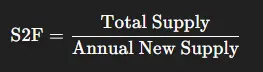
This model compares stock (existing supply) and flow (annual new supply). The higher the ratio, the scarcer the commodity. The S2F model is applied to Bitcoin because its total supply is fixed, and mining rewards are distributed at fixed intervals. Each halving doubles Bitcoin's stock-to-flow ratio, as the new supply is halved. Currently, Bitcoin's stock-to-flow ratio is about 110, while gold's is about 60, making Bitcoin a scarcer asset under the stock-to-flow model.
Psychological Factors
Another simple explanation involves psychology and self-fulfilling prophecies. Bitcoin prices are heavily influenced by narratives, herd behavior, and expectations for the future. Because Bitcoin does not have intrinsic value like traditional financial assets, its value primarily depends on people's expectations of its future worth. Therefore, Bitcoin's price is highly reflexive, being more sensitive to halving expectations, rumors, and narratives. As the four-year Bitcoin cycle has played out multiple times, investors are more inclined to trade Bitcoin based on past cycle trends, creating a self-fulfilling prophecy.
Liquidity
Some believe that Bitcoin's cycles primarily depend on global liquidity. Arthur Hayes, the founder of BitMEX, pointed out in his article "Long Live The King" that Bitcoin's four-year cycle is directly related to global liquidity, emphasizing the influence of the US dollar and the Chinese yuan. Hayes explained that the peak in 2013 was caused by monetary expansion following the 2008 financial crisis, the peak in 2017 was due to the depreciation of the yen against the dollar, and the peak in 2021 was driven by monetary expansion after the COVID-19 pandemic.
Recently, discussions around the end of quantitative tightening (QT, which involves the Federal Reserve reducing the number of assets on its balance sheet to decrease liquidity), the restart of quantitative easing, and interest rate declines have led some to claim that the Bitcoin cycle in 2025 will not follow previous patterns.
Retail vs. Institutions
The holdings of retail and institutional investors also play a significant role in driving Bitcoin cycles. Institutional investors are generally more disciplined, with longer investment horizons, and tend to buy during panic periods, helping to form market bottoms. In contrast, retail investors are more emotional and are more likely to buy due to FOMO. Therefore, retail investors are more likely to chase price momentum and use leverage. Retail investors often create greater volatility during the cycle, especially in the later stages.
Why Do Some Say the Cycle Has Ended?
There are several reasons why people claim that the Bitcoin cycle is outdated. One major reason is the increased institutional participation through ETFs, corporate treasuries, hedge funds, and more. The behavior of these financial entities differs from that of retail investors, as they buy on a fixed schedule, use reasonable leverage, and manage risks cautiously. This behavior suppresses volatility, thereby slowing down cyclical fluctuations.
Another potential reason is that cryptocurrencies have significantly grown compared to earlier cycles. Bitcoin is increasingly linked to macroeconomic factors such as interest rates and Federal Reserve policies, weakening the impact of halving on Bitcoin prices. Halving occurs every four years, while Federal Reserve policies do not follow a similar fixed schedule. Additionally, as the impact of halving on block rewards gradually diminishes, the importance of halving itself is also decreasing. The first halving reduced the reward from 50 BTC to 25 BTC, while the most recent halving only reduced it from 6.25 BTC to 3.125 BTC.
How to Determine if the Cycle Has Ended?
Closely monitoring the developments of the current cycle can help better assess whether the four-year cycle has become a thing of the past. Some key signs that may indicate this include:
- Previous cycles typically saw a price surge after halving, generally within 12-18 months post-halving.
- Previous cycles ultimately ended with large-scale liquidations and chain liquidations, leading to declines of over 70%.
- If Bitcoin's price begins to perfectly align with changes in global liquidity, then Bitcoin becomes a macro asset rather than an asset based on halving cycles.
- Previous cycles experienced a surge in retail participation in the later stages, with altcoins rising parabolically. Insufficient retail participation means the cycle is primarily driven by institutional buying, which may lead to reduced volatility and a flattening of the cycle.
Conclusion
Bitcoin has long followed the pattern of a four-year cycle. Bitcoin slowly recovers from bear markets, enters the halving phase, then experiences a sustained price surge, followed by a rapid decline due to losses from leveraged traders. Historically, various factors have contributed to this phenomenon, ultimately forming the familiar four-year cycle we see today. Nevertheless, Bitcoin continues to develop steadily, ultimately becoming a behemoth with a market capitalization of $1.8 trillion. The emergence of institutional investors, ETFs, and sovereign wealth funds signifies a significant change in market participants compared to the first cycle. Bitcoin appears to be increasingly sensitive to macroeconomic factors, but its price movements are still influenced by some traditional factors, such as psychological factors and mining economics.
It remains unclear whether Bitcoin's cycle has completely ended, but each cycle is unique, and future cycles could very well differ significantly from past ones. Understanding the historical evolution of this asset and its participants is key to grasping future cycles, but ultimately, only time will tell whether this pattern continues to exist or becomes a relic of the past.
Related reading: Has the Bitcoin Four-Year Cycle Failed?
免责声明:本文章仅代表作者个人观点,不代表本平台的立场和观点。本文章仅供信息分享,不构成对任何人的任何投资建议。用户与作者之间的任何争议,与本平台无关。如网页中刊载的文章或图片涉及侵权,请提供相关的权利证明和身份证明发送邮件到support@aicoin.com,本平台相关工作人员将会进行核查。


