The letter states: "This proposal is seriously misleading and will have far-reaching destructive consequences for the interests of global investors and the development of the digital asset industry. We strongly urge MSCI to completely withdraw this plan."
Written by: KarenZ, Foresight News
The game concerning the development of the Digital Asset Treasury (DAT) industry is ongoing.
In October, global index provider MSCI proposed to exclude companies that hold 50% or more of their total assets in digital assets from its global investable market index. This move directly threatens the market position of digital asset treasury companies represented by Strategy and could even rewrite the capital flow of the entire digital asset treasury sector.
According to statistics from Bitcoin for Corporations, 39 companies could be excluded from the MSCI global investable market index. JPMorgan analysts previously warned that the exclusion of just Strategy could lead to nearly $2.8 billion in passive fund outflows, and if other index providers follow suit, it could result in outflows of up to $8.8 billion.
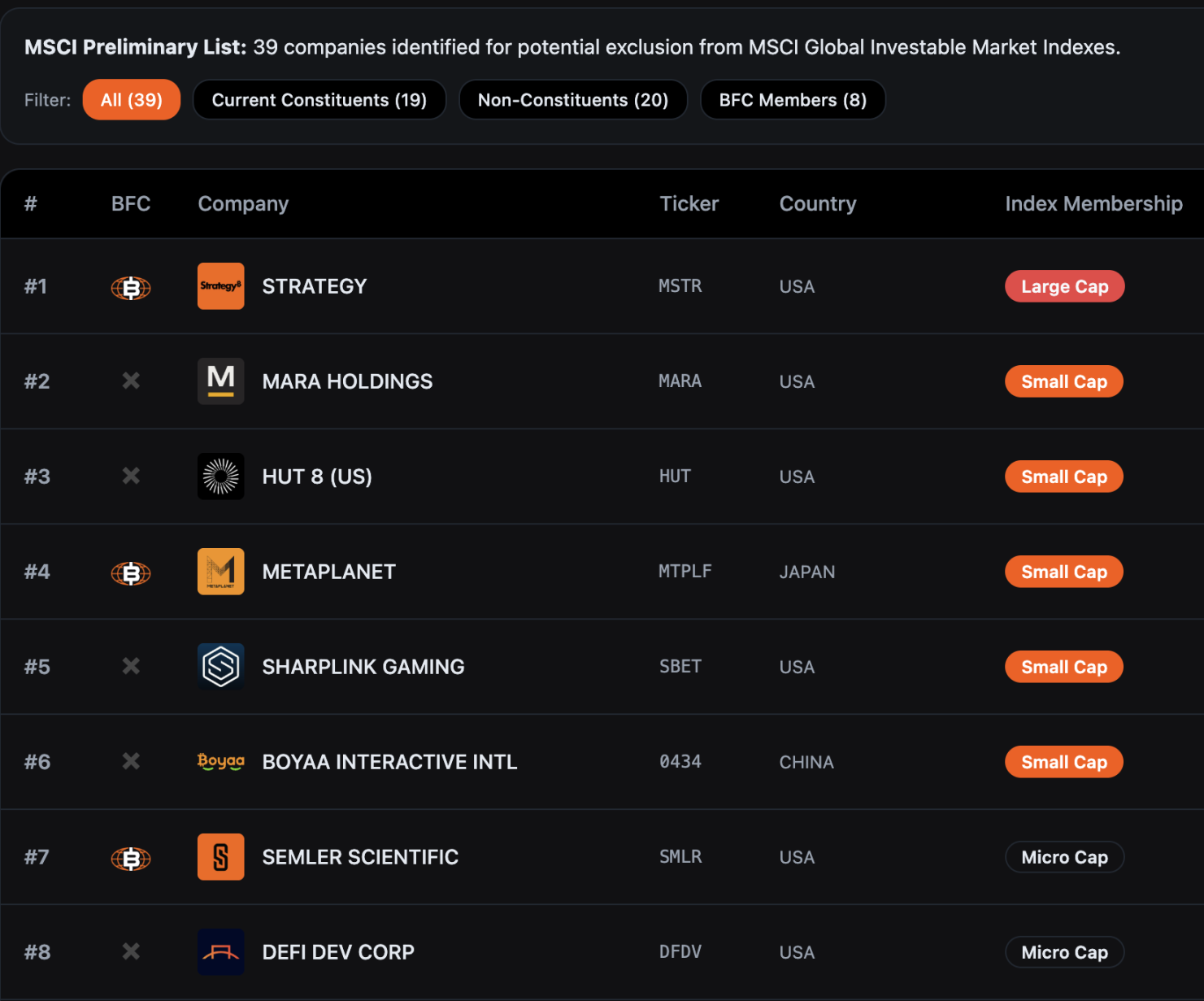
Currently, MSCI's consultation period for this proposal will last until December 31, 2025, with a final conclusion expected to be announced before January 15, 2026. If there are adjustments, they will be formally implemented in the index review process in February 2026.
In the face of this urgent situation, Strategy submitted a strongly worded 12-page open letter to the MSCI Equity Index Committee on December 10, co-signed by the company's Executive Chairman and Founder Michael Saylor and President and CEO Phong Le, clearly expressing their firm opposition to the proposal. The letter states: "This proposal is seriously misleading and will have far-reaching destructive consequences for the interests of global investors and the development of the digital asset industry. We strongly urge MSCI to completely withdraw this plan."
Four Core Arguments of Strategy
Digital Assets are Revolutionary Fundamental Technologies Reshaping the Financial System
Strategy believes that MSCI's proposal underestimates the strategic value of Bitcoin and other digital assets. Since Satoshi Nakamoto introduced Bitcoin 16 years ago, this digital asset has gradually grown into a key component of the global economy, with a current market capitalization of approximately $1.85 trillion.
In Strategy's view, digital assets are not merely financial tools but a fundamental technological innovation capable of reshaping the global financial system — companies investing in Bitcoin-related infrastructure are building a new financial ecosystem, akin to leading companies in history that deeply invested in a single emerging technology.
Just as Standard Oil focused on oil extraction in the 19th century and AT&T dedicated itself to building the telephone network in the 20th century, these companies laid a solid foundation for subsequent economic transformation through forward-looking investments in core infrastructure, ultimately becoming industry benchmarks. Strategy believes that companies focusing on digital assets today are repeating this path of "technological pioneers" and should not be simply dismissed by traditional index rules.
DAT is an Operating Business, Not a Passive Fund
This is the core argument of Strategy's defense — Digital Asset Treasury (DAT) companies are operating businesses with complete business models, not merely passive investment funds holding Bitcoin. Although Strategy currently holds over 600,000 Bitcoins, its core value does not rely on Bitcoin price fluctuations but rather on designing and launching unique "digital credit" tools to create sustainable returns for shareholders.
Specifically, the "digital credit" tools issued by Strategy include various types of preferred stock with fixed dividend rates, floating dividend rates, different priority levels, and credit protection clauses. By raising funds through the sale of these tools and then using them to increase Bitcoin holdings, as long as the long-term investment returns of Bitcoin exceed Strategy's financing costs in USD, it can provide stable returns for shareholders and clients. Strategy emphasizes that this "active operation + asset appreciation" model is fundamentally different from the passive management logic of traditional investment funds or ETFs and should be regarded as a normal operating business.
At the same time, Strategy also questions in the letter: why are oil giants, real estate investment trusts (REITs), timber companies, and others allowed to concentrate on a single asset class without being classified as investment funds and excluded from the index? The special restrictions placed only on digital asset companies clearly violate the principle of fairness in the industry.
The 50% Digital Asset Threshold is Arbitrary, Discriminatory, and Unrealistic
Strategy points out that MSCI's proposal employs discriminatory standards. Many large companies in traditional industries also hold a high concentration of a single asset class in their assets, including oil and gas companies, real estate investment trusts, timber companies, and power infrastructure companies. However, MSCI has set special exclusion standards only for digital asset companies, which constitutes a clear unfair treatment.
From the perspective of feasibility, the proposal also has serious issues. Due to the extreme volatility of digital asset prices, the same company may repeatedly enter and exit the MSCI index within a few days due to changes in asset value, causing market chaos. Additionally, differences in accounting standards (the treatment of digital assets under U.S. GAAP versus international IFRS standards) will lead to differential treatment of companies with the same business model based on their registration locations.
Violating the Principle of Index Neutrality, Injecting Policy Bias
Strategy believes that MSCI's proposal is essentially a value judgment on a certain type of asset, which violates the fundamental principle that index providers should remain neutral. MSCI claims to the market and regulators that its index provides "comprehensive" coverage, aiming to reflect "the evolution of the underlying stock market," and should not make judgments about "the merits or appropriateness of any market, company, strategy, or investment."
By selectively excluding digital asset companies, MSCI is effectively making policy judgments on behalf of the market, which is precisely what index providers should avoid.
Contradicting U.S. Digital Asset Strategy
Strategy emphasizes that this proposal conflicts with the strategic goals of the Trump administration to promote digital asset leadership. The Trump administration signed an executive order in its first week in office to promote the growth of digital financial technology and established a strategic Bitcoin reserve, aiming to make the U.S. a global leader in the digital asset space.
However, if MSCI's proposal is implemented, it will directly prevent U.S. pensions, 401(k) plans, and other long-term funds from investing in digital asset companies, leading to billions of dollars in capital outflows from the industry. This will not only hinder the development of U.S. digital asset innovation companies but may also weaken the U.S.'s competitiveness in this strategic field, going against the government's established policy direction.
Strategy cites analysts' estimates that Strategy alone could face up to $2.8 billion in passive stock liquidation due to MSCI's proposal. This not only harms Strategy itself but will also have a chilling effect on the entire digital asset ecosystem, potentially forcing Bitcoin mining companies to sell assets prematurely to adjust their asset structures, thereby distorting the normal supply and demand relationship in the digital asset market.
Strategy's Final Appeals
In the open letter, Strategy makes two major appeals:
First, it hopes MSCI will completely withdraw the exclusion proposal, allowing the market to test the value of Digital Asset Treasury (DAT) companies through free competition, so that the index can neutrally and faithfully reflect the development trends of the next generation of financial technology;
Second, if MSCI insists on "special treatment" for digital asset companies, it should expand the industry consultation scope, extend the consultation period, and provide more sufficient logical support to explain the rationale of the rules.
Strategy is Not Alone
Strategy is not alone in this fight. According to data from BitcoinTreasuries.NET, as of December 11, 208 publicly listed companies globally hold over 1.07 million Bitcoins, accounting for more than 5% of the total Bitcoin supply, currently valued at approximately $10 billion.
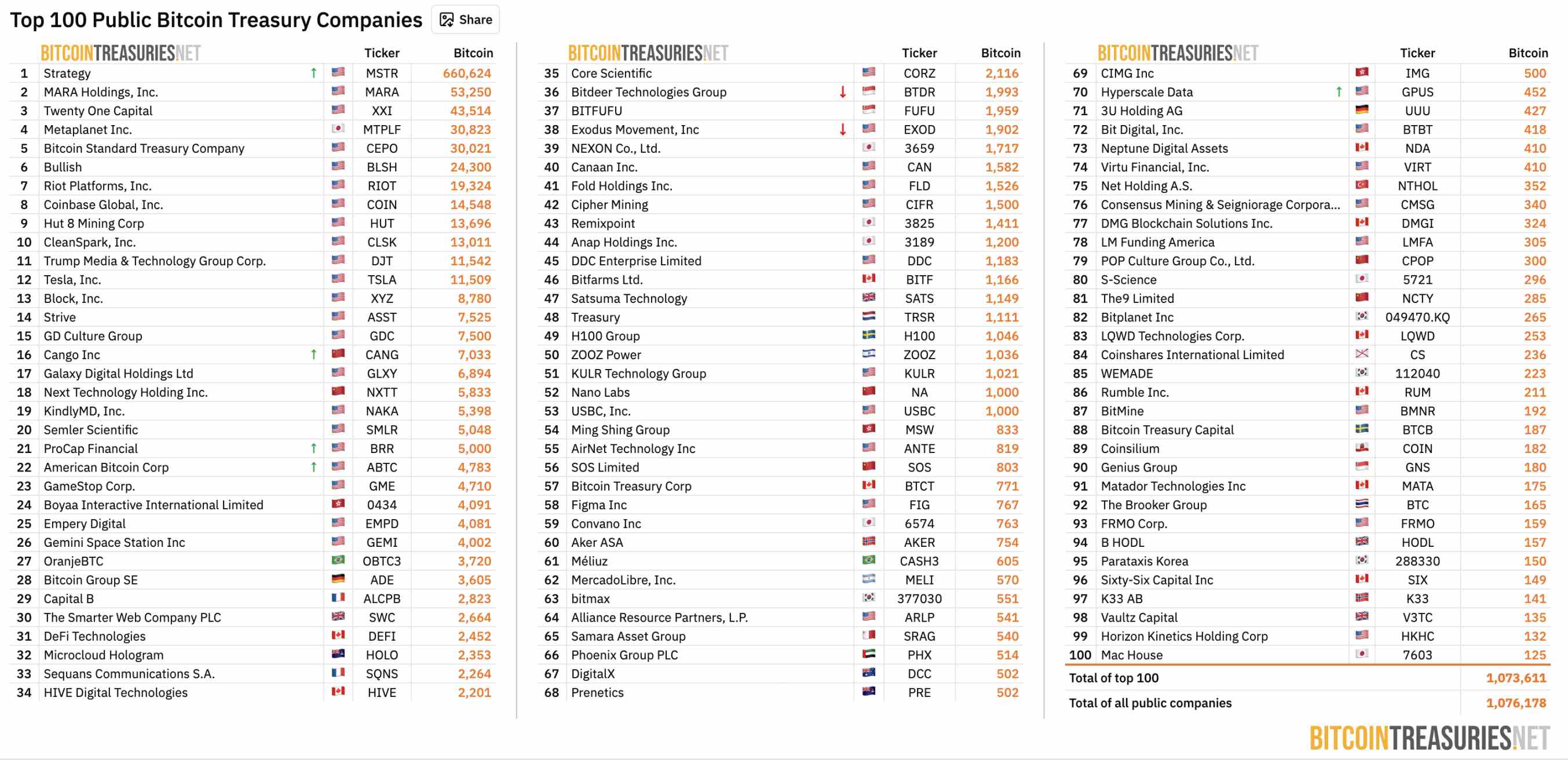
Source: BitcoinTreasuries.NET
These digital asset treasury companies have become an important bridge for institutions adopting cryptocurrencies, providing compliant indirect exposure for traditional financial institutions such as pension funds and endowment funds.
Previously, publicly listed company Strive, which holds Bitcoin, suggested that MSCI should return the "choice" of digital asset companies to the market. A simple and direct solution is to create a version of the existing index that excludes digital asset treasury companies, such as the MSCI USA ex Digital Asset Treasuries Index and the MSCI ACWI ex Digital Asset Treasuries Index, allowing investors to choose their tracking benchmarks through a transparent screening mechanism, thus preserving the integrity of the index while meeting the needs of different investors.
Additionally, the industry organization Bitcoin for Corporations has initiated a joint initiative calling for MSCI to withdraw the digital asset proposal, advocating for classification based on actual business models, financial performance, and operational characteristics rather than simply drawing a line based on asset proportions. According to the organization's official website, 309 companies or investors have signed the joint letter, including not only Strategy but also senior executives from well-known industry companies such as Strive, BitGo, Redwood Digital Group, 21MIL, Btc inc, DeFi Development Corp, as well as many individual developers and investors.
Conclusion
The confrontation between Strategy and MSCI is essentially a fundamental debate about "how emerging financial innovations integrate into traditional systems." Digital Asset Treasury (DAT) companies, as "cross-border players" between traditional finance and the cryptocurrency world, are neither purely technology companies nor simple investment funds, but a new business model built on digital assets.
MSCI's proposal attempts to categorize these complex entities as "investment funds" and exclude them from the index using the "50% asset proportion" standard; however, Strategy insists that this simplification is a serious misunderstanding of their business nature and a deviation from the principle of index neutrality. As the decision date of January 15, 2026, approaches, the outcome of this game will not only determine the index "eligibility" of several publicly listed companies holding Bitcoin but will also delineate the critical "survival boundaries" for the future position of the digital asset industry within the global traditional financial system.
免责声明:本文章仅代表作者个人观点,不代表本平台的立场和观点。本文章仅供信息分享,不构成对任何人的任何投资建议。用户与作者之间的任何争议,与本平台无关。如网页中刊载的文章或图片涉及侵权,请提供相关的权利证明和身份证明发送邮件到support@aicoin.com,本平台相关工作人员将会进行核查。


