This article reviews the distinction of macro turning points and the capital rotation patterns in the cryptocurrency market, and delves into the specific configuration strategies and practical paths of the TRON ecosystem during the cycle.
As the global macroeconomic landscape quietly shifts, two traffic lights gradually illuminate in the market's fog: the US dollar index has retreated from its highs, and global liquidity shows signs of warming. This change touches the sensitive nerves of the cryptocurrency market, with Bitcoin and mainstream cryptocurrencies stabilizing and rebounding, seemingly resonating with this macro warming trend.
However, in the crypto space, the brief capital-driven rebound and a true trend reversal are often separated by a distance that requires careful discernment. The core confusion faced by investors is not the phenomenon itself, but its sustainability and depth: is this merely a short-term fluctuation under policy rhythm adjustments, or the starting point of a longer period of dollar weakness and liquidity expansion? Will capital truly be systematically and significantly reallocated to crypto assets? How will the recovery path unfold?
Against this backdrop, SunPump recently held a roundtable discussion focused on the transformation of macro liquidity and the prospects of the cryptocurrency market, aiming not only to analyze the core proposition of whether "the weakening dollar and warming liquidity constitute a trend reversal in the crypto market," but also to convert macro tidal changes into perceivable and executable capital allocation logic and phased strategies. This review will outline the core insights from the discussion, helping users to more clearly identify direction amidst the fluctuations of global capital tides.
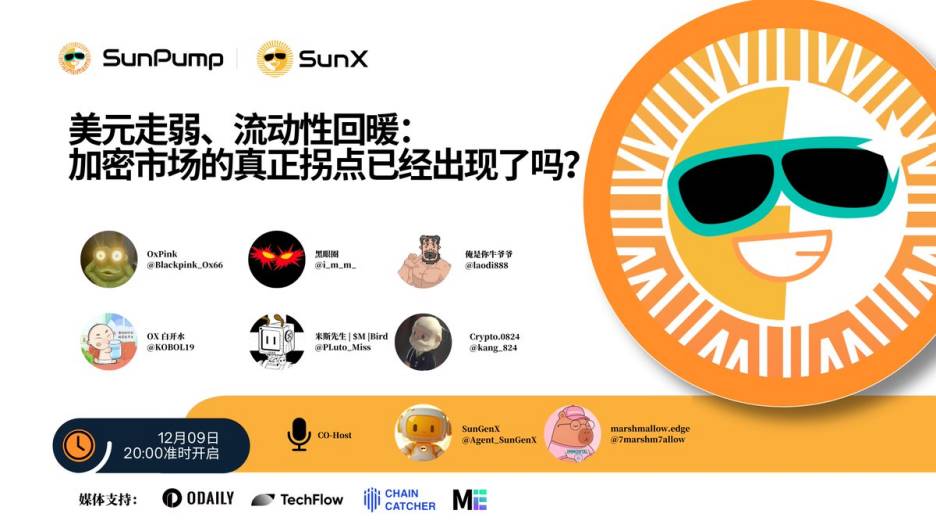
Does a weakening dollar + warming liquidity truly constitute a trend reversal in the cryptocurrency market?
In the first segment of the Space discussion, several seasoned observers conducted in-depth and cautious analyses around the core question of whether "the weakening dollar and warming liquidity constitute a trend reversal." Although market sentiment has shown warmth, the guests generally tended to define it as a "repair" rather than a "reversal," emphasizing that confirming a true trend reversal requires more time and multi-dimensional signal verification.
BlackEye first set a high standard for judgment. He believes that short-term data fluctuations are insufficient to support a trend assertion; a true turning point requires backing from long-term logic: first, the confirmation of the Federal Reserve's easing cycle, entering a sustained rate-cutting path and substantial balance sheet relaxation; second, the weakening dollar must be based on the weakness of the US economic fundamentals, thereby long-term suppressing dollar credit; third, global non-dollar currencies need to form a pattern of synchronized strengthening. He emphasized that only when liquidity shows a dual sustainability of "total expansion" and "qualitative inflow into the crypto market" can the market shift from repair to a trend upward.
@laodi888, drawing from historical market experiences, reminded investors of this year's multiple instances of "expectations falling short," indicating that a single positive data point or a few days of dollar decline are insufficient to support a long-term bull market. She defined the current market situation as a "strong repair after a deep correction," a correction of the previously overly pessimistic sentiment. Her pragmatic advice is to view the next 1-2 months as a critical observation period, focusing on whether the dollar's weakness can persist and whether the Federal Reserve's rate cuts can materialize. During this period, participation in the market is possible but caution is necessary, as rebounds should not be equated with reversals.
0xPink also reviewed history, pointing out that each major cycle in crypto has been accompanied by a backdrop of a weakening dollar and liquidity easing, making the association of "a big market is coming" very natural. However, he sharply noted that the market is "one data point changing sentiment, but sustained data determines the trend." He shared several indicators for confirming turning points: a comprehensive recovery in risk appetite (broad increases in various risk assets), continuous growth in stablecoin supply, and major cryptocurrencies breaking through key resistance levels. He concluded that if US Treasury yields continue to decline and the Federal Reserve releases clearer dovish signals in the next two months, the likelihood of a major cycle will increase.
Turning points are not yet here, but layout comes first: Insights into capital rotation patterns and the deterministic opportunities within the TRON ecosystem
After clarifying that the current market is in a "repair observation period" rather than a "confirmed turning point," a more practical question arises: if liquidity continues to warm, what path will capital follow to layout in the crypto world? In the second segment of the Space, the guests, combining historical patterns and the current market structure, outlined a clear roadmap for capital rotation and provided ordinary investors with highly actionable strategic frameworks.
Regarding the sequence of liquidity injection, the guests showed a high degree of consensus, indicating a gradual process from "core mainstream" to "marginal innovation." 0xPink vividly described this process with a metaphor: liquidity is like water, which will first fill up reservoirs like Bitcoin and Ethereum. He specifically pointed out that assets like TRX, which have solid payment demand, a large user base, and stable cash flow, also fall within the early beneficiaries due to their unique practicality and stability. Subsequently, the market enters the second phase, where capital will seek higher returns, flowing into sectors like RWA, AI, and meme coins that have strong narratives and amplified emotions. In the final stage, when capital penetrates into smaller projects, it often indicates that the cycle has entered a later phase, with both returns and risks sharply magnified.
Mr. Miss supplemented the flow of capital, stating that in addition to the most liquid mainstream assets like Bitcoin and Ethereum, capital will also favor compliant stable income products. The vast stablecoin assets and rich DeFi ecosystem on the TRON network are becoming the first stop for many users to enter the crypto world and obtain stable returns.
Specifically, the "stable income path" provided by TRON is clear and attractive:
Low-risk entry: As one of the largest stablecoin circulation networks globally, a large amount of USDT and other stablecoins are issued and circulated on the TRON chain, providing a zero price volatility risk crypto entry for funds seeking safety and stability.
Robust DeFi returns: After holding stablecoins, funds can earn returns through mature DeFi protocols on the TRON network without taking risks. For example, depositing stablecoins into the JustLend DAO lending platform for stable annualized returns, or participating in liquidity mining on the SUN.io platform. Currently, the popular trading pair TRX/USDT on SUN.io has a liquidity of $129 million, with a 24-hour trading volume of $42.8 million. This model provides a cash flow "buffer" during the observation period, balancing safety and profitability.
Connecting stable and growth asset hubs: When market risk appetite increases, the stable funds settled in the TRON DeFi ecosystem can be conveniently exchanged for other tokens within the TRON ecosystem through SunSwap, participating in subsequent sector rotations. For example, investors can quickly switch part of their stablecoin returns to high-narrative, high-volatility ecological projects like AI (e.g., AINFT) and meme (e.g., SunPump), thus capturing excess return opportunities brought by sector rotation while controlling overall risk.
At this juncture, where macro signals are beginning to emerge and market sentiment is cautiously recovering, the core conclusion of this roundtable is clear and prudent: confirming a trend requires time, but the framework for action can come first. A true turning point is not defined by a single data point, but by the resonance and continuous verification of multiple signals (macro cycles, capital flows, market structure). For investors, what is more important than accurately predicting a "turning point" is building their own "certainty" amidst uncertainty. The path demonstrated by TRON, from stablecoin entry, DeFi yield generation to efficient rotation within the ecosystem, precisely provides an actionable real-world model for this strategy of "participating while observing, advancing steadily."
Ultimately, when the direction of global liquidity tides becomes truly clear, those who are well-prepared, have a solid asset structure, and are familiar with capital flows will have a greater opportunity to become the navigators of the trend, rather than merely passive followers. The market cycle always moves forward amidst fluctuations, and rationality and strategy are the fundamentals for anchoring value in every tide.
免责声明:本文章仅代表作者个人观点,不代表本平台的立场和观点。本文章仅供信息分享,不构成对任何人的任何投资建议。用户与作者之间的任何争议,与本平台无关。如网页中刊载的文章或图片涉及侵权,请提供相关的权利证明和身份证明发送邮件到support@aicoin.com,本平台相关工作人员将会进行核查。
