Author: Jae, PANews
Another stablecoin, proudly bearing the title of "Tether's favorite child," has officially launched, but the market seems unconvinced.
On the evening of December 8, the highly anticipated stablecoin-specific public chain Stable officially launched its mainnet and STABLE token. As a Layer 1 deeply incubated by the core teams of Bitfinex and Tether, the narrative of "Tether's favorite child" attracted widespread market attention upon its debut.
However, against the backdrop of tightening market liquidity, Stable did not kick off as impressively as its competitor Plasma; it not only faced a sluggish price but also fell into a trust crisis due to alleged insider trading. Is Stable's script aiming for a rise after a fall, or will it continue to decline?
STABLE's Launch Peak Drops 60%, Deeply Entrenched in Trust Crisis Over Insider Trading
Before the launch of Stable, market sentiment was quite optimistic. The total scale of the project's two rounds of pre-deposits exceeded $1.3 billion, with approximately 25,000 participating addresses, averaging about $52,000 per address, indicating strong user interest. This was particularly remarkable during a period of low market sentiment, reflecting a high level of recognition for the "Tether system" backing and hopes that STABLE's launch could replicate the wealth narrative of Plasma from previous years.
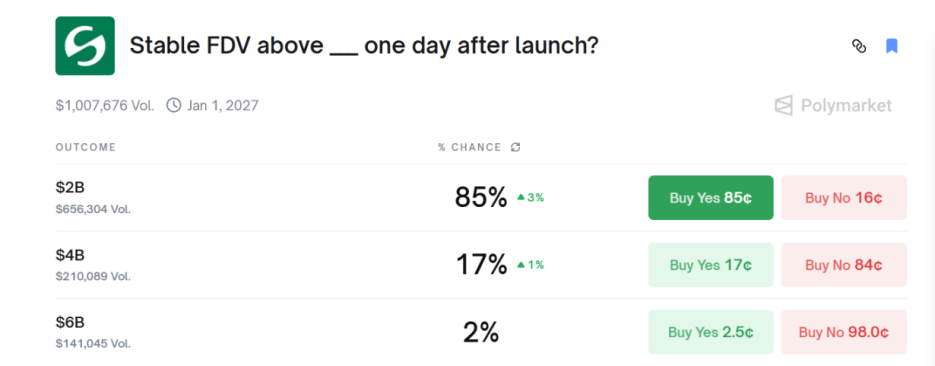
Data from the prediction market Polymarket indicated that the market once estimated an 85% probability that STABLE's fully diluted valuation (FDV) would exceed $2 billion.
However, the law of "what is hot must die" proved true once again.
The performance of the STABLE token on its first day of trading was disappointing. The opening price of the STABLE token was about $0.036, peaking at nearly $0.046 after launch, and then it continued to decline by over 60%, hitting a low of $0.015. As of 9 PM on December 9, the FDV of the STABLE token shrank to $1.7 billion, with no buyers willing to step in amid thin liquidity.
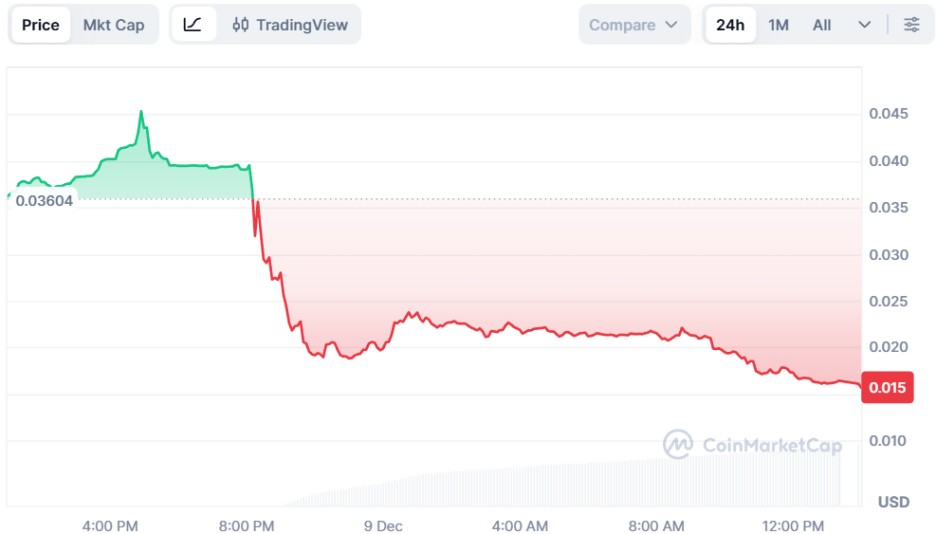
It is worth noting that the spot markets of leading centralized exchanges (CEX) such as Binance, Coinbase, and Upbit have not yet listed the STABLE token. Their absence limits the STABLE token's reach to a larger retail audience, further constraining its liquidity.
The sharp decline of the STABLE token has also sparked heated discussions within the community.
DeFi researcher @cmdefi stated: Expectations for Stable are relatively low, and various amateur operations occurred during the early project launch, raising concerns about its seriousness.
Crypto KOL @cryptocishanjia pointed out: The community is more willing to pay for new narratives. When the market has already seen a leader (Plasma), the consensus around the second player (Stable) will greatly increase, leading to reduced profit margins.
Former VC practitioner @Michael_Liu93 bluntly stated: The pre-launch $3 billion combined FDV is inflated, making it a suitable target for long-term shorting. Tight control over supply (no airdrops, no pre-sales, no KOL rounds) does not equate to price increases, but the lack of listing on leading CEXs may lead to a reversal.
Additionally, many users mentioned the controversy surrounding the pre-deposit before Stable's mainnet launch. In the first round of pre-deposit activities, a whale wallet deposited hundreds of millions of USDT before the official opening time, raising strong doubts about fairness and insider trading from the community and project team. The project team did not respond directly and proceeded to the second round of pre-deposits.
This incident constitutes a paradox in Stable's narrative, which claims to provide transparent, reliable, and compliant infrastructure. However, the emergence of suspected insider trading at the project's inception creates a trust deficit that will hinder community participation and negatively impact its long-term narrative.
USDT as Gas Fee Optimizes Payment Experience, Token Economic Model Hides Concerns
Stable's architecture aims to maximize transaction efficiency and user-friendliness.
Stable is the first Layer 1 to use USDT as its native gas fee, providing a user experience similar to no gas fees. The significance of this design lies in minimizing user friction. Users can pay transaction fees using the medium of exchange itself (i.e., USDT) without managing or holding highly volatile governance tokens. This feature will enable sub-second settlement and minimize costs, especially suitable for daily transactions and institutional payment scenarios that require strict price stability and predictability.
Stable employs the StableBFT consensus mechanism, a customized DPoS (Delegated Proof of Stake) model based on CometBFT (formerly Tendermint), and is fully compatible with the EVM (Ethereum Virtual Machine). StableBFT ensures transaction finality through Byzantine fault tolerance, meaning that once a transaction is confirmed, it is irreversible, which is crucial for payment and settlement scenarios. Additionally, StableBFT supports parallel processing of proposals by nodes, ensuring that the network can achieve high throughput and low latency performance, thus meeting the stringent requirements of a payment network.
Stable received strong capital backing at its launch. The project raised $28 million in seed funding, led by Bitfinex and Hack VC. Paolo Ardoino, CEO of Tether/Bitfinex, serves as an advisor, which has led the market to associate Stable with a close strategic relationship with the leading stablecoin issuer Tether.
Stable CEO Brian Mehler previously served as Vice President of Venture Capital at Block.one, the developer of EOS, managing a $1 billion crypto fund and investing in industry giants like Galaxy Digital and Securitize.
The CTO is Sam Kazemian, founder of the hybrid algorithmic stablecoin project Frax, who has deep experience in the DeFi field and has advised on U.S. stablecoin legislation.
However, Stable's initial CEO was Joshua Harding, the former investment head at Block.one, who was replaced without any announcement or explanation, casting a shadow over Stable's transparency.
Stable's token economic model adopts a strategy of separating network utility from governance value. The only role of the STABLE token is governance and staking. It is not used for paying any fees on the network, with all transactions settled in USDT.
Token holders can stake STABLE to become validators and maintain the network's security. They can also participate in key decisions such as network upgrades, fee adjustments, or the introduction of new stablecoins through community voting. However, since they cannot share in the network's profits, this diminishes the token's appeal, and before the ecosystem is fully formed, its token lacks empowerment.
It is noteworthy that 50% of the total token supply (10 billion tokens) will be allocated to the team, investors, and advisors. Although this portion of tokens is subject to a one-year lock-up period (Cliff) before linear release begins, the obvious bias in allocation ratios will have a long-term potential impact on token prices.
Intense Competition in the Stablecoin Public Chain Track, Execution Will Be the Deciding Factor
Stable faces extremely fierce market competition. In the current multi-chain landscape, Polygon and Tron have a large retail user base in low-cost remittances across Southeast Asia, South America, the Middle East, and Africa, while Solana occupies a place in the payment field due to its high throughput performance.
More importantly, Stable also faces emerging vertical Layer 1 competitors that are similarly focused on stablecoin payments. For example, Arc, developed by Circle, aims to become an institutional-grade on-chain treasury, global settlement, and tokenized asset infrastructure. Additionally, Tempo, supported by Stripe and Paradigm, is positioned as a payment-oriented public chain and is a strong competitor targeting the same vertical field.
In the payment and settlement field, network effects will be the core winning factor. Whether Stable can succeed will depend on its ability to quickly leverage the USDT ecosystem, attract developers and institutional users, and establish a first-mover advantage in large-scale settlement. If execution strength and market penetration are insufficient, it may be surpassed by similar Layer 1s with stronger integration capabilities or deeper compliance backgrounds.
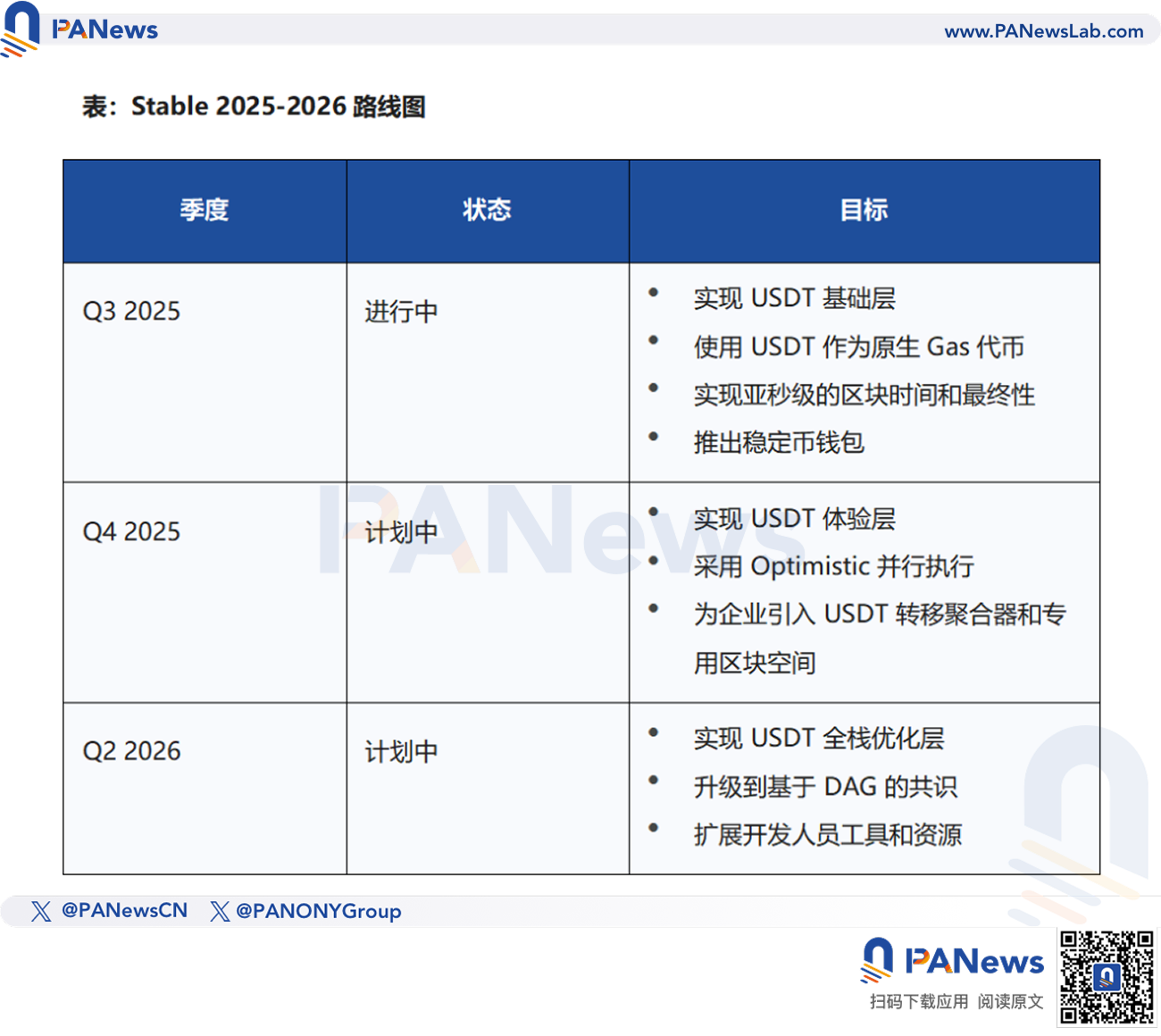
According to its roadmap, the main timeline is the enterprise integration and developer ecosystem building from Q4 2025 to Q2 2026. Whether these goals can be successfully achieved will be key to validating Stable's value proposition and the feasibility of vertical Layer 1. However, with only about six months from mainnet launch to pilot implementation, Stable must quickly overcome multiple challenges such as technical optimization, institutional integration, and ecosystem cultivation. Any execution missteps could further undermine market confidence in its long-term potential.
The launch of Stable's mainnet marks a new phase of competition in the stablecoin track, entering a stage of infrastructure development, and whether it can achieve its goal of reshaping the payment network will ultimately depend on execution rather than narrative.
免责声明:本文章仅代表作者个人观点,不代表本平台的立场和观点。本文章仅供信息分享,不构成对任何人的任何投资建议。用户与作者之间的任何争议,与本平台无关。如网页中刊载的文章或图片涉及侵权,请提供相关的权利证明和身份证明发送邮件到support@aicoin.com,本平台相关工作人员将会进行核查。


