The market is evolving, and retail investors' cognitive abilities and tool usage capabilities are also improving.
Author: tochi
Translation: Deep Tide TechFlow
Have retail investors become smarter now?
Honestly, I really don't know the exact moment of this shift; it may have happened gradually or perhaps in an instant. It might be one of those things that can only be noticed in hindsight. Maybe the meme coin craze of Solana had some influence, but I can't pinpoint a specific reason.
However, at some point, the market became more conscious, more perceptive, and frankly, more efficient. Of course, when I say "efficient," I mean it in the context of Crypto Twitter (CT), not in an academic sense.
This efficiency is reflected in people no longer being willing to be the exit liquidity for others.
Let me try to explain this from my perspective; this is just based on my observations, so don't take it too seriously, haha.
The information gap is narrowing
The proliferation of tools and information has changed the game. The more information and tools we have, the less room there is for "tricks" in the market. A few years ago, that wasn't the case; back then, even if you threw out the most predatory tokenomics, people on Crypto Twitter would dive in without hesitation because the mantra at the time was "buy first, ask questions later."
But today's average crypto user has changed. They check everything. A quick scroll through CryptoRank will show you a project's tokenomics and unlock schedule, and you'll immediately understand why this project is suddenly being heavily promoted on the timeline—it's because a large wave of tokens is unlocking in 48 hours, haha.
The same situation occurs with projects that have a high FDV (Fully Diluted Valuation). You've witnessed countless times how prices plummet in the days following a Token Generation Event (TGE). You understand this pattern, so once you enter, you quickly exit because you know that if you hold on, you'll soon regret it. Nowadays, almost no one buys those overvalued projects on the first day.
In summary, the market is evolving, and retail investors' cognitive abilities and tool usage capabilities are improving. This change is making the market more rational and efficient, and the space for tricks and scams is gradually diminishing.
The speed of attention shifts is astonishing
Just open Crypto Twitter (CT) for a day, and you'll see how people quickly jump from one project to another after a Token Generation Event (TGE).
Poor project launches are immediately punished by the market and quickly forgotten, as people turn to the next "shiny new thing." Frankly, I'm not sure if this is entirely a good thing, as it gradually creates the notion that a TGE is the endpoint of a project.
There is an audience that allows you to see how smart retail investors have become. They closely monitor every word you say, analyze your points in detail, and even provide thorough interpretations of your statements.
Personally, I often engage in "social listening" on X (Twitter), spending a lot of time browsing the comments section to observe people's views on various matters. Aside from the information garbage (infofi slops), I find these discussions to be quite complex. People are not just tracking wallet addresses; they are also tracking so-called "influencer circles." For example, you might see comments like, "Ah, don't buy what this person is promoting; he's a friend of Ardizor."
When you piece this information together, you realize that everyone has learned how to track wallets, tokenomics, marketing parties (KOLs/influencers, etc.), and can even sniff out scams from a distance.
But this change also has its downsides
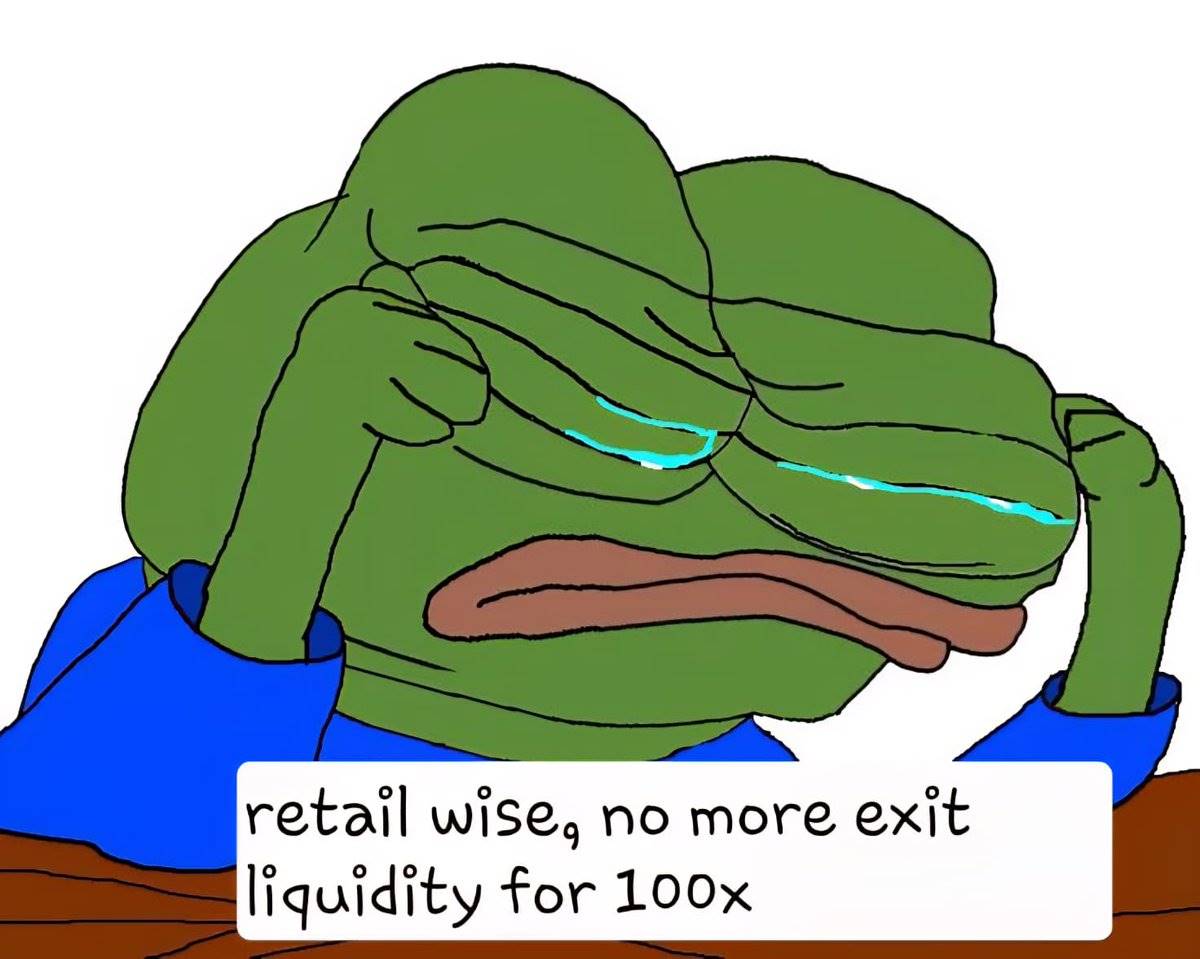
Is there really a downside to "efficiency"? Let's explore this…
The improvement in market efficiency may reduce the upper limit of returns. I tend to think that when everyone has enough information, the so-called "ignorance premiums" will disappear. No one will hold onto assets for a long time out of fear of becoming exit liquidity.
Nowadays, people don't mind selling early because "profit is profit," haha, which is certainly better than becoming exit liquidity in the end.
While this is indeed the case, sometimes I still miss the relatively "ignorant" era of the market, when there were countless 100x opportunities.
Of course, the benefits of efficiency are evident, and it ultimately has a positive impact on the entire ecosystem. Efficiency makes everyone more alert, and the market begins to punish predatory behavior. You can no longer expect retail investors to be your exit liquidity with predatory tokenomics or by promoting some junk projects—you will be exposed! This reminds me of recent X (Twitter) users exposing influencers trying to whitewash "apriori scams," which is quite satisfying.
While this does make it more difficult to find those 10x investment opportunities, it also means that the projects that ultimately succeed are genuinely valuable and sustainable projects—those with high liquidity.
To be honest, I fully support this shift, and I believe this trend of efficiency will continue. Both project teams and retail investors must adapt to this new reality, or they will be eliminated by the market.
Wishing everyone a great week!
免责声明:本文章仅代表作者个人观点,不代表本平台的立场和观点。本文章仅供信息分享,不构成对任何人的任何投资建议。用户与作者之间的任何争议,与本平台无关。如网页中刊载的文章或图片涉及侵权,请提供相关的权利证明和身份证明发送邮件到support@aicoin.com,本平台相关工作人员将会进行核查。


