As the Federal Reserve's policies increasingly impact the cryptocurrency market, Bitcoin investors are preparing for potential changes in liquidity.
Written by: Oluwapelumi Adejumo
Translated by: Saoirse, Foresight News
The price movements of Bitcoin are fluctuating alongside the Federal Reserve's final policy decision of the year, appearing almost stable on the surface, but the underlying market structure presents a starkly different scenario.
Beneath the seemingly stable price range lies a concentrated period of pressure: on-chain data shows that investors are losing nearly $500 million daily, the leverage in the futures market has significantly decreased, and nearly 6.5 million Bitcoins are currently in an unrealized loss state.
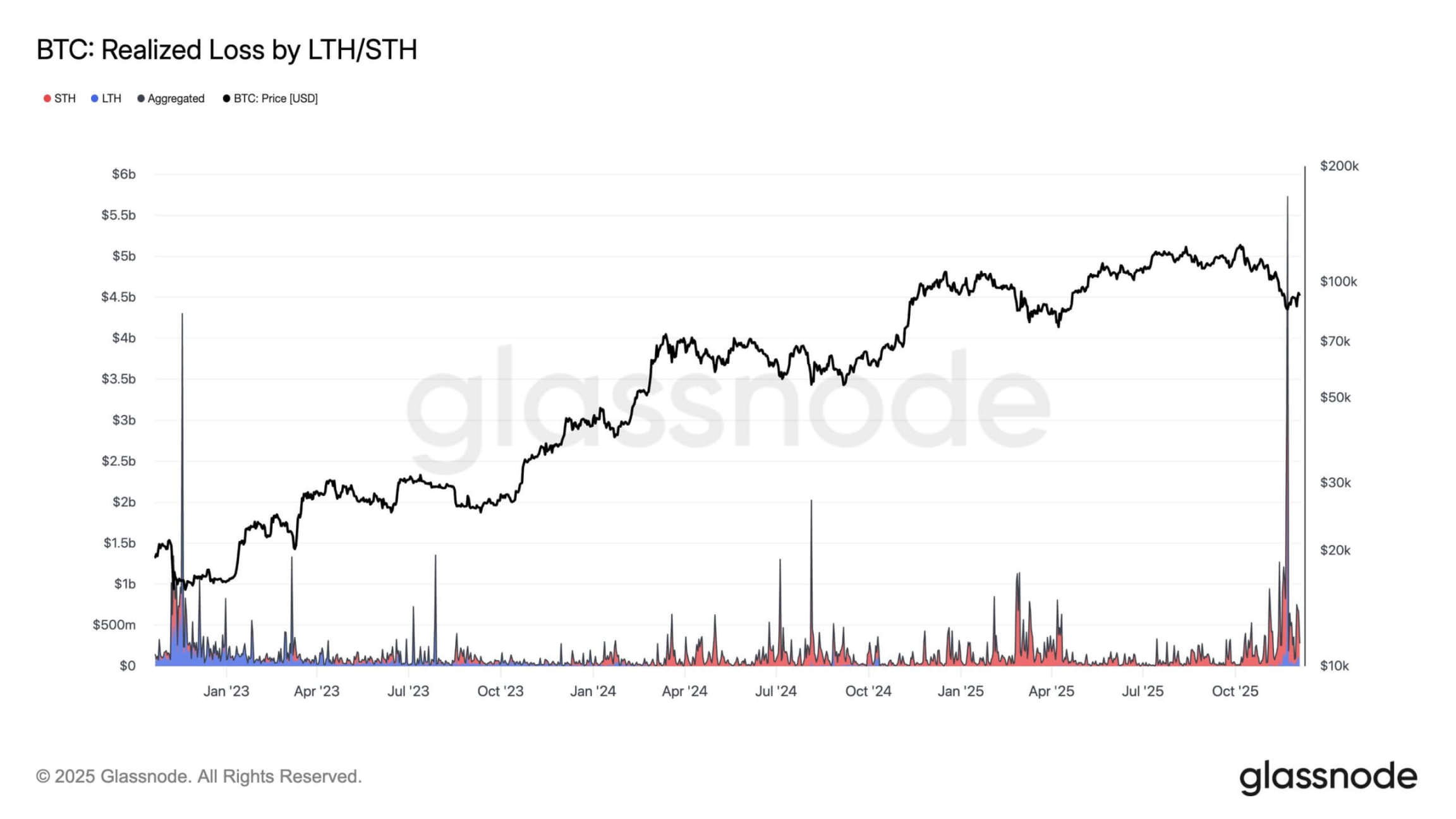
Realized loss levels of Bitcoin, source: Glassnode
This situation resembles the late-stage contraction of previous markets rather than a healthy consolidation phase.
However, structural adjustments occurring beneath the calm surface are not uncommon for Bitcoin, but the timing of this adjustment is noteworthy.
The internal "surrender-style sell-off" coincides with an external turning point in U.S. monetary policy. The Federal Reserve has concluded the most aggressive balance sheet reduction phase in over a decade, and the market anticipates that its December meeting will outline a clearer framework for "transitioning to reserve management purchases."
In light of this, the on-chain market pressure and the pending liquidity shift together form the backdrop for this week's macro events.
Liquidity Shift
According to the Financial Times, quantitative tightening (QT) officially ended on December 1, during which the Federal Reserve reduced its balance sheet by approximately $2.4 trillion.
This move has led to bank reserves dropping to historically tight levels, while the secured overnight financing rate (SOFR) has repeatedly tested the upper limit of the policy interest rate range.
These changes indicate that the market system is no longer flush with liquidity but is gradually entering a phase of "concern over reserve scarcity."
In this context, the most critical signal released by the Federal Open Market Committee (FOMC) is not the widely expected 25 basis point rate cut, but rather the direction of its balance sheet strategy.
The market expects the Federal Reserve to clarify its specific plan for transitioning to "reserve management purchases (RMP)" through explicit statements or policy execution documents.
According to investment research firm Evercore ISI, this plan could start as early as January 2026, with monthly purchases of approximately $35 billion in short-term Treasury bills — funds from maturing mortgage-backed securities will be reallocated to short-term assets.
The details of this mechanism are crucial: although the Federal Reserve is unlikely to define RMP as "stimulus policy," the continued reinvestment in short-term Treasury bills will steadily rebuild bank reserves and shorten the asset maturity structure of the "system open market account."
This operation will gradually increase the size of reserves, ultimately leading to an annualized increase in the balance sheet exceeding $400 billion.
This shift will mark the first time since the initiation of quantitative tightening that the Federal Reserve has signaled a sustained expansionary policy. Historically, Bitcoin's sensitivity to such liquidity cycles is much higher than to changes in policy interest rates.
Meanwhile, broader monetary aggregates indicate that the liquidity cycle may have begun to turn.
Notably, the M2 money supply has reached a historical peak of $22.3 trillion, surpassing the highs of early 2022 after a prolonged contraction.
(Note: M2 is one of the core indicators for measuring money supply, falling under the category of "broad money," encompassing a wider range than base money (M0) and narrow money (M1), providing a more comprehensive reflection of overall liquidity in society.)
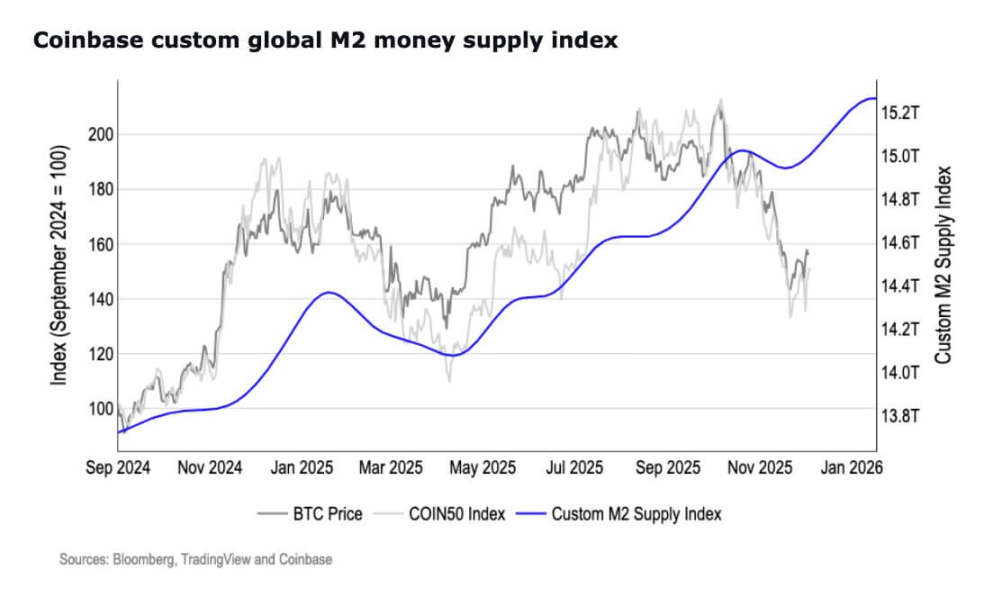
U.S. M2 money supply, source: Coinbase
Therefore, if the Federal Reserve confirms the initiation of "reserve rebuilding," Bitcoin's sensitivity to balance sheet dynamics may quickly rebound.
Macro Traps
The core basis for this policy shift stems from changes in employment data.
In the past seven months, non-farm payrolls have declined in five of those months; simultaneously, job vacancies, hiring rates, and voluntary resignation rates have all shown a slowing trend, shifting the narrative of the job market from "robust" to "fragile under pressure."
As these indicators cool, the theoretical framework of a "soft landing" becomes increasingly difficult to sustain, and the Federal Reserve's policy options are continually narrowing.
Current inflation, while having receded somewhat, remains above the policy target; at the same time, the costs of "maintaining tight policy for a longer duration" are rising.
The potential risk is that the weakness in the labor market may further exacerbate before inflation fully returns to target levels. Therefore, the information value of this week's Federal Reserve press conference may surpass that of the interest rate decision itself.
The market will focus on how Federal Reserve Chairman Powell balances two major objectives — maintaining stability in the labor market while ensuring the credibility of the inflation path. His statements regarding "reserve adequacy," "balance sheet strategy," and "timing of RMP initiation" will dominate market expectations for 2026.
For Bitcoin, this means its price movements will not be a binary outcome of "up or down," but rather depend on the specific direction of policy signals.
If Powell acknowledges the weakness in the labor market and clarifies the reserve rebuilding plan, the market may perceive the current range-bound price as disconnected from policy direction — if Bitcoin breaks through the $92,000 - $93,500 range, it will indicate that traders are positioning for liquidity expansion.
Conversely, if Powell emphasizes policy caution or delays clarifying RMP details, Bitcoin may remain in the lower consolidation range of $82,000 - $75,000 — this range has concentrated ETF holding bottoms, corporate inventory reserve thresholds, and historical structural demand areas.
Will Bitcoin Experience a "Surrender-style Sell-off"?
Meanwhile, the internal market dynamics of Bitcoin further corroborate the view that "the asset is undergoing a reset beneath the surface."
Short-term holders continue to sell tokens during market weakness; as mining costs approach $74,000, the economics of mining have significantly deteriorated.
At the same time, Bitcoin mining difficulty has seen the largest single drop since July 2025, indicating that marginal miners are reducing capacity or completely shutting down mining rigs.
However, these pressure signals coexist with early signs of "supply tightening."
Research firm BRN Research revealed to CryptoSlate that in the past week, large wallets have cumulatively increased their holdings by approximately 45,000 Bitcoins; exchange Bitcoin balances continue to decline; and inflows of stablecoin funds indicate that if market conditions improve, capital is preparing to re-enter.
Additionally, asset management firm Bitwise's supply indicators show that even when retail sentiment is in a state of "extreme fear," various wallets are still accumulating Bitcoin. Tokens are shifting from high liquidity platforms to long-term custody accounts, further reducing the proportion of supply available to absorb sell-offs.
This "coexistence of forced selling, miner pressure, and selective accumulation" pattern is typically a foundational condition for the market to form a long-term bottom.
Bitwise further added:
"Bitcoin's inflows continue to contract, with the 30-day actual market cap growth rate dropping to just 0.75% per month. This indicates that the current market's profit-taking and stop-loss selling are roughly balanced, with losses slightly exceeding profits. This rough balance suggests that the market has entered a 'calm period,' with neither bulls nor bears holding a clear dominance."
Technical Analysis
From a market structure perspective, Bitcoin remains constrained by two key ranges.
If it continues to break through $93,500, the asset will enter a zone where "momentum models are more easily triggered," with subsequent target levels of $100,000, $103,100 (short-term holder cost basis), and the long-term moving average.
Conversely, if it fails to break resistance in the face of cautious signals from the Federal Reserve, the market may retreat to the $82,000 - $75,000 range — a range that has repeatedly served as a "reservoir" for structural demand.
BRN Research points out that cross-asset performance also confirms this sensitivity: ahead of the Federal Reserve meeting, gold and Bitcoin exhibited inverse movements, reflecting "asset rotation driven by changes in liquidity expectations," rather than fluctuations solely dictated by risk sentiment.
Therefore, if Powell's statements reinforce the expectation that "reserve rebuilding is the core of the next phase of policy," capital may quickly shift towards those assets that respond positively to "liquidity expansion."
免责声明:本文章仅代表作者个人观点,不代表本平台的立场和观点。本文章仅供信息分享,不构成对任何人的任何投资建议。用户与作者之间的任何争议,与本平台无关。如网页中刊载的文章或图片涉及侵权,请提供相关的权利证明和身份证明发送邮件到support@aicoin.com,本平台相关工作人员将会进行核查。


