Author: imToken
In the previous article of the Interop series, we introduced the Open Intents Framework (OIF), which acts like a universal language, allowing users to express their intent of "I want to buy an NFT across chains" and be understood by solvers across the network.
However, merely being "understood" is not enough; it must also be "executed." After all, once your intent is sent out, how does the funds safely move from Base to Arbitrum? How does the target chain verify that your signature is valid? Who will cover the Gas fees for the target chain?
This involves the core of the "Acceleration" phase in the Ethereum interoperability roadmap—the Ethereum Interoperability Layer (EIL). Recently, at Devconnect, the Ethereum Foundation's account abstraction team officially brought EIL to the forefront.
In simple terms, EIL has an ambitious goal: to make the user experience of all L2s "look like it's on the same chain" without hard forks or changes to Ethereum's underlying consensus.
1. What exactly is EIL?
To understand EIL, it is essential not to be misled by the term "Layer," as EIL is neither a new blockchain nor a traditional cross-chain bridge.
It is essentially a set of standards and frameworks that combines "account abstraction (ERC-4337)" with "cross-chain messaging" capabilities to create a virtual unified execution environment.
In the current Ethereum ecosystem, each L2 is an isolated island. For example, your account (EOA) on Optimism and your account on Arbitrum, although they have the same address, are completely isolated in terms of state:
- Signatures on chain A cannot be directly verified by chain B.
- Assets on chain A are invisible to chain B.
EIL attempts to break this isolation through two core components:
- Smart Accounts based on ERC-4337: Utilizing the capabilities of account abstraction to decouple user account logic from keys; solving the issue of lacking Gas on the target chain through the Paymaster mechanism; and achieving multi-chain state synchronization through Key Manager.
- Trust-Minimized Messaging Layer: Establishing a standard that allows UserOps to be packaged and securely transmitted to another chain via the official Rollup bridge or light client proofs.
To put it simply, previous cross-chain interactions were like traveling abroad, where you needed to exchange currency (cross-chain assets), obtain a visa (re-authorization), and follow local traffic rules (purchase target chain Gas). In the EIL era, cross-chain interactions will resemble using a Visa card:
No matter which country you are in, as long as you swipe your card (sign), the underlying banking network (EIL) will automatically handle the exchange rate, settlement, and verification, making you feel as if there are no borders.
The EIL proposal put forth by the Ethereum Foundation's account abstraction team envisions a future where users can complete cross-chain transactions with a single signature, without relying on centralized relayers or introducing new trust assumptions, allowing direct initiation from wallets and seamless settlement across different L2s.
This is closer to the ultimate form of "account abstraction." Compared to the current high-threshold and fragmented operations, this experience will help users automatically create accounts, manage private keys, and handle complex cross-chain transactions.
Especially with the native account abstraction feature (AA), all accounts can become smart accounts, allowing users to focus on on-chain experiences and asset management without worrying about Gas fees (or even being unaware of their existence).
2. The Paradigm Shift from "Cross-Chain" to "Chain Abstraction"
If EIL is successfully implemented, it is likely to bridge the "last mile" for the large-scale adoption of Web3. This marks a shift in the Ethereum ecosystem from multi-chain competition to chain abstraction integration, potentially solving the most troublesome issues for users and developers.
First, for users, it enables a true "single-chain experience."
In short, under the EIL framework, users no longer need to manually switch networks. For example, if all your funds are on Base but you want to play a game on Arbitrum, you can simply click start in the game, and your wallet will pop up a signature box. After signing, the game begins.
In the background, EIL will automatically package your UserOp from Base and transmit it to Arbitrum through the messaging layer, with the Paymaster covering the Gas and entry fees, making it feel as smooth as playing the game on Base.
Secondly, from a security perspective, it completely eliminates the single-point risk of multi-signature bridges.
Traditional cross-chain bridges often rely on a group of external validators (multi-signatures). If this group is compromised by hackers, billions of dollars in assets are at risk. EIL emphasizes "trust minimization," preferring to utilize the security of L2 itself (such as Storage Proofs) to verify cross-chain messages rather than relying on external third-party trust. This means that as long as the Ethereum mainnet is secure, cross-chain interactions are relatively safe.
Finally, for developers, there will be a unified account standard. Currently, if a DApp wants to create a multi-chain application, developers must maintain several sets of logic. With EIL, developers can assume that users have a full-chain account and only need to write interfaces based on the ERC-4337 standard, naturally supporting full-chain users without worrying about which chain the user's funds are on.
However, to realize this vision, we face a significant engineering challenge: how to allow the existing hundreds of millions of EOA users to enjoy this experience?
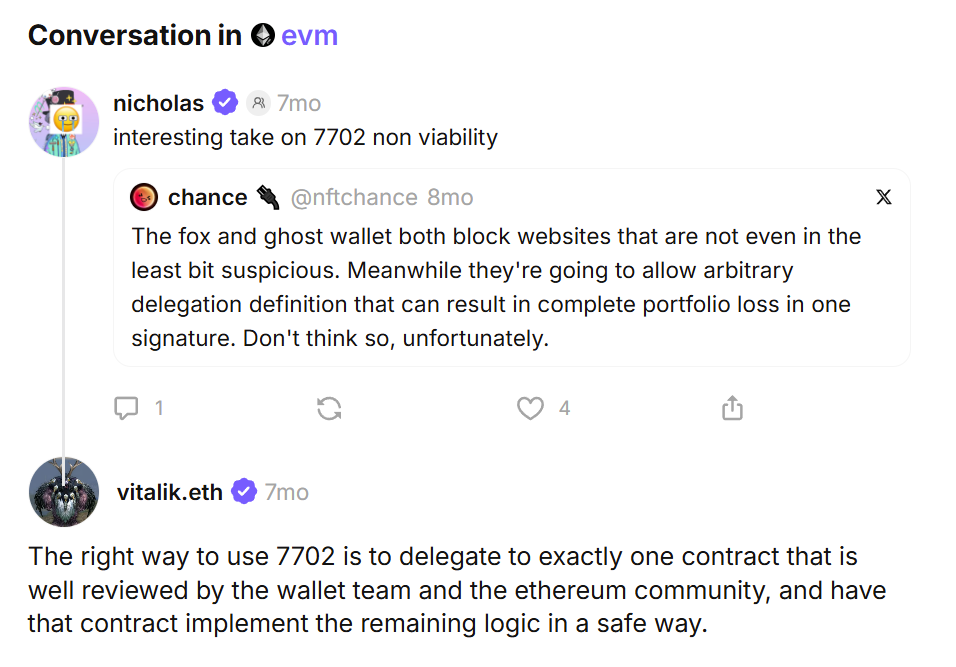
After all, migrating from EOA to AA requires users to transfer assets to a new address, which is cumbersome. This leads to the EIP-7702 proposal previously put forth by Vitalik Buterin, which cleverly resolves the compatibility issues that have been debated in the previous three proposals (EIP-4337, EIP-3074, EIP-5003) by doing something remarkable: allowing existing EOA accounts to "temporarily transform" into smart contract accounts during transactions.
This proposal means you do not need to register a new wallet or transfer assets from your current wallets like imToken to a new AA account address. Instead, through EIP-7702, your old account can temporarily gain smart contract functionalities (such as batch authorization, Gas payment, cross-chain atomic operations), and after the transaction ends, it reverts back to being a highly compatible EOA.
3. The Implementation and Future of EIL
Compared to OIF, which is co-built by the community in a "bottom-up" manner, EIL carries a stronger official tone, being a project led by the Ethereum Foundation's account abstraction team (the creators of ERC-4337).
Specifically, the current progress is mainly reflected in the advancement of the following three key dimensions:
- Multi-Chain Expansion of ERC-4337: The community is researching how to expand the UserOp structure of ERC-4337 to include cross-chain information such as target chain IDs, which is the first step in giving smart accounts "far-sightedness."
- Collaboration with ERC-7702: With the advancement of EIP-7702 (which gives EOA smart account capabilities), ordinary EOA users will also be able to seamlessly access the EIL network in the future, significantly lowering the user threshold.
- Standardized Messaging Interface: Similar to the intent standardization mentioned in our previous article on OIF, EIL is promoting the standardization of underlying message transmission. Optimism's Superchain, Polygon's AggLayer, and ZKsync's Elastic Chain are all exploring interoperability within their respective ecosystems, while EIL aims to further connect these heterogeneous ecosystems to build a universally applicable messaging layer.
Interestingly, the vision of EIL goes beyond mere "connection"; it also addresses another critical underlying capability: privacy.
If EIP-7702 and AA solve "accessibility," then the Kohaku privacy framework released by Vitalik at Devconnect may become the next piece of the EIL puzzle, echoing another core principle in the "Trustless Declaration," which is "anti-censorship."
At Devconnect, Vitalik stated, "Privacy is freedom," and indicated that Ethereum is on a path of privacy upgrades aimed at providing real-world privacy and security. To this end, the Ethereum Foundation has established a privacy team composed of 47 researchers, engineers, and cryptographers dedicated to making privacy a "first-class attribute" of Ethereum.
This means that future privacy protection will no longer be an optional plugin but a fundamental capability as natural as transferring funds. As a realization of this vision, the Kohaku framework has emerged—essentially, Kohaku uses your public key to create a temporary stealth address, allowing you to perform private operations without revealing links to your main wallet.
With this design, future AA accounts will not only be asset management tools but also privacy shields.
By integrating protocols like Railgun and Privacy Pools, AA accounts will allow users to provide "proof of innocence" while protecting transaction privacy, enabling any user to prove that their funds are not of illegal origin without exposing specific consumption paths.
Thus, we can clearly see the full picture of the Ethereum interoperability roadmap:
- OIF (Intent Framework): Enabling the application layer to "understand" user needs;
- EIL (Interoperability Layer): Paving the way for execution at the infrastructure layer.
This may also be a clear signal that the Ethereum Foundation wants to convey: Ethereum should not be a collection of loosely connected L2s but a massive, unified supercomputer.
In the future, when EIL is fully realized, we may no longer need to explain to new users what L2s or cross-chain bridges are; all they will see are assets, without the barriers of chains.
免责声明:本文章仅代表作者个人观点,不代表本平台的立场和观点。本文章仅供信息分享,不构成对任何人的任何投资建议。用户与作者之间的任何争议,与本平台无关。如网页中刊载的文章或图片涉及侵权,请提供相关的权利证明和身份证明发送邮件到support@aicoin.com,本平台相关工作人员将会进行核查。


