Galaxy Digital's market valuation is significantly lower than the sum of its segment values.
Written by: Lawrence Lee
1. Research Summary
Galaxy Digital (GLXY) is a hybrid platform spanning crypto finance and AI computing power, with a business structure covering three core modules: ① Global Markets (trading, market making, and crypto investment banking); ② Asset Management and Infrastructure Solutions (fund management, staking, custody, and proprietary investments); ③ AI Data Centers and Computing Power Infrastructure (Helios campus).
Over the past three years, Galaxy has achieved a leap from the lows of the crypto winter to synergistic growth across multiple businesses. In Q3 2025, driven by the surge in crypto treasury companies (Digital Asset Treasury Company) and the sale of 80,000 BTC, it achieved over $730 million in adjusted gross profit, setting a new record; the AUM of asset management and staking business reached $9 billion, with staking volume exceeding $6.6 billion, and annual management fees surpassing $40 million; while the Helios mining site has fully transformed into an AI computing power campus, signing a 15-year contract with CoreWeave, locking in 800MW of total power capacity in a three-phase lease, with expected annual revenue exceeding $1 billion after full delivery.
GLXY's financial performance has been highly volatile, significantly influenced by the crypto market: a loss of nearly $1 billion in 2022, a return to profitability in 2023, and a net profit of $365 million in 2024. Although there was a temporary decline in the first half of 2025, Q3's single-quarter profit reached a record $505 million amidst overall fluctuations in the crypto market, with adjusted EBITDA significantly turning positive, indicating enhanced resilience in core business.
In terms of valuation, we adopt the SOTP (Sum of the Parts) framework: the segment valuation for Galaxy's digital asset financial services business is $7.7 billion; the segment valuation for AI computing power infrastructure business is $8.1 billion, totaling $15.8 billion, plus net assets yielding a total equity value of approximately $19.4 billion. However, Galaxy's current market capitalization is $10.1 billion, representing a 48% discount from our segment valuation calculation. This may be due to investors adopting a conservative valuation strategy for companies facing both industry cycle fluctuations (currently at a cycle peak according to crypto cycles) and business transformation challenges (with computing power business starting delivery only in 2026).
PS: This article reflects the author's thoughts as of publication, which may change in the future, and the views expressed are highly subjective and may contain errors in facts, data, or reasoning logic. All opinions in this article are not investment advice, and criticism and further discussion from peers and readers are welcome.
2. Business and Product Lines
Galaxy Digital was founded in 2018 by former Wall Street star investor Michael Novogratz. Novogratz was a partner and macro fund manager at the renowned hedge fund Fortress, and currently, Galaxy Digital's business landscape has formed "three core segments": ① Global Markets (including trading, derivatives market making, investment banking, and lending services), ② Asset Management & Infrastructure Solutions (including fund management, staking services, proprietary investments, etc.), ③ Data Centers and Computing Power Business (including previous Bitcoin mining and the ongoing AI/HPC high-performance computing infrastructure). Below, we will detail the business models, latest developments, and revenue contributions of each major product line.
2.1 Global Markets
Business Content and Definition
The Global Markets business encompasses the digital asset trading and related financial services that Galaxy Digital provides to institutions, serving as its core revenue source. This module includes two main segments: Franchise Trading and Investment Banking. The sell-side trading team acts as a market maker and liquidity provider in the crypto market, offering over 1,500 counterparties OTC trading services for spot and derivatives, supporting trading of over 100 mainstream crypto assets. Meanwhile, Galaxy utilizes regulated entities to conduct digital asset collateralized lending, OTC block brokerage, and structured yield products, providing leverage, hedging, and instant liquidity solutions for institutional clients such as miners and funds. The investment banking team offers professional financial advisory services to blockchain and crypto industry companies, including M&A advisory, equity and debt financing arrangements, and private placements, helping companies in the digital asset space connect with traditional capital markets. This series of services enables Galaxy to provide comprehensive financial solutions to institutional investors, akin to Wall Street investment banks, meeting the evolving demands of the crypto financial ecosystem.
Key Developments
- 2018–2019: Galaxy Digital was established in 2018 with the goal of "bringing crypto to Wall Street and bringing Wall Street into crypto." It quickly began building a comprehensive platform covering trading, asset management, and investment, and rapidly accumulated an institutional client base.
- 2020: Galaxy achieved a leap in trading business expansion through acquisitions: in November 2020, it acquired digital asset lending and structured products company DrawBridge Lending and professional market maker Blue Fire Capital to enhance its capabilities in OTC lending, futures derivatives, and bilateral market making. This rapidly extended Galaxy's trading landscape to include leveraged loans, OTC options, structured notes, and other advanced products, increasing its annual OTC trading volume to over $4 billion and expanding its active counterparties to nearly 200.
- 2021: The company appointed former Goldman Sachs executive Damien Vanderwilt and other senior professionals to establish an investment banking department focused on the crypto industry, providing M&A and financing advisory services. That year, Galaxy continued to enrich its product line by acquiring Vision Hill Group (a digital asset investment advisor and crypto fund index provider), enhancing its fund products and data analysis capabilities. In trading, the Galaxy Digital Trading team developed the GalaxyOne integrated trading platform (combining trading, lending, and custody) and completed key technical frameworks within the year, laying the foundation for the subsequent launch of a unified institutional service portal.
- 2022: Despite the crypto market entering a winter, Galaxy's Global Markets business continued to expand steadily. The sell-side trading department increased its counterparty count to over 930 in Q4, providing continuous market making and liquidity support for over 100 digital assets. In investment banking, the team seized industry consolidation opportunities, participating in several significant transactions: for example, serving as the financial advisor for Genesis Volatility's acquisition by Amberdata and assisting CoreWeave in securing strategic investment from Magnetar Capital. Notably, at the end of 2022, when Galaxy itself acquired the Helios mining site (detailed in the data center section below), the investment banking department also provided transaction advisory support, reflecting internal synergy.
- 2023: As the market gradually recovered, Galaxy's Global Markets business rebounded strongly. That year, Galaxy continued to expand its business coverage in regions such as Asia and the Middle East, establishing teams in Hong Kong, Singapore, and other locations to serve local institutional clients (such as family offices and funds). The investment banking department remained active in the first half of 2023, participating in several industry M&A and financing transactions, such as advising on the acquisition of crypto custody company GK8 by Galaxy (as the buyer) and some mining company restructuring projects. Despite ongoing fluctuations in the crypto industry that year, Galaxy's Global Markets segment demonstrated a more stable revenue curve compared to traditional crypto exchanges, due to its more diversified business model (including interest income, market making spreads, advisory fees, etc.).
- 2024: This year, the digital asset market showed a clear recovery, and the company's Global Markets business recorded record performance. In 2024, counterparty trading and advisory revenue reached $215 million, exceeding the total of the previous two years. Q4 alone achieved $68.1 million in revenue (up 26% quarter-on-quarter). The growth was primarily driven by active derivatives trading and strong institutional lending demand – during the quarter, Galaxy's OTC derivatives and credit business surged, with counterparty trading volume increasing by 56% quarter-on-quarter, and the average loan book size expanding to $861 million, setting a historical high. By the end of 2024, the total number of Galaxy's counterparties reached 1,328, significantly increasing from the previous year. In investment banking, Galaxy completed a total of 9 advisory transactions in 2024, successfully closing 3 in Q4, including serving as the exclusive financial advisor for Ethereum staking service provider Attestant's sale to Bitwise, and assisting Thunder Bridge Capital in merging with Coincheck (SPAC transaction). These transactions brought substantial fee income to Galaxy, solidifying its reputation in the crypto investment banking market.
- 2025: Entering 2025, driven by favorable expectations such as ETFs, the digital asset market rebounded strongly, and Galaxy's Global Markets business reached new heights. In Q3 2025, Galaxy's Global Markets segment generated $295 million in adjusted gross profit for the quarter, soaring 432% from the previous quarter, setting a historical high. During this quarter, the company's total trading volume increased by 140% quarter-on-quarter, reaching the highest level ever, far exceeding the market's average growth rate. One standout business was Galaxy's trust in selling 80,000 BTC (nominal amount of approximately $9 billion) for a large institution, which significantly contributed to the quarterly spot trading volume. The two ETH stock companies, BMNR and SBET, also acquired ETH through Galaxy. Meanwhile, Galaxy's institutional lending business rapidly expanded, with an average loan balance of $1.78 billion in Q3, a 60% increase from Q2, indicating that more institutions are seeking crypto credit financing through Galaxy. In investment banking, Galaxy seized the market financing window, completing a $1.65 billion PIPE private financing for Forward Industries in Q3 (serving as co-placement agent and financial advisor) and acting as the exclusive financial advisor for Coin Metrics' sale to Talos. These heavyweight transaction cases further established Galaxy's leading position in the digital asset investment banking business. Looking ahead to the full year of 2025, amid the surge of crypto stock companies, the market expects Galaxy's Global Markets business to achieve revenue and profit levels far exceeding previous years.
Financial Reports and Public Report Summary (2023–2025)
Revenue and Profit: In 2023, due to the market being at the tail end of a bear market, Galaxy still recorded losses overall, but the Global Markets segment showed improvement in the second half of the year. Entering 2024, the Global Markets business became the main driver of the company's performance: the annual counterparty trading and advisory revenue reached $215 million, a significant increase compared to 2022 (which was only about $100 million due to market sluggishness). The profitability from derivatives and quantitative trading increased, and interest income also rose with the expansion of lending volume. In 2024, the adjusted EBITDA for the Global Markets business exceeded $100 million, highlighting operational leverage. In Q4 2024, the Global Markets revenue for the quarter was $68.1 million, directly driving the company's net profit for the quarter back to profitability. By Q3 2025, Galaxy reported that its digital asset business (including Global Markets and Asset Management) achieved $250 million in adjusted EBITDA for the quarter, with a significant contribution from the Global Markets segment. The adjusted gross profit for the Global Markets segment that quarter reached $295 million. This reflects the strong profitability elasticity of Galaxy's trading business under bullish market conditions. It is worth noting that in the first three quarters of 2025, the company's overall net profit was still affected by the volatility of proprietary investments (for example, losses in Q1 due to a drop in digital asset prices), but the growth trend of core operational business remained quite robust. Management projected in the Q3 2025 financial report that with the full launch of the GalaxyOne platform and the onboarding of more institutional clients, the company's trading-related revenue is expected to grow further. At the same time, the cost-to-income ratio of the Global Markets business has decreased (reflecting improved operational efficiency), bringing considerable operational leverage benefits to the company.
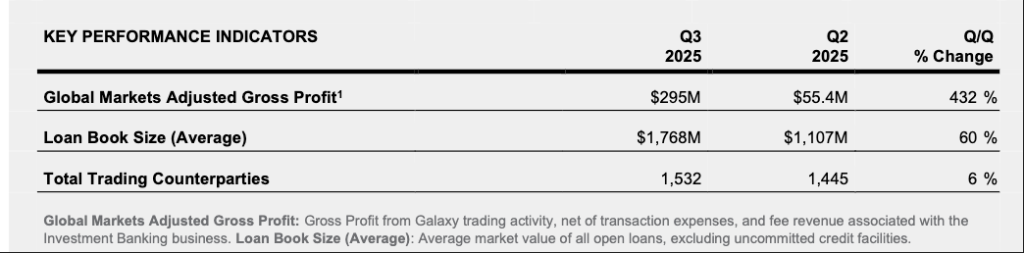 GLXY Q3 2025 Global Markets Profit, Loan Volume, and Counterparty Data
2.2 Asset Management & Infrastructure Solutions
Business Content and Definition
The Asset Management and Infrastructure Solutions segment integrates Galaxy Digital's businesses in digital asset investment management and blockchain infrastructure technology services, serving as an important complement to the Global Markets segment.
In Asset Management, Galaxy provides diversified crypto asset investment products for institutions and qualified investors through its subsidiary, Galaxy Asset Management (GAM). The product forms include: 1) Public market products: such as ETFs/ETPs (exchange-traded products) issued in collaboration with traditional institutions, including single-asset ETFs for Bitcoin, Ethereum, and thematic ETFs for the blockchain industry; 2) Private fund products: including actively managed hedge funds (Alpha strategies), venture capital funds (investing in blockchain startups like Galaxy Interactive), crypto index funds, and funds of funds, providing investors with diversified risk-return exposure. Galaxy also offers customized crypto investment services for institutional clients, such as digital asset index construction, treasury management, and co-investment (SPV) opportunities. As of Q3 2025, Galaxy's assets under management (AUM) approached $9 billion, covering over 15 ETFs and alternative investment strategy products. This scale positions it among the largest crypto asset managers globally.
In Infrastructure Solutions, Galaxy leverages its technology and operational experience to provide institutions with foundational technology services and custody solutions for blockchain networks. This primarily includes two modules: Custody and Staking. The GK8 platform acquired by Galaxy in 2023 offers institutional-grade digital asset self-custody technology, allowing clients to securely manage crypto assets through cold wallets and MPC (multi-party computation) custody solutions. GK8 technology also supports a range of functionalities, including participation in DeFi protocols, token issuance, and NFT custody, enabling Galaxy to provide institutional clients with a "one-stop" digital asset infrastructure (such as token issuance platforms). In the staking business, Galaxy has established a dedicated blockchain infrastructure team to provide node hosting and staking as a service. This team operates a globally distributed network of validation nodes, supporting multiple mainstream PoS blockchains, including Ethereum and Solana, helping clients delegate their held crypto assets to participate in network validation to earn staking rewards. Galaxy's staking services offer institutional-level security and flexibility: on one hand, by integrating with compliant custodians like Anchorage, BitGo, and Zodia, clients can easily stake their custodial assets; on the other hand, Galaxy provides innovative features such as collateral financing for staked assets, allowing clients to use staked tokens as collateral to obtain loans, enhancing capital efficiency. Additionally, Galaxy engages in proprietary investments through departments like Galaxy Ventures, investing in high-quality blockchain startups and protocols. By the end of 2022, the company had invested in over 100 related companies (145 investments). These strategic investments not only bring potential financial returns to Galaxy but also expand the company's influence and collaboration network within the industry (for example, Galaxy's early investments in well-known projects like Block.one, BitGo, and Candy Digital). Overall, the Asset Management and Infrastructure Solutions module allows Galaxy to vertically extend its industry chain, providing "dual-driven" services from asset management to managing underlying technology.
Key Developments
- 2019–2020: Galaxy began to lay out its asset management business, collaborating with traditional financial institutions to issue crypto investment products. In 2019, Galaxy partnered with Canada's CI Financial to launch the CI Galaxy Bitcoin Fund (a closed-end Bitcoin fund listed on the Toronto Stock Exchange), making it one of the first publicly raised Bitcoin investment products in North America. Subsequently, in 2020, they jointly launched the CI Galaxy Bitcoin ETF, which became one of the Bitcoin ETFs with the lowest management fees at that time. Through these collaborations, Galaxy established its pioneering position in the public crypto product space.
- 2021: In May, Galaxy acquired Vision Hill Group (a New York-based digital asset investment advisory and asset management firm), incorporating its team and products (including crypto hedge fund indices, the data platform VisionTrack, and funds of funds) into its operations. After the acquisition, the Galaxy Fund Management platform was able to provide institutions with richer data-driven investment decision support and a more comprehensive fund product line. In the same year, the Galaxy Asset Management division continued to expand its actively managed products, such as launching the Galaxy Liquid Alpha fund, and by the end of the year, it managed approximately $2.7 billion in assets (a significant increase from $407 million at the beginning of the year).
- 2022: In Q4, Galaxy announced a strategic partnership with Itaú Asset Management, one of Brazil's largest private banks, to jointly develop a series of digital asset ETF products for the Brazilian market. By the end of 2022, they launched their first collaborative product, the "IT Now Bloomberg Galaxy Bitcoin ETF," allowing Brazilian investors to gain exposure to physically-backed Bitcoin through local exchanges. In the same year, Galaxy's asset management faced a decline in scale due to the broader crypto market environment (with AUM at $1.7 billion at the end of 2022, a 14% decrease from the previous year), but the company strategically focused on "scaling active strategies": for instance, the Galaxy Interactive fund successfully completed investments in several gaming/metaverse startups, and the Liquid Alpha hedge fund still achieved net subscriptions despite challenging market conditions.
- 2023: In February, Galaxy successfully bid to acquire the GK8 digital asset custody platform from the bankrupt Celsius Network for approximately $44 million (far below Celsius's original acquisition price of $115 million). The GK8 team, nearly 40 people (including top crypto security experts), officially joined Galaxy, establishing a new R&D center in Tel Aviv. GK8's patented technology includes offline cold storage trading and multi-party computation (MPC) hot storage, allowing institutions to sign on-chain transactions in an offline environment and perform automated, multi-signature custody operations. This acquisition significantly enhanced Galaxy's capabilities in secure custody, staking, and DeFi access infrastructure, which CEO Novogratz described as "a key step towards providing a full suite of financial platforms." GK8 was subsequently integrated into the GalaxyOne platform, becoming an important tool for Galaxy to provide self-managed asset solutions for institutional clients. In 2023, Galaxy's asset management business also had highlights: on one hand, Galaxy was appointed as an advisor to the FTX bankruptcy management team, helping to manage the FTX asset portfolio, which brought additional management fee income and enhanced reputation; on the other hand, with the market rebound, Galaxy's AUM bottomed out and recovered in the second half of the year, reaching approximately $3 billion by Q4. At the end of 2023, Galaxy announced the launch of its upgraded asset management platform brand "Galaxy Asset Management & Infrastructure Solutions," integrating traditional asset management with blockchain technology services to highlight its differentiated positioning.
- 2024: This year, Galaxy's asset management and blockchain infrastructure businesses entered a rapid development phase. In July, Galaxy announced the acquisition of most of the assets of CryptoManufaktur (CMF), a blockchain node operator founded by Ethereum veteran engineer Thorsten Behrens. CMF specializes in automated deployment of Ethereum nodes and oracle infrastructure operations, and this move immediately added approximately $1 billion equivalent in Ethereum staking assets (raising Galaxy's total staking scale to $3.3 billion). The three-person core team from CMF subsequently joined Galaxy, accelerating the company's technological accumulation in Ethereum staking and Oracle data services. Staking became one of Galaxy's biggest highlights in 2024: benefiting from the Ethereum Shanghai upgrade allowing withdrawals and institutional entry, Galaxy's staking assets skyrocketed from just $240 million at the beginning of the year to $4.235 billion by the end of the year, an increase of nearly 17 times (with $1 billion from acquisitions and the rest from organic growth). The company responded to market demand by successively partnering with several mainstream custodians: in February, Galaxy became an integrated staking service provider for BitGo, allowing BitGo's custodial clients to easily stake using Galaxy's nodes and use staked assets for third-party loans; in August, Galaxy partnered with Zodia Custody (an institutional custodian supported by Standard Chartered) to provide compliant staking solutions for European clients; additionally, it expanded technical integrations with Fireblocks, Anchorage Digital, and others. These initiatives greatly broadened the distribution channels for Galaxy's staking services.
- 2025: In the gradually clarifying market and regulatory environment of 2025, Galaxy's asset management and infrastructure segment continued to make significant strides. In Q3 2025, Galaxy reported an adjusted gross profit of $23.2 million for the segment, a 44% increase from Q2, reflecting the expansion of business scale. The main driver of growth was over $2 billion in net new fund inflows for the quarter, sourced from multi-year mandates from large digital asset holding institutions. These institutions (such as crypto project foundations and publicly listed company treasuries) entrusted Galaxy with managing and staking their assets, which, as disclosed, had contributed a cumulative $4.5 billion+ in assets by Q3, generating over $40 million in recurring management fee income annually. Galaxy refers to these services as "digital asset treasury outsourcing," helping project parties or enterprises manage their crypto asset reserves for stable appreciation. As a result, Galaxy's AUM rose to nearly $9 billion, and staking assets reached $6.61 billion, both hitting historical highs. On October 29, Galaxy announced the completion of staking business integration with Coinbase Prime, becoming one of Coinbase's selected staking service providers. Through this partnership, Coinbase's institutional clients can seamlessly access Galaxy's high-performance validation node network on its platform, marking Galaxy's staking business entry into a top-tier custody ecosystem. Overall, in 2025, Galaxy achieved simultaneous progress in product innovation, scale growth, and ecosystem deepening in its asset management and infrastructure segments.
Financial Report and Public Report Summary (2023–2025)
Asset Management Business Performance: In 2023, amid a sluggish market, Galaxy's asset management revenue declined, but with the market warming in Q4, management fee income began to recover. In 2024, the company's asset management business experienced a bumper harvest: it recorded a total of $49 million in revenue for the year, setting a historical high (a significant increase from approximately $28 million in 2022). The driving forces included: first, organic net fund inflows and market increases enhanced management scale and asset-based fee income; second, Galaxy's entrusted execution of FTX bankruptcy asset disposal contributed considerable income from commissions earned from selling assets for creditors. By the end of 2024, Galaxy's assets under management (AUM) reached $5.66 billion, an increase from the end of 2023 (~$4.6 billion). Among them, ETF/ETP products accounted for $3.482 billion, and alternative investment products accounted for $2.178 billion (such as venture capital funds). The operating profit margin of the asset management business also improved in 2024, with adjusted EBITDA exceeding $20 million for the year, indicating that scale effects were gradually materializing.
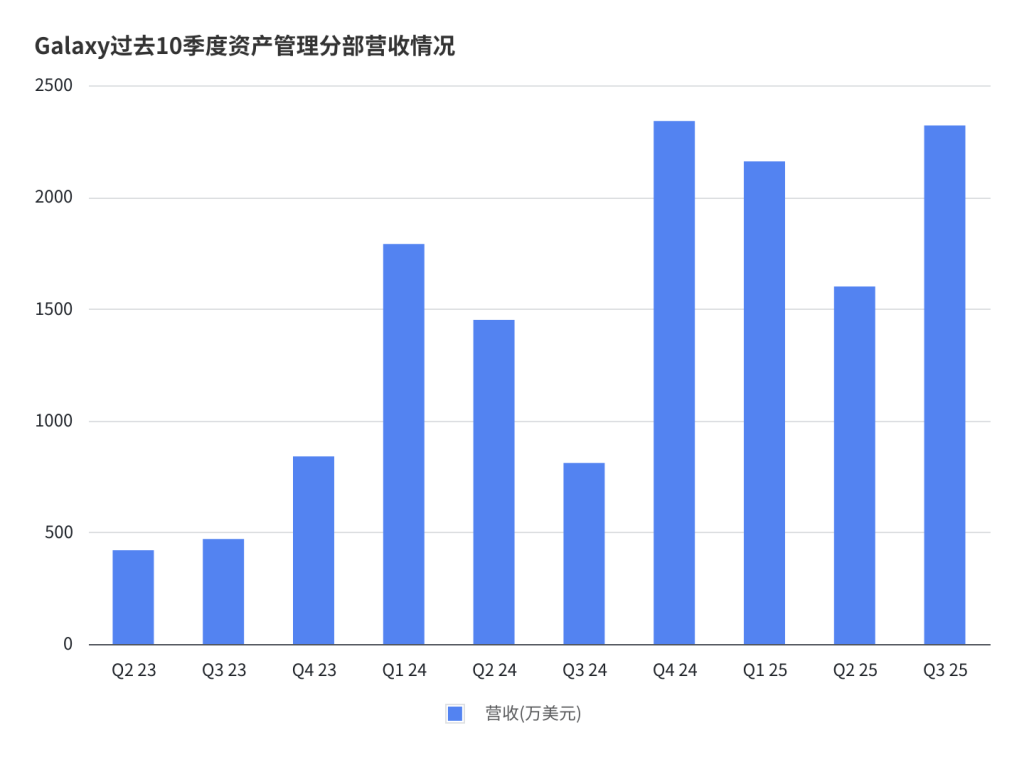
In the first three quarters of 2025, Galaxy's asset management segment continued to grow in a strong market environment. Especially in the recently concluded third quarter:
- Galaxy's assets under management (AUM) reached nearly $9 billion, with alternative investment products surging 102% quarter-on-quarter to $4.86 billion, and ETFs also growing to $3.8 billion;
- The scale of staking assets also increased by 110% quarter-on-quarter to $6.6 billion.
- Driven by this, the revenue (adjusted gross profit under GAAP) for Galaxy's asset management and infrastructure solutions segment was $23.2 million, a 44% increase quarter-on-quarter, with quarterly revenue approaching nearly half of the total for 2024.
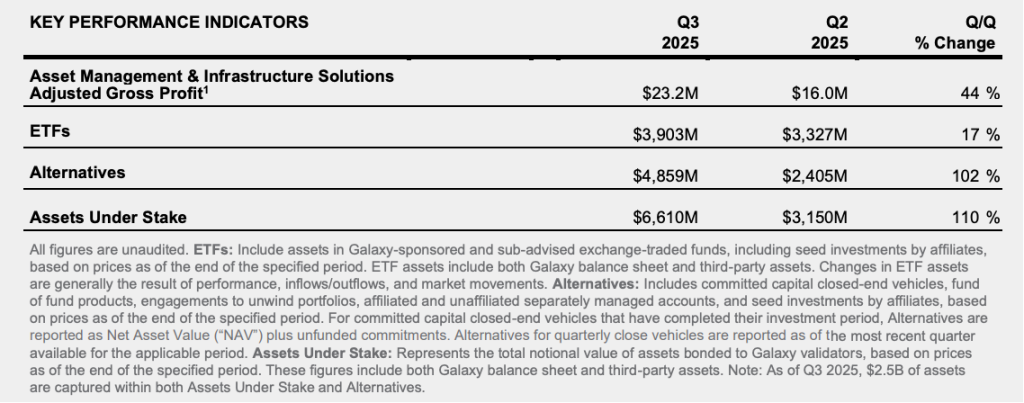 Galaxy Q3 2025 Asset Management Business Adjusted Gross Profit, AUM (including ETFs and alternative products), and Staking Asset Scale
Overall, from 2023 to 2025, Galaxy's digital asset segment, including Global Markets and Asset Management, achieved a leap from trough to peak, driven by favorable factors such as the crypto bull market, regulatory benefits, and the launch of ETFs, setting new records in both revenue and profit.
2.3 Data Centers & Computing Power
Business Content and Definition
The data center and computing power business is the second major strategic area that Galaxy Digital has developed outside of digital assets, focusing on the investment, construction, and operation of foundational computing power facilities. Its core mission is to transform abundant energy and data center resources into computing power for blockchain mining and high-performance computing (HPC), creating value for itself and its clients. Galaxy initially entered this field through Bitcoin mining: by deploying specialized mining machines and utilizing its own or hosted data center computing power to obtain Bitcoin block rewards. At the same time, the company also provides hosting services and financial support to other miners (such as machine hosting maintenance, electricity purchasing strategy consulting, and mining machine financing), building an ecosystem for mining. With the explosive growth in demand for computing power in the era of artificial intelligence and big data, Galaxy strategically adjusted in 2023, gradually expanding its data center resources for AI model training, cloud rendering, and other high-performance computing tasks. Specifically, Galaxy collaborates with AI infrastructure companies to transform its large campuses into artificial intelligence computing power supply bases, obtaining stable rental and service income through a model of leasing electricity and server racks (equivalent to providing "Infrastructure as a Service (IaaS)").
Currently, Galaxy's most core data center asset is the Helios data center campus located in Dickens County, Texas, USA. The Helios campus was originally developed by Argo Blockchain, aiming to utilize the cheap renewable energy (wind and solar) in West Texas for Bitcoin mining. However, at the end of 2022, soaring natural gas prices led to increased electricity prices, and Argo lacked effective fixed-price electricity procurement agreements, leaving it fully exposed to extreme fluctuations in electricity prices. Under the pressure of a liquidity crisis, Argo sold the Helios facility to Galaxy Digital for $65 million in December 2022 (along with an additional $35 million loan).
For Galaxy, this transaction included not only physical assets but also the critically important 800 MW grid connection approval capacity. Currently, in Texas, the queue time for grid connection approval for large loads has extended to over four years, making Helios's existing grid connection permit one of the most valuable intangible assets on its balance sheet. In terms of scale, 800 MW places Helios in the top tier of global computing power campuses—by comparison, Google's new AI data center planned in Arizona has an estimated power of about 1200 MW, and Microsoft's expansion projects in Iowa and other locations are in the 300-600 MW range. Therefore, Helios's scale is quite substantial, and if the long-term vision of 3.5 GW is achieved (with the remaining 2700 MW grid connection permit still under approval), it will be more than twice the size of the current largest data center clusters in the world.
In terms of specific business operations, Galaxy does not directly operate AI cloud services but has signed a long-term hosting agreement with CoreWeave for 15 years. CoreWeave is a top cloud service provider backed by NVIDIA, with an extreme demand for computing power infrastructure. A series of long-term leasing agreements signed between the two parties effectively convert Galaxy's electricity resources into bond-like stable cash flows. Currently, CoreWeave has exercised all available options, locking in the entire 800 MW of approved power capacity at Helios. The cooperation between the two parties adopts a Triple-Net leasing structure: Galaxy is primarily responsible for providing the physical shell and electricity access, while CoreWeave must bear its own electricity costs (including the risk of electricity price fluctuations), equipment maintenance costs, insurance, and taxes. In this model, Galaxy resembles a digital real estate developer rather than an operating service provider, resulting in a high level of cash flow stability. For Galaxy, its revenue is almost equivalent to net profit, and the EBITDA profit margin for this business is expected to reach as high as 90%.
Galaxy has divided the development of the Helios campus into multiple phases: Phase I plans to deploy 133 MW in the first half of 2026, Phase II will deploy 260 MW in 2027, and Phase III will deploy 133 MW in 2027, providing a total of 526 MW of "critical IT load" for server use (corresponding to a total power capacity of 800 MW). To meet CoreWeave's needs, Helios is accelerating the transformation from a "mining farm" to an "HPC data center," primarily including upgrades to cooling systems, redundant architecture, and structural reinforcement.
Important Development Milestones
- 2018–2020: Driven by the bull market in digital assets, Galaxy recognized the significant value of upstream computing power and began to venture into the Bitcoin mining sector. Initially, the company adopted a cooperative hosting model, entrusting mining machines to professional mining farms while providing financing for mining machines and other financial services such as over-the-counter hedging, accumulating experience and resources. During this period, Galaxy discreetly invested in several mining infrastructure projects and formed a team proficient in power and mining machine technology to prepare for future self-built mining farms.
- 2021: Galaxy officially announced the establishment of the "Galaxy Mining" mining department, elevating mining to one of the company's core strategies. That year, Galaxy expanded its cooperation with several large mining farms in North America and actively sought suitable locations in Texas and other areas to build its own data centers.
- 2022: This year marked a milestone for Galaxy's data center business. On December 28, 2022, Galaxy announced the acquisition of the Helios Bitcoin mining facility located in Dickens County, Texas, from Argo Blockchain for $65 million (including a full set of operational assets) and provided Argo with a $35 million loan to help it through its liquidity crisis. The Helios facility had just begun operations, with a built capacity of 180 MW and significant expansion potential. After the acquisition, Galaxy immediately took over operations, establishing it as a core mining base. The company announced plans to increase Helios's operational power to 200 MW by the end of 2023, with part of the capacity used for hosting third-party mining machines and part for Galaxy's own mining. This acquisition greatly enhanced Galaxy's mining landscape and was seen as "Galaxy owning its own Bitcoin mining factory."
- 2023: Galaxy's data center business began transitioning from a "mining model" to a "mining + computing power leasing dual track." In the first half of the year, the Helios facility steadily expanded: by mid-2023, approximately 3 EH/s of computing power had been deployed, with Galaxy's own and hosted operations each accounting for half. The rebound in Bitcoin prices in the first half of the year also restored profitability in mining operations. In Q2 2023, Galaxy revealed in its financial report that its mining department's Hashrate Under Management (HUM) reached approximately 3.5 EH/s, with the unit cost of BTC production in the self-operated segment remaining relatively low in the industry. In the second half of the year, while continuing to enhance Helios's Bitcoin computing power, the company proactively negotiated with CoreWeave to explore the possibility of leasing part of Helios's power and space for deploying GPU servers. In September 2023, Galaxy reached a preliminary agreement with CoreWeave, planning for Galaxy to provide space and power infrastructure at Helios, with CoreWeave gradually deploying AI equipment. This marked the beginning of the strategic transformation of Galaxy's data center business. By Q4 2023, Galaxy's mining business Hashrate management scale rose to 6.1 EH/s, with a total of 977 BTC mined throughout the year; however, the company clearly stated that it would reduce self-operated mining scale after the agreement took effect and focus on the transformation and construction of Helios.
- 2024: This year, Galaxy's data center business focus completely shifted to HPC. On March 28, 2024, Galaxy announced the signing of a formal lease agreement for Phase I with CoreWeave: Galaxy would provide 133 MW of "critical IT load" at Helios for CoreWeave to deploy AI/HPC infrastructure, with a lease term of 15 years. According to the terms, CoreWeave would pay rent to Galaxy in a manner similar to data center hosting, with a total expected revenue of approximately $4.5 billion over 15 years for Galaxy. Galaxy stated that it plans to deliver the full capacity of Phase I for CoreWeave's use by the first half of 2026. Shortly thereafter, in April 2024, CoreWeave exercised the first option in the contract (Phase II), adding an additional 260 MW of IT load at Helios, bringing the total commitment to 393 MW. Galaxy stated that this Phase II contract would be executed under similar economic terms as Phase I (i.e., long-term lease), with Phase II capacity expected to be delivered in 2027. Meanwhile, Galaxy began significantly reducing its Bitcoin mining investments: in the first half of 2024, it sold some mining machines and gradually shut down the expansion plans for self-operated mining machines, reallocating the freed-up power and space at Helios for retrofitting the facility to accommodate high-density GPU servers. On November 7, 2024, Galaxy announced that it had reached a term sheet for financing the Helios project with a large financial institution. Subsequently, in 2025, it officially closed the financing (see below). By the end of 2024, Galaxy's mining business Hashrate had decreased to 6.1 EH/s, with some mining machines in a standby state for sale; the profit from self-operated mining accounted for a declining proportion of the company's overall performance, while capital expenditures in the data center segment surged, entering an investment phase. However, this year, Galaxy successfully completed its strategic pivot: from a pure Bitcoin mining operator to an AI data center developer with long-term contracts with major clients.
- 2025: Galaxy's data center business entered a full construction and financing phase. On August 15, 2025, Galaxy announced that it had completed project financing totaling $1.4 billion (debt financing) to accelerate the development of the Helios AI data center. The loan was led by a large institution, issued at an 80% Loan-to-Cost ratio, with a term of 3 years, secured by the assets of Helios Phase I. Galaxy contributed $350 million in equity to support this, bringing the total funding for Phase I to $1.7 billion. This means that the construction and retrofitting of Helios Phase I (including substation upgrades, cooling systems, structural reinforcement of the facility, etc.) received ample financial support, ensuring timely delivery. In August 2025, Galaxy also disclosed that CoreWeave had exercised the final option (Phase III), locking in an additional 133 MW of capacity, bringing the total leased amount at Helios to 800 MW. At this point, all of Helios's approved power capacity was covered by leases, achieving 100% occupancy. The company expects that, based on the contract terms and full utilization of the 526 MW IT load, the Helios project could generate over $1 billion in average annual revenue over the next 15 years, becoming an important long-term cash flow source for Galaxy. To plan for the long term, Galaxy acquired additional land around Helios in 2025, expanding the total area of the campus to over 1500 acres, which could support a potential power load of up to 3.5 GW (nearly double the current 800 MW). These capacity expansions are still under research with the grid operator ERCOT, and once approved, will be implemented in phases. In October 2025, Galaxy received a $460 million equity investment from a top global asset management company to support the Helios project construction and other company purposes. Market rumors suggest that the investor is BlackRock (not yet officially confirmed), and this investment, once completed in phases, will grant the investor a certain equity stake, symbolizing traditional mainstream institutions' recognition and support for Galaxy's computing power strategy. By the end of 2025, Galaxy stated that the construction of Helios Phase I was progressing as planned, with 133 MW set to be delivered to CoreWeave in the first half of 2026; preparations and infrastructure for Phase II were also underway, with an expected delivery in 2027; Phase III is planned to start delivery in 2028.
Financial Reports and Public Report Summary (2023–2025)
Mining Business Performance: In 2023, Galaxy's mining business was in the investment phase just after acquiring Helios, and due to the sluggish Bitcoin prices, the overall performance for the year still resulted in a loss. However, in 2024, with the price rebound and operational optimization, the mining segment turned profitable and contributed stable cash flow. In 2024, Galaxy's mining department generated $94.9 million in revenue, directly mining 977 BTC; after deducting operating costs such as electricity, the average gross margin for the year was approximately 50%. However, Galaxy has indicated in its financial report that due to the strategic transformation, mining revenues will significantly decline in 2025. In 2025, as mining machines were gradually sold and taken out of operation, Galaxy's mining revenue decreased sharply. In Q3 2025, the data center segment (mainly mining) generated only $2.7 million in adjusted gross profit. Galaxy expects that as the Helios transformation progresses, there will be almost no significant mining profits in the second half of 2025, until some remaining mining machines are restarted in 2026 or strategies are adjusted based on market conditions.
AI/HPC Hosting Business Prospects: Since the contract between Helios and CoreWeave will not begin execution until 2026, there will be no recurring revenue recorded for this part from 2023 to 2025. Galaxy will capitalize the costs during the construction period, so the short-term profit and loss statement has not been significantly impacted. The company clearly stated in its Q3 2025 financial report: "Galaxy expects that before the first half of 2026, the adjusted gross profit and EBITDA contributed by the data center segment will not be significant" (i.e., still in the preparation phase). However, at the same time, Galaxy has provided investors with future revenue guidance: once Helios is officially delivered for operation, the data center segment will become a new cash cow for the company. Based on the signed contracts, Galaxy expects to start recognizing substantial rental income in the first half of 2026, and since the counterparties will bear the operating costs, Galaxy's gross margin is expected to be quite considerable (similar to a REIT model). In the announcement in August 2025, Galaxy disclosed that after all contracts are executed, it will generate over $1 billion in annual revenue on average, totaling over $15 billion over 15 years, several times the current asset scale of the company. Even considering operating costs and loan interest, the net profit contribution is also expected to be considerable. This prospect attracted attention in the capital markets in 2025: Galaxy's stock price surged by about 60% after announcing full occupancy and financing news, reflecting investors' reassessment of the value of its "computing power segment." In summary, from 2023 to 2025, the data center business is still in the "seeding" phase financially, but its future "harvest" potential has been repeatedly emphasized in financial reports and management discussions, making it an indispensable part of Galaxy's narrative.
Summary
In summary, Galaxy Digital's three core business modules—global markets, asset management and infrastructure solutions, and data center computing power—each cover different segments of the digital asset ecosystem's value chain, forming a complementary and synergistic relationship under the company's strategy. The global markets module provides revenue from trading and investment banking, leading the market frontier; the asset management and infrastructure module accumulates long-term management fee income and technical advantages, binding high-quality clients; the data center computing power module is expected to bring substantial and stable cash flow, supporting the company's performance "safety net." Through a clear strategic layout and a series of bold acquisitions and collaborations, Galaxy has positioned itself as a unique player straddling finance and technology. In the rapidly changing landscape of the digital asset industry, the growth potential and mutual support exhibited by Galaxy's various modules give it a rare cyclical resilience and comprehensiveness in the eyes of investors. This also explains why an increasing number of institutional investors are showing interest and confidence in Galaxy. Looking ahead, the three modules of Galaxy are expected to continue advancing together, constantly creating new milestones and achieving value co-creation for shareholders and clients.
3. Industry Analysis
According to the analysis above, the businesses undertaken by Galaxy can be divided into two industries: the cryptocurrency industry and the AI computing power infrastructure industry. We will now analyze the current status and development trends of these two industries in detail.
3.1 Cryptocurrency Industry
Industry Status: Market Capacity, Participants, and Structure
Market Size and Major Participants: The cryptocurrency market is regaining growth momentum in 2024-2025, with North American trading activity accounting for about 1/4 of the global share. By mid-2025, North America received approximately $2.3 trillion in cryptocurrency trading value within a year, with monthly peaks occurring in December 2024. The global total market capitalization approached $4 trillion by the end of 2024, with trading volumes also reaching historical highs. In terms of market participants, centralized exchanges (CEX) still dominate the vast majority of spot and derivatives trading: in 2024, the annual spot trading volume of the top 10 CEX reached $17.4 trillion, doubling from the previous year. The share of decentralized exchanges (DEX) has rapidly increased in recent years, with DEX trading volume accounting for about 7.6% of the global total in the first five months of 2025, a significant increase from 3% in 2023. Additionally, large market makers and OTC institutions provide off-exchange liquidity, regarded as the "third pillar of liquidity" following CEX and DEX. Especially for large funds in the hundreds of millions of dollars, OTC trading can avoid public market impacts and facilitate large transactions behind the scenes. Leading market makers and brokers (such as Galaxy Digital, Jump Trading, Wintermute, Cumberland, etc.) play a key role in providing liquidity to exchanges and facilitating large off-exchange transactions. Traditional institutional investors (hedge funds, asset management companies, etc.) are increasingly participating, entering the digital asset market through high-level accounts on exchanges or OTC channels, making the proportion of "large" transactions (>$10 million) in the North American market as high as 45%, far exceeding other regions.
Market Structure Changes and Liquidity: In terms of market structure, there has been a recent trend of integration between on-exchange and off-exchange trading. On one hand, centralized exchanges have undergone a reshuffle; after events like FTX, compliant platforms in North America (such as Coinbase and Kraken) have solidified their positions, while some trading volume has shifted to off-exchange (OTC) and on-chain DEX. Since 2024, OTC market trading has surged: monthly OTC trading volumes in 2024 have consistently exceeded the same period last year, with fourth-quarter off-exchange trading volume increasing by 106% year-on-year, and a further year-on-year surge of 112.6% in the first half of 2025. Institutions tend to complete positions through "dark pool" OTC to reduce impacts on public market prices. This has made OTC an invisible liquidity pool, playing a greater role in smoothing market fluctuations. On the other hand, improvements in decentralized trading technology (such as on-chain order books and Layer 2 scaling) have driven DEX to achieve breakthroughs in long-tail assets and perpetual contracts markets. For example, by 2025, the trading share of decentralized perpetual contract platforms (such as Hyperliquid) has significantly increased. Although CEX still accounts for over 70-80% of total trading volume, DEX, with its transparency and trustless advantages, is becoming an important venue for users to exchange emerging tokens and stablecoins. Overall, market liquidity has significantly improved after the lows of 2022, with the daily trading volume of mainstream cryptocurrencies (BTC, ETH, etc.) returning to the tens of billions of dollars range. Stablecoins have played a key role in enhancing liquidity and transparency: US dollar stablecoins are widely used as a pricing unit, and by the end of 2024, the number of on-chain stablecoin transfers in North America reached a historical high. Because stablecoin transactions are transparent and traceable on-chain, the flow of funds between on-exchange and off-exchange has become more monitorable, thereby enhancing market transparency. Some institutions have also used on-chain analysis tools to monitor fund dynamics, resulting in improved information transparency in the entire market compared to a few years ago. In summary, the North American cryptocurrency trading market is evolving towards a more institutionalized and multi-layered structure: CEX provides basic liquidity and fiat entry/exit, DEX offers long-tail assets and trustless trading, while OTC serves as a connector for large funds, collectively forming a mature market system.
Regulatory Dynamics: The regulatory environment in North America (mainly the United States) has undergone significant changes in recent years, directly affecting market structure and participant behavior. The U.S. Securities and Exchange Commission (SEC) and the Commodity Futures Trading Commission (CFTC) have had disagreements over the classification of digital assets, leading to regulatory uncertainty: the SEC has classified most tokens as securities and intensified enforcement, taking legal action against exchanges like Coinbase and Binance in 2023 to "enforce rather than regulate" and clean up illegal issuance and trading. Meanwhile, the CFTC has classified Bitcoin and Ethereum as commodities, authorizing exchanges like the CME to offer regulated futures and options trading. This overlap in SEC/CFTC jurisdiction has resulted in regulatory fragmentation—some trading products can only participate in CFTC-regulated futures markets (such as Bitcoin futures ETFs), while spot exchanges face pressure from the SEC to delist certain tokens or restrict trading options for U.S. users.
The changes in the U.S. political landscape at the end of 2024 brought about a regulatory shift: the new government has shown a more open attitude, with the SEC, OCC, and other agencies retracting previous stringent guidelines that hindered banks from engaging in cryptocurrency business, instead formulating clearer frameworks to encourage traditional institutions to participate. In early 2025, U.S. regulators halted a series of high-profile investigations and enforcement actions, seen as a signal to end the "enforcement regulation" model, with the presidential task force even proposing a policy vision to make the U.S. a "global crypto capital." This policy relaxation directly boosted market confidence and institutional participation. While regulatory clarity has improved, compliance requirements are also increasing: exchanges must adhere to stricter KYC/AML and asset transparency standards, and licensed custodians are gradually entering the market to provide compliant custody and settlement services. Notably, the approval breakthrough for cryptocurrency spot ETFs has become a milestone in U.S. market regulatory dynamics. In early 2024, the first Bitcoin spot ETFs in the U.S. were approved for listing, leading to a boom in cryptocurrency investment products. By July 2025, the global Bitcoin ETF management scale had reached approximately $179.5 billion, with U.S.-listed products accounting for about $120 billion. By intervening in the form of spot ETFs, cryptocurrency assets have gained compliant investment channels through traditional brokerage firms, making it easier for institutional portfolios to allocate assets like Bitcoin. This series of regulatory dynamics has shifted the North American market environment from previous suppression to support, resulting in significant increases in trading volume and asset prices by the end of 2024. Overall, regulatory uncertainty is decreasing, and the compliance market framework is becoming more refined, clearing some obstacles for large financial institutions and publicly traded companies to engage in digital asset trading.
Development Trends: Institutionalization, Derivatives, and New Products
Institutionalization and Strengthened Compliance: The North American cryptocurrency market is undergoing a rapid institutionalization process, with participants expanding from early retail and crypto-native funds to hedge funds, asset management companies, and even traditional banks. In 2024-2025, multiple signs indicate an increase in institutional participation: the proportion of large on-chain transactions is rising, traditional investment banks are applying for trading licenses, and well-known asset management companies (such as BlackRock) are issuing cryptocurrency trust products and even spot ETFs. This is expanding market demand from simple trading to compliant custody, auditing, and risk control services. The increase in compliance demand is forcing standardization across various industry segments: exchanges are adding compliance departments and introducing on-chain analysis and monitoring tools, while OTC businesses are proactively accepting regulatory filings or obtaining licenses (for example, regions like Hong Kong and Singapore are issuing OTC licenses to attract institutional trading). The U.S. sectoral regulatory model is also prompting trading companies to adjust their business structures: some platforms choose to register as ATS (Alternative Trading Systems) or brokers, accepting SEC regulation to provide trading for security tokens; others focus on commodity-type assets regulated by the CFTC. Overall, the entry of "institutional funds" is making the market more focused on compliance transparency and risk management, driving industry reshuffling, with strong and compliant companies (such as Coinbase and Fidelity Digital Assets) gaining advantageous positions. Companies like Galaxy Digital, which have a Wall Street background and cover multiple businesses, are viewed as preferred partners by many institutions because they can provide one-stop compliance services and experience. For example, Galaxy, as a cryptocurrency investment bank, has established confidence among institutional clients based on the Wall Street experience of its founding team and corporate governance, with substantial traditional funds entering the cryptocurrency space through its OTC and asset management platforms. It is foreseeable that the proportion of institutions and trading volumes will continue to rise, leading to a more mature and stable market with relatively converging volatility.
Expansion of the Derivatives Market: Derivatives have become one of the fastest-growing areas in the cryptocurrency market. As early as 2023, the global cryptocurrency derivatives trading volume was several times that of spot trading, and it has rapidly developed since 2024. In North America, derivatives trading is mainly conducted through regulated platforms under supervision: the CME's Bitcoin and Ethereum futures and options volumes have reached new highs, with the average daily trading volume of Bitcoin futures significantly increasing by the end of 2024 compared to the beginning of the year. At the same time, there is strong demand for off-exchange derivatives, with institutions often using forwards, swaps, and other tools to hedge risks or obtain returns. Traders like Galaxy provide a suite of customized derivatives services, including options and swaps, offering channels for mining companies, cryptocurrency funds, and other clients to hedge price fluctuations or amplify returns. Notably, innovative products like perpetual contracts are rising in the decentralized space, with trading volume on decentralized perpetual exchanges accounting for about 4-5% of all futures volume in 2024, further increasing in 2025. This indicates that derivatives trading is expanding from centralized to decentralized platforms. In the future, as regulations gradually allow more types of cryptocurrency derivatives (such as options based on spot ETFs, volatility indices, etc.), the capacity of the derivatives market is expected to expand, attracting more professional trading companies to participate and providing deeper liquidity and pricing efficiency for the market. Risk management and clearing will evolve accordingly, potentially introducing new models for central clearing counterparties (CCP) or blockchain smart contract clearing, enhancing the stability of the derivatives market.
Custody Integration and New Product Innovation: As institutionalization advances, the trend of integrating "trading - custody - clearing" has become evident. Compliant custodians have become a necessary component for institutions participating in digital asset trading: custodians and trading platforms are seamlessly connected through APIs, enabling rapid transfers of assets between cold storage custody accounts and exchanges, thus ensuring security while not missing trading opportunities. This integration has given rise to the "crypto prime brokerage" model, providing comprehensive services such as custody, financing, and execution both on and off the exchange. For example, Coinbase and Fidelity have launched comprehensive platforms aimed at institutions. Galaxy Digital is building a similar all-encompassing service system by acquiring custody technology (such as its acquisition of the GK8 self-custody platform) and integrating its own OTC and brokerage businesses to meet the "one-stop" needs of institutions. On the other hand, new trading products are continuously emerging and impacting market structure. Among them, stablecoins remain one of the most important innovations in the trading field: US dollar stablecoins have become the base currency for many trading pairs, reducing friction in fiat deposits and withdrawals and enabling 24/7 continuous trading. In the second half of 2024, the use of stablecoins surged, with monthly on-chain transfer numbers reaching record highs. The widespread application of stablecoins has improved the international consistency of market liquidity, ensuring that there is a significant amount of US dollar liquidity available for trading at any time globally. Additionally, the emergence of physically-backed ETFs (such as Bitcoin spot ETFs) in North America has provided a bridge for traditional funds to enter the market. After the first Bitcoin physical ETFs were launched in 2024, their scale skyrocketed to hundreds of billions of dollars within a year. The combination of stablecoins and ETFs allows investors to choose between two distinctly different channels to gain exposure to crypto assets, either on-chain or through securities accounts, which will somewhat change the trading structure: some trading volume may shift from crypto-native exchanges to ETF products listed on traditional exchanges (especially for long-term allocation funds), while stablecoins continue to play a role in on-chain and off-exchange trading settlement. Overall, the emergence of new products in the crypto trading market enriches investment strategies and triggers a reconfiguration of market structure, requiring industry participants to continuously adapt to the opportunities and challenges brought by innovation.
Characteristics of the North American Market and the Role of Galaxy Digital
Regulatory Fragmentation and Regional Characteristics: One major characteristic of the North American (U.S.) market is its complex regulatory system, which coexists at both federal and state levels. This has led to particularly pronounced regulatory fragmentation in the crypto space: the SEC and CFTC are in a tug-of-war over jurisdiction, federal regulations have yet to be unified, and various states (such as New York's BitLicense and exemptions in Xinjiang) have their own regulations, requiring market participants to navigate compliance requirements cautiously. This environment has historically created uncertainty for exchanges and investors; for example, some U.S. exchanges have reduced the range of tokens listed for compliance reasons, and institutions have slowed their investments due to concerns about regulatory repercussions. On the other hand, North America's highly developed financial infrastructure and rule of law environment have positioned it at the forefront of compliance innovation. The U.S. has launched futures-based crypto ETFs, and Canada was the first to approve Bitcoin spot ETFs, reflecting North America's willingness to embrace new assets within traditional frameworks. Investors in the U.S. and Canada are also more accustomed to regulated investment channels, preferring to trade digital assets through monitored platforms. This has made compliant custodians and regulated trading platforms crucial in North America. For instance, the Bakkt platform, established by ICE, the parent company of the New York Stock Exchange, initially attracted significant attention as a regulated digital asset custody and futures exchange, despite undergoing several strategic adjustments. Coinbase, as the largest compliant crypto exchange in the U.S., holds significant shares in both retail and institutional markets, and since its listing, it has leaned towards regulatory cooperation, being viewed as a "white list" member of the industry. In contrast, many global exchanges (such as Binance) face strict restrictions or have exited the North American market. This has led to a more localized trading landscape in North America, dominated by a few compliant giants (such as Coinbase and Kraken) and specialized service providers. North American investors also place a greater emphasis on transparency and auditing, requiring platforms to regularly disclose asset reserves and undergo independent audits, which are higher than some overseas market standards. Overall, the North American market is known for its high compliance and high institutional participation, and while its structure has been fragmented due to regulatory division, it is expected to gradually unify through new legislation (such as the market structure bill promoted by Congress) around 2025, laying a systemic foundation for the long-term development of the industry.
Roles of Platforms like Coinbase/Bakkt: Coinbase, as the undisputed leading exchange in North America, plays a dual role in the ecosystem as both a "retail entry + institutional portal." Its retail trading volume is substantial, and its institutional business (Coinbase Prime) serves hedge funds, corporate treasuries, and others, providing custody and large-scale matching services. After its listing, Coinbase became well-capitalized and actively developed its derivatives business starting in 2023 (gaining regulatory approval to offer crypto futures trading to U.S. users), becoming one of the main liquidity providers in the U.S. market while solidifying its spot market share. Bakkt initially started with physically delivered Bitcoin futures, attracting attention but with limited trading volume. Bakkt later transformed into a digital asset custody and settlement network aimed at institutions and businesses, entering the securities brokerage crypto service sector through acquisitions (such as acquiring Apex Crypto). Although Bakkt has a quieter presence on the retail side, it is backed by a traditional exchange group and has accumulated resources in compliant custody and payments. In the North American market, platforms like Bakkt with traditional backgrounds provide secure and compliant infrastructure for institutions, complementing the services of emerging crypto companies. It can be said that Coinbase represents a typical case of a crypto-native enterprise successfully embracing regulation and growing, while Bakkt represents the exploration of traditional finance entering the digital asset space. Both have enhanced North America's appeal to mainstream institutions. In addition to these two, licensed U.S. trading platforms like Kraken and Gemini also have their unique characteristics (for example, Gemini focuses on compliance and conservative listing strategies, while Kraken offers a variety of derivatives), collectively forming a matrix of North American trading platforms. The existence of these platforms ensures that institutions in the U.S. have "reliable" trading channels without having to rely on offshore markets, making the North American trading ecosystem healthier and more transparent.
Galaxy Digital's Positioning and Competitive Landscape: As mentioned in the previous business analysis, Galaxy's core positioning in the crypto trading space includes: market making/OTC brokerage, institutional brokerage and advisory, investment banking, asset management, and infrastructure. Through a diversified layout, Galaxy has established a certain degree of business synergy: its self-developed GalaxyOne trading platform, deep institutional relationships, and diversified revenue sources allow it to stand out in competition. In contrast, other competitors in the North American market have their own focuses: Coinbase emphasizes exchanges and custody, Fidelity focuses on custody and custody trading, while market makers like Cumberland and Jump specialize in market making, and traditional investment banks like Goldman Sachs and Citigroup also provide some brokerage or liquidity services. However, Galaxy, with its "trading + asset management + infrastructure" full-stack model, is relatively unique in the industry. Its main competition comes from comprehensive platforms like Coinbase and some emerging crypto financial companies (such as Fidelity Digital Assets, Anchorage, FalconX, etc., as prime brokers). Galaxy's advantages lie in its breadth of services and flexibility: it can act as a market maker providing deep liquidity (which is the most valued factor by institutions) while also obtaining high-end client business in its investment banking role. Recently, Galaxy successfully raised funds by listing on NASDAQ (in May 2025), enhancing its brand and transparency.
Overall, in the landscape of the North American institutional crypto market, Galaxy Digital occupies a leading position in the second tier: it may not be as large as Coinbase, but it has established a strong reputation in the institutional service sector, forming a competitive and cooperative relationship with traditional giants and specialized market makers. Looking ahead, as the crypto market becomes further institutionalized, Galaxy is expected to secure a place in the North American digital asset investment banking/brokerage sector through its comprehensive layout and compliant operations, shaping the industry landscape alongside other leading players.
3.2 AI Computing Power Infrastructure Industry
Industry Status: AI Computing Power Demand and Bottlenecks
Explosive Demand for AI Computing Power: In recent years, the demand for computing power for training and inference of artificial intelligence models has surged exponentially. Especially for large-scale pre-trained models (such as GPT-4, PaLM, etc.), the number of parameters reaches hundreds of billions, and their training process requires massive parallel computing. From 2023 to 2025, large tech companies and startup AI labs are competing to train larger models for applications in natural language processing, image generation, and other fields, directly driving an explosion in demand for GPU clusters. Industry observations indicate that training cutting-edge AI models often requires hundreds or even thousands of high-end GPUs running continuously for weeks or even months, a computing demand far exceeding that of traditional applications. Even in the model deployment phase, AI inference services supporting millions of users also require substantial computing power. This trend has made computing power a key "production resource" in the AI era, with a growing imbalance between supply and demand. North America, as a core region for AI technology development, is home to major power consumers like Google, OpenAI, and Meta, leading to particularly strong demand for high-performance computing (HPC) infrastructure. Some forecasts suggest that by 2025, global AI training computing demand will grow several times compared to 2022, urgently necessitating large-scale data center expansions to accommodate this demand. Overall, AI computing power has become a bottleneck constraining AI progress, with the industry even witnessing a "computing power arms race," as companies invest heavily to stockpile GPUs and build computing clusters in a bid to gain an edge in the new round of AI technology competition.
Transition from "Chip Shortage" to "Power Shortage": The most critical bottleneck currently facing the North American data center industry is undergoing a fundamental shift. If the focus in the past two years was on the shortage of GPU chips, the core contradiction in the next five years will be the insufficient power access and grid capacity. According to research by Goldman Sachs, driven by the dual demands of training and inference for generative AI large models, the power demand of U.S. data centers is expected to grow at a compound annual growth rate of 15% from 2023 to 2030, with total demand projected to reach 45GW by 2030. However, the reality is that the pace of building power grid infrastructure is lagging far behind this demand growth.
The power supply shortage is not merely due to a lack of generation capacity but is more about bottlenecks in the transmission and distribution network. In major data center cluster regions in the U.S. (such as Northern Virginia), the timelines for grid interconnection and substation construction have been significantly extended, with some projects' waiting times increasing from the previous 1-2 years to 2-4 years or even longer. Additionally, the supply chain for critical electrical equipment like transformers has also faced severe congestion, leading to significantly extended delivery cycles. This lag in physical infrastructure has led to a reassessment of the value of power assets with "instant access" capabilities.
In this context, the "power shell" held by Bitcoin mining companies—namely, approved large-scale power capacity, ready land reserves, water resource permits, and existing high-voltage substation infrastructure—has become a strategically valuable scarce asset. Traditional data center operators and hyperscale cloud service providers urgently need these sites to quickly deploy GPU clusters and seize the time window for AI development.
In fact, the reason Coreweave is willing to sign a lease agreement with terms that seem very favorable to Galaxy, as mentioned above, is due to the 800MV power grid connection permit of the Helios mining site. According to the Q3 2025 financial report, Coreweave has a revenue backlog of up to $55.6 billion, and its demand for computing power infrastructure is extremely high, with the main concern in the market being its performance accuracy.
Representing Enterprises and Their Strategies: The North American AI computing power infrastructure sector has seen the emergence of various players, including cloud giants, specialized computing power providers, and traditional data center companies, all working together to meet market demand.
First, large cloud service providers remain the dominant force: Amazon AWS has the most data center facilities globally and continues to invest in GPU/AI chips (developing its own Inferentia/Trainium chips) to meet customer AI needs. AWS is building or renovating available zones that support HPC in various locations across the U.S. and has launched products like the P4d instance (equipped with NVIDIA GPUs) to serve enterprises. Microsoft Azure, backed by its deep collaboration with OpenAI, is aggressively expanding its supercomputing clusters, having built AI supercomputing centers specifically for OpenAI in places like Iowa, USA. Reports indicate that Microsoft has invested billions of dollars for this purpose. Google Cloud, with its TPU cluster advantage, is also continuously expanding data centers domestically in the U.S. and providing AI platform services. These giants leverage their substantial funding and comprehensive technology to provide IaaS/PaaS services through their self-built data center networks, capturing a significant share of the high-end market.
Secondly, emerging specialized computing power cloud companies are rapidly rising, with CoreWeave as a representative player. Originating from crypto mining, CoreWeave has gained significant capital attention after transitioning to AI cloud services, raising over $1.1 billion in cumulative financing and $2.3 billion in debt financing from 2023 to 2024. It focuses on providing GPU computing power as a service, optimizing infrastructure for AI training, and continuously expanding its data center footprint. CoreWeave's strategy is to widely establish regional computing power centers across North America to serve AI companies nearby while rapidly enhancing power supply capabilities through partnerships with real estate and power partners. The continuously rising stock price after its listing and the $6.3 billion investment agreement with NVDA also reflect the market's enthusiasm.
Thirdly, traditional data centers and hosting service providers have also joined the fray: Neutral hosting providers like Equinix, while primarily focused on network nodes and enterprise hosting, have recognized the high power demand brought by the AI wave and have begun to retrofit some data centers to support GPU deployments, collaborating with cloud providers to offer "edge computing" services. Switch, a large U.S. data center operator known for its high-density design, has continued to expand its campuses in Nevada and other locations after being privatized in recent years, with its advanced cooling technology being very attractive to HPC customers.
The capital market's attitude towards this sector is extremely positive: AI computing power is seen as an opportunity for "next-generation infrastructure," with related companies frequently securing large financing and high valuations. For example, CoreWeave raised over $2.5 billion in a short period, including funding from well-known institutions like Blackstone and Coatue; its valuation has also continued to rise post-listing, with a market cap peak in June approaching $100 billion, currently still near $40 billion. TeraWulf successfully brought in Google as a strategic investor; even traditional data center REITs like Equinix have seen their stock prices boosted by AI demand expectations. It can be said that the capital market compares AI infrastructure to the early days of cloud computing infrastructure, assigning high growth expectations. Publicly listed or soon-to-be-listed computing power companies are being pursued by investors, with valuations soaring, reflecting market confidence in the sustainability of AI computing power demand. Of course, there are rational voices concerned about profit models (the interest burden from extensive borrowing) and uncertainties that may arise from chip supply bottlenecks. However, overall, AI computing power infrastructure is regarded as one of the most strategically valuable assets in the current technology cycle, with a generally positive and optimistic attitude from the capital market.
Development Trends: IaaS Model, Mining Transformation, and Regional Competition
IaaS Leasing vs. Self-Build Model Divergence: In the supply model of AI computing power, the industry is witnessing a divergence between two routes. One is the Infrastructure as a Service (IaaS)/leasing model, where specialized computing power providers or cloud vendors build large GPU clusters centrally, and enterprise users lease according to their usage. The advantage of this model is that users do not need to incur upfront capital expenditures and operational maintenance investments, allowing for flexible access to computing power to meet peak demand. CoreWeave and AWS are representatives of this route, capitalizing computing power investments to be shared among numerous customers. In AI startups and small to medium enterprises, the leasing model is the primary choice, as the barriers to building clusters independently are too high and the technology is complex. However, as the computing power demand from top AI labs and large companies continues to rise, another self-build model is gaining attention: sufficiently large institutions, for cost and control considerations, tend to invest directly in building dedicated data centers. For example, OpenAI, backed by Microsoft, has plans for self-developed computing facilities; Tesla is building its own Dojo supercomputer for autonomous driving training; some companies with extremely high computing power needs are even purchasing land and power plants to create their own campuses. The self-build model can optimize hardware architecture for specific workloads and secure long-term supply, but it tests financial strength and management capabilities. Therefore, the industry currently shows a polarization: super computing power demanders tend to vertically integrate their own infrastructure, while most small to medium AI projects still rely on third-party computing power clouds. In the coming years, a development trajectory similar to that of cloud computing may emerge—hybrid models becoming mainstream: leading tech companies will have core self-owned computing power while renting some external computing power to meet flexible demands, while medium-sized enterprises will primarily lease, supplemented by a small amount of local or edge deployments. For computing power providers, this means opportunities for customized services: offering dedicated hosting (renting an entire data center to a single client) or remote dedicated line connection services, allowing large clients to enjoy the security of self-built facilities while having the flexibility of the cloud. IaaS vendors will also lock in large clients through long-term contracts (such as CoreWeave signing multi-year leases with numerous AI labs), approaching traditional IT outsourcing models. In short, the coexistence of leasing and self-building will be a trend, depending on user scale and demand characteristics, with the industry chain finding a balance between standardized services and customized delivery.
Transition from Mining Infrastructure to HPC: A significant trend is that a large amount of infrastructure and experience originating from crypto mining is migrating to the high-performance computing (HPC, including AI computing power) sector. The crypto mining boom from 2017 to 2022 established a vast network of power contracts, substations, and server rooms in North America. These facilities, originally used to run ASIC miners or GPU mining, are now partially idle or experiencing reduced yields due to market volatility and Ethereum's transition to proof of stake (PoS). Mining companies are seeking transformation, repurposing their "power + facilities" resources for AI computing. A typical example is CoreWeave, whose founding team previously operated a large Ethereum GPU mining farm, which adeptly pivoted to AI cloud services at the right moment, leveraging its existing GPU clusters and power supply advantages to become a leading computing power company. Another example is the U.S. mining company TeraWulf, which transformed its Lake Mariner mining site in New York into an AI data center campus, bringing in AI company Fluidstack as a tenant and securing backing from Google Capital. Similarly, Canada's Hut 8, which originally operated a Bitcoin mining farm, announced a merger with a U.S. data center company in 2023, partly motivated by the desire to expand cloud computing and AI services. Many former large mining sites in Texas and North America's oil field regions are now seeing numerous HPC projects: this is due to the high compatibility between mining infrastructure (power supply, large spaces, operational teams) and HPC demand. The difference lies in the need to upgrade IT equipment (replacing ASIC miners with GPU servers), enhance cooling and networking facilities, and develop different technical operational capabilities to transition from mining to HPC. However, the overall transition is much easier than starting from scratch. This wave of transition is receiving tacit approval and even support from the government: the transformation of mining sites to HPC often creates more high-skilled jobs and improves the social benefits of power usage (AI research vs. Bitcoin hashing), leading some local governments to welcome it or provide policy incentives. It is foreseeable that in the next 2-3 years, many former crypto "computing power" bases in North America will gradually be reborn as AI "computing power" bases, providing significant increments to the AI industry supply. Additionally, for mining companies, transitioning to HPC also helps secure more stable long-term revenue contracts, mitigating the risks of crypto market volatility. Overall, the transition from mining to HPC achieves a more optimal allocation of resources, representing a win-win phenomenon in the interplay between the crypto and AI industries. This also reflects the universality of computing power as an abstract resource—whether used for blockchain or AI, it fundamentally combines electricity and computing devices, creating greater value when applied where it is most needed.
Regional Resource Competition: With the rise of AI data center construction, competition surrounding energy and geographical advantages is becoming increasingly fierce. Texas, with its cheap electricity and relaxed regulations, has attracted a large number of projects in recent years. For example, Galaxy's Helios campus, large mining company Riot's expansion in Texas, and many independent power + computing projects. State governments are actively courting these projects, offering tax breaks, and the private grid ERCOT encourages interruptible loads to participate in balancing, allowing these computing centers to enjoy cheap electricity during low-demand periods and temporarily reduce loads during peak times to earn subsidies. Some companies are even collaborating directly with wind and solar farms to create green AI computing power bases that integrate source, grid, and load. Meanwhile, regions like Virginia on the East Coast emphasize their mature data center ecosystems and low network latency, targeting AI needs from government and financial institutions. The competition here is more about securing power quotas—Northern Virginia has had to limit new data center approvals in recent years because grid growth has not kept pace with demand; operators are competing for valuable substation capacity indicators. Canada and Nordic countries are investing significant effort in competing for overseas computing power projects. Quebec, Canada, has abundant hydropower and some of the lowest electricity prices in North America; the local government had previously frozen new power allocations during the crypto mining era but is now opening the door to AI projects, hoping to attract supercomputing facilities from Europe and the U.S. (for example, some European countries have expensive energy and are considering deploying supercomputers in Canada). Nordic countries are promoting their natural cooling and renewable energy as selling points, continuously attracting investment for large-scale data centers, including AI training centers. Facebook and Google have invested in facilities in Sweden and Finland over the past decade, and these countries are now targeting a new wave of AI infrastructure. For computing power companies, regional selection has become crucial—not only concerning electricity prices but also involving policy risks (such as government carbon policies and permitting speeds) and customer positioning (being close to customers to reduce latency). Therefore, we see various regions competing to create a "computing power Silicon Valley" image, offering incentives in legislation and investment attraction. For example, Texas has passed legislation to ensure tax breaks for data centers, North Dakota has established special funds to support supercomputing projects, and even places like Las Vegas are promoting their abundant air-conditioned power resources. It is foreseeable that in the coming years, this regional resource competition will continue, resembling past scenarios where states competed for auto plants and semiconductor factories, only this time the focus is on AI data centers. The ultimate outcome may be a more decentralized and diversified deployment of computing power, closely aligned with energy sources or user groups, thereby forming a balanced regional layout of North American computing power infrastructure.
- Management, Governance, and Shareholder Situation
4.1 Key Executive Team
Galaxy Digital has a management team that combines a senior background from Wall Street with expertise in the crypto industry.
Founder and CEO Michael Novogratz is the soul of the company, known for his outspoken bullish stance on crypto, frequently sharing his market views in the media and personally overseeing major business decisions.
President and Chief Investment Officer (CIO) Christopher Ferraro previously served as an Executive Director in Goldman Sachs' investment banking division. After joining Galaxy in 2018, he has held various positions, including CFO, and is currently responsible for the company's daily operations and strategic execution.
COO Erin Brown also has Wall Street experience, overseeing operations and risk control. CFO Tony Paquette comes from traditional financial institutions, responsible for financial management and compliance disclosure.
Notably, Galaxy has also established a team in the European market, appointing former UK financial figure Leon Marshall as CEO for Europe to expand its business. The company has gathered several senior experts in the crypto field, such as Jason Urban, head of derivatives business (who previously managed crypto operations at trading giants like DRW). The diverse backgrounds and complementary skills of the management team are a significant advantage for Galaxy: they understand both financial regulation and risk, as well as crypto technology and markets, allowing them to balance aggressiveness and prudence when formulating strategies. This core team emphasized during the Q3 earnings call that the company will adhere to disciplined execution, focusing on cost control and risk management while experiencing rapid growth. Executives also stated that new products like GalaxyOne play a positive role in attracting high-net-worth clients, and in the future, they will focus on improving capital efficiency to drive long-term profitability.
The management team's past strategic judgments have performed excellently, especially during the last crypto bear market cycle (early 2022 - mid-2023), where Galaxy excelled: in addition to maintaining normal operations (many projects at that time, such as FTX, Luna, Celsius, which had far more resources than Galaxy's project team, could not maintain normal operations), they also demonstrated outstanding judgment and financing capabilities by "bottom-fishing" GK8 and the Helios mining site: GK8 became a key factor for their subsequent bull market performance, while the Helios mining site opened up a second growth curve in mining/computing power, which later completely transformed into computing power infrastructure under the management team's foresight, potentially providing $1 billion in annual revenue in the future.
4.2 Corporate Governance Mechanism
Since its establishment, Galaxy Digital has placed great importance on the transparency and compliance of its governance structure, which is a key factor in gaining the trust of institutional investors.
The company has a board of directors that includes a majority of independent directors and specialized committees for audit, compensation, and other matters, having established comprehensive governance documents and internal control processes. Legally, Galaxy initially adopted an offshore structure (limited partnership registered in the Cayman Islands) to list on the TSX, but to meet U.S. regulatory requirements, the company underwent a restructuring in 2025: "Galaxy Digital Holdings Ltd." was restructured into a Delaware-registered corporation, Galaxy Digital Inc., completing the "migration to the U.S." process. This restructuring officially took effect on May 13, 2025, and on May 16, Galaxy Digital Inc. began trading on NASDAQ (with the same stock code GLXY). Currently, Galaxy has achieved listings in both Canada and the U.S., subject to dual regulation by the U.S. SEC and Canadian securities regulators, with information disclosure and financial reporting standards consistent with those of Wall Street-listed companies. This enhances the credibility of the company's governance while expanding its investor base.
After the restructuring, all of Galaxy's limited partnership units were converted into Class A common stock and Class B units of the new company: Class A shares circulate in the public market, while Class B units are held by original holders like Novogratz, collectively accounting for about 53% of the company's voting rights. This means that the management team and early shareholders still hold a relative majority of the company's voting power, maintaining stable control over significant corporate decisions, which also reflects their confidence in Galaxy's long-term value.
4.3 Changes in Listing and Shareholder Structure
The aforementioned restructuring and listing have made Galaxy the only crypto financial enterprise currently listed in both the U.S. and Canada in North America. Listing on NASDAQ is a significant milestone in the company's development, not only significantly enhancing its international visibility but also broadening the channels for capital market participation. In the first month after the listing, driven by positive market sentiment, the GLXY stock price rose approximately 55.87%.
Galaxy is also actively bringing in strategic capital: in October 2025, "one of the world's largest asset management companies" invested $460 million in Galaxy, subscribing to 12,777,800 shares of Class A newly issued stock (with a subscription price of about $36 per share). This transaction includes both new stock issuance and a slight sale of shares by executives like Novogratz. After the completion of this investment, the asset management company holds about 7.5% of Galaxy's equity and has sent representatives to serve as observers, indicating its optimism about Galaxy's long-term prospects. However, in November-December 2025, early locked shares will gradually expire, with tens of millions of restricted shares set to be released (detailed in the next section).
Overall, Galaxy's current shareholder structure is dominated by the founding team and strategic shareholders, with the proportion of institutional investors gradually increasing. This distribution of equity helps the company maintain strategic stability while attracting external wisdom and resources. If the stock price remains strong in the future, the company may also consider a secondary offering or additional issuance in the U.S. to raise funds (as the company previously issued 29 million new shares for Helios investment after listing on NASDAQ in Q2), but the management team emphasizes that any financing measures will be carefully evaluated for shareholder interests and will not blindly dilute equity.
4.4 Release of Restricted Shares
As of mid-November 2025, the GLXY share structure is as follows:
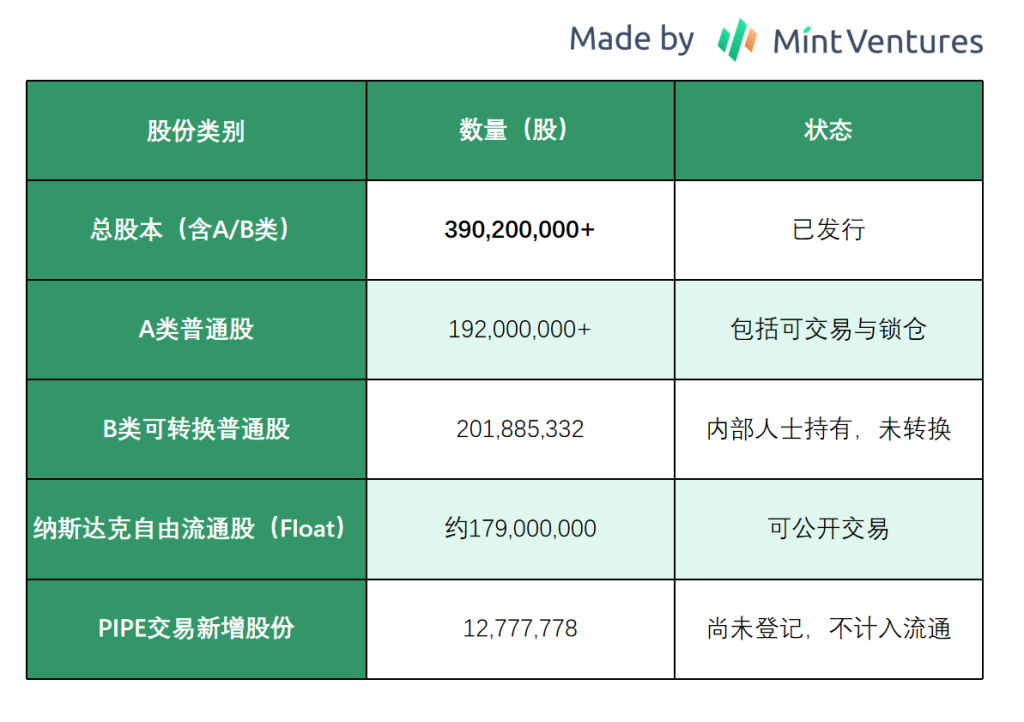
Currently, about half of the shares are still in the lock-up period. According to the IPO underwriting agreement, most restricted shares are subject to a 180-day lock-up period, which will gradually be released between November 12 and November 25, 2025; such a large scale of release is highly concentrated in a single window period, which is noteworthy.
The release of these shares mainly involves various shareholders who held shares before Galaxy Digital's listing, including the company's founders, executive team, and early investors:
- Founder and controlling shareholder: CEO Michael Novogratz controls the vast majority of the company's shares through personal holdings and his entity Galaxy Group Investments (GGI). It is reported that before the listing, Novogratz held approximately 194.59 million shares, which will theoretically gain circulation rights after the lock-up period expires, making it the core of this release.
- Co-founders / executives: President and CIO Christopher Ferraro and other early team members also hold a considerable proportion of shares. Ferraro previously held several million shares, accounting for about 1-2% of the company’s equity. Additionally, other executives (such as COO, CFO, etc.) and board members also received shares during the listing restructuring, and their holdings are also included in this release.
- Early institutional investors: Some institutions held shares during the company's private financing and Canadian listing (such as Fidelity and Vanguard, with holdings ranging from 7% to 13%). Since Galaxy migrated its listing from Canada, whether these institutional shareholders are affected by the U.S. IPO lock-up depends on specific agreements. Some institutions may not be subject to lock-up constraints (having already traded through the Toronto Stock Exchange), but they may also face certain lock-up commitments during the early stages of the U.S. listing. It is important to note that in October 2025, Galaxy brought in a top global asset management company as a strategic investor—this institution acquired 9,027,800 newly issued shares of Galaxy and 3.75 million shares transferred by executives at $36 per share. Although this strategic investment is technically not part of the May IPO restricted shares, it effectively also has a lock-up (waiting for SEC registration to take effect), and it is expected to be eligible for sale around the end of the year.
In summary, the subjects of the release in November-December include founders and related entities, the core executive team, and some early institutional/strategic shareholders. Among them, Novogratz's personal and GGI holdings are the most significant portion. Executives like Ferraro also have considerable holdings set to be released. In the early institutional aspect, the lock-up arrangements of some strategic and institutional investors also need to be taken into account.
Key Shareholder Selling Intentions
Founder/CEO Novogratz: As the absolute controlling shareholder of the company, Novogratz has shown a long-term commitment to Galaxy. Since the listing, he has only sold a very small amount of shares through directed transactions: in October 2025, he took advantage of a strategic fundraising opportunity to sell 3 million shares at a discount to new investors (including transferring 2.477 million shares through GGI and 523,000 shares personally). This reduction accounts for less than 2% of his total holdings, cashing out approximately $108 million. Choosing to sell a small amount when bringing in important strategic shareholders indicates his preference for strategic fundraising rather than selling in the secondary market. He still holds about 192 million shares, accounting for about 50% of the equity. Based on this behavior and his role as a founder, Novogratz is unlikely to have a strong intention to sell a large amount in the short term—excessive selling would weaken his control and market confidence. He has not expressed any further intention to reduce his holdings in public, instead emphasizing his confidence in the company's long-term value (for example, stressing "this is just the beginning" in his listing speech). Therefore, it is expected that Novogratz will continue to maintain his controlling position after the lock-up expires, with only a possibility of small reductions at opportune times (such as introducing long-term investors through over-the-counter block trades), and it is unlikely he will sell a large amount in the public market.
Key Executives and Directors
Compared to the founder, other executives show a significantly stronger willingness to cash out. Ferraro and others quickly reduced a considerable proportion of their holdings after the lock-up period expired: according to regulatory disclosures, Ferraro sold 750,000 shares just before the end of the lock-up period, with an average transaction price of $36, cashing out approximately $27 million. This transaction accounted for more than half of his holdings, leaving him with less than 700,000 shares. Additionally, COO Erin Brown exercised options and sold 350,000 shares in August 2025 (after a partial lock-up release). A director, Rhonda Medina, also sold 33,300 shares in September. These signs indicate that some executives/directors have a strong motivation to liquidate during the release window, especially compared to the founder, as they have higher financial diversification needs. Some executives have already realized part of their gains by utilizing the early release window, and it is expected that after the main release in November, if the stock price and market conditions allow, there may be further reductions in their remaining holdings. Although key management like Ferraro has not explicitly stated their intentions, their past selling behavior suggests they tend to cash out some shares when performance is good and stock prices are high. Investors should be cautious of the possibility of executives reducing their holdings again during the release window.
Institutional Investors
For institutional shareholders like Fidelity and Vanguard, their holdings are primarily of a strategic financial investment nature. Most of these institutions built their positions during the company's early stages or during its Canadian listing, with relatively low acquisition costs. Currently, Galaxy's stock price has surged over 100% this year, and it is possible that some institutions may consider taking moderate profits. However, these large institutional investors tend to have a long-term investment style, and passive index funds (like Vanguard) are more likely to continue holding their positions. Additionally, their holdings could already be traded through the TSX before the listing and were not strictly subject to lock-up. Therefore, the willingness of institutional shareholders to reduce their holdings is relatively mild and depends more on their assessment of the company's fundamentals. So far, there have been no reports of Fidelity or others significantly reducing their holdings in the public market; instead, there are signs that some institutions increased their holdings in the third quarter. Furthermore, the newly entered strategic investor (an unnamed large asset management company) invested $460 million to purchase shares, clearly indicating confidence in the company's long-term value. It is expected that this locked-up share will not be sold immediately after the release—this investor is more likely to prefer holding strategic equity long-term, and their entry price of $36 per share is currently at a loss. Overall, there are no obvious signs of key external shareholders being eager to sell in the short term, but they will adjust their positions flexibly based on market conditions. Attention should be paid to subsequent Form 13G/13F holding reports to assess institutional trends.
Financial Analysis
Revenue and Net Profit
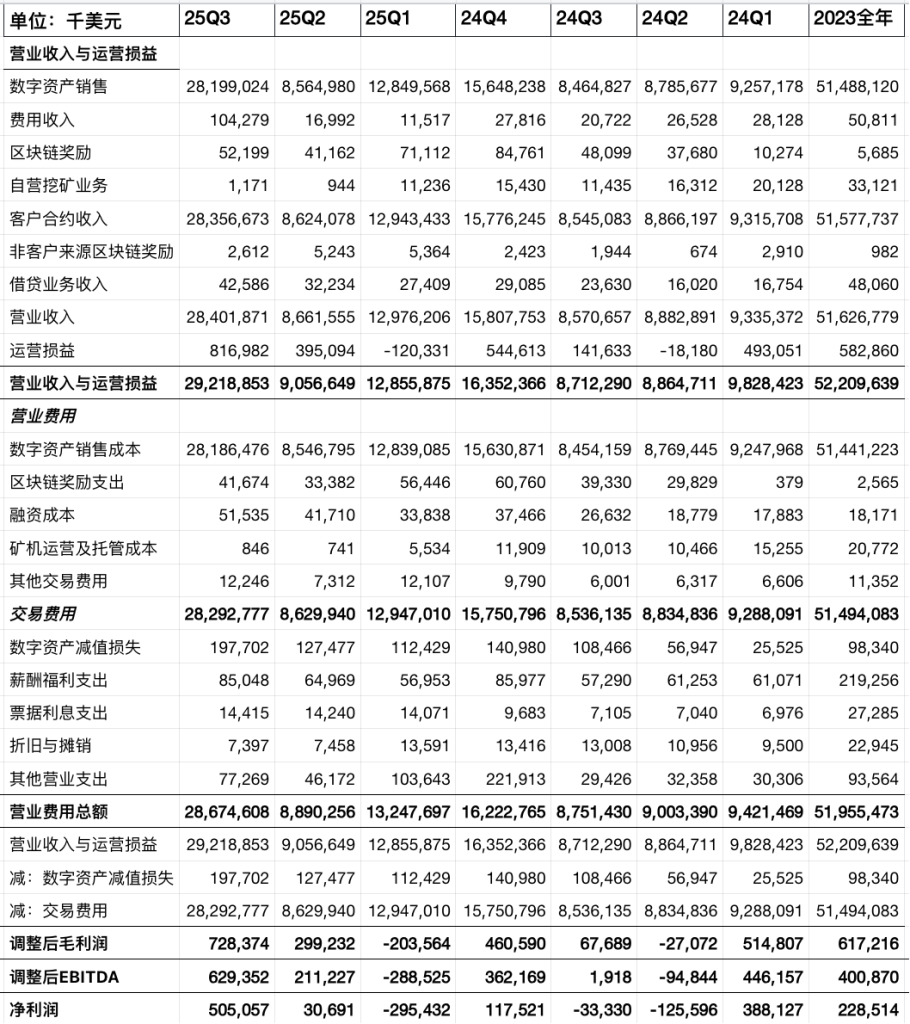 Galaxy Q1 2024 – Q3 2025 Quarterly Revenue, Expenses, and Adjusted Gross Profit Data Source
Galaxy Digital's performance has always been highly volatile. In 2022, the total loss reached approximately $1 billion (a significant reversal from a net profit peak of $1.7 billion in 2021). In 2023, with the market warming and business adjustments, the company returned to profitability, achieving a net profit of $296 million for the year. Entering 2024, performance further improved, but volatility remained high: Q1 2024 net profit reached a historical high of approximately $422 million, a 40% increase from the previous quarter; however, it then fell back—Q2 2024 turned into a net loss of approximately $177 million (as the crypto market weakened in the second quarter); Q3 2024 saw the net loss narrow to about $54 million. In Q4 2024, due to market activity and one-time project impacts, the company netted $174 million, with a total net profit of $365 million for the year. In the first half of 2025, profit momentum weakened: Q1 2025 saw a net loss of $295 million due to declines in digital asset prices and impairments in mining operations; however, Q2 2025 returned to profitability with a net profit of $30.7 million as the market rebounded; Q3 2025 was Galaxy's best-performing quarter since its listing, with quarterly net profit reaching a record $505 million.
Overall, the company's net profit has shown significant year-on-year and quarter-on-quarter fluctuations: 2023 reversed the massive losses of 2022, while the first half of 2024 saw a peak in profitability, followed by volatility in the second half due to regulatory and market factors. The first half of 2025 again saw losses, but Q3 2025 achieved the best performance in history.
In terms of revenue, after Galaxy Digital adopted U.S. GAAP in 2025, the reported "total revenue" saw a significant leap in scale, as GAAP requires the full amount of digital asset trading to be counted as revenue, with corresponding costs recorded as "trading expenses." (For example, in Q1 2025, GAAP total revenue reached $128.56 billion, with corresponding trading expenses of $130.59 billion, resulting in a very small net amount).
Compared to revenue data, the adjusted gross profit metric better reflects Galaxy's revenue level by eliminating this adjustment.
Key driving factors for the year-on-year and quarter-on-quarter changes in revenue and net profit are influenced by several factors: first, the digital asset market conditions and market activity (which affect trading business and proprietary investment returns). For instance, the bear market in 2022 led to significant unrealized losses, while the bull market rebound in 2023-24 brought trading profits and investment appreciation, and the early 2025 decline in coin prices led to paper losses. Second, the performance of key business segments: for example, the trading segment contributed major profit growth during the bull market but incurred losses during the bear market; the mining segment expanded and contributed revenue in 2023-24, but strategic adjustments in 2025 led to short-term losses. Third, one-time events: including regulatory fines, provisions, and asset impairments that significantly impact quarterly net profit, causing GAAP net profit to deviate from operational norms. Overall, Galaxy's GAAP revenue metric has limited value due to the inclusion of massive trading counterparty cash flows, and it should be viewed in conjunction with trading expenses and adjusted gross profit; while GAAP net profit is highly dependent on fluctuations in investment fair value and one-time items, these factors need to be excluded to assess recurring profit trends.
Regarding EBITDA and adjusted EBITDA, Galaxy began disclosing EBITDA and adjusted EBITDA in 2025, further excluding the impacts of stock-based compensation, fair value changes, etc., to measure operational cash profitability. For example, in Q2 2025, GAAP net profit was only $30.7 million, but adjusted EBITDA reached $211 million. These adjustments mainly added back the significant investment losses and one-time impairments for the quarter, indicating an improvement in the profitability of the company's core business.
Comparing GAAP and adjusted metrics shows that the quality of the company's recurring profits is gradually improving. From an operating loss in 2022, it transitioned to adjusted profits being positive in 2023-2024. Notably, the adjusted gross profit and EBITDA for the entire year of 2024 were significantly positive, indicating an improvement in the profitability of the business segments themselves. The gap between GAAP and non-GAAP profits mainly arises from volatile investment exposures and one-time expenses. As Galaxy reduces its exposure to proprietary risk assets and focuses on recurring revenues from fees and mining profits, the proportion of adjusted net revenue/gross profit is increasing. Although GAAP losses were recorded in the first half of 2025, adjusted EBITDA remained positive, indicating that the company's core operations still possess profitability.
In terms of the impact of one-time projects on profits, to more accurately assess Galaxy Digital's recurring profitability, several one-time or non-recurring items need to be excluded from the short-term impact on profits:
Regarding legal provisions, in Q4 2024, the company accrued $166 million in legal fees related to a settlement with the New York State Attorney General (total fees of $200 million, with $166 million accrued in Q4 2024). This fee relates to civil claims arising from Galaxy's early involvement in LUNA token investments and is considered a one-time non-operating loss. Its impact was to reduce the reported net profit for Q4 2024 to $174 million. If restored, it can be seen that the core profitability for 2024 was very strong.
Regarding asset impairments and disposal losses, in Q1 2025, the company incurred approximately $57 million in asset impairment losses and disposal expenses due to the strategic shutdown of mining machines and the transition to data centers. This was a one-time expense related to the handling of Helios mining equipment. However, this is not a recurring expense, and this loss will not recur as the data center becomes operational.
Regarding fair value changes in trading positions, as a digital asset investor and market maker, the fair value fluctuations of Galaxy's own assets and liabilities have a significant and unsustainable impact on quarterly profits and losses. The net loss of $1 billion in 2022 was largely due to a collapse in portfolio value. In Q4 2023, significant gains were recorded due to a rebound in investment holdings. The same pattern occurred in 2024: Q1 saw a profit of $422 million, partly due to unrealized gains from rising coin prices; Q2 turned to a loss related to declines in digital asset prices in the second quarter. These investment-related profits and losses are highly volatile and unpredictable, not representative of operational capabilities.
Summary
Considering the aforementioned one-time factors, Galaxy Digital's recurring profit quality is clearer and healthier. Over the past three years, excluding significant investment volatility and extraordinary expenses, the company's core business has achieved sustained profitability in 2023-2024, reaching new high levels in 2024 (with robust profits from trading and core operations). Although nominal net profit in the first half of 2025 was affected by market conditions and one-time losses, adjusted profits remained positive, indicating that the core business has resilience, while Q3 performance surged, suggesting that annual performance will set new records.
However, it is important to note that 2023-2025 are all within a bull market cycle in the crypto industry. According to the four-year cycle theory of cryptocurrencies, 2026 is expected to be a relatively subdued downward process for crypto markets. Although Galaxy performed excellently during the last crypto bear market cycle, entering a bear market would clearly bring significant funding and operational pressure to Galaxy, posing a risk of performance decline.
Moat and Core Advantages
In the fiercely competitive and rapidly changing crypto finance and computing power industry, Galaxy Digital's rise and continuous expansion are supported by its multifaceted moats and core competitive advantages:
Brand Reputation and Industry Position: As one of the few crypto financial institutions to enter mainstream capital markets, Galaxy has established a professional and compliant brand image after years of operation. The reputation and media influence of its founder, Novogratz, also lend credibility to the company. Galaxy currently ranks among the top tier in the global digital asset financial services sector and is regarded as "the Goldman Sachs of the crypto market." This industry position provides a first-mover advantage in business: for instance, when large institutions conduct massive transactions, Galaxy often becomes the preferred partner; many traditional companies looking to enter crypto are also willing to partner with Galaxy for consulting and asset management. The brand's endorsement effect allows Galaxy to acquire customers and expand its business more efficiently, creating barriers that competitors find difficult to replicate in the short term.
Key Intangible Assets and Resource Endowments
As analyzed above, the current power supply shortage in the artificial intelligence sector is not solely due to insufficient power generation but is more attributed to bottlenecks in the transmission and distribution network. The construction speed of grid infrastructure lags far behind the increasing power demand from data centers, with new power grid connection applications often facing a waiting period of 2-4 years. In this context, when Galaxy acquired the Helios mining facility, it also obtained its 800MV power grid connection permit, which has become a key intangible asset enabling Galaxy to enter the data center industry. This is also the fundamental reason why Coreweave is willing to sign a contract with Galaxy under what appears to be a very favorable 3N net leasing model. Additionally, the Helios site is rich in wind and solar power resources, providing Helios with cheap electricity, which has become a competitive advantage for Galaxy.
Comprehensive Compliance Advantage
Since its inception, Galaxy has embraced regulation, obtaining licenses such as the U.S. FINRA brokerage license and the Canadian OSC regulatory license, and has established a comprehensive compliance and risk control system internally. In 2025, the company completed its re-registration in the U.S. and went public on NASDAQ, actively accepting strict regulatory scrutiny. Compared to many unlisted or offshore competitors, Galaxy's compliance allows it to connect with a broader range of institutional funds (such as U.S. pension funds, university endowments, and other fiduciary assets) and participate in collaborative projects with traditional financial institutions (such as launching ETFs in partnership with State Street and Invesco). At the same time, the compliance advantage also reduces the company's operational risks. For instance, during the industry turbulence of 2023-2024, many non-compliant platforms faced crackdowns, while Galaxy remained unscathed due to its long-term compliance operations and settled historical LUNA trading investigations for $200 million to clear obstacles. A good regulatory relationship and compliance record are the cornerstones of Galaxy's steady development, forming an unshakeable moat.
Customer Stickiness and Comprehensive Services
Galaxy provides institutional clients with a one-stop service combination ranging from spot/derivatives trading, custody, and lending to asset management and consulting. This business synergy greatly enhances customer stickiness. For example, a company entrusting its assets to Galaxy for wealth management may also borrow through Galaxy when liquidity is needed and execute trades for hedging, creating interconnected services that make it difficult for clients to switch to other providers. Galaxy's statistics show that its customer retention and repeat business rates are among the highest in the industry. Moreover, Galaxy strengthens customer relationships through strategic investments and collaborations, such as becoming the asset manager after investing in SharpLink and partnering with platforms like Fireblocks to access thousands of potential clients. All these factors create a strong network effect: the more customers there are, the richer the company's services become, and better services attract more clients. The positioning as a comprehensive financial platform distinguishes Galaxy from single-service competitors, making it synonymous with a "one-stop crypto bank" in the minds of clients, thereby establishing a highly sticky customer moat.
Fundraising and Capital Operation Capability
Galaxy excels at utilizing capital market tools to support its development. From the early stages, it raised funds through public offerings and has successfully completed multiple rounds of financing for expansion projects. At critical strategic transformation points, the company has successfully attracted substantial equity investments from top asset management firms and large-scale debt financing, demonstrating the capital market's high recognition of its management team and business model. In contrast, many peers faced financing difficulties or were forced to downsize during the bear market, while Galaxy gained a "well-armed" advantage due to its good reputation. This fundraising capability itself is a moat—it ensures that Galaxy always has resources to invest in innovation and expansion when needed and has the capacity to acquire distressed assets (such as the low-cost acquisition of the Helios mining facility). Strong financial strength also enhances customer trust in Galaxy, especially for custody and lending services, where substantial proprietary funds provide security. In summary, Galaxy's capital operation capability allows it to remain invulnerable amid industry fluctuations, enabling it to "buy" opportunities, weather downturns, and shape long-term competitive advantages.
In conclusion, Galaxy Digital has built a multi-layered, sustainable core competitiveness through its compliance brand, customer network, synergistic ecosystem, and capital strength. These moats provide it with significant advantages when facing both new and old competitors (such as Coinbase, Bakkt, etc.) and are a key reason why investors assign it a high valuation premium. Of course, the company still needs to continuously strengthen and extend these advantages, such as investing in technology research and development to enhance trading and custody security, maintaining good regulatory communication, and exploring new synergies in AI+ finance, to maintain its leading position in future competition.
Major Risks and Challenges
Despite the positive outlook, Galaxy Digital still faces numerous risks and challenges in its medium- to long-term development, requiring investors to remain vigilant:
Regulatory and Policy Risks: The regulatory environment in the crypto industry is complex and ever-changing, and any tightening of regulations could impact Galaxy's business. For instance, if the U.S. delays passing the stablecoin bill or if the SEC takes a long time to approve a spot Bitcoin ETF, it could affect market sentiment and business growth. In the international market, differing policies across jurisdictions also pose challenges for Galaxy's cross-border business compliance. More importantly, as a publicly listed company, any involvement in regulatory investigations or legal disputes could negatively impact its reputation and finances. Although the company has cleared most historical risks by settling the LUNA incident for $200 million, "compliance risk control" remains a Damocles sword hanging over it. For example, if a DeFi business in which Galaxy is involved is deemed illegal in the future, or if there is a security incident involving its custodial assets, regulatory accountability could ensue. Therefore, Galaxy needs to continuously invest in compliance resources, maintain positive communication with regulatory agencies, and strike a balance between innovation and compliance.
Market Volatility and Cycle Risks: Galaxy's business is highly dependent on the prosperity of the digital asset market, making it difficult to completely avoid cyclical fluctuations. The crypto market exhibits significant bull and bear cycles, and substantial price volatility will directly impact Galaxy's trading volume, asset management fees, and proprietary investment gains and losses. As seen in the bear market of 2022-2023, Galaxy experienced significant losses and a reduction in AUM; if mainstream coins like Bitcoin were to decline sharply or remain depressed for an extended period in the future, Galaxy's trading and investment income would inevitably come under pressure. Furthermore, although the company is actively expanding its recurring revenue, its current profits are still heavily reliant on trading, thus increasing its dependence on market conditions. Investors should be prepared for the possibility that Galaxy's performance may fluctuate significantly with the crypto market, and the short-term instability of financial performance is an inherent risk of its business model.
Combined Risks of Crypto and AI Industry Cycles: Galaxy's strategy is now tied to two highly volatile industries—crypto and artificial intelligence. In addition to the crypto cycle, the AI computing infrastructure also faces supply-demand cycles and technological iteration risks. Currently, there is strong demand for AI training, and NVIDIA GPUs are in short supply, making the outlook for data center leasing bright. However, if the AI boom declines or competition intensifies in the next 2-3 years, computing power prices may drop, and tenants like CoreWeave could face market risks. If major tenants perform poorly or even default, it would impact Galaxy's cash flow from its computing power business. Even if leases are secure, technological upgrades in the AI field may require ongoing capital expenditures to upgrade equipment; otherwise, falling behind in computing efficiency could lead to a loss of competitiveness. Additionally, AI training also has cyclical characteristics; for instance, after the peak of large model training, demand for computing power may slow down. Galaxy has invested heavily in building Helios, and if the anticipated demand for computing power does not materialize as expected, there could be overcapacity or rental income falling short of expectations. Energy prices and policies are also variables—rising electricity prices could erode data center profits, while adjustments to electricity regulatory policies (such as power rationing or carbon taxes) could affect operating costs. In summary, Galaxy is transitioning from exposure to a purely crypto cycle to facing dual cycles of crypto and AI, which, while diversifying risks, also introduces new uncertainties, necessitating forward-looking planning and risk buffers from the company.
Execution and Expansion Management Risks: The company is currently in a phase of multi-line expansion, and advancing new businesses and geographic expansion places higher demands on management. While investment banking and asset management are rapidly developing, attracting and retaining professional talent while maintaining service quality is a significant challenge. The competition for talent on Wall Street is fierce, and Galaxy needs to compete with large financial institutions for top talent while maintaining its corporate culture. On the other hand, large projects like Helios require high levels of project management and execution capability. Building an 800MW data center campus is an unprecedented undertaking for Galaxy, involving supply chain management, construction safety, progress control, and more; any delays or cost overruns could impact investment returns. Although the project is currently progressing smoothly, potential engineering risks and operational startup issues must still be monitored. Additionally, the company has launched new platforms like GalaxyOne to serve high-net-worth individual clients, which also requires investment in customer service and technical support to avoid damaging the brand due to poor experiences. Global expansion is another challenge: Galaxy is opening offices in Europe, the Middle East, and other regions, requiring adaptation to local markets and regulations, while remote management also increases operational complexity. If expansion occurs too rapidly and management cannot keep pace, there may be internal control gaps or decision-making errors. Therefore, the company must strengthen internal governance, improve IT systems and risk management frameworks, and ensure that the pace of expansion aligns with management capabilities to avoid the "growth trap."
Competitive Risks: The industry in which Galaxy operates is highly competitive, with both traditional financial giants and emerging crypto companies. In the crypto trading space, leading exchanges like Coinbase are ramping up their institutional business, offering services similar to OTC and prime brokerage; global platforms like Binance are also vying for a share of the institutional market. In asset management, firms like Grayscale and Fidelity Digital Assets are competing for institutional funds, while platforms like Bakkt are seeking to penetrate the enterprise market through custody and payment services. The computing power sector is even more crowded, with tech giants like Amazon and Google offering cloud GPU services, and traditional data center REITs and mining companies may also pivot to compete in the AI infrastructure market. Although Galaxy currently has a clear differentiation advantage, it cannot rule out the possibility of future giants quickly catching up using their financial and customer resources. For example, if Coinbase fully expands into investment banking and lending, it could siphon off Galaxy's clients. Additionally, the emergence of innovative DeFi protocols and decentralized custody technologies could fundamentally change existing business models, posing "disruptive competition" to Galaxy. Galaxy needs to continuously monitor competitive dynamics and maintain a leading edge in products and services, without any complacency. When necessary, Galaxy should also strengthen itself through alliances or acquisitions—similar to its previous attempt to acquire BitGo (although it ultimately did not succeed), which was motivated by considerations of integrating upstream and downstream operations. Overall, competitive risks require Galaxy to continuously innovate and respond quickly; only by doing so can it maintain a favorable position amid industry reshuffling.
Other Risks
Macroeconomic changes and market liquidity fluctuations can also impact Galaxy's performance. For instance, if the global economy enters the tail end of a rate hike cycle or even shifts to rate cuts, it may temporarily boost risk assets and uplift crypto market sentiment. However, long-term low interest rates could reduce the yield spread of stablecoins. Geopolitical risks (such as a sudden ban on crypto trading by a country) can also affect the market. Additionally, the risk of technological security should not be overlooked. Although Galaxy has a robust risk control system, any incidents such as hacking attacks or smart contract vulnerabilities leading to asset losses would severely damage the company's reputation and customer trust. Galaxy has remained highly vigilant in this regard, continuously upgrading security measures and purchasing insurance as a precaution. Lastly, the risk associated with key personnel is worth mentioning: Novogratz, as the company leader, has a significant impact on Galaxy's strategy and market confidence. If he were unable to perform his duties due to unforeseen circumstances, or if there were turmoil within the executive team, it could impact the company's stability. However, Galaxy has gradually established a systematic governance structure, and its executive team is becoming increasingly diverse, suggesting that even in the event of personnel changes, the company's operations can continue.
In summary, Galaxy Digital must cautiously navigate various challenges related to regulation, market conditions, and execution on its growth path. Some measures currently being implemented by the company (such as increasing the proportion of recurring revenue, advancing compliance for public listing, and securing computing power leases) have mitigated risks to some extent. However, investors should maintain rational expectations and recognize that high growth comes with high volatility. As the management team has stated: "There are still uncertainties in the macro and industry environment, and short-term volatility risks are high." Only by traversing cycles with risk control and prudent operations can Galaxy realize its long-term value.
Valuation Analysis
Galaxy Digital's business is clearly divided into the digital asset module and the AI computing power module, with significantly different valuation logic for these two parts. We will use a segmented valuation approach to assess GLXY.
Business Segment Division and 2025 Performance Forecast
Digital Asset Financial Services Segment: Galaxy's core operations include global market trading, over-the-counter (OTC) trading, crypto brokerage, investment banking advisory, and active/passive digital asset management. This segment's profit model is similar to that of a crypto investment bank and trading platform. In the first three quarters of 2025, the adjusted gross profits for this segment were -$203 million, $299 million, and $728 million, totaling approximately $824 million, but these figures are highly volatile due to the fluctuations in cryptocurrency prices.
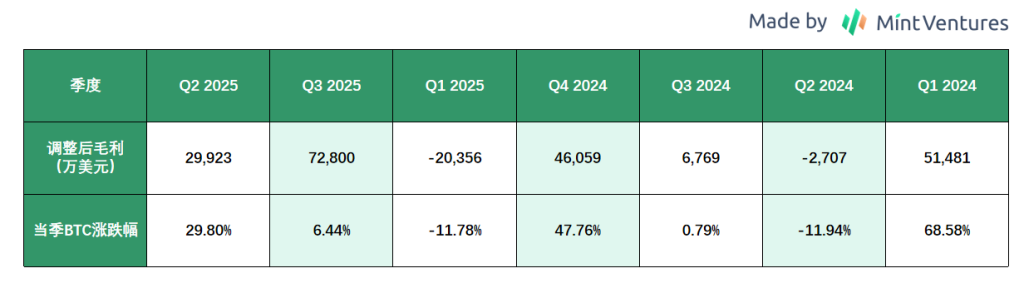 Adjusted gross profit of GLXY over the past 7 quarters vs. BTC price fluctuations in the same period
It can be seen that prior to Q3 2025, Galaxy's adjusted gross profit closely followed the trend of BTC price fluctuations. In Q1 and Q4 2024, when BTC saw gains exceeding 40%, Galaxy's adjusted gross profit also reached a peak; conversely, when BTC declined in Q2 2024 and Q1 2025, Galaxy's adjusted gross profit for those quarters was negative. However, Q3 2025 appears to be an exception: despite BTC's increase of only 6.44%, Galaxy's adjusted gross profit reached a record $728 million. The reasons for this have been analyzed earlier, with the sale of 80,000 BTC and Galaxy's high participation in the DAT boom being two key factors. Currently, the enthusiasm for DAT has clearly receded, but if Galaxy can continue to solidify its position as the preferred platform for institutional and large investors in cryptocurrency trading, it is expected to enhance the stability of its profits by increasing recurring business revenue, partially offsetting the cyclical fluctuations of the cryptocurrency market.
Over the past twelve months (LTM), Galaxy's adjusted gross profit was $1.284 billion. We will use this as the basis for the valuation comparison below.
AI Computing Power Infrastructure Segment: Galaxy acquired the Helios data center campus in Texas in 2022 and strategically shifted to high-performance computing power hosting starting in 2024, gradually exiting self-operated Bitcoin mining. In 2025, this segment is not expected to contribute substantial revenue— the company anticipates recognizing rental income from Phase I with CoreWeave starting in the first half of 2026. CoreWeave has locked in critical IT loads of 526 MW (corresponding to a total power capacity of 800 MW, with critical IT loads needing to be less than power loads due to high availability and redundancy requirements) for AI/HPC computing power, with a lease term of 15 years. It has been disclosed that this long-term contract, when fully operational, could generate approximately $1 billion in annual revenue. In 2025, due to being in a construction and transition phase, Helios is expected to generate minimal gross profit through the processing of remaining Bitcoin mining machines/assets (approximately $2.7 million in Q3). Therefore, we will use the operational revenue from 2026-2027 as a valuation reference, assuming that annual revenue reaches the range of $500 million to $1 billion starting in 2027 (approximately $300 million from Phase I when fully operational, plus partial production from Phase II). This segment is currently capitalizing its main costs, and the financial statements for 2025 will not show significant revenue or EBITDA contributions.
Comparable Company Valuation Multiples
To value the two major segments, we selected comparable publicly traded companies in the respective fields and compared their enterprise value multiples (calculated based on the most recent 12 months of performance, i.e., LTM, with all figures in USD):
Comparable Companies for Digital Asset Financial Services Segment
Representative companies include Coinbase (COIN) and Robinhood (HOOD), while fully comparable companies like FalconX and Cumberland are not publicly listed. In comparison, both Coinbase and Galaxy (currently) focus primarily on crypto, while Robinhood also includes stock trading; from a user perspective, Robinhood is entirely retail-focused, Galaxy is fully institutional, and although Coinbase primarily targets the ToC end, it also has a significant institutional business. Clearly, Coinbase is a better comparable for Galaxy.
In terms of valuation metrics, due to the "distortion" of revenue data after Galaxy adopted GAAP rules: any comparison using sales metrics between Galaxy and Coinbase is akin to comparing one company's total trading volume with another's net fees, which is clearly imbalanced and not comparable. We need to find a consistent metric for valuation comparison. Adjusted Gross Profit is a suitable metric for this purpose. GLXY disclosed "Adjusted Gross Profit" in its financial reports to exclude the impact of direct trading expenses. Adjusted Gross Profit represents the net revenue GLXY actually earns from its trading and business activities, similar to the concept of net operating income. COIN does not directly disclose adjusted gross profit, but we can use its operating revenue minus transaction-related costs (Transaction expense) as COIN's "Adjusted Gross Profit."
Using this method, Coinbase's net revenue from Q4 2024 to Q3 2025 totaled approximately $7.37 billion, with transaction-related costs (Transaction expense) of about $1.119 billion during the same period. The difference between the two gives us the "LTM Adjusted Gross Profit" of approximately $6.251 billion. Based on this calculation, its EV/Adjusted Gross Profit (LTM) is about 11 times.
The valuation of the aforementioned comparable companies is shown in the table below:
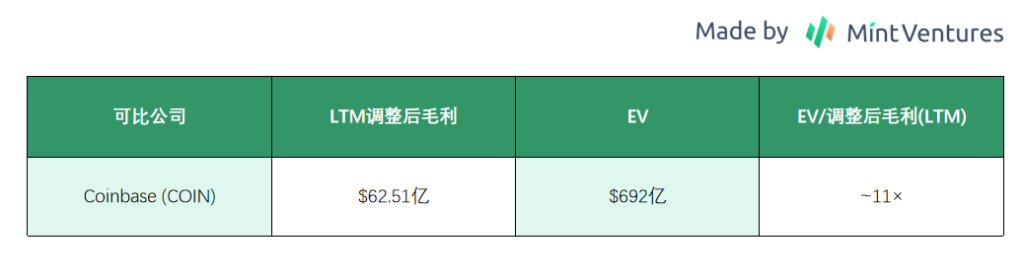
Comparable Companies for Computing Power Infrastructure Segment
For the computing power infrastructure module, due to the current high demand and the relatively long construction cycle in the industry, future expected cash flows are quite certain, so we can use EV/EBITDA to value different companies.
There are many comparable companies in this segment, summarized as follows:
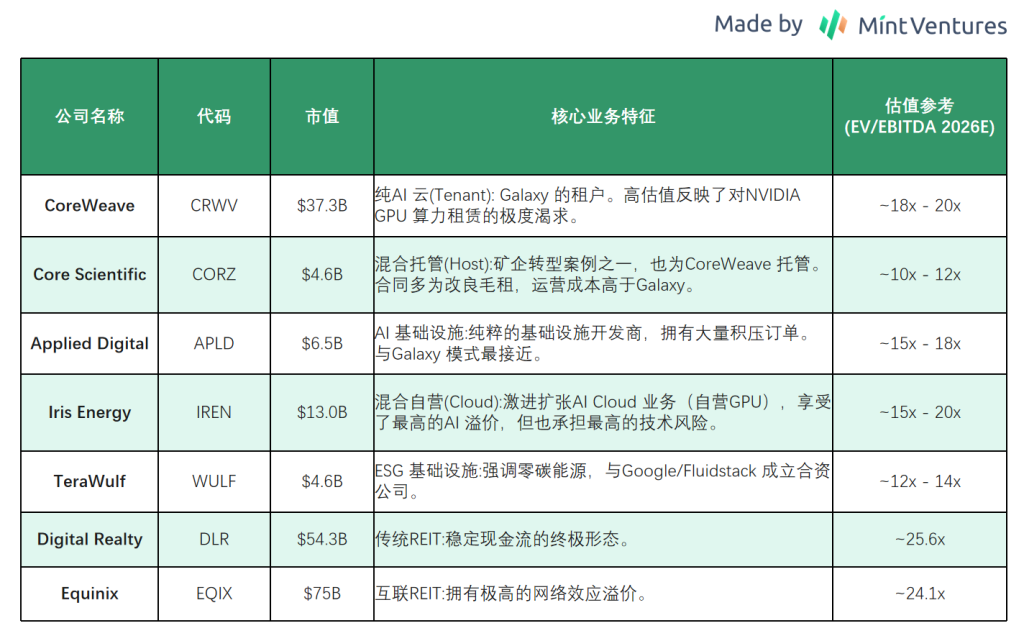
CoreWeave (CRWV) serves as an upper limit reference: CoreWeave's market capitalization of $37.3 billion demonstrates the enormous demand in the AI computing power market, and it currently enjoys an EV/EBITDA valuation of up to 18-20 times. Applied Digital (APLD) serves as the most direct benchmark: APLD also focuses on building physical infrastructure to lease to hyperscale users (including CoreWeave), with a market capitalization exceeding $6.5 billion and an EV/EBITDA in the range of 15-18, making it the most suitable comparable for Galaxy. CORZ and WULF serve as lower limit references: these two companies still retain a significant amount of self-operated Bitcoin mining business, and their valuations are affected by Bitcoin price fluctuations, with a heavier operating model (OpCo), currently having an EV/EBITDA in the range of 10-14. Galaxy's Helios operates on a pure NNN lease (PropCo), with a profit margin (90%) significantly higher than CORZ's custody business (~50%), thus its valuation multiple should be considerably higher than CORZ. REITs (DLR/EQIX) serve as the terminal value target: DLR and EQIX trade at 24x-26x EBITDA. As Helios enters a stable operating phase, its long-term valuation logic may shift from "mining company transformation" to "stable REIT."
Estimated EBITDA for Galaxy's computing power segment:
Annual Revenue: $1 billion. This figure comes from the management's revenue guidance. It primarily stems from the contract signed with CoreWeave. Although the full details of the contract have not been disclosed, we can compare it with similar contracts in the industry to validate its authenticity. From the collaboration between APLD and CRWV: their partnership lease also has a 15-year term, with a total of 250 MW of critical load. The total contract value is approximately $7 billion, equating to an average annual revenue of $467 million, which translates to about $1.87 million in annual revenue per MW of critical load. Additionally, TeraWulf has signed two contracts of over 10 years with Fluidstack and Google, with annual revenue per MW of critical load estimated at $1.85 million and $2.26 million, respectively. According to the contract signed between Galaxy and CoreWeave, Galaxy's 526 MW of IT critical load is expected to generate $1 billion in annual revenue, providing an annual revenue of $1 billion / 526 MW = $1.9 million per MW of critical load. Galaxy's revenue guidance of $1 billion is close to industry quotes, further validating the credibility of its revenue.
EBITDA Profit Margin: 90% (NNN lease structure, tenants bear OpEx, low operating costs).
Production Timeline: Phase 1, accounting for 25%, is expected to go live in the first half of 2026; Phase 2, accounting for 50%, is expected to go live in 2027; Phase 3, accounting for 25%, is expected to start production in 2028.
Therefore, we assume that in 2027, Galaxy can achieve an EBITDA of 10 * 75% * 90% = $675 million for valuation calculations.
Segment Valuation and Total Value Estimation
Based on the above performance forecasts and comparable multiples, we will value Galaxy Digital's two segments separately and then aggregate them to obtain the company's total enterprise value (EV). We will then consider Galaxy's net cash and non-operating assets such as investments to derive the equity value and compare it with the current market capitalization.
Valuation of the Digital Asset Financial Services Segment: As analyzed above, we use EV/Adjusted Gross Profit (LTM) for comparison. Galaxy's current adjusted gross profit (LTM) is $1.284 billion. We reference comparable company Coinbase's EV/Adjusted Gross Profit at approximately 11×. Considering that Galaxy's business is primarily institutional and smaller in scale than Coinbase, especially given its higher volatility and dependence on cryptocurrency market conditions: while fluctuations in the crypto market also affect Coinbase's profit data, its adjusted gross profit remains positive with relatively minor fluctuations (compared to Galaxy); whereas Galaxy's adjusted gross profit was negative in the first quarter of this year during a downturn in the crypto market, not to mention net profit. Therefore, we need to apply a significant discount to Galaxy's valuation. We take an EV/Adjusted Gross Profit multiple range of 5-7× for valuation. This estimates the enterprise value of this segment to be approximately $6.42 billion to $8.988 billion. Using a median of $7.7 billion seems reasonable. This valuation implies that the market recognizes the growth potential and profitability of Galaxy's digital financial business, but slightly discounts it compared to pure exchange leaders, reflecting its smaller business scale and lower recognition, as well as higher performance volatility.
Valuation of the AI Computing Power Infrastructure Segment: Given that this segment has no actual revenue in 2025, we base the valuation on the future revenue potential from signed contracts. As analyzed above, we use $675 million in EBITDA for estimation, applying the EV/EBITDA valuation metric. The business model most similar to Galaxy Helios, Applied Digital, trades at approximately 15 times valuation, while CORZ, with a slightly inferior business model to Helios, trades at 12 times valuation. Considering that it is still in the construction phase and contracts need to be gradually fulfilled, we conservatively take a 12 times valuation, resulting in an EV of $8.1 billion.
Adjustment for Other Asset Values: As of the third quarter of 2025, Galaxy holds a substantial amount of balance sheet investments and cash: approximately $1.91 billion in cash and stablecoins, $2.14 billion in digital assets, and long-term investment holdings. The company also secured an additional $325 million in net equity financing in Q4 for Helios construction. After deducting the portion of financing debt already utilized for the Helios project (approximately $430 million at the end of Q3), Galaxy's net cash and investment assets are approximately $3.5 billion to $3.8 billion. Since our above segment valuations do not include these assets (such as owned crypto assets and fair value investments recorded in equity on the financial statements), we need to add them back to calculate the total equity value. For simplicity, we take $3.6 billion as an approximate value for net cash and investment assets.
Valuation Results Compared to Current Market Capitalization: In summary, we estimate the segment valuation of Galaxy's digital asset financial services business at $7.7 billion; the segment valuation of the AI computing power infrastructure business at $8.1 billion, totaling $15.8 billion. Adding the net assets gives a total equity value of approximately $19.4 billion. Galaxy's current market capitalization is $10.1 billion, reflecting a discount of 48% compared to our segment valuation results.
Galaxy Digital's market valuation is significantly lower than the sum of its segment values, primarily due to:
First, the company's core business is highly dependent on the cryptocurrency market, with profit volatility closely tied to the digital asset cycle. If we refer to the traditional four-year cryptocurrency market cycle, the industry is expected to enter a downturn starting in 2026. Historical data shows that Galaxy's profitability is significantly weakened in a crypto bear market environment, and it may even incur losses. Although the Q3 2025 financial report demonstrated some cyclical resilience, its sustainability remains to be tested by the market.
Second, while the Helios AI data center transformation project has long-term potential, it is still in the construction phase and has not yet generated substantial revenue. This project faces multiple execution risks, including construction progress, technological implementation, and market demand, leading to significant delays and uncertainties in revenue realization.
Based on these factors, investors generally adopt a conservative valuation strategy for companies facing both industry cycle fluctuations and business transformation challenges, requiring a higher risk premium for the certainty of future cash flows, resulting in a significant valuation discount.
免责声明:本文章仅代表作者个人观点,不代表本平台的立场和观点。本文章仅供信息分享,不构成对任何人的任何投资建议。用户与作者之间的任何争议,与本平台无关。如网页中刊载的文章或图片涉及侵权,请提供相关的权利证明和身份证明发送邮件到support@aicoin.com,本平台相关工作人员将会进行核查。


