Let's walk into Shadow Exchange and explore the core mechanism of the vision of "maximizing LP protection + better fee capture."
Written by: Deep Tide TechFlow
The market is harsh, and while many people are caught in the anxiety of "the more they operate, the more they lose," some have discovered:
Shadow Exchange's $x33 automatically compounds weekly, with weekly returns exceeding 30% APR for the last six weeks.
Meanwhile, when high volatility arrives, Shadow's dynamic fees better protect LPs from massive impermanent losses while capturing fees and profits comprehensively, enabling greater returns to users and achieving higher protocol revenue and trader rewards.
This has sparked much curiosity, and created an opportunity for an in-depth conversation with Shadow Exchange's Chinese promotion lead Dr. Koala.
As the leading DEX in the Sonic ecosystem in terms of trading volume and revenue, Shadow Exchange's core innovation is the x(3,3) model, which includes three main tokens: the native token $SHADOW, the governance token $xSHADOW, and the liquidity version $x33 of $xSHADOW. This model aims to better coordinate the interests of traders, LPs, and token holders, setting a benchmark for DeFi liquidity incentives.
When discussing the underlying value logic of $x33, Dr. Koala stated:
On one hand, users can mint $x33 at a 1:1 ratio using $xSHADOW. Since Shadow allows users to exit $xSHADOW lock-up at any time, an early exit incurs a maximum penalty of 50%. This penalty is fully returned to holders through the PVP Rebase mechanism, ensuring that $x33 has a minimum price guarantee, which will always be no less than half the price of $SHADOW.
On the other hand, as $x33 automatically reinvests weekly, the quantity of its underlying asset $xSHADOW only increases, forming the intrinsic value basis of $x33. This leads to a faster overall investment appreciation rate, making long-term holding the best strategy for realizing reinvestment returns.
As the DeFi face of the Sonic ecosystem, when discussing the current overall market downturn and the decline in discussions around the Sonic ecosystem, Dr. Koala expressed confidence:
The decline in Sonic ecosystem activity has correspondingly reduced Shadow's earnings, which is an unavoidable reality. However, recent dynamic changes in Sonic, including personnel changes, the launch of the new project Flying Tulip (FT), and the Sonic Foundation's continued support for new projects, will positively impact Shadow.
In addition to the support from the Sonic ecosystem, the Shadow team is also continuously advancing product development and technological innovation. Recent updates include the integration of Circle CCTP, the launch of limit orders, and time-weighted average price (TWAP) features. Regarding future focus, Dr. Koala revealed:
The team is concentrating resources on developing new MEV solutions, aiming to provide Shadow users with richer platform value and a higher quality user experience. We believe that these enhancements in underlying capabilities will bring users more long-term and sustainable returns, helping Shadow solidify its foundation and better meet future market opportunities and challenges.
In this issue, let us follow Dr. Koala's insights and delve into the core mechanism of Shadow Exchange's vision of "maximizing LP protection + better fee capture," and understand Shadow Exchange's future competitive strategies within the upcoming MEV module multifunctional matrix.

The Largest DeFi Protocol in the Sonic Ecosystem: Exploring Shadow's Core Competitive Advantages
Deep Tide TechFlow: Thank you for your time. Please start with a self-introduction (including educational background, the opportunity to join the crypto industry, and your entrepreneurial/career experience in the crypto industry).
Dr. Koala:
Hello everyone, I am Dr. Koala, the Chinese promotion lead for Shadow Exchange. I am glad to communicate with you all.
I come from a background in computer engineering, majoring in network systems, and occasionally return to university to teach. Currently, I am focusing more on the crypto industry.
In 2025, I joined Shadow Exchange and initially created a lot of Chinese content, including a series of introductory educational materials. As the Chinese community for Shadow Exchange gradually improved, I officially took over the Chinese promotion for Shadow in conjunction with Sonic's new promotion in the Asia-Pacific region.
Deep Tide TechFlow: What attracted you and your team to choose the Sonic ecosystem? Why build a DEX based on Sonic?
Dr. Koala:
The sub-second finality, low gas fees, and FeeM rebate features of the Sonic blockchain are several key reasons why Shadow chose to build on Sonic. The sub-second finality allows transactions to be completed quickly, low gas fees enable ecosystem users to trade easily, and the FeeM rebate on the Sonic chain provides additional incentives for projects, allowing project teams to invest more effort into optimizing their projects and providing users with a better experience.
Deep Tide TechFlow: The market is not lacking in DEXs, and this year's DEX competition is particularly fierce. As the largest DEX protocol in the Sonic ecosystem, what are Shadow Exchange's key differentiating competitive advantages?
Dr. Koala:
Since the Solidly V1 period, our team has focused on the development of the (3,3) model, accumulating deep experience. At the same time, the team has been continuously operating multiple ve(3,3) projects on six other blockchains, further broadening our practice and understanding.
To promote the evolution of the ve(3,3) economic model, the Shadow team innovatively proposed the x(3,3) design and successfully deployed it on the Sonic chain. We are very honored to be the leading DEX in the Sonic ecosystem and are satisfied with the achievements we have made so far.
Additionally, the Shadow team has been continuously deepening the project. Since our launch in January, we have consistently introduced new features and content updates every month, continuously optimizing product experience and promoting protocol development.
Comprehensive Value Capture + Maximum LP Protection
Deep Tide TechFlow: The economic model is the lifeline of DeFi. What groundbreaking innovations does Shadow Exchange's x(3,3) model, as an evolution of the ve(3,3) model, bring? How does the value cycle formed by the three tokens $SHADOW, $xSHADOW, and $x33 better achieve the balance of interests among traders, LPs, and token holders?
Dr. Koala:
The x(3,3) model includes three major token mechanisms:
SHADOW: The native token of the Shadow ecosystem, with utilities such as trading and liquidity mining, an initial supply of 3 million, and the protocol will adjust token emissions based on each cycle's protocol revenue, with a maximum supply of 10 million. Users can stake SHADOW to earn $xSHADOW;
xSHADOW: The governance token of the Shadow ecosystem, which users can use to earn $x33;
x33: The liquidity version of $xSHADOW, allowing users to mint $x33 using $xSHADOW, thereby retaining governance rights and earnings while obtaining liquidity for the token. Users can also buy directly from the market.
The x(3,3) model repackages the originally non-tradable governance token into a freely tradable token called $x33.
$x33 automatically reinvests weekly, and the quantity of its underlying asset $xSHADOW only increases, forming the intrinsic value basis of $x33. Due to the high reinvestment frequency (once a week), the overall investment appreciation rate is fast, making long-term holding the best strategy for realizing reinvestment returns.
At the same time, $x33 supports exit at any time, allowing users to buy or sell directly on the market. The selling pressure on $x33 itself is low because it has a price floor guarantee: users can mint $x33 at a 1:1 ratio using $xSHADOW. Since Shadow allows users to exit $xSHADOW lock-up at any time, an early exit incurs a maximum penalty of 50%, and this penalty is fully returned to holders through the PVP Rebase mechanism, ensuring that $x33 has a minimum price guarantee, which will always be no less than half the price of $SHADOW.
As long as there is trading volume on the Sonic chain, the value of $x33 will continue to grow; even in the absence of trading volume, Shadow's Rebase mechanism will still allocate earnings to $x33 holders.
Deep Tide TechFlow: The x(3,3) model endows Shadow Exchange with a more powerful "ecological value capture + feedback" capability. Could you share how this stronger "ecological value capture + feedback" capability is specifically reflected compared to other DeFi protocols?
Dr. Koala:
Since our launch, we have always been committed to giving back to users. For example, the fees and Gems rewards obtained from the Sonic network are 100% returned to users.
Shadow currently has extremely high "Bribe Efficiency," meaning that if a project invests $1 in Shadow, it can receive about $1.5 in return. More importantly, all the bribes we receive are 100% distributed to users. We believe that maintaining a user-centric approach is the truly effective and sustainable way to grow and strengthen Shadow.
Since our launch, SHADOW's unique MEV bot has achieved value capture and anti-capture across multiple dimensions. For example, our Anti-JIT system monitors in real-time, intercepting invalid and malicious wallets, and automatically transfers their earnings to $x33. Beyond the normal redemption price range of $x33 and $SHADOW (50%-100%), the bot also automatically captures arbitrage profits, which are similarly injected into $x33.
Deep Tide TechFlow: Can you share the key data that Shadow Exchange has achieved in terms of its stronger "ecological value capture + feedback" capability?
Dr. Koala:
I can start with the MEV module of Shadow Exchange and specifically introduce the results we have achieved so far.
Recently, the DeFi protocol Shadow Exchange in the Sonic ecosystem launched the $x33 AMO and anti-JIT protection features, which are core components of the MEV module aimed at further enhancing trading efficiency and fairness.
The $x33 AMO system will maximize participant value through system arbitrage when the redemption floor of $x33 is triggered, bringing additional benefits to voters and $x33 holders while strengthening LP protection, reducing external bot interference, and preventing value leakage. Currently, this feature has captured value exceeding $151,236.52, which is 100% returned to users.
The anti-JIT protection feature actively monitors Just-In-Time (JIT) liquidity operations, and the rewards for related positions will automatically transfer to $x33, while wallets involved in JIT behavior will be banned by the system. Since the launch of this feature, the Anti-JIT mechanism has contributed over $151,000 in earnings to $x33 holders. If we combine all the returns Shadow has received from the Sonic chain, including two Gems activity rewards and all FeeM feedback, the current comprehensive annualized return rate (APR) of $x33 has reached 134%.
Deep Tide TechFlow: The recent launch of features like $x33 AMO and anti-JIT protection has garnered much attention, and the upcoming features such as buyback arbitrage and delayed rewards are widely discussed. As the core of the MEV module, how do these features further achieve LP protection and greater fee capture, thereby protecting and amplifying user rights?
Dr. Koala:
You may recall the severe fluctuations in the crypto market in October, during which Shadow's performance fully demonstrated its protective capabilities for liquidity providers (LPs).
During the market crash, Shadow quickly activated its protective mechanisms to ensure the safety of user funds. While other DEXs maintained their fee structures, Shadow's dynamic fee mechanism immediately increased, successfully preventing harmful trades and generating $172,243 in fee income during the volatility.
Shadow's dynamic rate algorithm can respond in real-time to market changes, effectively protecting LPs from severe impermanent losses while maximizing fee revenue. Once the system identifies potential harmful liquidity, it proactively raises the rates to protect funds. No other exchange in the Sonic ecosystem responded similarly during that period.
At the same time, thanks to Shadow's effective maintenance of $S / $USDC liquidity, lending protocols such as Silo Finance and Aave were able to complete their liquidation processes smoothly.
Despite the market crash leading to a sharp contraction in overall liquidity in Sonic, Shadow still ensured smooth execution of cross-platform transactions due to its ample liquidity reserves. This robust performance is attributed to the strategic liquidity support and real-time risk control algorithms that the Shadow team had deployed in advance.
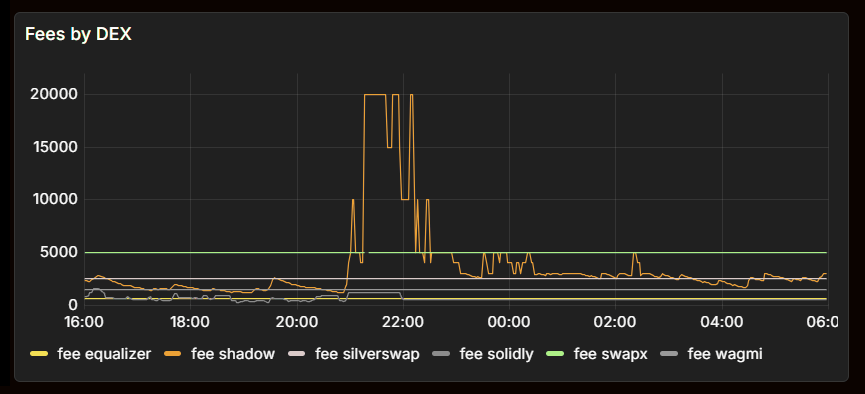
Additionally, Shadow maintained a high level of synchronization with Binance during extreme market fluctuations, demonstrating strong market responsiveness.
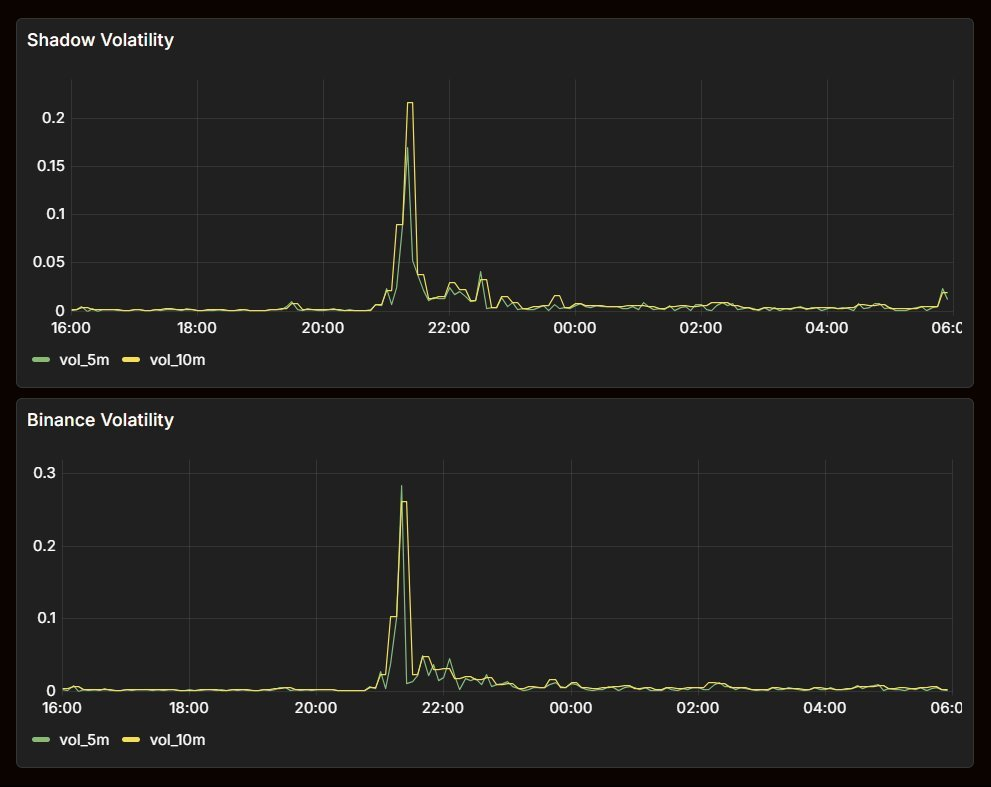
Furthermore, our upcoming MEV bot will further capture value earnings across various trading pools in both centralized and decentralized exchanges, with all profits returned to Shadow's token holders.
Deep Tide TechFlow: What is the most efficient way for users to participate in Shadow Exchange currently?
Dr. Koala:
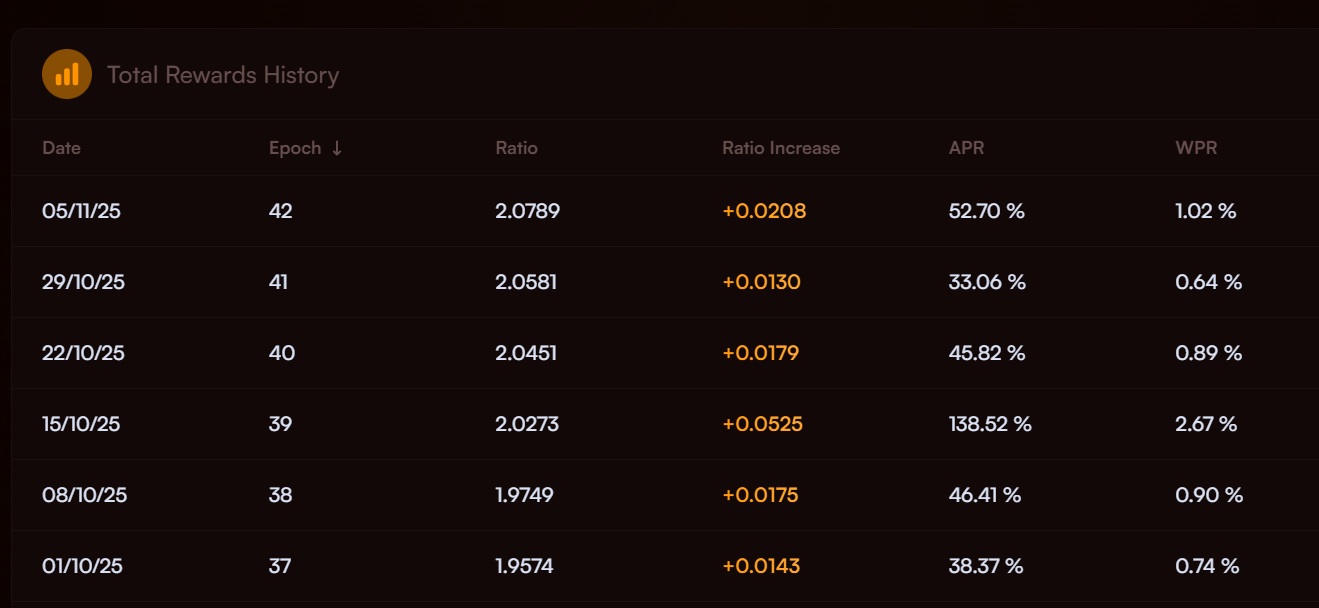
My suggestion is to participate as an LP and consider buying $x33 to achieve automatic compounding growth of assets.
Shadow remains one of the best-performing projects on the Sonic chain in terms of actual returns. Even in the recent overall market downturn, simply holding $x33 has yielded weekly returns exceeding 30% APR for the last six weeks.
Next Phase Focus: MEV Module
Deep Tide TechFlow: Shadow Exchange is deeply tied to the Sonic ecosystem. Some users believe this deep integration will bring strong synergies for symbiotic development, while others think that the current decline in attention towards the Sonic ecosystem may impose some developmental limitations on Shadow Exchange. How do you view this divergence?
Dr. Koala:
The decline in activity within the Sonic ecosystem has correspondingly reduced Shadow's earnings, which is an unavoidable reality.
However, it is worth noting that the highly praised father of DeFi, Andre Cronje, remains the core designer of the Sonic chain, and his new project Flying Tulip continues to receive significant market attention. Any activity occurring on-chain will have a positive impact on Shadow.
Additionally, the Shadow team is continuously advancing product development and technological innovation. For example, the latest launch of cctp.to has integrated CCTP developed by Circle, the issuer of $USDC, providing users with completely free cross-chain services that support operations within the Sonic chain and are compatible with asset transfers across other blockchains.
Deep Tide TechFlow: Previously, Shadow Exchange joined the Circle Alliance Directory and integrated versions 1 and 2 of CCTP to provide users with a seamless cross-chain experience. Does Shadow Exchange have more plans for multi-chain development in the future?
Dr. Koala:
The Shadow team is always closely monitoring the trends of the project itself and the public chain ecosystem. We have noticed recent personnel changes in the Sonic chain, as well as the launch of the new project Flying Tulip (FT) and the Sonic Foundation's continued support for new projects. Under these series of dynamics, Shadow maintains an optimistic attitude towards future development.
Deep Tide TechFlow: What do you think are the core reasons behind the increasingly fierce competition among DEXs this year? And which key dimensions do you think the competition among DEXs will ultimately focus on in the next phase?
Dr. Koala:
Each DEX has its unique philosophy and positioning, and healthy market competition often drives progress and innovation across the industry. This competition not only motivates projects to continuously optimize but also brings users better services and features.
Shadow itself is a great example. In August of this year, Shadow launched limit orders and time-weighted average price (TWAP) features, further enriching trading strategies and enhancing user experience. These new features have allowed Shadow to gradually develop into a more comprehensive and convenient one-stop DeFi trading platform.
Deep Tide TechFlow: What key measures does Shadow Exchange plan to take in order to better respond to the next phase of DEX competition?
Dr. Koala:
The team is concentrating resources on developing new MEV solutions, aiming to provide Shadow users with richer platform value and a higher quality user experience. We believe that these enhancements in underlying capabilities will bring users more long-term and sustainable returns, helping Shadow solidify its foundation and better meet future market opportunities and challenges.
免责声明:本文章仅代表作者个人观点,不代表本平台的立场和观点。本文章仅供信息分享,不构成对任何人的任何投资建议。用户与作者之间的任何争议,与本平台无关。如网页中刊载的文章或图片涉及侵权,请提供相关的权利证明和身份证明发送邮件到support@aicoin.com,本平台相关工作人员将会进行核查。


